
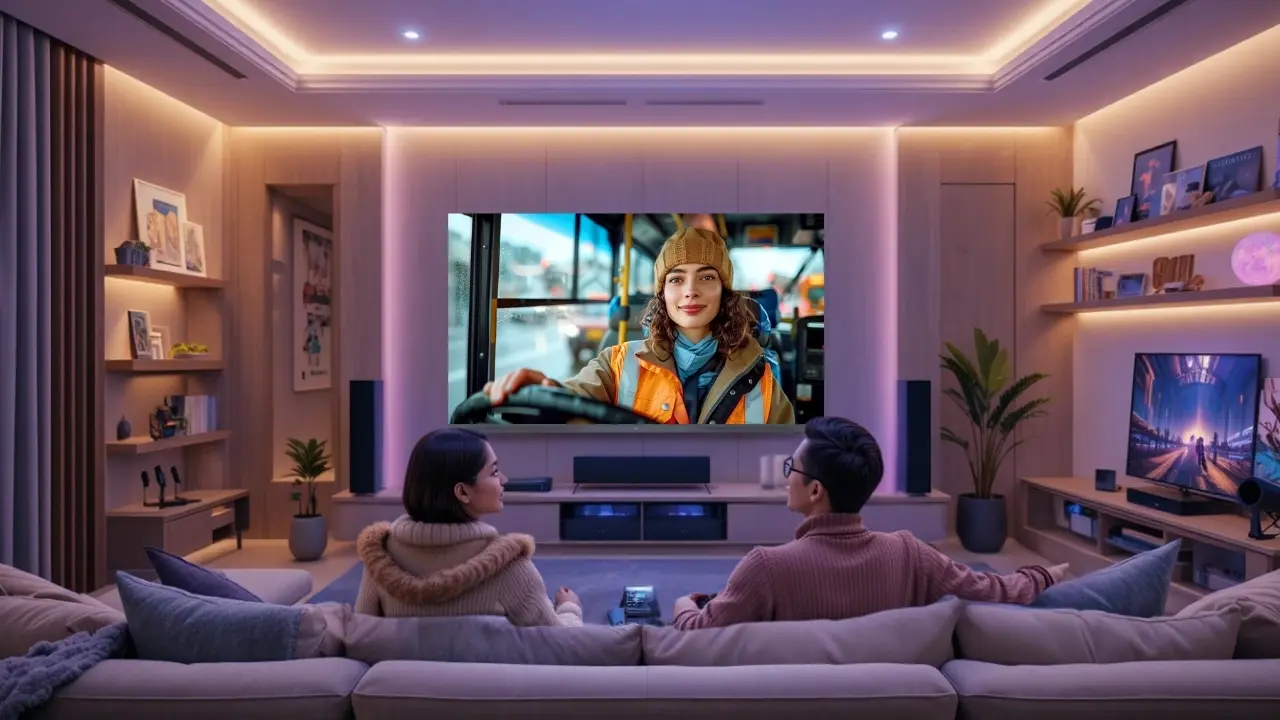

Large TVs make movies feel more real because they reduce visual distance, occupy your field of vision, and allow your brain to stay inside the story without fighting the room around it.
When the screen becomes an environment instead of an object, movies stop feeling watched and start feeling lived.
That is the core idea.
Everything else is how that idea plays out in real Indian homes.
The evening when the room fades away.
It is after dinner.
Lights are dimmed. Someone is still scrolling in the corner. The ceiling fan hums quietly.
You press play.
On a smaller TV, the movie competes with the room. Your eyes move back and forth. Your phone stays nearby. Attention breaks easily.
On a large TV, something else happens.
The room recedes.
The screen becomes the main surface your senses respond to. Not because it is flashy. Because it is unavoidable.
Immersion begins when your attention stops negotiating.
Bigger screens do not impress your eyes. They convince your brain.
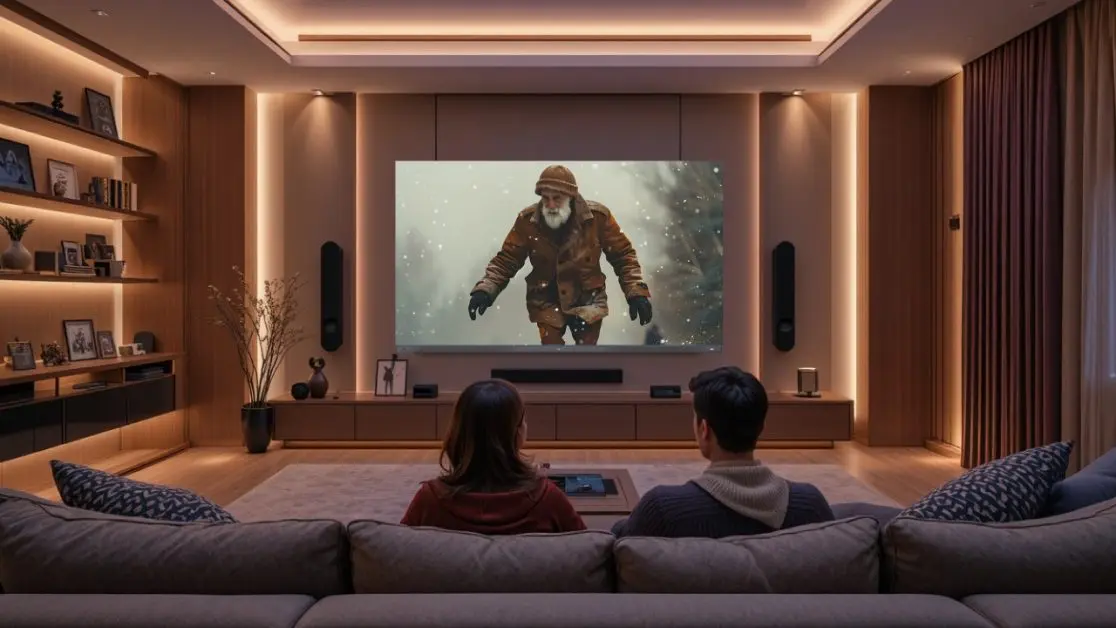
Most people think realism comes from picture quality alone.
4K resolution. HDR. Contrast ratios.
Those matter. But they are not the main trigger.
The real shift comes from scale.
When a screen is large enough, your brain treats it less like a device and more like a window.
On a large TV:
- Faces feel human sized
- Landscapes feel expansive
- Camera movement feels natural
- You stop noticing the frame
Your brain believes what your eyes cannot easily escape.
That is why cinema halls work. And that is why large TVs work at home.
Why field of vision matters more than sharpness
A phone screen can be sharper than an old television.
Yet it never feels cinematic.
Why?
Because realism is not about how many pixels you see. It is about how much of your vision they occupy.
Large TVs fill a greater portion of your horizontal and vertical view. This reduces peripheral distractions and keeps your gaze locked in.
The effect is subtle but powerful:
- Fewer eye movements
- Less mental switching
- Stronger emotional response
- Better recall of scenes
Realism is sustained attention, not visual fireworks.
Indian homes make this effect even stronger
Indian homes are rarely isolated spaces.
There is movement. Conversation. Kitchen sounds. Street noise.
A small TV gets lost in that rhythm.
A large TV anchors it.
Think about familiar situations:
- A late night movie while someone finishes chores
- A weekend film where parents join halfway
- A solo watch after work when the house finally quiets down
A big screen becomes the visual centre of the room. Everyone orients toward it naturally.
Scale creates gravity.
Gravity creates focus.
Motion feels real when your eyes do not struggle
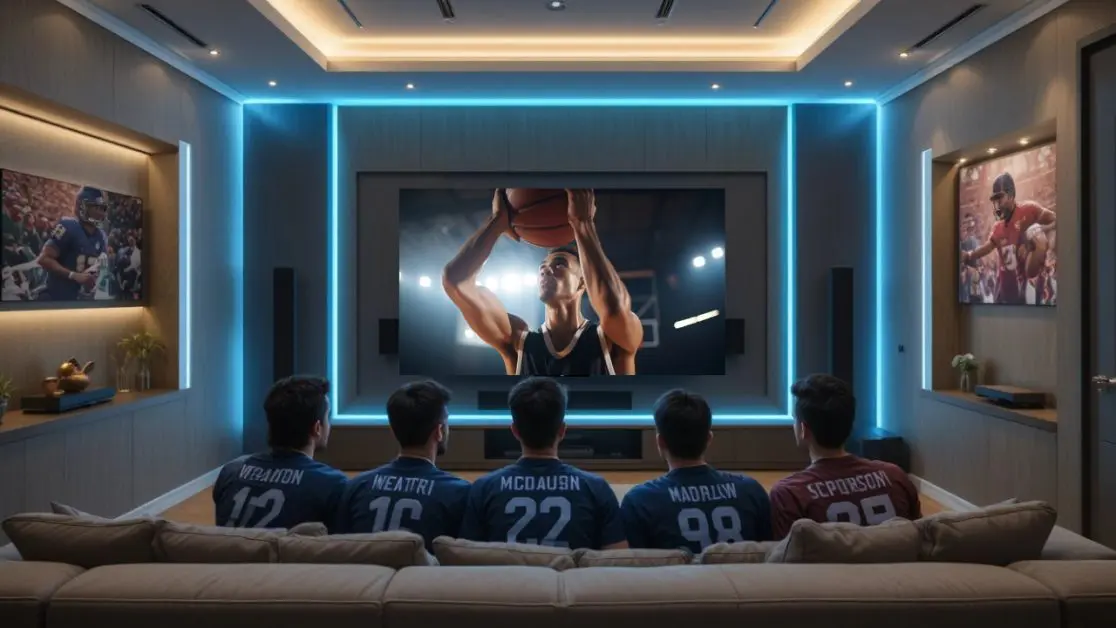
Fast motion exposes weak displays.
Sports. Action scenes. Chase sequences.
On smaller screens, your eyes constantly adjust. That effort breaks immersion.
On a large TV with a high refresh rate:
- Motion looks continuous
- Fast cuts feel smoother
- Blur feels controlled
- Your eyes relax instead of chasing movement
This is why features like a 144Hz refresh rate matter more on big screens. Motion flaws scale with size. So does motion excellence.
When motion feels natural, the movie feels real.
Sound feels deeper when the screen feels physical
Sound is rarely discussed correctly.
It is not about volume. It is about placement.
When sound comes from a large visual source, your brain accepts it more easily.
Explosions feel grounded. Dialog feels anchored. Music feels wider.
Large TVs enhance this effect by pairing scale with spatial audio processing.
Technologies like Dolby Atmos and multi channel speaker setups allow sound to wrap around the image instead of floating independently.
Immersion is alignment between what you see and what you hear.
Depth perception grows with screen size
Contrast and brightness create depth.
But scale amplifies it.
On a large TV:
- Foreground objects feel closer
- Backgrounds feel layered
- Light feels spatial, not flat
A sunset fills the wall instead of sitting inside it. A close up fills your vision instead of floating in a rectangle.
This is why viewers describe large screen movies as emotional rather than impressive.
Depth triggers empathy.
When technology disappears, realism appears
The best large TVs do not demand attention.
They remove effort.
Features that matter most are often invisible:
- Automatic brightness adjustment based on room light
- Flicker free viewing for eye comfort
- Intelligent scene detection that tunes colour and contrast
- Low reflection panels that work in bright rooms
These systems keep your eyes comfortable and your focus uninterrupted.
You do not notice them working. You notice that you stay longer.
A closer look at what makes large TVs work today
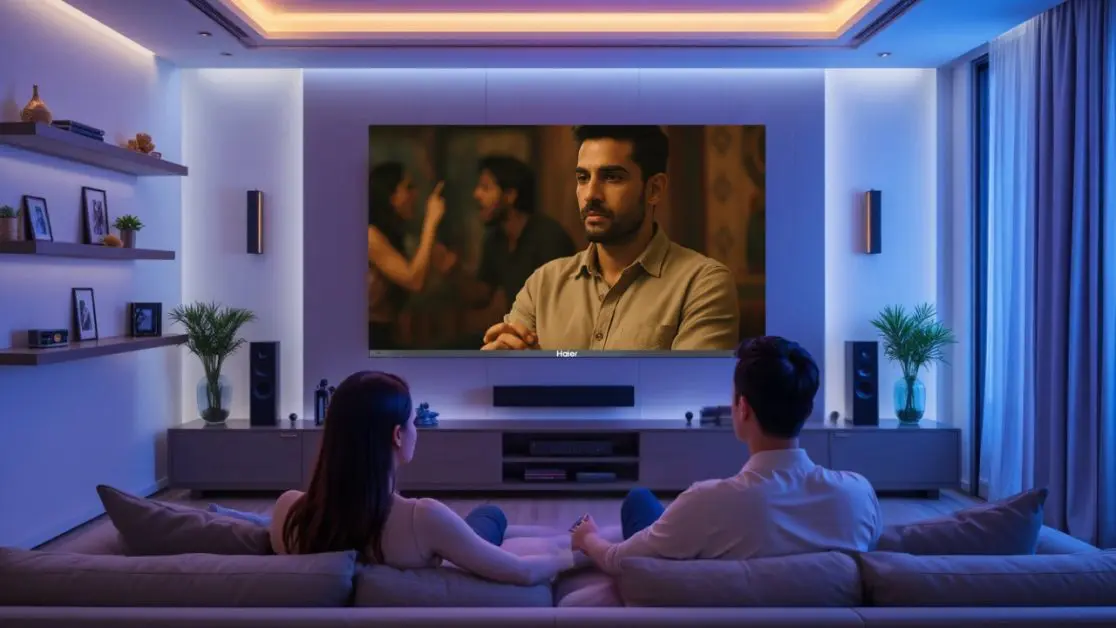
Modern large screen TVs are very different from older big displays.
They are thinner. Smarter. More adaptive.
Take the Haier New M96 Series 254cm (100) QD Mini LED AI Smart Google TV as an example of how size and intelligence now work together
This model pairs scale with systems designed to remove friction:
- 254cm (100) display that fills your field of vision and reduces peripheral distractions
- QD Mini LED panel with 2160 local dimming zones for precise contrast and deeper blacks
- AI Ultra Sense Processor, co developed with MediaTek, that recognises scenes and adjusts colour, motion, contrast, and depth in real time
- Dolby Vision IQ and HDR10+ that adapt picture quality to ambient room lighting
- 144Hz refresh rate for smoother sports, action films, and gaming
- Low reflection screen and wide viewing angles that work well in Indian living rooms with mixed lighting
- Sound by KEF with Dolby Atmos, featuring a powerful 6.2.2-channel speaker system with 90W output that delivers immersive, three-dimensional audio matched to the scale of the screen
- Google TV with hands free voice control that reduces friction between deciding and watching
None of these features shout.
They quietly support the experience.
One screen. Three types of viewers.
Large TVs serve different needs. Understanding that helps explain their appeal.
One option is the family viewer
This viewer watches together.
Different seating positions. Different ages.
A large screen ensures:
- Clear viewing from every angle
- Details stay visible even from the sides
- Shared moments feel inclusive
The cost is space. The benefit is connection.
The second option is the solo unwinder
This viewer watches alone after long days.
For them, the TV is a decompression tool.
A large screen delivers:
- Deeper escape
- Reduced visual fatigue
- Stronger emotional engagement
The cost is investment. The benefit is mental rest.
The third option is the experience builder
This viewer curates moments.
Movie nights. Match nights. Weekend marathons.
A large TV becomes the anchor of the room.
The cost is planning. The benefit is the atmosphere.
Large TVs do not change what you watch. They change how the room behaves while you watch.
Why big screens now fit modern homes better
Earlier, large TVs felt intrusive.
Thick frames. Heavy bodies. Design compromises.
Today, they blend in.
Ultra slim profiles, minimal bezels, and wall hugging designs allow large screens to sit comfortably in apartments and modern homes.
When turned off, they fade into the background. When turned on, they take over completely.
This dual personality is what makes modern large TVs practical, not indulgent.
The hidden system behind cinematic realism
Here is the pattern worth noticing.
Realism does not come from adding more features.
It comes from removing resistance.
Large TVs remove resistance by:
- Filling your vision
- Smoothing motion
- Anchoring sound
- Reducing eye strain
- Holding attention without effort
Each improvement reinforces the next.
This is why the experience feels different, not just better.
What this means for everyday life
In uncertain, fast moving times, people seek moments that feel complete.
Not louder. Not busier.
Just focused.
A movie that pulls you in.
A match that feels alive.
An evening that feels intentional.
Large TVs quietly support that need.
They do not demand attention. They hold it.
The insight worth remembering
Movies feel real when the screen stops reminding you that it exists.
Large TVs do not add drama.
They remove distance.
And in modern homes, distance is the one thing nobody wants anymore.