
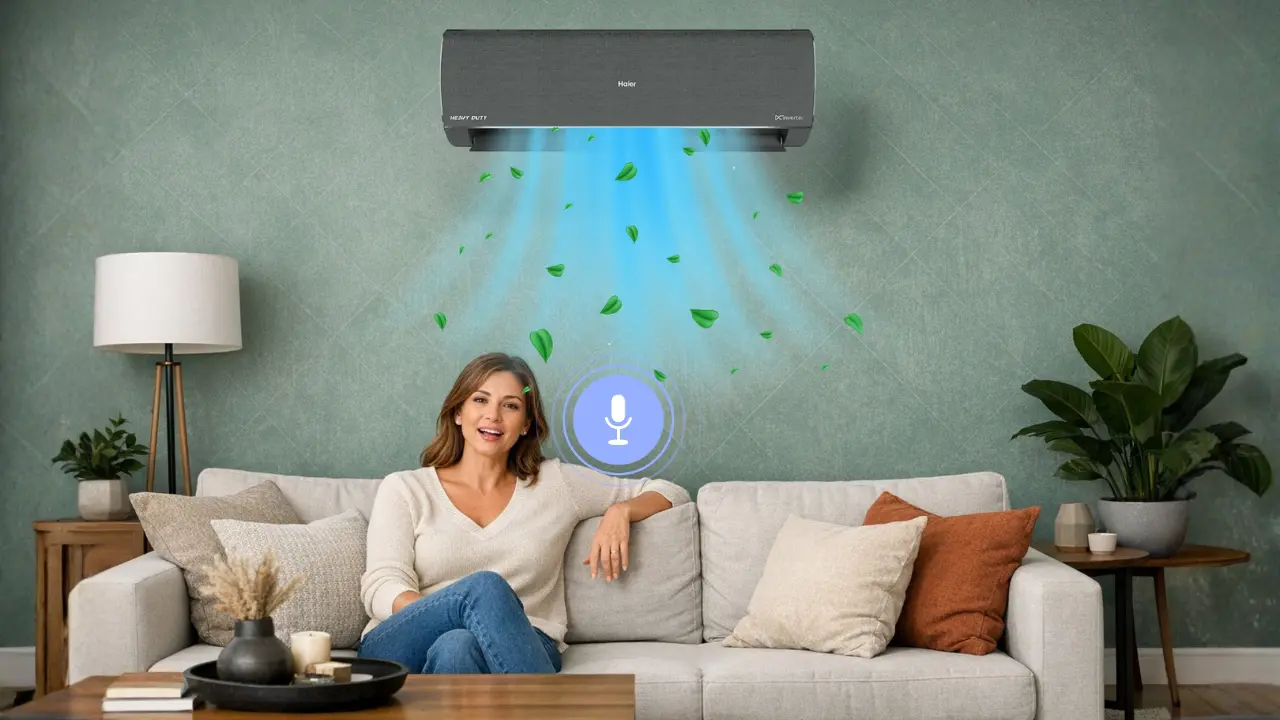

Voice-controlled ACs are the future because they remove friction from everyday living.
They respond in real time, adapt to human behaviour, reduce energy waste, and fit seamlessly into how modern Indian homes actually function.
Not as gadgets. As systems that listen, learn, and quietly take responsibility.
The real problem is not temperature. It is an effort.
Think about a familiar moment.
You come home after a long commute. Shoes off. Phone down. Lights on.
The room feels warm. Not unbearable. Just enough to be irritating.
You reach for the remote. It is not where you thought it was.
You stand up. You search. You sigh.
That moment is not about cooling.
It is about friction.
Most homes are full of tiny frictions we have learned to tolerate.
Smart living starts by removing them.
Voice-controlled ACs do exactly that.
What changes when your AC listens instead of waits?
Traditional ACs wait for instructions.
Voice-controlled ACs anticipate intent.
That difference changes everything.
When you can say “Hello Haier, cool the room” and the system responds instantly, control shifts from device-first to human-first. No buttons. No menus. No mental load.
According to Haier’s AI Atmox, select models even support direct voice control without WiFi, which matters deeply in Indian homes where connectivity can be inconsistent during peak seasons or monsoons .
The system does not pause because your router does.
Comfort remains uninterrupted.
That is not a feature.
That is reliability by design.
Voice control is not convenient. It is cognitive relief
Here is the hidden system most people miss.
Every decision you make costs energy.
Not electricity. Mental energy.
- Where is the remote?
- Which mode works best?
- Should I lower the temperature or change the fan speed?
Voice-controlled ACs remove these micro-decisions.
You speak.
The system acts.
Over time, this reduces decision fatigue, especially for:
- Working professionals managing long days
- Parents juggling multiple responsibilities
- Elderly family members who prefer simplicity
- Solo residents who want minimal effort
Smart homes are not about showing intelligence.
They are about absorbing responsibility.
Why voice control fits Indian homes better than apps ever will
Apps sound great in theory.
In practice, they require:
- Phone access
- App updates
- Logins
- Navigation through screens
Voice control skips all of that.
In Indian homes, where:
- Multiple people share spaces
- Phones are not always nearby
- Elders and kids coexist in the same room
Voice becomes the most democratic interface.
Anyone can speak.
Everyone gets comfort.
This is why Haier integrates Direct Voice Control into its AI Climate Control ecosystem in select models, alongside other adaptive systems like AI Pre-Cooling and AI Target Cooling .
One interface.
Many users.
Zero confusion.
The deeper shift is from manual control to adaptive systems
Voice control is only the visible layer.
The real transformation happens underneath.
Modern voice-controlled ACs operate inside a larger intelligence loop:
- They listen through voice commands.
- They observe patterns like usage time and room occupancy.
- They adapt temperature, airflow, and power consumption automatically.
Haier’s AI-Atmox system is built around this idea.
It learns behaviour, tracks environmental data, and optimises cooling without constant manual input .
This creates a system that improves over time.
Not smarter on day one.
Smarter every day after.
Three everyday moments where voice-controlled ACs quietly win
One: When your hands are full
Cooking. Holding a sleeping child. Carrying laundry.
Voice control works when your hands do not.
A simple command adjusts comfort without breaking your flow.
Two: When the room is already occupied
Traditional ACs cool entire rooms uniformly.
AI-powered systems like Haier’s AI Target Cooling direct airflow to where people actually are.
That means:
- Faster comfort
- Less wasted energy
- More intentional cooling
You cool people, not empty corners.
Three: When energy bills start to matter
Haier’s AI Atmox Power Manager and AI Eco modes track electricity consumption in real time and adjust performance accordingly .
Voice control lets users act instantly.
“Switch to Eco mode.”
No delays. No second thoughts.
Small commands create long-term savings.
The cost-benefit equation nobody talks about
Let us make this practical.
Costs
- Slightly higher upfront investment
- Learning to trust automation
Benefits
- Reduced electricity consumption
- Lower mental effort
- Better comfort consistency
- Fewer manual adjustments
- Systems that improve with use
Over the lifespan of an AC, the balance shifts clearly toward benefit.
Especially in Indian climates where AC usage stretches across long seasons.
Efficiency is not optional anymore.
It is structural.
Why the future of cooling is conversational
Technology always follows human behaviour.
We moved from switches to remotes.
From remotes to apps.
Now from apps to voice.
Because conversation is the most natural interface we have.
Voice-controlled ACs represent a broader shift in how homes are designed.
Homes are no longer static spaces.
They are responsive environments.
They listen.
They adapt.
They reduce friction quietly.
Haier’s approach reflects this shift by combining voice control with AI-driven climate intelligence rather than treating it as a standalone novelty .
That integration is what makes the system feel human.
What this means for modern Indian households
For new homeowners, it sets a baseline for smart living.
For renters, it offers comfort without complexity.
For families, it creates shared control without conflict.
For solo professionals, it removes one more thing to manage at the end of a long day.
Voice-controlled ACs are not about luxury.
They are about alignment.
Between people, space, time, and energy.
The one insight worth remembering
The best technology disappears into routine.
When cooling responds to your voice, learns your habits, and saves power without reminders, it stops feeling like technology.
It starts feeling like the house understands you.
That is why voice-controlled ACs are not a trend.
They are the next default.
And once a home listens, it never feels right to live in one that does not.
Frequently Asked Questions
Is voice control really about comfort, or just convenience?
It’s about cognitive relief. Comfort improves not only because the room cools faster, but because you don’t have to think about it. Over time, that reduction in daily effort matters more than speed or features.
Why does voice control work better than apps in Indian households?
Apps assume personal devices, stable internet, and individual users. Indian homes are shared, dynamic, and multi-generational. Voice is democratic, elders, kids, guests, anyone can speak and get results instantly.
What does it mean when brands say an AC ‘learns’ my behaviour?
Systems like Haier’s AI-Atmox observe patterns, when you use the AC, preferred temperatures, room conditions, and adjust automatically over time. The AC becomes smarter every day, not just on day one.
Is voice control just a surface feature?
Yes, and that’s the point. Voice is the visible layer. Underneath is an intelligence loop that listens, learns, and optimizes cooling quietly. The best technology disappears into routine.
What’s the one thing I should remember about voice-controlled ACs?
The best technology disappears into routine.
When cooling listens, adapts, and saves power without reminders, it stops feeling like technology.
It starts feeling like the house understands you.