
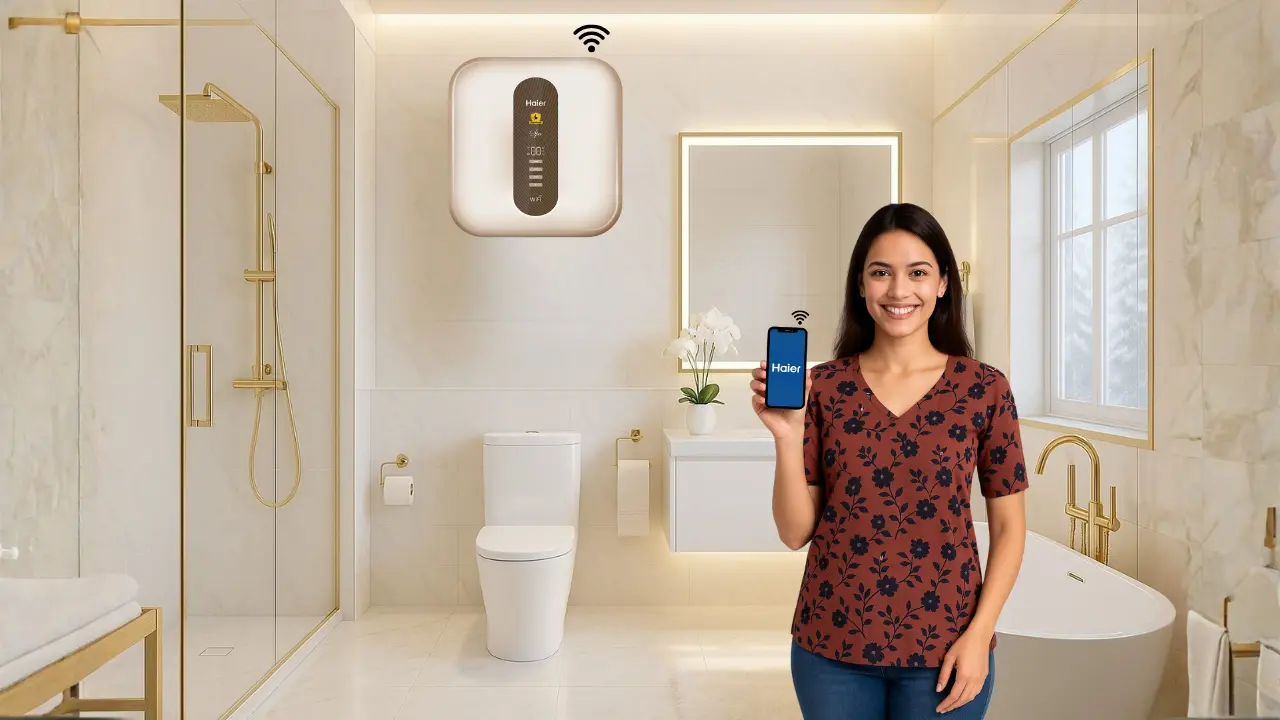

Wi-Fi water heaters save power by intelligently heating water only when you need it most.
They use smart scheduling, remote control, and temperature memory to avoid unnecessary reheating, cutting electricity use during winter rush hours while keeping your mornings seamless.
The winter morning paradox
Every Indian home knows the scene.
It’s 7:45 a.m. in December.
The water heater light is on in three bathrooms. The kitchen kettle is whistling. Someone’s hair straightener is plugged in, the washing machine hums in the background and suddenly, the power dips.
That’s the rush hour no one talks about.
In cities from Delhi to Dehradun, Mumbai to Manali, winter mornings turn our homes into micro power stations. Everyone wants hot water now. The problem? Traditional water heaters heat continuously, even when no one’s using them, wasting energy that could be saved with smarter timing.
What makes a water heater “smart”?
A Wi-Fi water heater, like the Haier 15 L Smart Wi-Fi Water Heater (ES15V-SD Wi-Fi), doesn’t just store hot water, it learns your habits.
Through the Haier Smart App, you can:
- Schedule heating hours for morning and evening showers
- Adjust temperature remotely from your phone
- Switch to Eco Mode during off-peak times
- Monitor power usage in real time
It’s a small shift that changes everything.
Instead of heating 24/7, your water heater works only when needed. Imagine your shower water hitting the perfect temperature right as you step in without wasting a single watt extra.
Why power matters most in the morning
Electricity demand spikes every winter morning across India. According to the Central Electricity Authority, domestic consumption in metros increases by up to 25 percent during early morning hours. Heating appliances, especially water heaters, are among the top contributors.
That’s not just an environmental issue. It’s economical.
Residential tariffs in many cities have moved to time-of-day billing, where units consumed during peak hours cost more. A water heater that reheats twice instead of once can quietly nudge up your bill each month.
Wi-Fi water heaters solve this with precision. They can delay or prep heating cycles during off-peak hours, reducing both grid pressure and household costs.
The hidden system: insulation and memory
Smart technology alone doesn’t save power the system design does.
The Haier 15 L Smart Wi-Fi Water Heater combines:
- PUF insulation, which keeps water hot for hours
- Smart memory, which remembers your last temperature preference
- Dual thermal protection, which prevents overheating and energy waste
Together, these features mean the heater doesn’t restart repeatedly to maintain temperature. It heats once, holds heat longer, and rests intelligently like a well-trained marathon runner pacing its energy.
How it works in real homes
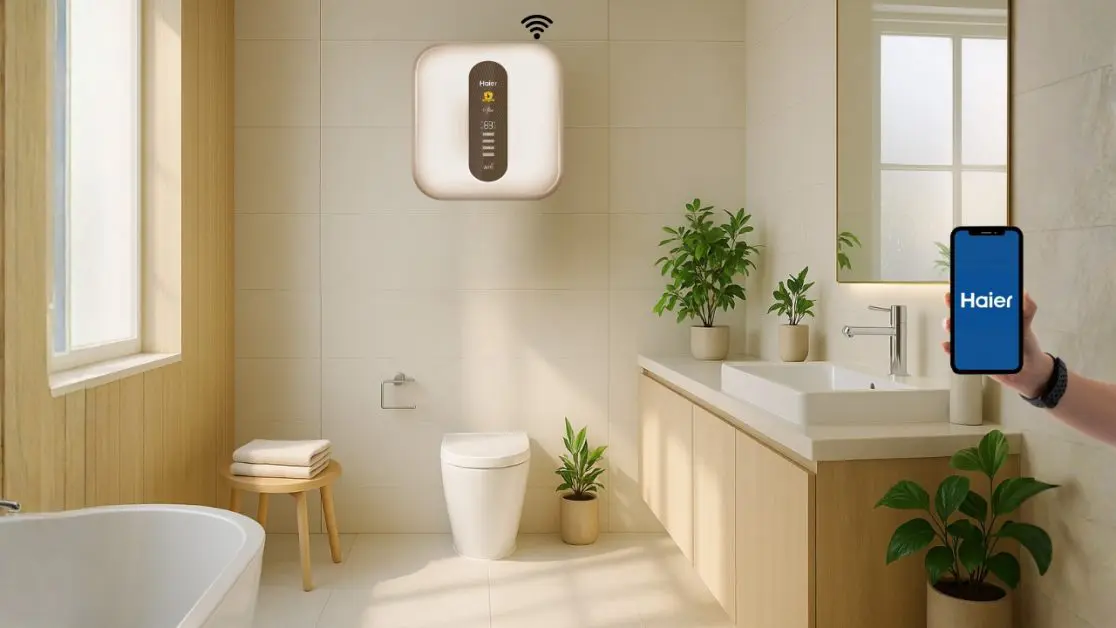
Think of three scenarios.
1. The working couple:
They leave for work at 9 a.m., return by 8 p.m. Their water heater used to run all morning, idle all day, and reheat again at night. Now, with the smart timer, it switches on at 7:30 a.m. and 7:45 p.m. automatically. One touch on the app, and they can even delay it when stuck in traffic. Result? Consistent hot water, lower bills.
2. The joint family:
Six members, three bathrooms, endless queues. The Smart Wi-Fi water heater allows each to set individual preferences and stagger usage. The load distributes smoothly across the morning no last-minute surprises.
3. The solo professional:
Lives alone, travels often. Through remote control, she turns the water heater off while away and switches it back on while commuting home. That’s a convenience that pays for itself.
Smarter heating, safer living
Energy efficiency often comes hand in hand with safety and Haier designs for both.
Features like Shock Proof Technology, RSC U-Turn Flow for fresh water circulation, and anti-bacterial BPS mode that heats up to 80 °C to inhibit bacteria, make the system not just efficient but hygienic.
Add Incoloy 800 SS heating elements and glass-lined tanks, and you get a heater built for long service life critical for high-rise apartments where pressure levels reach 8 bar.
So the energy you save isn’t just electricity. It’s the emotional energy spent worrying about leaks, shocks, or inconsistent temperatures.
The bigger pattern: intelligent homes, not indulgent ones
We often think of “smart” as luxury. But in Indian homes, it’s becoming a necessity.
A smart water heater is not about showing off; it’s about aligning comfort with consciousness. It’s what modern households quietly crave appliances that do their job efficiently, think ahead, and make daily routines effortless.
Technology isn’t replacing care, it’s refining it.
In a home that’s already juggling multiple devices, a Wi-Fi water heater becomes the invisible collaborator keeping everything on time and on temperature.
Cost, convenience, and conscience three sides of the same system
Every smart appliance teaches us a subtle truth: sustainability is a system, not a slogan.
When your water heater:
- Heats only during set hours
- Stores warmth efficiently
- Lets you monitor consumption
- Extends its life with corrosion-proof materials
it’s not just cutting power bills; it’s training you to live smarter.
Even a 10 percent reduction in daily reheating can save over ₹400–₹500 per month in an average household, enough to cover a month’s internet bill. Multiply that across a city, and you start to see how everyday actions reduce collective load on the grid.
So what does this mean for your winter mornings?
It means warmth, without waste.
Hot water that waits for you, not the other way around.
And the quiet assurance that your home runs on intelligence, not excess.
The next time you walk into a foggy December bathroom and find perfectly heated water waiting, remember, it’s not magic. It’s design. It’s Haier’s idea of smart living at work.
Because saving power isn’t about doing less.
It’s about doing just enough, at the right time.