
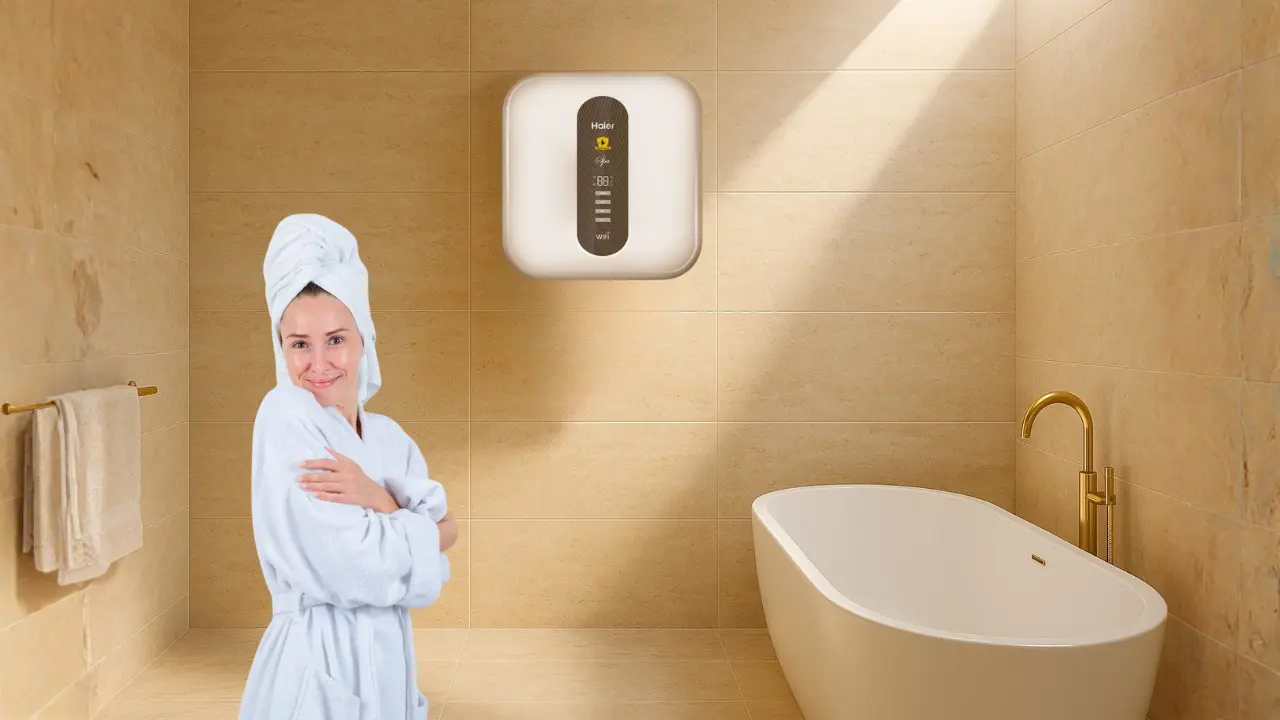

You save winter energy not by using your water heater less but by using it smarter. The real gains come from timing, insulation, temperature control, and a system that avoids reheating cycles.
A modern water heater can actually reduce your monthly bill if you align it with how a real home functions.
That is the simple truth this article builds from.
Why winter suddenly exposes the flaws in your daily routine
Every Indian winter follows a pattern.
The first real chill arrives. Showers get postponed. Buckets replace mixers. Someone complains the water heater is taking forever. Someone else says the bill jumped for no reason.
But the jump is never random.
It is a system reacting to stress.
Cold pipes, colder inlet water, long bathing queues, constant switching on and off, a tank that loses heat because nobody adjusted the schedule. All of it stacks up quietly and then surprises you at the end of the month.
The goal is to understand this rhythm and reshape it.
Energy savings begin with seeing where the waste hides.
What actually increases your water heater bill in winter
Let us reveal the system behind it.
1. Lower inlet water temperature
Water arriving through pipes in North and Central India drops by 8 to 12 degrees in peak December.
Your heater must work longer to reach the same output.
2. Erratic usage patterns
When family members take baths hours apart, the heater reheats multiple times.
Small gaps become expensive gaps.
3. Overheating the tank
Most people set 75 to 80 degrees thinking hotter means faster.
It actually triggers more rapid heat loss.
4. Old insulation
A tank without premium insulation loses heat like a thermos without its lid.
This is where PUF insulation becomes crucial.
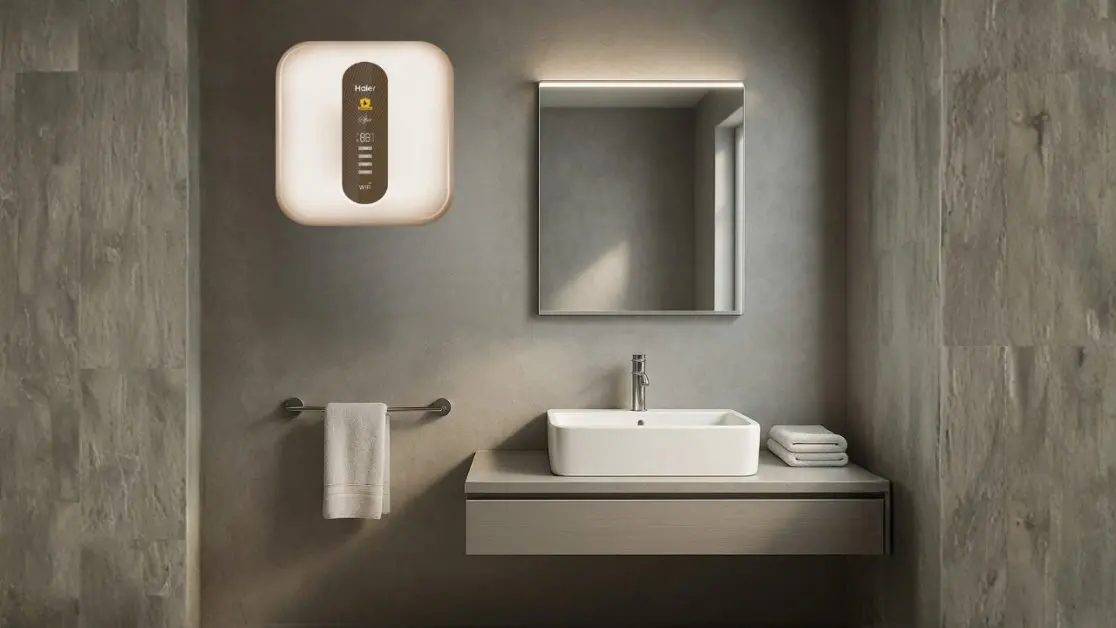
The Haier 15L Smart Water Heater uses PUF and EPS insulation to retain heat for long hours, reducing reheating cycles and therefore saving electricity .
5. Manual switching
Forgetfulness becomes a cost.
Leaving it on for 45 minutes when 15 minutes was enough.
These are the hidden drains.
The smarter way to run a water heater in winter
Bold statement.
Your water heater should behave like a routine, not a switch.
This is how efficiency works in real life.
Below are the systems that save power without reducing comfort.
1. Heat at the same time every day
Consistency reduces reheating.
Most households follow natural patterns: morning baths, evening fresh-ups, or late night dishwashing.
When heating aligns with these moments, wastage drops sharply.
A study by energy strategist A. Ramanathan notes that users who schedule heating save up to 18 percent on winter bills.
This is where modern features matter.
Haier’s Smart Timer and Smart Memory system let the heater learn your daily habits and heat water exactly when you need it, not an hour before or after .
Water heats. Water stays hot. Energy is not wasted.
2. Adjust the temperature to the season
Temperature is not only a comfort choice.
It is an energy decision.
What temperatures actually work
- 55 to 60°C for bucket baths
- 45 to 50°C for mixer showers
- 60°C for kitchen use
- 80°C only for hygiene cycles like anti bacterial modes
Heating beyond this increases convection losses.
The water is hotter than you will ever need, so you mix it with cold water anyway.
A smart way to handle this is to use the built in BPS (bacteria proof system) mode, where the Haier water heater heats water to 80°C only when required to deactivate bacteria, not on every cycle .
This creates hygiene without unnecessary power consumption.
3. Let insulation carry the load, not electricity
Think of a water heater as a thermos.
A thermos saves energy because the heat stays inside.
Haier uses superior PUF insulation that retains temperature for long, reduces reheating, and directly cuts electricity usage .
This matters more in winter than any other season.
Because when the ambient temperature drops, weaker insulation bleeds heat faster.
Good insulation turns your heater from a power device into a heat storage device.
4. Use the right heating power for your routine
One option is high power.
The second option is moderate power.
The third is an adaptive choice.
Most winter decisions involve time pressure.
If your mornings are rushed, a 2kW or 3kW element heats faster.
If your schedule is flexible, using a lower power mode reduces peak load.
Haier offers multiple power levels up to 3kW on the Smart Water Heater so users control both heating speed and energy consumption .
This is not about saving electricity only.
It is about saving electricity that does not improve comfort.
5. Reduce standing water and keep the tank fresh
Here is something few people know.
Stagnant water reduces heating efficiency.
Haier uses RSC U Turn Flow Technology that keeps water fresh by ensuring proper flow and preventing cold zones inside the tank .
Fresh water heats more uniformly.
Uniform heating needs less energy.
Less energy means a lower bill.
A small internal design creates a meaningful external benefit.
6. Turn heating into a shared household system
This is where practical Indian living comes in.
If the tank is 15 litres, and each bath uses 6 to 8 litres, clustered bathing saves money.
If the kitchen washing routine happens right after bathing, the remaining hot water is used instead of reheated.
Here is the pattern.
One person bathes.
Second follows soon.
Someone washes utensils next.
The laundry bucket gets warm water after.
A single heating cycle supports 3 to 4 tasks.
You spend less.
Your home feels seamless.
7. Maintain the water heater like a winter appliance
Most people treat maintenance as repair.
Better to see it as optimisation.
Below are the elements that improve performance:
- Clean pipes before winter
- Check the magnesium rod to prevent corrosion
- Inspect the thermostat
- Use anti bacterial mode weekly
- Ensure proper wall mounting for airflow
- Remove scale formation if you live in a hard water region
The Haier heater includes a corrosion proof glass lined tank and a magnesium rod for long life, which means fewer inefficiencies caused by buildup or rust .
A maintained heater is a cheaper heater.
8. Make WiFi control a winter habit
This is where smart homes quietly save money.
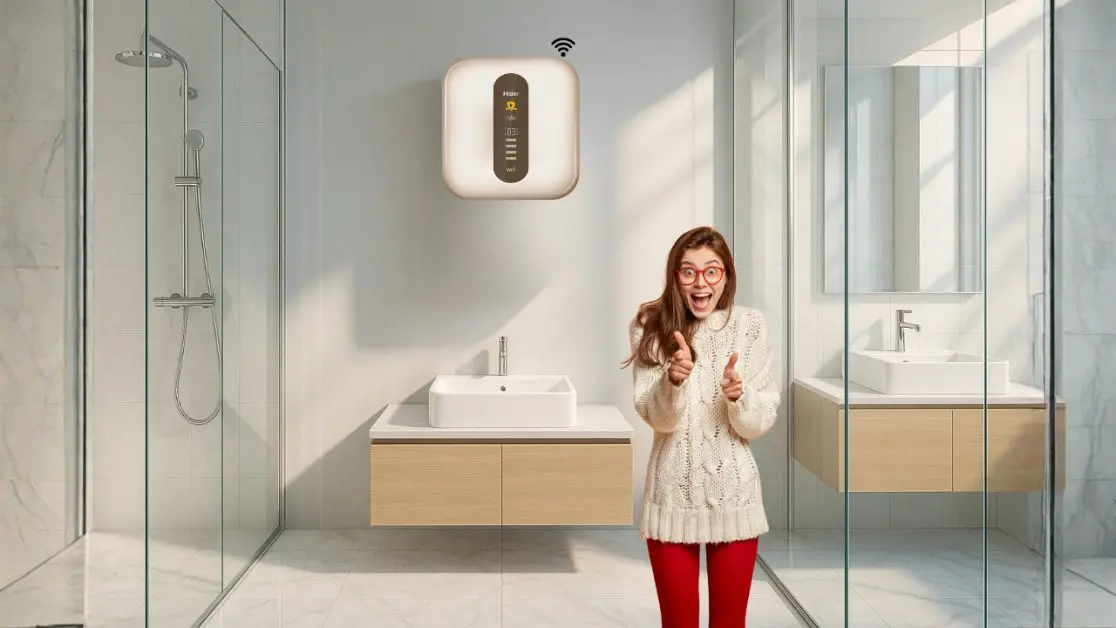
The Haier Smart WiFi Heater lets you turn heating on or off from your phone, control schedules, set temperatures and avoid overuse entirely through the app .
So you never forget to turn it off.
Never heat more than required.
Never run it at night unnecessarily.
You bring intention back into an appliance that usually runs on autopilot.
Quick Table: What Saves the Most Electricity in Winter
| Habit | Savings Impact | Why it Works |
| Using smart timer | High | Reduces reheating cycles |
| Lower temperature setting | Medium | Slows heat loss |
| Clustered usage | High | One heating serves many |
| Anti bacterial mode weekly | Low | For hygiene only |
| PUF insulation advantage | High | Heat stays trapped |
| WiFi control | Medium | Prevents overuse |
| RSC flow design | Medium | Heats uniformly |
A simple winter model for real Indian households
Think of your home as a small ecosystem.
Everyone wakes at different times.
Everyone has their own routine.
Yet the system works well only when the water heater supports these rhythms instead of reacting to them.
Here is a simple winter model many Indian households follow:
Morning
- Smart timer heats water at 6:45 AM
- Family takes back to back baths
- Remaining water used for light kitchen washing
Afternoon
- Heater stays off
- Heat remains due to PUF insulation
Evening
- Quick 10 minute heating for dishwashing
- No full reheating cycle required
Night
- Water heater off through WiFi
- Temperature does not drop too much because of good insulation
This routine uses the heater for only 25 to 35 minutes a day.
Yet comfort stays high.
What this means for the future of smart homes
Every appliance in the home is slowly learning to think ahead.
Water heaters were once the last holdout.
No longer.
A water heater with shock proof protection, bi capillary dual thermostat, smart memory, anti bacterial mode, incoloy element and IPX4 design is not just safer.
It is more intelligent.
It reduces waste built into the old way of doing things .
The bigger pattern is this.
Energy savings grow not by sacrificing comfort but by aligning systems with behaviour.
That is the hidden architecture of a modern Indian home.
The takeaway that stays with you
Hot water is a winter comfort.
Your electricity bill is a winter cost.
The gap between them is design.
When a water heater understands timing, temperature, insulation and flow, it becomes an ally instead of an expense.
Smart cooking starts fitness habits.
Smart heating keeps winter peaceful.
And a smarter home gives you something rare.
Control without effort.