


A single modern TV can deliver true 3D surround sound by combining precisely tuned speaker placement, dedicated subwoofers, object-based audio formats like Dolby Atmos, and real-time AI processing.
Instead of relying on multiple external speakers, the TV itself analyses scenes, positions sound in space, and adapts audio output to the room. The result feels layered, directional, and immersive without clutter.
The familiar living room moment we all recognise
It is a Friday night.
The lights are dimmed. Someone is finishing dinner. A match or movie is already playing.
You sit down expecting to relax.
But something feels flat.
The picture looks great. The sound does not travel. Dialogue feels stuck to the screen. Crowd noise sounds like a single wall of volume.
This is the moment where most people assume one thing.
Good surround sound needs extra speakers.
That assumption is outdated.
Why surround sound used to mean wires everywhere
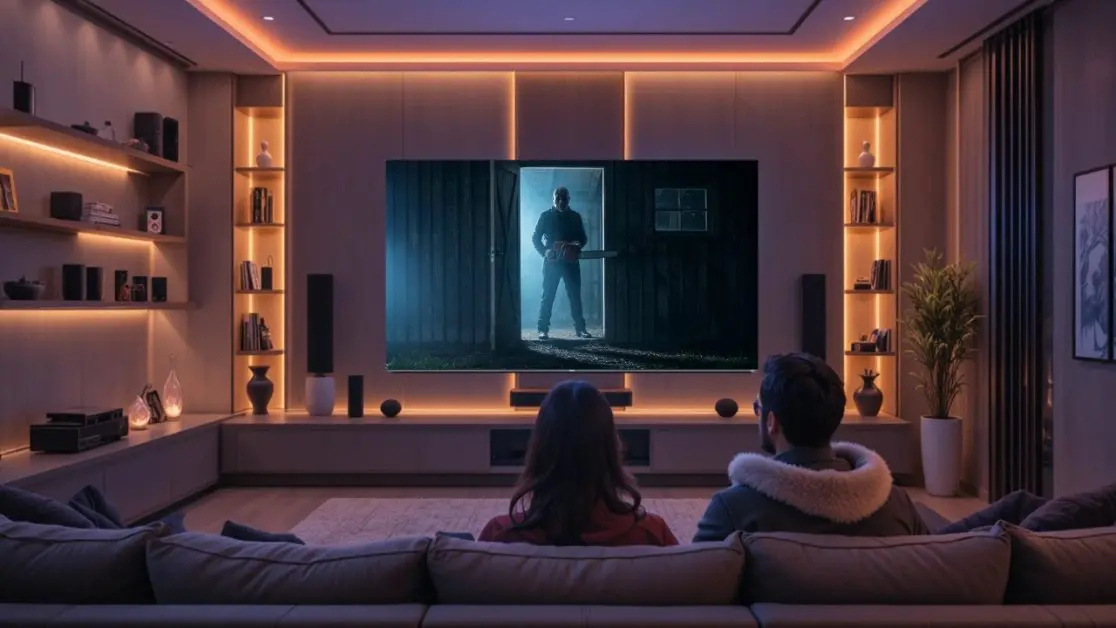
For years, surround sound followed a simple logic.
More speakers equals more immersion.
One in front. Two on the sides. One behind. A subwoofer on the floor. Cables running across the room. Setup manuals that never quite made sense.
It worked.
But it demanded space, patience, and tolerance from everyone else in the house.
Modern homes have changed.
Living rooms became multipurpose. Rental spaces became tighter. Minimal interiors replaced bulky setups.
Audio systems had to adapt.
The shift most people did not notice
Sound systems quietly went through a structural change.
Instead of relying on physical placement alone, audio started relying on processing.
Not louder speakers.
Smarter ones.
This is where the idea of a single TV delivering true 3D surround sound becomes real.
What “true 3D sound” actually means
True 3D surround sound is not about volume.
It is about position.
You hear:
- Dialogue anchored at mouth level
- A helicopter passing overhead
- Crowd noise spreading outward, not forward
- Music filling the room instead of pushing at you
This happens because modern audio treats sound as objects, not channels.
Formats like Dolby Atmos allow sound elements to be placed in three-dimensional space.
Above you.
Beside you.
Behind you.
The TV decides where each sound belongs.
How a single TV pulls this off
This does not happen by accident.
It happens through four coordinated systems working together.
1. Purpose-built speaker architecture
Modern premium TVs no longer rely on downward-firing speakers alone.
They use a combination of:
- Front-facing drivers for clarity
- Side-firing drivers for width
- Dedicated subwoofers for depth
In the Haier S90 QLED 254cm (100) Google TV AI Center Max, this is delivered through a 2.1 channel speaker system with a built-in subwoofer, tuned by KEF and powered at 55W for controlled impact and balance .
The placement is intentional.
Every driver has a role.
2. Dolby Atmos without extra hardware
Dolby Atmos is often associated with ceiling speakers.
That is no longer mandatory.
When implemented correctly, Dolby Atmos uses psychoacoustics. It creates the illusion of height and movement by how sound reflects and reaches your ears.
A TV with Dolby Atmos processing maps sound upward and outward, even from a flat panel.
This is how a single screen creates vertical sound layers.
3. AI-driven audio processing
Here is where things get interesting.
AI does not just enhance pictures anymore. It shapes sound.
In TVs like the Haier S90, the AI Ultra Sense Processor analyses content in real time.
It understands:
- Dialogue-heavy scenes
- Sports environments
- Music playback
- Action sequences
Based on this, it adjusts sound separation, bass response, and spatial spread.
Crowd noise stays wide.
Commentary stays sharp.
The background score stays immersive.
No manual switching required.
4. Room-aware tuning
Sound behaves differently in every home.
Curtains absorb it.
Walls reflect it.
Furniture breaks it up.
Modern TVs compensate.
AI-driven tuning adjusts output based on ambient conditions, ensuring clarity without overwhelming the room.
This is why the same TV sounds controlled in a compact apartment and expansive in a larger living space.
Why this matters in real Indian homes
Credits: Haier India,
Indian living rooms are not sound labs.
They are active spaces.
Parents talking.
Pressure cookers whistling.
Kids walking in and out.
Doors opening.
A good sound system does not fight this chaos.
It adapts to it.
Clear dialogue at lower volumes matters more than booming bass.
A single-TV surround system works because it prioritises balance over brute force.
Three common setups people consider
Most households still weigh their options this way.
Option one: TV speakers only
- Clean setup
- Minimal cost
- Limited immersion
Option two: Soundbar plus subwoofer
- Improved bass
- Extra hardware
- Still directional, not truly spatial
Option three: Single TV with integrated 3D sound
- No clutter
- Smart spatial audio
- Designed for modern living
The third option is where technology quietly solved an old problem.
The KEF difference most people miss
KEF is known globally for acoustic engineering.
When a TV integrates KEF tuning, it means:
- Balanced mids for speech
- Controlled bass without distortion
- Precise separation between sound layers
This is not about louder sound.
It is about cleaner sound.
And cleaner sound feels more immersive over time.
Gaming, sports, and cinema all benefit differently
True 3D sound is not one-size-fits-all.
It adapts.
- Sports: Crowd energy spreads wide, commentary stays centred
- Movies: Background scores wrap around you, effects move naturally
- Gaming: Directional cues become clearer, reactions feel faster
The Haier S90 also supports high refresh rates and gaming features, ensuring audio and visuals stay in sync during fast-paced action .
Why fewer components often mean better results
Credits: Haier India,
Complex systems fail at the edges.
More cables.
More settings.
More points of error.
A single-TV surround system works because it is designed as one ecosystem.
Picture, sound, processing, and tuning speak the same language.
Systems that talk to each other perform better than systems stitched together.
The invisible benefit no one talks about
Consistency.
A well-tuned TV sounds good every day.
Not just during movie night.
Not just when everything is set perfectly.
That reliability changes habits.
People watch more together.
Volume stays reasonable.
Listening fatigue reduces.
A good sound does not announce itself.
It disappears into the experience.
What this shift tells us about modern technology
The future is not about adding more.
It is about integrating better.
One device.
Multiple capabilities.
Less effort.
A single TV delivering true 3D surround sound is not a compromise.
It is a design decision rooted in how people actually live.
The takeaway worth remembering
When technology respects space, time, and attention, it earns a place in everyday life.
True immersion does not require complexity.
It requires intelligence.
And sometimes, the smartest system is the one you barely notice at all.
Frequently Asked Questions
Is a “single-TV surround system” just marketing language?
It used to be. Now it reflects real engineering shifts, object-based audio formats like Dolby Atmos and AI-driven tuning make it technically legitimate.
My living room is noisy, will 3D sound still work?
Yes. Modern TVs prioritise dialogue clarity and adaptive volume control, so speech remains clear even with background noise.
What does “object-based audio” really mean for me?
Instead of pushing sound through fixed channels, the TV places each sound, dialogue, effects, music, into a 3D space around you.
How does Dolby Atmos work without ceiling speakers?
Through psychoacoustics. The TV uses timing, reflection, and frequency cues to create the illusion of height and movement.
Does the TV adapt to my room automatically?
Yes. Modern TVs account for walls, furniture, curtains, and room size to fine-tune audio output.
Will audio stay in sync during high-frame-rate gaming?
On modern TVs designed as a single system, audio and visuals remain tightly synchronised even during fast action.