
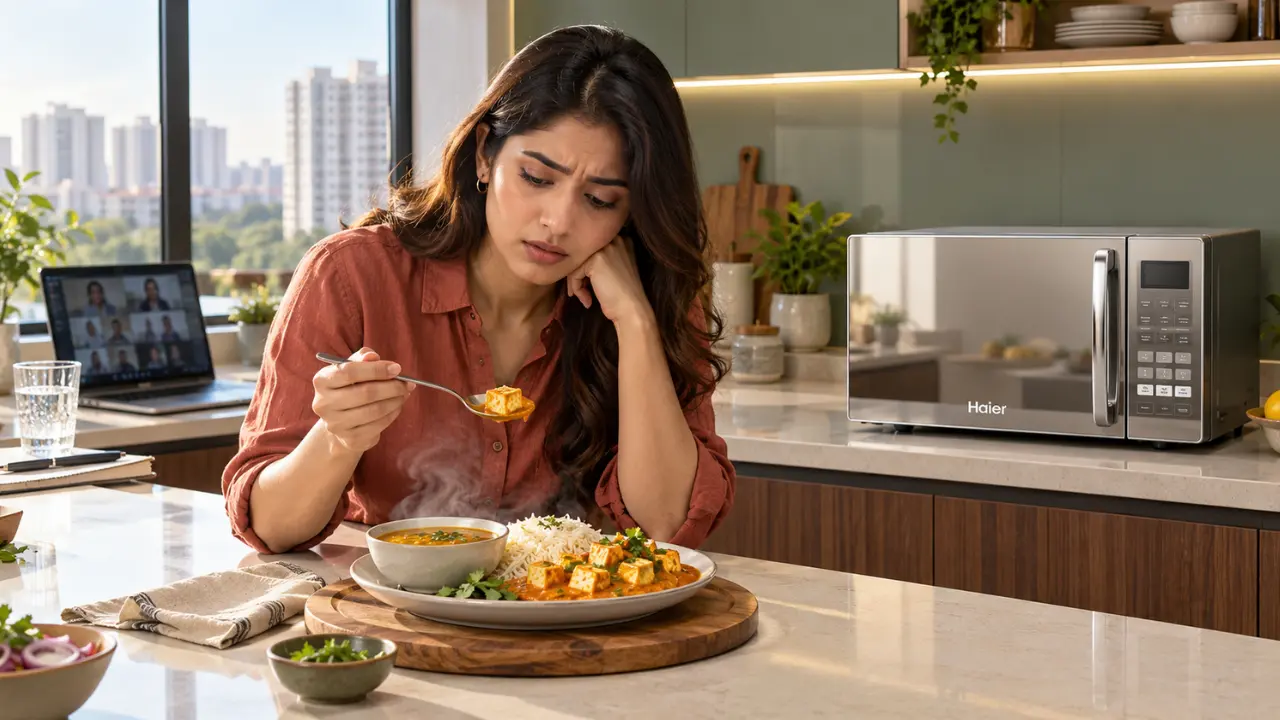

The dal is so hot that it’s steaming. The rice is only slightly hot. Oh, that bit of paneer in the middle? Still cold.
You place all the items you want to heat in the microwave, choose the length of time you want them to be heated for, and wait for the familiar beep. But somehow each part of the meal is a different temperature.
But it is a very frustrating experience, especially when you are having lunch between your office meetings, or warming up the leftovers of last night’s dinner after a long day.
However, why does cooking and reheating food become easier in a microwave oven but the food warps and bubbles?
What most people don’t know is that it all has to do with the interaction of food with the microwave energy. The food on the plate, its form, the amount you fill it with and even the setting of the plate can impact the outcome.
Let’s take a look at what is taking place in your microwave, and a few simple adjustments that can make it easier.
Why Do Areas of Food Get Hotter Than Others in a Microwave?
A microwave oven is based on the principle of heat generation in the food by electromagnetic waves. These waves are mainly absorbed by water molecules and other substances, such as dissolved salts and fats, resulting in the transformation of energy into heat.
Microwave energy however is not evenly distributed across the cooking chamber.
There are parts of the land where more energy is received than other parts. But the various foods react differently to microwave energy, so temperature differences can occur during the cooking process.
Think of a bowl of vegetable pulao.
The outside areas can be hot, with the middle cooler. This is due in part to the fact that microwave energy only penetrates a certain amount into food, depending on the food’s composition.
Heat will now have to be conducted towards the centre.
The centre may not be sufficiently heated if the food is thick, packed or heated for an inadequate length of time.
That’s why a longer microwave time doesn’t necessarily yield the best results.
6 Common Reasons Why Your Microwave Might Not Be Cooking Food Evenly
There are a few reasons why your microwave might not be cooking food evenly.
Prior to assuming that the appliance is broken, check these common causes.
1. The Food Is Piled Thick to Form a Stack
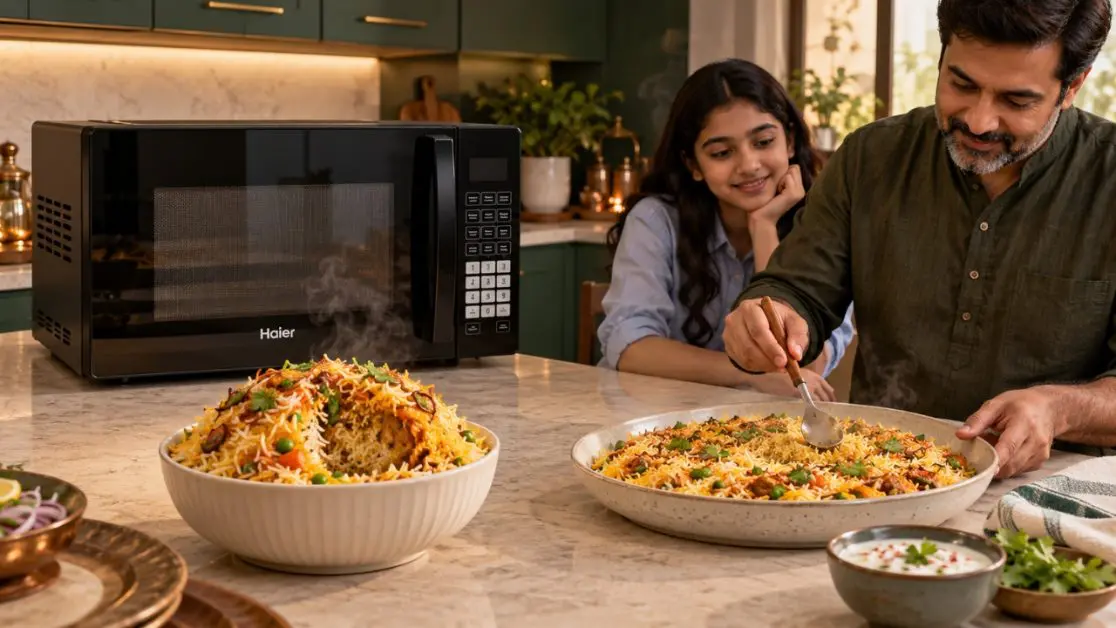
Suppose you have a big bowl and reheat the leftover biryani in it.
The top layer of the rice is hot, while the bottom layer is cold.
The microwave energy will not penetrate food to any great depth. A thick layer of food relies more upon the transfer of heat from neighbouring areas to the inside of the centre.
This can be helped by a simple adjustment.
Distribute the rice, noodles or vegetables so that it is spread out relatively evenly and not all on top.
If using thicker cuts, make a small opening in the middle to allow for even cooking.
2. Heat Absorption Is Absorbed by the Ingredients.
When foods are served in a mixed Indian thali, they have a huge variation in moisture, density and texture.
Not all of the above will heat up at the same time.
For example:
- Dal is fairly moist and can get hot fairly fast.
- If rice is reheated without adequate moisture it will develop dry places.
- You can still get a panner that is cooler inside when heated in thicker parts.
- Thick gravies should be stirred when heating to avoid hot spots.
- The longer it takes to cook dense foods like stuffed parathas, the more time should be allowed to cook them to cook the centre.
The solution does not always have to be a longer heating cycle.
However, if possible, reheat foods that are similar in kind.
3. The Turntable Isn’t Rotating Properly
The glass plate that you see rotating in your microwave is there for a purpose.
The turntable rotates and various parts of the food go through various parts of the energy field of the microwave.
This decreases the uneven heating.
If the turntable doesn’t turn or it is restricted from moving freely, however, some parts may be exposed to a much higher amount of microwave energy than others.
Check whether:
- The glass turntable is installed properly.
- The roller ring is properly seated.
- Obstruction due to food particles.
- There is an oversized container that is abutting cavity walls.
- The turntable moves freely when being used.
Do not attempt to do a microwave repair job yourself.
If the turntable still fails to operate after normal cleaning and re-positioning, call an authorised service person.
4. Wrong Container

The type of container can affect the reheating process of food.
Food tends to be more evenly distributed in a wide, flat dish than in a deep narrow dish, provided the dish is microwave-safe.
The type of container is also a factor.
Avoid using glass, ceramic or glass containers that are microwave-safe and have been marked as such.
Refrain from using metal utensils and aluminium foil, or metal decorated containers unless specified in the cookbook.
Also, keep in mind that a microwave safe container does not necessarily result in an evenly heated container.
The food setting still counts.
5. The Power Level Is Too High
When it comes to dinner it’s easy to fall into the trap of turning on the heat to the highest setting.
However, the outer parts can get very hot before the inner parts have come up to the right temperature sometimes, when aggressive heating is used.
This is especially evident when eating thick foods or frozen foods.
If you want to cook food slowly, you can use a lower power and cook for a longer time.
If the vegetable gravy or a large amount of cooked rice is to be reheated, a moderate level of power and occasional stirring can be more effective than high power and continuous stirring.
6. Frozen Food Hasn’t Defrosted Properly
The frozen food is another obstacle.
Ice and liquid water do not interact the same way with the microwave energy. During thawing, some parts may start to thaw faster than others, leading to a temperature gradient within the product.
It’s for this reason that a frozen curry may be hot around the edges and cold in the centre.
If available, defrost in the microwave.
Cut up food when it becomes soft; place and turn food from time to time, and observe proper food safety measures.
Cook raw meat, poultry and seafood after microwaving.
The 3-Step Method to Even Microwave Heating
There are no complicated cooking methods for enhancing results of reheating.
There are 3 habits that you could begin that will make a difference.
Step 1: Put Food in Order Before You Start to Heat.
Divide food into a microwave-safe container.
If necessary, add some water to prevent over-drying for rice or other foods.
Cover loosely with a microwave safe lid or appropriate cover to allow steam to escape.
Step 2: Pause, Stir, and Rotate the Liquid.
Stop the microwave half way through heating.
Mix gravies, dal, soups and rice well.
If the food will not stir, turn or rearrange the pieces of solid food.
This will help spread heat and lessen the risk of cold spots.
Step 3: Standing Time Is the Third Step in the Process.
This is the step that many people miss.
After removal from the microwave, cover and stand for a few minutes.
During this time, heat still flows from hot to cold.
Thick or dense or frozen foods are particularly important for standing time.
Before serving, stir if possible and make sure food is well heated. When preparing leftovers, use a food thermometer to check the internal temperature to be sure it reaches 74°C.
How Haier Microwave Ovens Make Everyday Reheating More Convenient
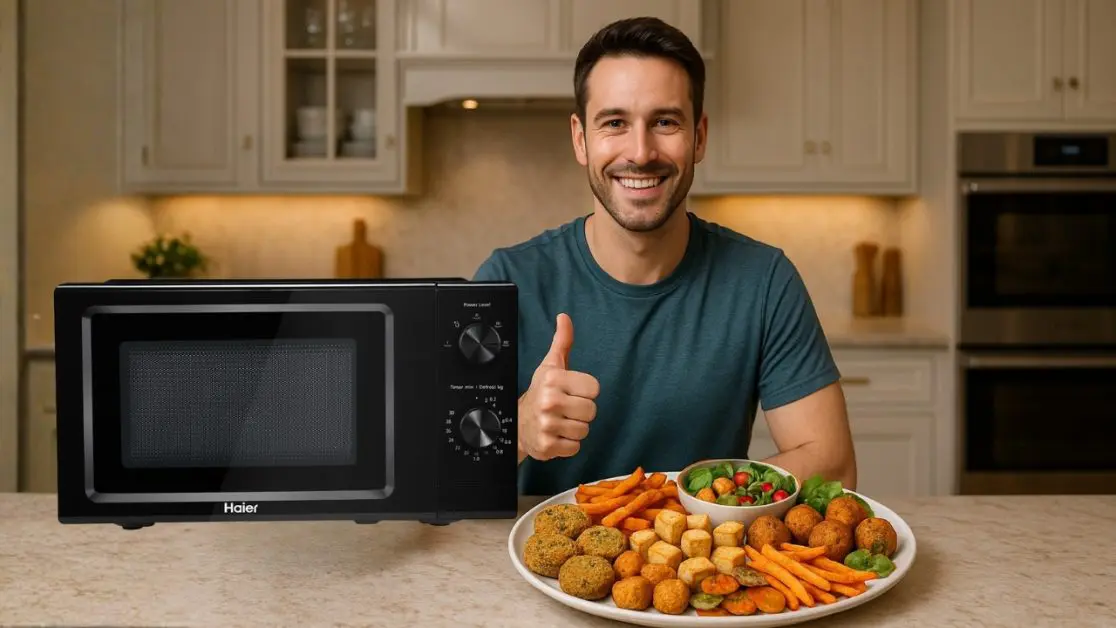
It helps to know the science of unequal heating. A microwave with sensible controls to heat things up can help make that easier.
For everyday cooking, reheating and defrosting needs, Haier India has microwave oven products which are designed to be used individually.
The Haier 19L Solo Microwave Oven With Inverter Technology (HIL1901MBPB) and Haier 20L Solo Microwave Oven (HIL2001MWPH) are two models to consider.
Both are ideal for people who want simple microwave use and don’t want to add more complexity.
Haier Solo Microwave Oven With Inverter Technology 19L (HIL1901MBPB).
Haier 19L Solo Microwave Oven With Inverter Technology proves to be a convenient option for everyday heating needs in compact Indian kitchens.
It is supported by its inverter technology, which is an electronic transformer which enables the appliance to operate in an energy-saving manner.
It can be used to cook, reheat and defrost foods, and is ideal for warming up ready meals or preparing frozen foods.
Some of the major characteristics of the products are:
- Everyday microwave use with a 19 litre capacity.
- Electronic transformer technology with an inverter.
- Energy saving operation according to product specifications.
- Operating quietness – a maximum noise level of 57 dB(A).
- Defrost for frozen foods.
- 700 W microwave output.
- They look like black, modern, and compact for contemporary kitchens.
The electronic transformer also helps to reduce the weight of the appliance.
The model is a good fit for individuals, couples, or smaller families who prepare meals on a frequent basis.
Of course, inverter technology won’t solve all the problems of uneven heating. Good food placement, storage containers and proper cooking times are still critical.
Haier 20L Solo Microwave Oven (HIL2001MWPH)
Some homes may want a greater degree of flexibility in choosing the power level of the microwave.
The Haier 20L Solo Microwave Oven (HIL2001MWPH) is relevant here.
This model has five microwave power settings which can be changed based on users’ heating needs.
Users do not need to set the maximum power for all dishes, but can change the power setting when reheating foods that require lower heat.
It has the following notable characteristics:
- Regular household use of 20 litres.
- Flexible heating with 5 power levels of the microwave.
- 35-minute cooking timer.
- Time and weight based defrost control.
- 700 W microwave output.
- Turning the turntable to achieve maximum exposure to microwave radiation.
Along with this is a turntable designed to fit regular dinner plates the perfect size for easily reheating individual meals.
These controls offer handy flexibility from using them for warm-up morning poha, to reheating dal for dinner, to cooking frozen foods.
These two Haier models are designed as stand-alone units to prepare, reheat and defrost foods in the microwave. Do not mistake them for “conventional” microwave ovens used for baking or grilling.
When Is Uneven Heating a Sign of a Microwave Problem?
Temperature changes are normal from time to time.
But, if heating issues continue, they warrant attention, particularly if they are not happening due to improper feeding and/or temperature.
Look for any of these symptoms:
- Food cools after an abnormally long cook time.
- The turntable stalls and comes to a halt repeatedly.
- The microwave produces strange sounds when operating.
- The heating capacity declines over time.
- The appliance shows errors or shuts off prematurely.
With persistent problems, stop use immediately (if safe to do so) and schedule a professional inspection.
High voltage parts are present in microwave ovens and can still be hazardous after the oven is turned off.
Do not take off the outer cabinet or try to do any in-house repairs.
Small Things Make a Big Difference at Mealtime!
Eating at home is more than just a matter of taste, it’s a matter of health!Small things make a big difference at mealtime!
A microwave should make kitchen life easier, rather than leaving you wondering if your dinner is hot enough.
And the explanations for the most uneven heatings are relatively simple.
The final temperature can be influenced by a very deep container, tightly packed food, an improper power setting, or inadequate standing time.
What is crucial is to understand how the microwave heating functions.
Spread food evenly. Stir when possible. Choose suitable power settings. Give sufficient time for the distribution of heat.
For a family looking to buy a new appliance in the market, Haier India’s 19L Solo Microwave Oven With Inverter Technology and 20L Solo Microwave Oven are the best options to reheat and defrost items at home every day.
Explore into Haier India’s microwave family to discover the best one for your kitchen, cooking style and family needs.
When one is cooking when the dish is ready, the last thing you want is the gravy hot around a cold paneer.
Frequently Asked Questions
1. Why is my microwave heating food unevenly?
Uneven microwave heating can result from differences in food thickness, moisture content, positioning, and microwave energy distribution. Stirring, rotating, and allowing standing time can help improve results.
2. Does a microwave turntable help food heat evenly?
Yes. A rotating turntable moves food through different areas of the microwave’s energy field, helping reduce uneven exposure. However, stirring and rearranging food may still be necessary.
3. Is it better to microwave food at a lower power level?
For certain thick, dense, or delicate foods, a lower power setting over a longer period can improve heating consistency. The appropriate setting depends on the food and appliance instructions.
4. Why is my food hot outside but cold inside?
Microwave energy penetrates food only to a limited depth. In thick portions, the centre relies partly on heat conducted from surrounding areas. Stirring, smaller portions, and standing time can help.
5. Can a Haier solo microwave oven reheat frozen food?
Yes. The Haier 19L Solo Microwave Oven With Inverter Technology and Haier 20L Solo Microwave Oven include defrost functionality. Follow the appliance instructions and appropriate food-safety guidelines.
6. How can I prevent rice from drying out in the microwave?
Add a little water, spread the rice evenly, and cover it with a microwave-safe lid that allows steam to escape. Stir during reheating and ensure the rice is thoroughly hot before serving.