

AI ECO adjusts cooling by constantly reading room temperature, usage patterns, and human presence, then shifting the AC into the most efficient operating mode in real time.
Instead of running at full power all the time, it cools just enough, just when needed, reducing energy waste while keeping comfort steady.
That sounds technical.
But the real story is very human.
The everyday AC problem nobody talks about
It is late evening.
Dinner is done.
One person is scrolling. Another is half asleep.
The AC is still running exactly the same way it was at 4 pm.
Most air conditioners do not know what has changed.
They only know one thing.
On or off.
That is the hidden inefficiency in Indian homes.
Rooms cool down faster than we think.
People move in and out more than we realise.
Weather shifts hour by hour, not day by day.
Yet traditional ACs behave like nothing ever changes.
AI ECO exists to fix that gap.
AI ECO is not about colder air. It is about smarter decisions
Here is the mistake most people make.
They think energy saving means weaker cooling.
In reality, it means better timing.
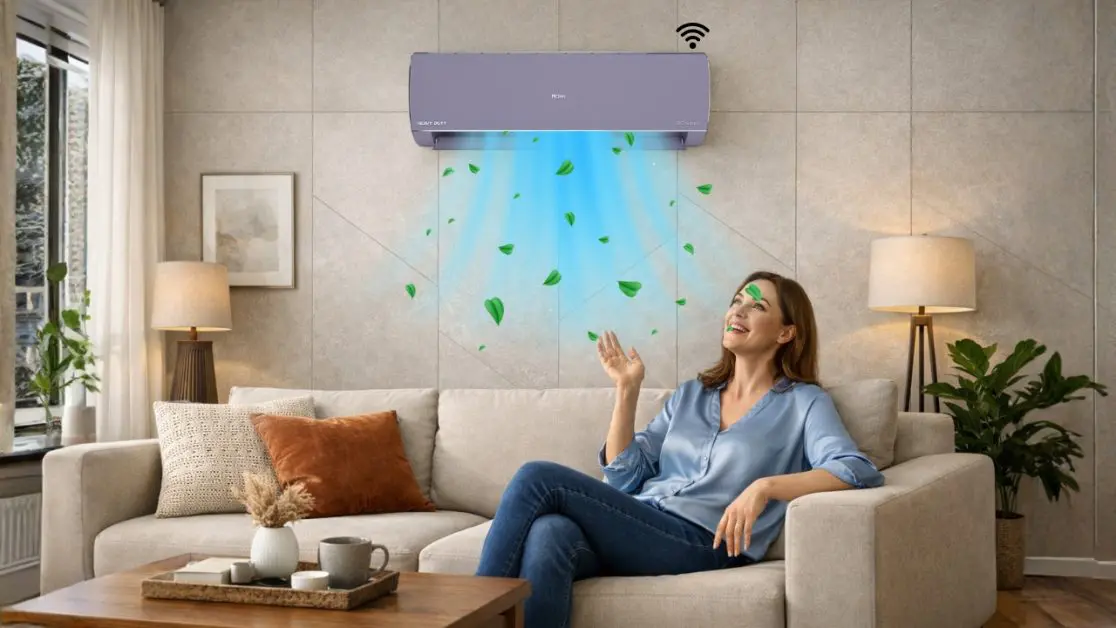
AI ECO focuses on how much cooling is actually required right now. Not what was required an hour ago.
It looks at:
- The difference between room temperature and the set temperature
- How fast the room is cooling
- Whether someone is present
- How long the AC has already been running
Then it decides the most efficient response.
Cooling is no longer fixed.
It becomes fluid.
How AI ECO actually works inside the system
This is where the system thinking shows up.
AI ECO is part of a larger intelligence layer inside Haier ACs powered by AI Atmox. It does not operate alone. It listens to data, interprets patterns, and adjusts performance accordingly.
Step one: Measuring the temperature gap
AI ECO constantly checks one key number.
The gap between:
- The current room temperature
- The temperature you have set
That gap decides everything.
No guesses.
Not presets.
Just real data.
Step two: Switching to the right ECO level
Instead of one generic eco mode, AI ECO uses multiple efficiency levels.
Here is how it works in simple terms:
- ECO Level 1
Activated when the temperature gap is more than 3°C
The AC reduces power slightly but still cools actively - ECO Level 2
Activated when the gap is between 1°C and 3°C
Cooling slows down as the room approaches comfort - ECO Level 3
Activated when the gap is 1°C or less
The AC maintains comfort with minimal energy use
This shift happens automatically.
No buttons.
No thinking.
That is the difference between automation and intelligence.
Why this matters in real Indian homes
Efficiency is not theoretical here.
It is practical.
Indian homes deal with:
- Unpredictable power usage
- Long AC running hours in summer
- Rising electricity tariffs
- Multiple people using the same room differently
AI ECO adapts to all of this.
Scenario one: Work from home afternoons
You sit near the desk.
The AC cools quickly at first.
Once comfort is reached, AI ECO steps down.
Result:
- Stable temperature
- No unnecessary compressor load
- Lower power consumption
Scenario two: Late night sleep
Body heat drops at night.
Cooling demand drops too.
AI ECO senses the smaller temperature gap and shifts to a deeper efficiency mode.
Result:
- No overcooling
- No midnight chills
- No wasted electricity
Comfort does not disappear.
It becomes quieter.
Scenario three: Empty rooms
Someone leaves the room.
The AC does not panic.
With AI Human Detection available in select models, the system detects inactivity and gradually reduces cooling or Switched off entirely when no human detected for continuous 30 minutes
This is not about saving pennies.
It is about eliminating invisible waste.
Why timers and manual eco modes fall short
Traditional solutions assume humans are consistent.
They are not.
Timers:
- Do not know if you came back early
- Do not know if the room cooled faster
- Do not know if someone stayed longer
Manual eco modes:
- Apply one rule to every situation
- Ignore room size, heat load, or occupancy
AI ECO works because it responds to reality, not schedules.
Systems that observe always outperform systems that assume.
The quiet role of electricity monitoring

One of the smartest parts of AI ECO is feedback.
With electricity monitoring features inside the Haier ecosystem, users can actually see how energy usage changes over time.
This visibility changes behaviour.
People stop guessing.
They start understanding.
When you can see:
- Daily consumption
- ECO vs normal mode usage
- Cost representation in currency
Efficiency stops being abstract.
It becomes personal.
Efficiency without effort is the real upgrade
The biggest innovation here is not technology.
It is absent.
No reminders.
No manual adjustments.
No compromise on comfort.
AI ECO removes the burden of decision-making from the user.
That is the future of smart homes.
Not more controls.
Fewer decisions.
Why AI ECO suits modern Indian lifestyles
Indian households today look very different than they did a decade ago.
- Hybrid work schedules
- Smaller nuclear families
- More time spent indoors
- Higher sensitivity to monthly bills
AI ECO fits into this shift naturally.
It does not demand attention.
It earns trust quietly.
The best systems are the ones you forget are working.
What AI ECO teaches us about better systems

This is bigger than air conditioning.
AI ECO reflects a broader design philosophy.
Good systems:
- Observe before acting
- Adjust gradually, not abruptly
- Optimise continuously, not occasionally
- Respect human comfort while reducing waste
Whether in homes, workplaces, or cities, efficiency improves when intelligence replaces rigid rules.
The long-term impact people actually feel
Over time, AI ECO delivers three real outcomes:
- Lower electricity bills
Not through sacrifice, but precision - Consistent comfort
Without temperature swings or overcooling - Longer AC lifespan
Less stress on components due to smarter load management
Efficiency is not a moment.
It is a habit built into the system.
Why this kind of intelligence will become the norm
As energy costs rise and climate awareness grows, systems that waste power will feel outdated.
AI ECO represents the shift from:
- Reactive cooling to predictive adjustment
- Manual control to adaptive intelligence
- Power consumption to power management
Once people experience this, going back feels inefficient.
Not uncomfortable.
Just inefficient.
The final insight
AI ECO is not trying to change how people live.
It is adapting to how they already do.
That is why it works.
When technology listens first and acts second, efficiency follows naturally.
And in real homes, that is what makes life feel a little more sorted.
Frequently Asked Questions
Do I really need to change AC modes every few hours to save electricity?
With traditional ACs, yes. With AI ECO, no.
Why does energy saving always feel like extra effort?
Because most systems shift responsibility to the user instead of the machine.
Why do I wake up cold even though I didn’t change the temperature?
Because your body heat drops at night, but your AC doesn’t.
What does “AI” in an AC actually do for me daily?
It replaces fixed rules with real-time decisions.
Is AI ECO just another eco mode with a fancy name?
No. It uses multiple ECO levels, not a single preset.
Why does AI ECO feel different from other “smart” features?
Because it listens first and acts second.