
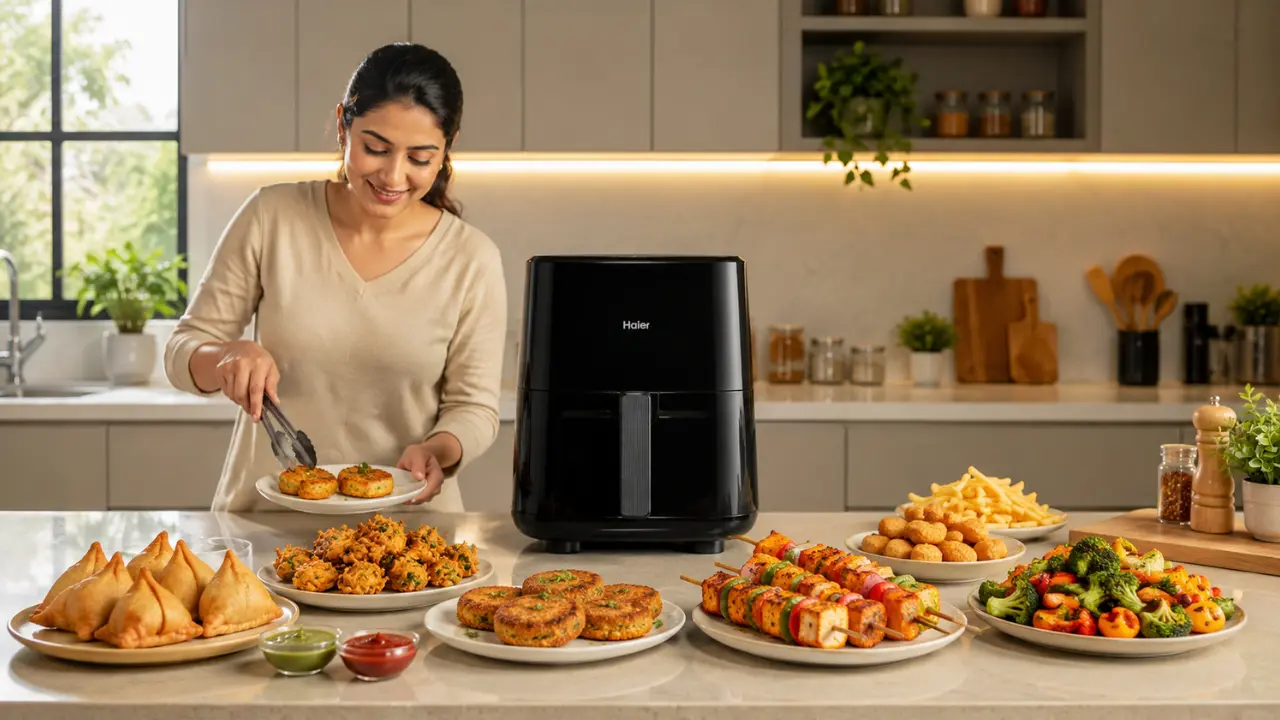

Air fryers are not replacing Indian cooking. They are redesigning the parts that quietly exhaust us.
Healthy cooking with air fryers works because it reduces excess oil without removing flavour, crunch, or familiarity. You still eat samosas, paneer tikka, aloo wedges, cutlets, and kebabs.
The difference is structural. Less grease. Less cleanup. Faster cooking. More control. In modern Indian homes, that changes how everyday eating feels.
There is a reason air fryers suddenly appear in so many kitchens.
Not because people stopped loving fried food.
Because people got tired of the cost of frying.
The lingering oil smell.
The heavy feeling after snacks.
The pan full of leftover oil nobody wants to deal with.
The weekday guilt after “just one more pakoda.”
Convenience changes habits faster than motivation ever does.
And that is the hidden story behind the rise of healthy cooking alternatives using air fryers.
The problem was never taste. It was friction.
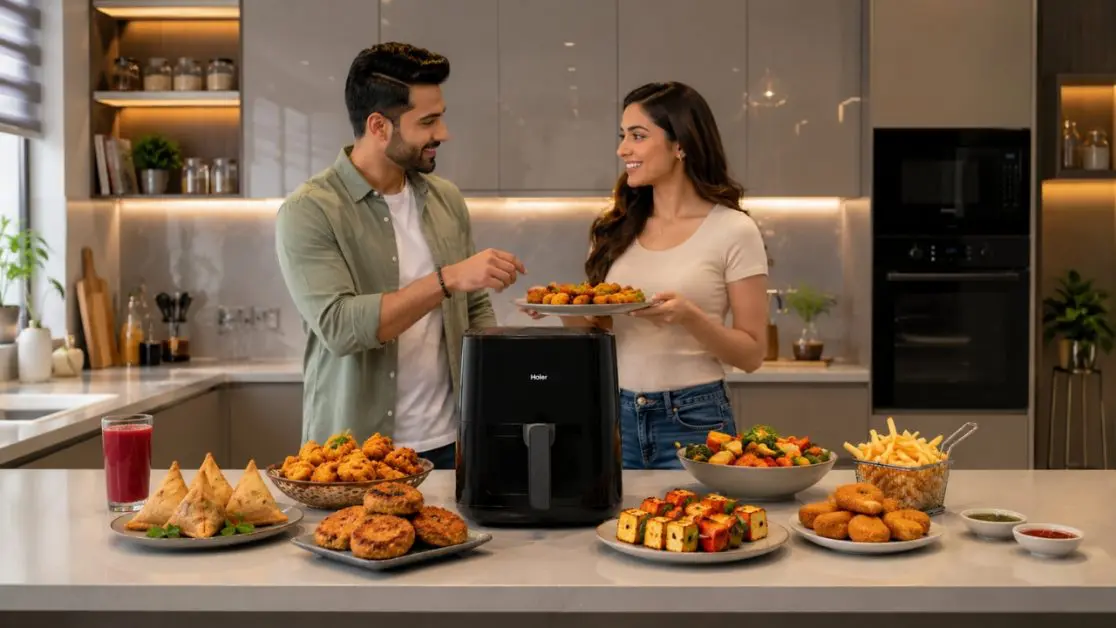
Indian kitchens are built around texture.
Crisp dosa edges.
Golden pakodas during rain.
Festival snacks that crackle when bitten.
Crunch matters emotionally.
Which is why most “healthy food” fails. It removes pleasure first.
Air fryers succeed because they preserve familiarity while changing the system underneath.
Instead of deep oil immersion, hot air circulates rapidly around food. That creates a crispy outer layer using far less oil.
But the real shift is behavioural.
When cooking becomes easier, people cook at home more often.
That single change affects everything else.
Healthy eating is often a time problem disguised as a food problem
A working professional reaches home at 8:30 PM.
There are two options.
One option is ordering food. Fast. Salty. Predictable.
The second option is cooking something simple but exhausting.
The third option is what modern appliances quietly create: low-effort cooking with high satisfaction.
That is where air fryers fit.
Frozen corn kebabs become dinner in minutes. Leftover rotis become crispy masala chips. Marinated paneer turns into smoky tikka without standing over hot oil.
Systems shape behaviour.
And kitchens are systems.
What can you actually cook in an air fryer? More than most people expect.
The assumption is simple: air fryers only make fries.
That assumption is outdated.
Modern air fryers now replace multiple small kitchen tasks at once.
Healthy Indian alternatives you can make in an air fryer
| Traditional Dish | Air Fryer Alternative | Why It Works |
| Deep-fried samosa | Crisp air-fried samosa | Less oil, easier cleanup |
| Aloo tikki | Air-fried tikki | Crispy outside, soft inside |
| Pakoda | Light onion or paneer pakoda | Less greasy texture |
| Chicken fry | Air-fried chicken | Faster cooking, lower oil |
| French fries | Minimal-oil fries | Crisp without excess oil |
| Spring rolls | Air-fried rolls | Even browning |
| Paneer tikka | Smoky roasted texture | Grill-like finish |
| Cookies and cakes | Small-batch baking | Faster than ovens |
The interesting part is not the variety.
It is repetition.
Healthy habits only survive when they feel sustainable on tired weekdays.
Oil reduction changes more than calories
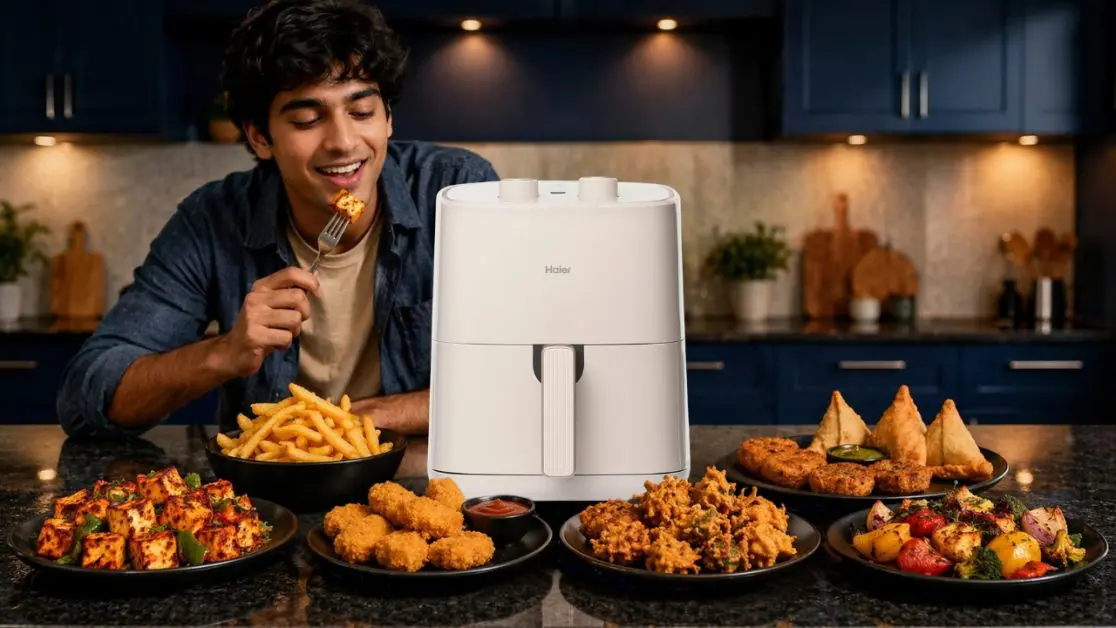
People focus only on fat reduction.
That is incomplete thinking.
Reducing oil changes the entire kitchen environment.
Less smoke.
Less greasy countertops.
Less lingering smell in curtains and sofas.
Less reheating old oil.
A cleaner cooking process changes how often families are willing to cook fresh food.
And freshness matters.
According to the World Health Organization, repeatedly reheating cooking oil may create harmful compounds over time. That habit is common in many households simply because oil feels expensive to waste.
Air fryers quietly reduce that cycle.
Not through discipline.
Through design.
The smartest kitchen appliances remove decisions
The best appliances do not show off technology.
They remove mental load.
Think about modern maps.
Earlier, people memorised routes. Now navigation apps quietly handle complexity in the background.
Air fryers work similarly.
Preset cooking modes, timed cooking, and controlled heat simplify routine decisions.
The Haier BLACK Air Fryer 5L Capacity (HAF-D503B), for example, includes digital touch control, 6 pre-set recipes, 1500W high-power cooking, and 3D hot air circulation for even cooking.
The Haier IVORY Air Fryer 5L Capacity (HAF-M503I) focuses on easy knob controls, 3D hot air circulation, and a large 5L basket for batch cooking.
That matters in Indian homes because cooking is rarely a one-person activity.
Someone is helping with chai.
Someone is checking homework.
Someone is answering work calls between dinner prep.
Ease becomes part of health.
Why air fryers work especially well in Indian households
Indian cooking creates unique kitchen pressures.
Frequent frying.
Multi-generational eating habits.
Festival cooking spikes.
Late-night snacking culture.
Compact urban kitchens.
Air fryers solve multiple small frictions simultaneously.
Here is where they fit naturally into Indian routines
- Evening snacks during monsoon season
- Kids wanting crispy after-school food
- Quick solo dinners for working professionals
- Oil-light festive cooking
- Reheating leftovers without making them soggy
- Weekend hosting without standing near a gas stove
Technology succeeds when it respects existing habits instead of forcing entirely new ones.
That is why air fryers feel practical rather than experimental now.
Healthy cooking is not about restriction anymore
Old health advice sounded punitive.
No fried food.
No snacks.
No indulgence.
That approach rarely survives real life.
Modern healthy cooking works differently.
It asks a better question:
How do we keep the joy while reducing the downside?
Air fryers are part of that shift.
You still eat crispy food.
You simply stop drowning it in oil.
That distinction changes adoption completely.
The economics are more practical than people realise
Many people still see air fryers as “extra appliances.”
But modern kitchens increasingly value multi-function systems.
One appliance replacing several repetitive cooking tasks saves:
- Cooking oil usage
- Gas stove dependency for some snacks
- Cleanup time
- Reheating effort
- Small oven usage for quick meals
And time savings compound quietly.
Ten saved minutes per evening becomes hours across a month.
Small efficiencies create large lifestyle shifts.
What should you actually look for in an air fryer?
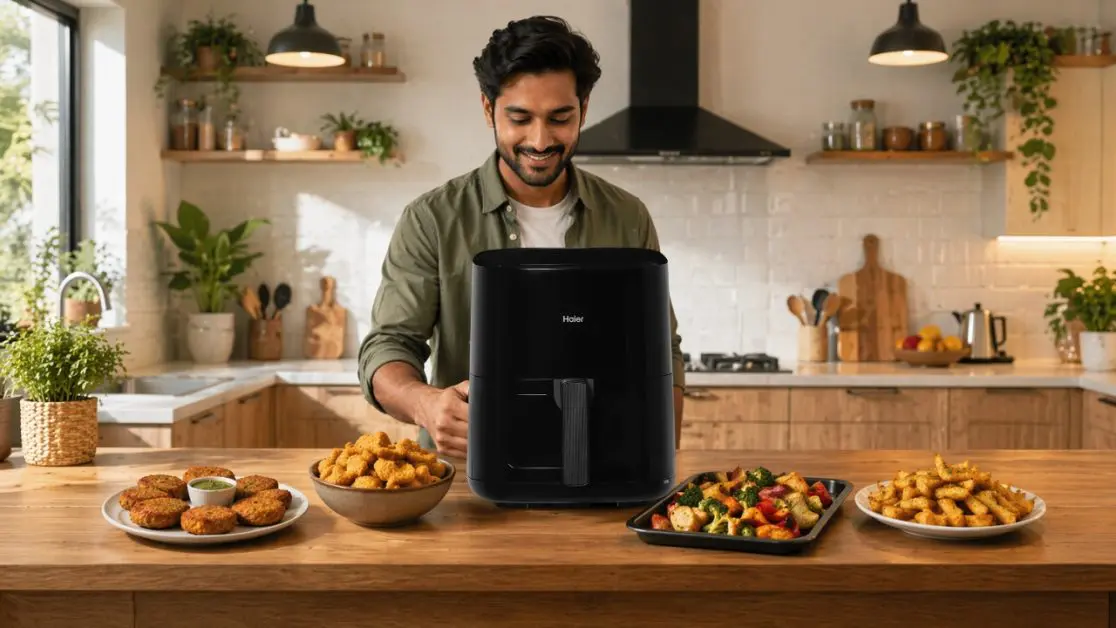
Not every air fryer fits every household.
The right choice depends on cooking style, family size, and routine.
A simple framework for choosing an air fryer
1. Capacity matters more than marketing
- 2L to 3L works for solo users
- 4L to 5L suits couples and small families
- Larger baskets reduce batch cooking during gatherings
The Haier air fryer range here uses a 5L basket, which fits Indian snack-heavy cooking patterns well.
2. Control style changes the experience
- Mechanical knobs feel simple and familiar
- Digital touch controls feel faster and more precise
Some people want tactile simplicity. Others prefer presets.
Neither is universally better.
Context decides.
3. Heating power affects speed
Higher wattage generally means faster cooking and crisping.
Both the Haier HAF-M503I and Haier HAF-D503B include 1500W high-power cooking systems.
4. Visibility reduces interruptions
Visible cooking windows reduce the urge to repeatedly open the basket.
That maintains temperature consistency.
The Haier BLACK Air Fryer HAF-D503B includes a visible cooking window.
The hidden benefit nobody talks about: confidence
Cooking confidence matters.
Many people avoid experimenting because failure feels expensive.
Burnt oil.
Ruined snacks.
Time wasted after work.
Air fryers lower that risk.
That changes behaviour.
Teenagers begin trying recipes.
Working professionals cook more often.
Parents simplify evening snacks.
A kitchen appliance is never just a machine.
It shapes participation.
Healthy kitchens are becoming systems, not spaces
The modern Indian kitchen is evolving.
Not dramatically. Quietly.
Refrigerators preserve better.
Air conditioners optimise energy.
Washing machines automate detergent use.
Air fryers reduce cooking friction.
Every appliance removes one layer of daily fatigue.
That accumulation matters more than flashy innovation.
Because real lifestyle upgrades rarely feel dramatic in the moment.
They feel lighter.
And that is the future air fryers point toward.
Not diet culture.
Not perfection.
Not extreme fitness.
Just healthier defaults built into everyday life.
The families that cook consistently are not always the most disciplined.
Often, they simply have systems that make good choices easier.
And that changes everything.
Frequently Asked Questions
Are air fryers actually healthier than deep frying?
Yes. Air fryers use rapid hot air circulation instead of fully immersing food in oil, which significantly reduces oil usage while still creating a crispy texture. This helps lower excess grease, smoke, and heavy post-meal feeling without removing familiar flavours.
What Indian foods can be cooked in an air fryer?
Air fryers work well for many Indian snacks and meals including samosas, aloo tikki, pakodas, paneer tikka, kebabs, spring rolls, fries, and even small-batch cookies or cakes. They are especially useful for quick evening snacks and reheating leftovers without making them soggy.
Do air fryers completely replace traditional cooking?
No. Air fryers are best seen as a support appliance rather than a full replacement for Indian cooking. They simplify repetitive frying tasks, reduce cleanup, and make weekday cooking faster while still preserving familiar textures and flavours.
What size air fryer is best for Indian families?
Capacity depends on household size and cooking habits. A 2L–3L model works well for solo users, while 4L–5L air fryers are generally better for couples and families because they handle larger snack batches more efficiently.
What features should I look for when buying an air fryer?
Key features include basket capacity, control type (digital or manual), heating power, and airflow technology. Features like preset cooking modes, visible cooking windows, and high-power heating systems can improve convenience and cooking consistency.