
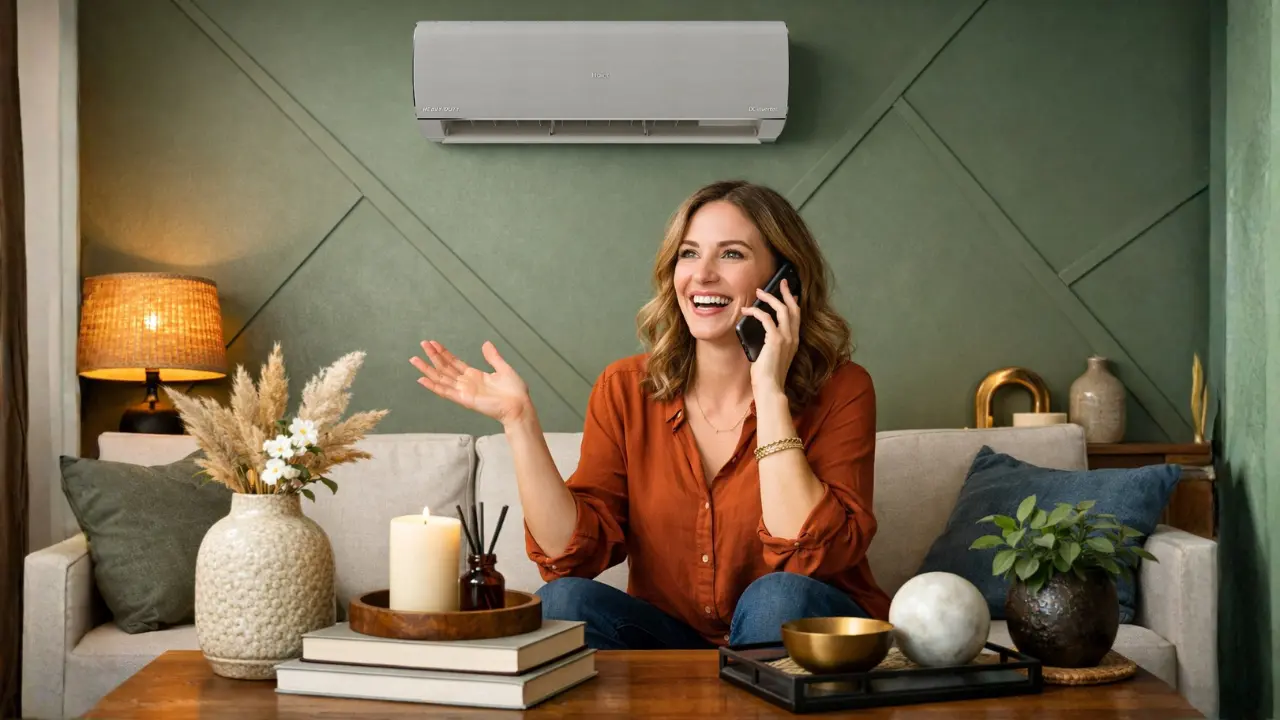

AI ECO goes beyond fixed energy-saving settings by learning your habits, sensing real conditions, and adjusting cooling in real time.
Standard energy-saving modes rely on preset limits that save power, but do not adapt. One thinks. The other follows instructions.
That difference quietly changes how comfort and electricity bills show up in Indian homes.
The familiar moment that starts the question
It is 11 pm.
The house finally settles.
Someone lowers the AC temperature.
Someone else reminds everyone to switch on Eco mode.
A few hours later, the room feels colder than needed.
This is not carelessness.
It is how standard energy-saving modes work.
They assume comfort is static.
Indian homes are not.
What standard energy-saving modes actually do
Standard energy-saving modes are rule-based.
They cap power usage.
They limit compressor speed.
They slow cooling once a set temperature is reached.
That simplicity is also their constraint.
How standard Eco modes usually behave
- Cooling follows a fixed pattern
- No awareness of room occupancy
- No adjustment for outside weather changes
- No learning from daily usage habits
They save electricity.
But only within narrow boundaries.
Think of it like driving a car only in second gear. Efficient, yes. Responsive, no.
Why Indian households feel the gap more
India does not have one climate.
It has many, often in the same week.
Everyday variables Eco modes ignore
- Afternoon heat vs midnight humidity
- Monsoon moisture vs dry summer nights
- One person sleeping vs a full family watching TV
- Short naps vs eight-hour sleep cycles
Standard energy-saving modes treat all of this the same.
AI ECO does not.
What AI ECO really changes
AI ECO is not a button.
It is a system.
Instead of asking you to choose efficiency, it adjusts efficiency around you.
According to Haier’s AI Atmox system, AI ECO continuously analyses room temperature gaps, usage duration, and environmental conditions to auto-adjust cooling levels without manual intervention .
That shift matters.
How AI ECO works in simple terms
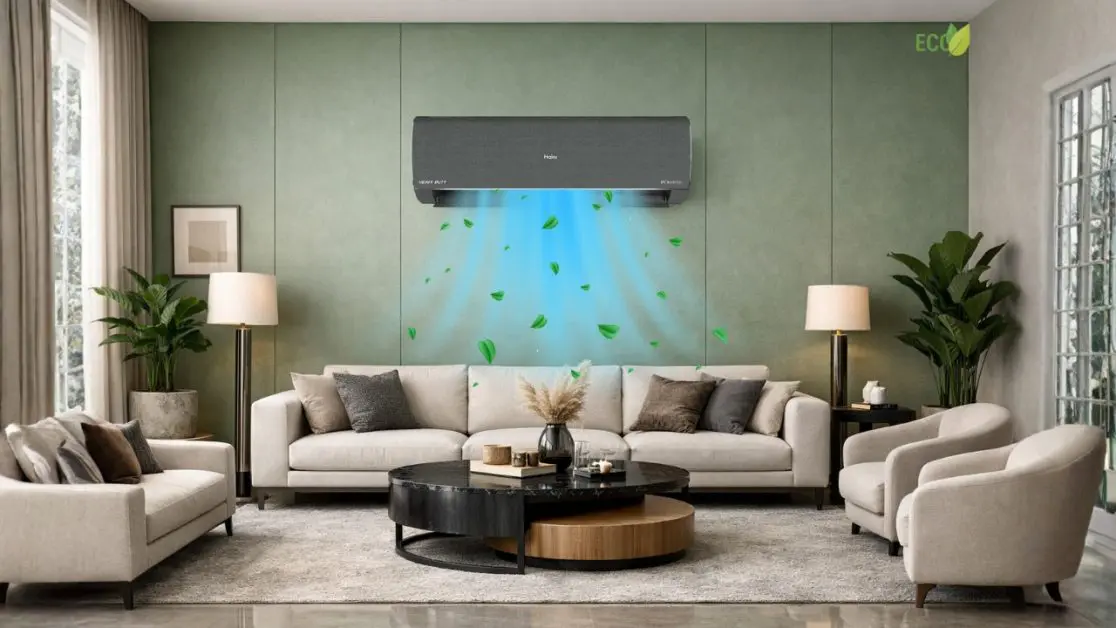
AI ECO operates on observation and response.
The system looks at
- Difference between room temperature and set temperature
- How long the AC has been running
- Whether the room is occupied
- Time of day and cooling requirement
Then it responds by
- Adjusting compressor levels dynamically
- Switching between multiple Eco intensity levels
- Preventing overcooling instead of reacting after it happens
This is not scheduling.
This is decision-making.
AI ECO vs standard Eco modes at a glance
| Aspect | Standard Energy-Saving Mode | AI ECO |
| Adjustment logic | Fixed preset | Real-time adaptive |
| Learns usage habits | No | Yes |
| Responds to room occupancy | No | Yes |
| Prevents overcooling | Limited | Actively |
| Manual intervention needed | Often | Rare |
Efficiency is no longer static.
It becomes situational.
The hidden cost most people miss
Electricity bills are not just about power units.
They are about wasted cycles.
Standard Eco modes still cool empty rooms.
They still push air when comfort is already achieved.
AI ECO reduces these invisible leaks.
Haier’s AI ECO, for example, shifts cooling intensity based on how close the room is to the desired temperature, automatically stepping down when the gap narrows .
That is where savings compound.
A real evening, played two ways
Scenario one: Standard Eco mode
- AC starts strong
- Room cools quickly
- Cooling continues at preset level
- Room gets colder than needed
- Someone wakes up to adjust settings
Energy saved. Comfort compromised.
Scenario two: AI ECO
- AC cools rapidly at first
- Senses temperature gap shrinking
- Reduces output automatically
- Maintains comfort without manual changes
Energy saved. Comfort preserved.
Same night. Different systems.
Why this matters for modern Indian homes
Homes today are busier.
Schedules are unpredictable.
People work late.
Children sleep early.
Parents wake up before sunrise.
AI ECO adapts to that variability.
Standard energy-saving modes resist it.
The difference is not technical.
It is emotional.
Comfort without reminders feels like progress.
AI ECO is not about maximum savings
This matters.
AI ECO does not chase the lowest possible power usage.
It chases balance.
Haier positions AI ECO as a comfort-first energy system, where savings emerge from smarter decisions rather than aggressive cutbacks .
That is why it feels different in daily use.
Where standard Eco modes still make sense
To be fair, standard energy-saving modes are not obsolete.
They work well when:
- Usage patterns are fixed
- Rooms are occupied consistently
- Users prefer manual control
They are predictable.
They are simple.
But they assume the user manages comfort actively.
AI ECO shifts responsibility
This is the deeper system change.
Earlier appliances waited for instructions.
AI-enabled appliances take responsibility.
AI ECO removes micro-decisions from daily life.
- No need to guess temperature
- No need to remember switching modes
- No need to wake up to adjust cooling
That reduction in thinking is the real upgrade.
A small insight that stays with you
Energy efficiency works best when it disappears.
If you are thinking about saving power, the system has already failed a little.
AI ECO succeeds because it fades into the background.
Choosing between AI ECO and standard modes
One option is predictability.
The other is adaptability.
One saves power by restriction.
The other saves power by understanding.
For households that value set routines, standard Eco modes still hold value.
For homes that change every day, AI ECO fits better.
The bigger implication
Energy efficiency is no longer a setting.
It is a behavior.
AI ECO reflects a broader shift in home technology.
From tools that wait.
To systems that think.
That is how appliances stop feeling like machines.
And start feeling like part of the home.
The takeaway worth remembering
The best energy-saving system is the one you never have to think about.
That is where AI ECO quietly changes the equation.
Frequently Asked Questions
I keep adjusting my AC at night. Why can’t Eco mode just get it right once?
Standard Eco modes don’t “understand” your night. They follow fixed rules, so as conditions change (humidity drops, body temperature falls), comfort drifts and you wake up to fix it.
Does AI ECO really reduce how often I need to think about temperature settings?
Yes. AI ECO actively manages cooling as conditions change, so you’re not stuck making micro-adjustments at midnight or early morning.
I want comfort without constantly checking the remote. Is AI ECO meant for that?
Exactly. AI ECO is designed to fade into the background and handle decisions you’d otherwise make repeatedly.
My room feels colder at 3 am than at 11 pm. Why does this happen in Eco mode?
Eco mode assumes comfort is static. Indian nights aren’t. Temperature, humidity, and airflow needs to change, but standard modes don’t react.
Does AI ECO adjust for humidity during monsoon nights?
Yes. AI ECO systems factor in environmental changes like humidity, reducing overcooling that often feels uncomfortable during monsoons.
We’re not always in the room. Does Eco mode still cool an empty space?
Standard Eco modes usually do. AI ECO can detect occupancy and reduce unnecessary cooling.