
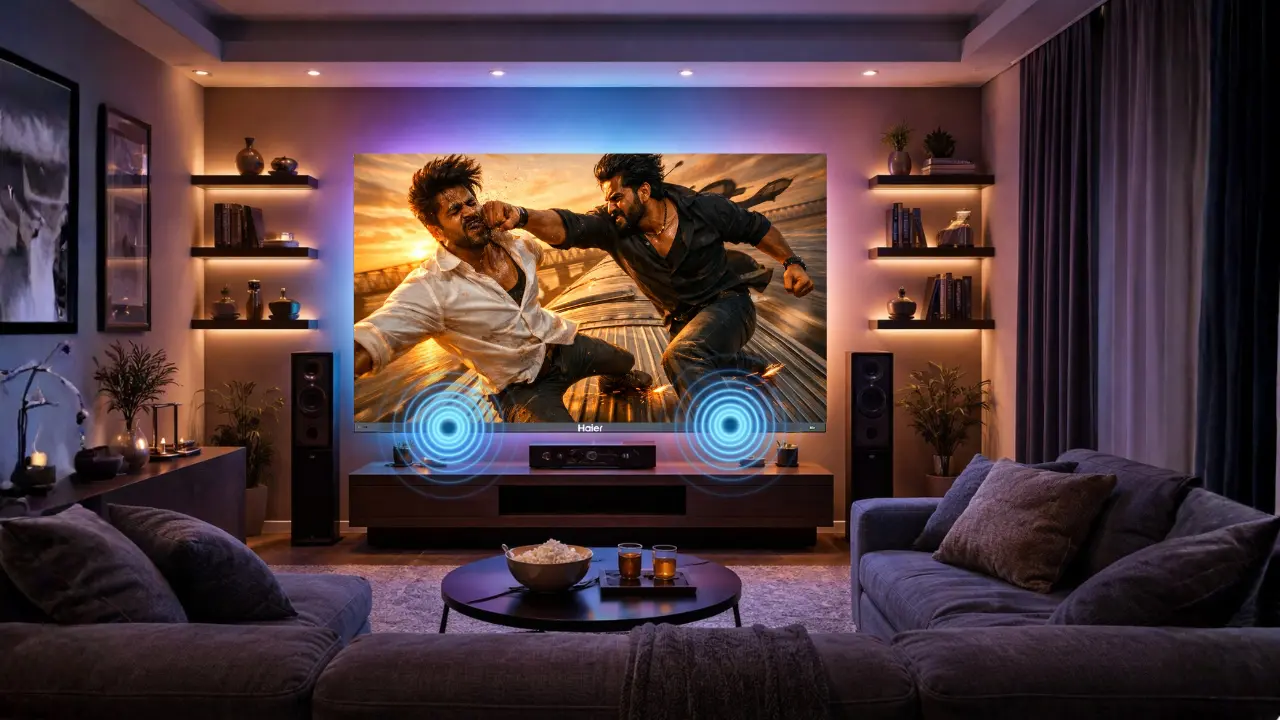

6.2.2 channel audio brings cinema home because it recreates how sound actually behaves in a real theatre.
Not just from the screen, but across the room, behind you, above you, and through controlled bass.
The experience feels immersive, balanced, and natural, without needing extra soundbars or external speakers.
Now let us slow down and talk about why this matters in real homes.
The ordinary evening when sound suddenly takes centre stage.
It starts like any other night.
Dinner is done. The lights are softer. Someone opens a streaming app. A movie begins.
The screen looks stunning. Big. Sharp. Clean.
But within minutes, something feels incomplete.
Dialogues feel thin. Action scenes feel loud but flat. Music plays, but it does not stay with you. You increase the volume. Then reduce it. Then increase it again.
Nothing settles.
This is when most people realise a quiet truth.
A great picture pulls you in. Great sound keeps you there.
Why TV sound has always lagged behind picture quality
Televisions have evolved fast.
Screens are larger. Designs are slimmer. Panels are smarter.
Sound, however, has been forced to shrink.
Thinner bodies left less space for speakers. Most TVs solved this with basic left and right audio.
That works for news. It works for casual watching.
It does not work for cinema.
Cinema sound is layered and spatial. Traditional TV sound is flat and directional.
6.2.2 channel audio exists to fix this gap.
Understanding 6.2.2 channel audio in simple terms
The numbers look technical. They are actually intuitive.
Breaking down the system
- 6 main channels spread sound horizontally across the room
- 2 subwoofers handle low frequency bass with depth and control
- 2 upward firing channels add vertical sound for height and realism
Together, they create a three dimensional sound field.
Not a louder sound.
Smarter sound.
Sound that moves the way your brain expects it to.
This structure aligns with modern Dolby Atmos audio standards used in premium cinemas and high end home theatres.
Why height changes how movies feel

Most people underestimate height.
But height is what makes sound feel real.
Rain no longer sounds like background noise. It feels like it is falling.
Helicopters do not sound close. They sound overhead.
Crowd noise does not blast forward. It surrounds you.
Height does not add noise. It adds realism.
Once you experience vertical audio, flat sound feels unfinished.
The role of dual subwoofers in everyday viewing
Bass is often misunderstood.
Good bass is not about shaking walls.
It is about balance.
Why two subwoofers matter
- Bass spreads evenly across the room
- Dialogues feel fuller and warmer
- Music sounds grounded, not boomy
- Action scenes stay powerful without distortion
In Indian homes, where living rooms serve many purposes, controlled bass matters more than raw output.
Dual subwoofers bring depth without disruption.
How 6.2.2 channel audio changes different content types
Movies feel layered, not aggressive
Explosions stay impactful. Dialogues remain clear. Background scores feel emotional, not overwhelming.
Sports feel immersive
Crowd noise wraps around the room. Commentary stays sharp. Stadiums feel open and alive.
OTT shows gain cinematic depth
Many modern shows are mixed with spatial audio in mind. A multi channel system lets you hear the creator’s intent, not just the sound.
The invisible system doing the real work
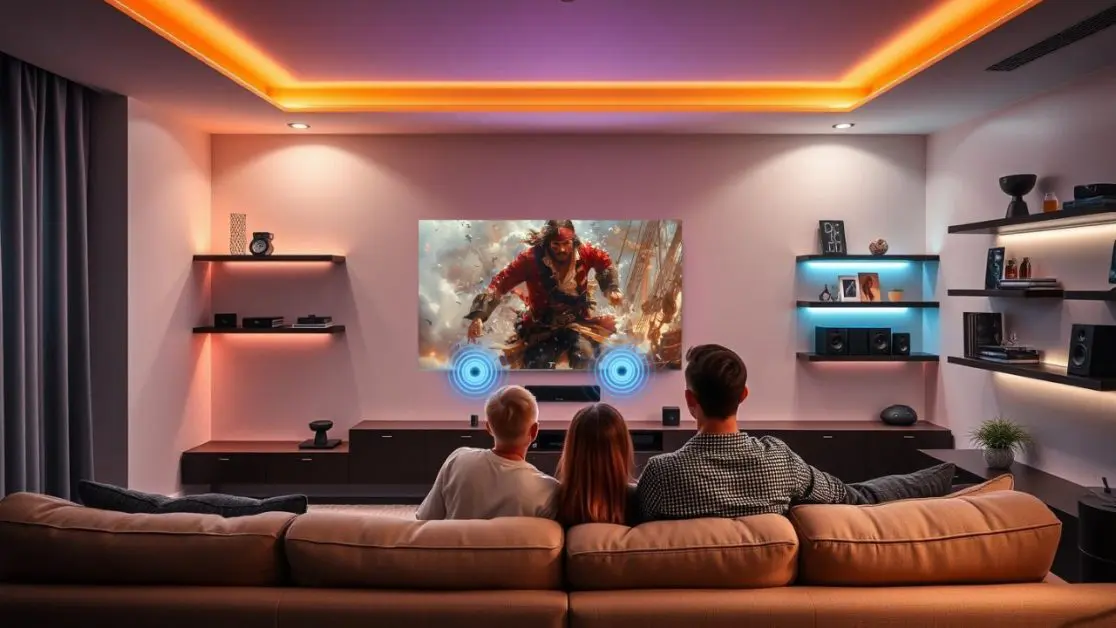
The best audio systems do not demand attention.
They disappear.
You stop noticing speakers.
You start noticing moments.
This is where integrated multi channel audio has a quiet advantage.
No extra cables. No placement anxiety. No syncing issues.
Everything works as one system.
Why integrated audio beats soundbars for most homes
Soundbars solve one problem. Space.
They introduce others.
- Cable clutter
- Placement limitations
- Sync delays
- Uneven sound coverage
Integrated audio systems are tuned directly to the screen and processor.
They understand the display. They understand the room.
The result feels cohesive and effortless.
Where Sound by KEF tuning makes a real difference
Hardware alone does not define sound quality.
Tuning does.
Sound by KEF is globally respected for speaker engineering that prioritises clarity, separation, and balance over exaggerated volume.
When Sound by KEF audio tuning is built directly into a television system, the sound feels natural, not processed.
Dialogues sound human. Instruments feel distinct. Bass stays controlled.
This approach is why premium televisions are increasingly designed as complete audio visual systems rather than screens that need add ons.
A real example from modern Indian living rooms
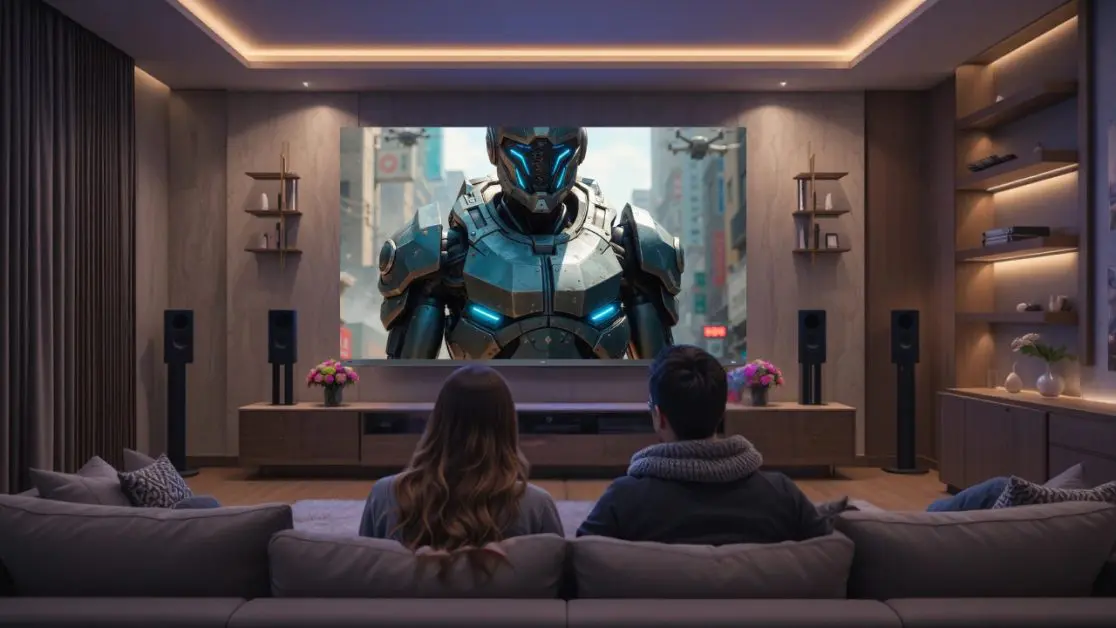
Think of a typical living room.
A sofa. A coffee table. A ceiling fan. A window slightly open.
Not a dedicated theatre.
Traditional TV audio struggles here.
Multi channel audio adapts.
Sound spreads naturally. Reflections feel intentional. Voices remain clear even at lower volumes.
This is exactly where televisions like the Haier M96 Series 254cm (100) QD Mini LED AI Smart Google TV (Model H100M96FUX) stand out, with an integrated 6.2.2 channel speaker system tuned by Sound by KEF and supported by Dolby Atmos, designed to deliver cinema grade sound without external equipment.
The cost benefit most buyers overlook
Many people compare prices.
Very few compare systems.
One option
Buy a TV. Add a soundbar later.
- Higher total spend
- More devices
- More complexity
Another option
Choose a TV with built in cinema grade audio.
- One integrated system
- Optimised performance
- Long term satisfaction
Over time, the second option usually delivers better value and less friction.
What this means for the future of home entertainment
Homes are becoming smarter, not larger.
People want fewer devices that do more.
Integrated audio fits perfectly into this shift.
The future of entertainment is not about adding equipment. It is about adding intelligence.
Sound that understands space, content, and context.
The quiet emotional upgrade that stays with you
The biggest change 6.2.2 channel audio brings is not technical.
It is emotional.
You stop adjusting volume.
You stop missing dialogues.
You stop thinking about sound.
You simply watch.
That is when cinema truly feels at home.
The one insight worth remembering
Sound makes them believable.
When audio moves around you, above you, and through you, home no longer feels like a compromise.
It feels complete.
And that is why 6.2.2 channel audio is not just a feature.
It is a shift in how everyday moments are experienced at home.
Frequently Asked Questions
I’m buying a new TV. Do I really need 6.2.2 channel audio, or is regular TV sound enough?
If you mostly watch news or casual YouTube videos, standard stereo may feel fine. But if you stream movies, OTT shows, or sports regularly, built-in stereo sound often feels flat and thin.
A 6.2.2 system spreads sound across the room, adds height, and balances bass properly. You don’t just hear the movie you feel placed inside it.
Should I buy a TV now and add a soundbar later, or choose a TV with built-in 6.2.2 audio?
Adding a soundbar later usually means:
More cost overall
More cables
Placement adjustments
Possible sync delays
An integrated 6.2.2 system is tuned with the TV processor and display. It works as one optimized system, not separate parts trying to cooperate.
Is 6.2.2 overkill for my living room?
Not necessarily. Unlike traditional home theatre setups, integrated 6.2.2 audio is designed to adapt to real homes sofas, fans, windows, reflections included. It’s not about loudness. It’s about spatial balance.
I keep adjusting volume during movies. Why does this happen?
Flat audio systems compress sound into two channels. Loud scenes overpower dialogue, forcing you to adjust volume repeatedly.
A multi-channel system distributes sound intelligently. Explosions stay powerful without drowning voices.
I don’t want my walls shaking. Does dual subwoofer bass mean excessive noise?
No. Dual subwoofers improve bass distribution, not loudness.
Benefits include:
Even low-frequency spread
Fuller dialogue
Controlled action scenes
Less distortion
In multipurpose living rooms, controlled bass matters more than raw power.
What’s the real advantage of two subwoofers instead of one?
With one subwoofer, bass can feel uneven depending on where you sit.
Two subwoofers balance the room acoustically, making sound feel consistent across seating positions.