
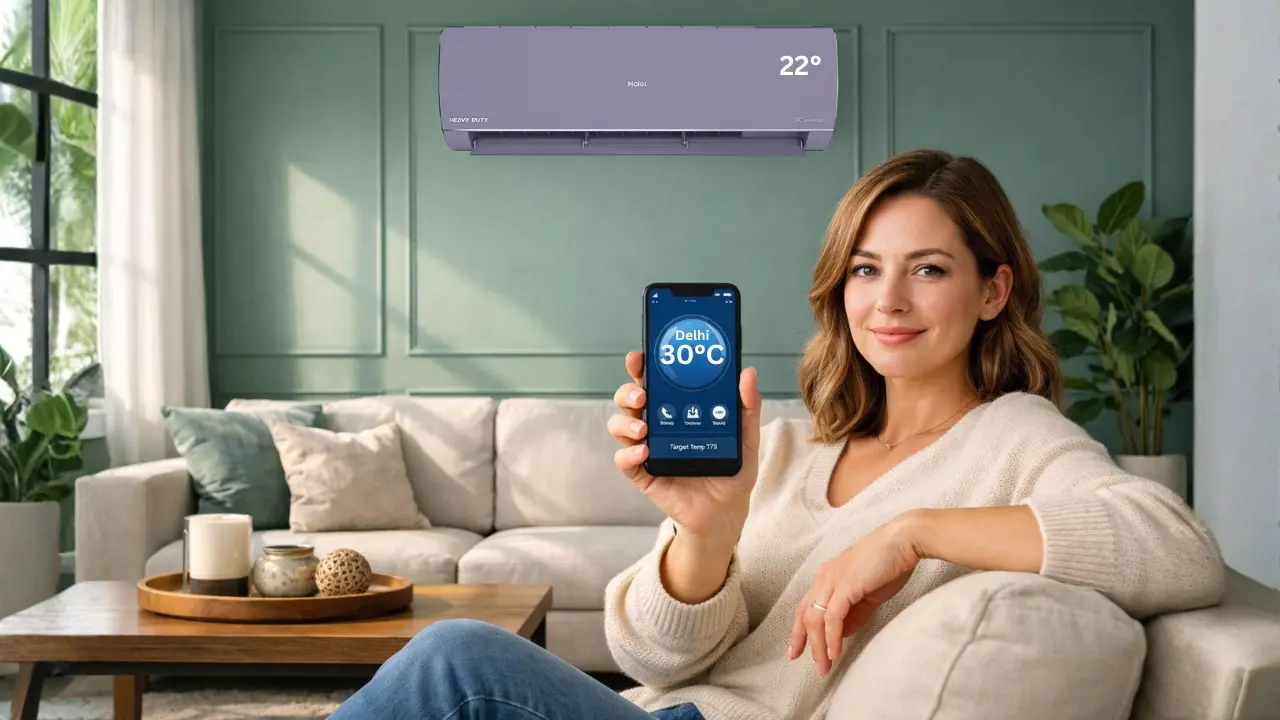

Built for Indian Weather & Pollution Conditions means appliances that survive heatwaves, humidity, dust, voltage swings, and urban pollution without losing performance or efficiency.
In India, climate is not a background detail. It is the main character.
From 45°C summer afternoons in Delhi to coastal humidity in Chennai, from monsoon dampness in Mumbai to winter smog in North India, appliances do not operate in ideal labs. They operate in real homes.
And real homes test everything.
If an appliance works only in perfect weather, it does not work in India.
Why is Indian weather a stress test for every appliance?
Step outside in May. The heat hits like an open oven. Step outside in July. The air feels heavy enough to hold. Add dust. Add traffic pollution. Add voltage fluctuations.
This is not a mild operating environment.
According to the India Meteorological Department, several Indian cities now routinely cross 44°C during peak summer. The Central Pollution Control Board regularly reports AQI levels above 200 in major metros during winter. That is not a minor inconvenience. That is a system challenge.
Now think about your home.
- Air conditioners running longer hours
- Refrigerators fighting higher ambient heat
- Washing machines dealing with hard water
- Televisions exposed to airborne dust
When external stress rises, internal systems must adapt.
Appliances built for Indian weather do not simply function. They anticipate strain.
Heat Is Not Just Temperature. It Is Pressure.
Heat changes behaviour.
When the outdoor temperature rises beyond 40°C, traditional air conditioners lose efficiency. Compressors work harder. Power consumption spikes. Cooling slows.
This is where design philosophy matters.
High Ambient Performance is not a marketing phrase. It is a survival mechanism. An AC that sustains cooling even at extreme outdoor temperatures protects both comfort and electricity bills.
Consider three options:
1. One option is a standard AC that performs well up to 35°C.
Cost: Lower upfront price.
Hidden Cost: Higher electricity consumption and slower cooling during peak summer.
2. The second option is an inverter AC with adaptive cooling.
Cost: Moderate investment.
Benefit: Better energy stability.
3. The third option is an AI-enabled climate system like those powered by AI Atmox.
Cost: Thoughtful investment.
Benefit: Real-time environmental analysis, predictive cooling, and optimized power use.
The difference is not temperature. It is intelligence.
As shown in Haier’s AI Atmox, the system combines environmental data and user behaviour to auto-adjust cooling for any season or condition . That means less manual effort and more consistent comfort.
In extreme climates, intelligence compounds.
Pollution Changes Performance Quietly
Dust does not knock on the door. It settles.
Outdoor condenser coils gather particles. Indoor filters trap airborne debris. Over time, cooling slows. Power bills rise. Noise increases.
The World Health Organization reports that several Indian cities rank among the most polluted globally. That pollution does not stay outdoors. It enters homes.
This is where self-cleaning systems become essential.
Haier’s AI IDU Frost Self Clean and AI ODU Cyclone Clean, as outlined in the AI Atmox material, reverse airflow and clean condenser surfaces automatically .
Why does that matter?
- Cleaner coils mean faster heat exchange
- Faster heat exchange means quicker cooling
- Quicker cooling means lower energy use
Dust is not cosmetic. It is operational.
Appliances that clean themselves extend their own life.
Humidity Is the Silent Load
Coastal cities know this well.
Humidity makes air feel heavier. It slows evaporation. It increases discomfort even at moderate temperatures.
When humidity rises above 70 percent, cooling must do more than reduce heat. It must manage moisture.
Traditional cooling systems often overcool to compensate. That leads to higher electricity bills and inconsistent comfort.
Smarter systems adapt airflow and compressor speed dynamically. According to the AI Climate Control section in the AI Atmox file, the system auto-adjusts without manual input, maintaining comfort while preventing overcooling .
The principle is simple.
Comfort is not about colder air. It is about balanced air.
Electricity in India Is Not Always Predictable
Voltage fluctuations are common in many regions. Peak load seasons increase stress on household circuits.
This affects appliance durability.
Appliances built for Indian weather account for power variability. Inverter technology stabilizes operation. AI Eco 2.0 modes adjust performance when the temperature gap narrows.
For example, the AI Eco 2.0 system shifts modes depending on the temperature difference, ensuring efficiency while maintaining performance .
Let us simplify the benefit.
- If the room is far from target temperature, cooling intensifies.
- As it approaches the comfort range, power reduces.
- Once stable, consumption drops further.
It is economically efficient and requires no manual switching.
Energy management is not a feature. It is discipline built into design.
Indian Homes Are Multi-Season Environments
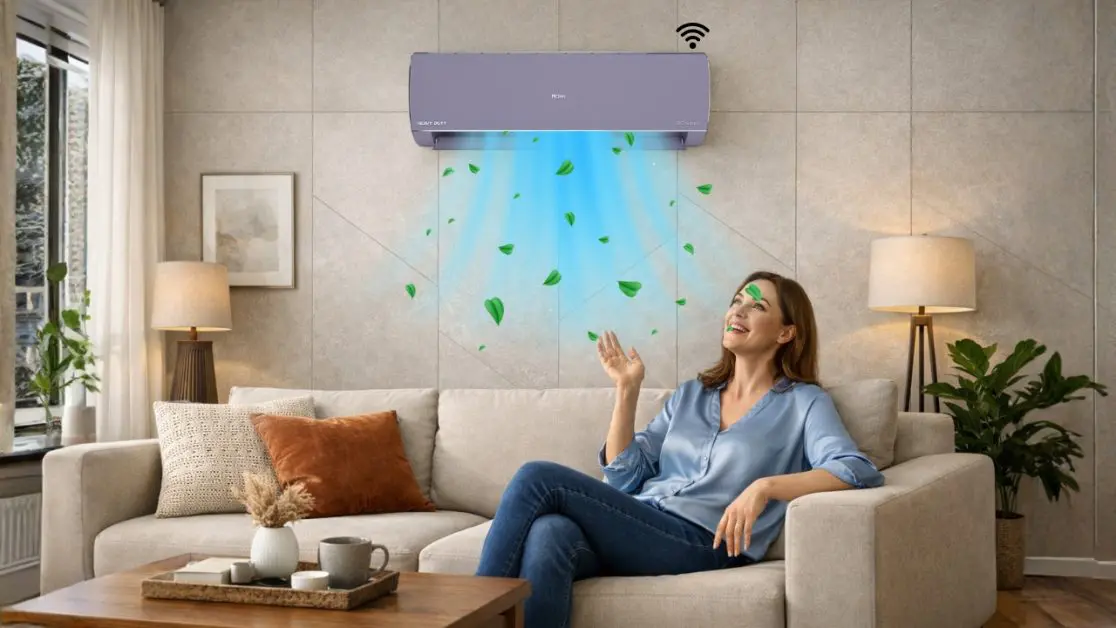
One house. Four climates.
Summer heat.
Monsoon dampness.
Post-monsoon humidity.
Winter dryness and pollution.
An appliance that survives one season but struggles in another creates friction.
The best systems understand seasonal transitions.
AI Pre-Cooling, for instance, anticipates arrival through geofencing and prepares the room in advance . That reduces peak load stress. Instead of blasting at maximum when someone enters, cooling begins gradually.
Small design shifts create large comfort gains.
Real Homes Need Real Intelligence
Picture this.
A working professional returns home in Gurgaon at 7 pm in June. Outdoor temperature: 41°C. AQI: 230. The house was empty all day.
Three possible outcomes:
- Manual control. AC switches on at maximum. Energy spike.
- Timer-based cooling. May start too early or too late.
- Predictive AI cooling. Begins when you are within 100 metres. Balanced performance.
According to the AI Atmox material, pre-cooling starts when the user enters a preset geofence .
That is not luxury. That is stress reduction.
Technology should remove decisions, not create them.
Weather Resilience Extends Beyond Air Conditioners
Refrigerators fight ambient heat daily. Higher kitchen temperatures force compressors to work harder.
Washing machines face hard water in many regions. Hard water causes scaling, reducing efficiency.
Televisions deal with dust and voltage shifts.
When Haier designs appliances for Indian weather and pollution conditions, the philosophy applies across categories. Durable materials. Stable performance. Adaptive systems.
Because a fridge that maintains cooling during heatwaves protects food and reduces waste. A washing machine built for local water conditions prevents maintenance surprises.
Resilience is a lifestyle feature.
The Hidden System Behind Comfort
There is a pattern here.
Indian weather creates variability. Variability creates stress. Stress exposes weak design.
Smart appliances close that loop.
They:
- Monitor environment
- Adapt performance
- Reduce waste
- Extend lifespan
Comfort becomes consistent. Bills become predictable. Maintenance reduces.
And the home feels calmer.
This is what systems thinking looks like inside a living room.
Costs and Benefits: A Clear Comparison
| Factor | Basic Appliance | Climate-Adapted Appliance |
| Extreme Heat Performance | Slows down | Sustains cooling |
| Dust Management | Manual cleaning | Self-clean cycles |
| Energy Monitoring | Limited | Real-time tracking |
| Seasonal Adaptation | Manual adjustment | AI-driven |
| Long-term Cost | Higher bills | Controlled consumption |
Short-term savings feel attractive.
Long-term stability feels better.
The real cost of ignoring Indian weather is paid monthly.
A Final Perspective
India does not offer predictable conditions. It offers intensity.
Intensity of heat.
Intensity of humidity.
Intensity of pollution.
Intensity of ambition.
Homes are not just shelters anymore. They are workplaces, classrooms, theatres, and recovery spaces.
Appliances built for Indian weather and pollution conditions protect that ecosystem.
Because when systems handle pressure quietly, people think better. Work better. Rest better.
The memorable insight?
Design for extremes, and everyday life feels easy.
And in a country like India, that principle defines the future of comfortable living.
Frequently Asked Questions
How do I know if an AC will actually cool my room at 45°C in Delhi?
Look for high ambient performance ratings (tested up to 50–60°C). Systems like those powered by Haier AI Atmox are designed to sustain cooling even during extreme heatwaves without spiking electricity consumption.
I see cheaper ACs that claim similar tonnage. Why shouldn’t I just buy the lowest price option?
Lower upfront cost often means reduced efficiency beyond 35°C. In peak Indian summer, compressors work harder, power use rises, and cooling slows. Over time, your electricity bill becomes the “hidden EMI.”
Should I choose a standard AC, inverter AC, or AI-powered AC for Indian weather?
Standard: Budget-friendly, less adaptive
Inverter: Better energy stability
AI-powered: Real-time environmental adaptation, predictive cooling, optimized energy use
If my home faces direct sunlight all day, does that change which AC I should buy?
Yes. Homes with high heat gain benefit from adaptive compressors and predictive cooling features that anticipate thermal load instead of reacting late.
Is investing in climate-adaptive appliances worth it long-term?
If your city routinely crosses 40°C or faces heavy pollution, the long-term savings in electricity, maintenance, and appliance lifespan often outweigh the upfront cost difference.
Why does my AC cooling feel weaker after a few months?
Dust accumulation on condenser coils reduces heat exchange efficiency. Cooling slows, noise increases, and bills rise.
I clean my AC filter regularly. Isn’t that enough?
Not always. Outdoor units collect pollution and dust too. Systems like Haier AI Atmox include AI IDU Frost Self Clean and AI ODU Cyclone Clean to reverse airflow and clean internal components automatically.