
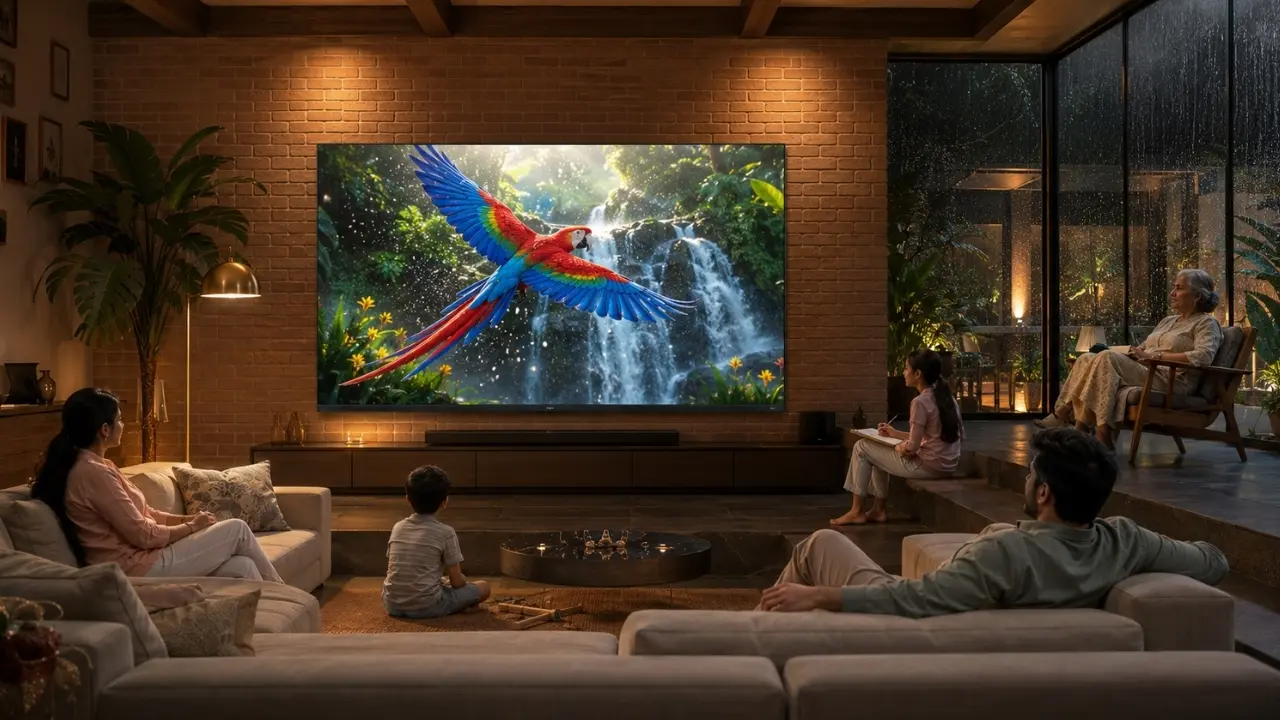

The television in an Indian home rarely belongs to one person.
At 7 am, somebody may be catching the news before work. By afternoon, children might be watching an educational programme. Evening brings cricket, music, serials and YouTube into the mix. Then comes the weekend, when the same screen suddenly has to become a cinema, gaming display and family entertainment centre.
That changes what “a good TV” actually means.
Picture quality matters, of course. But for a family television, convenience, sound, comfortable viewing, content discovery and versatility matter just as much. The most useful TV features are the ones that quietly remove small annoyances from everyday viewing.
And that is where newer smart TVs become considerably more interesting.
Start With the Feature Families Actually Notice: A Better Picture
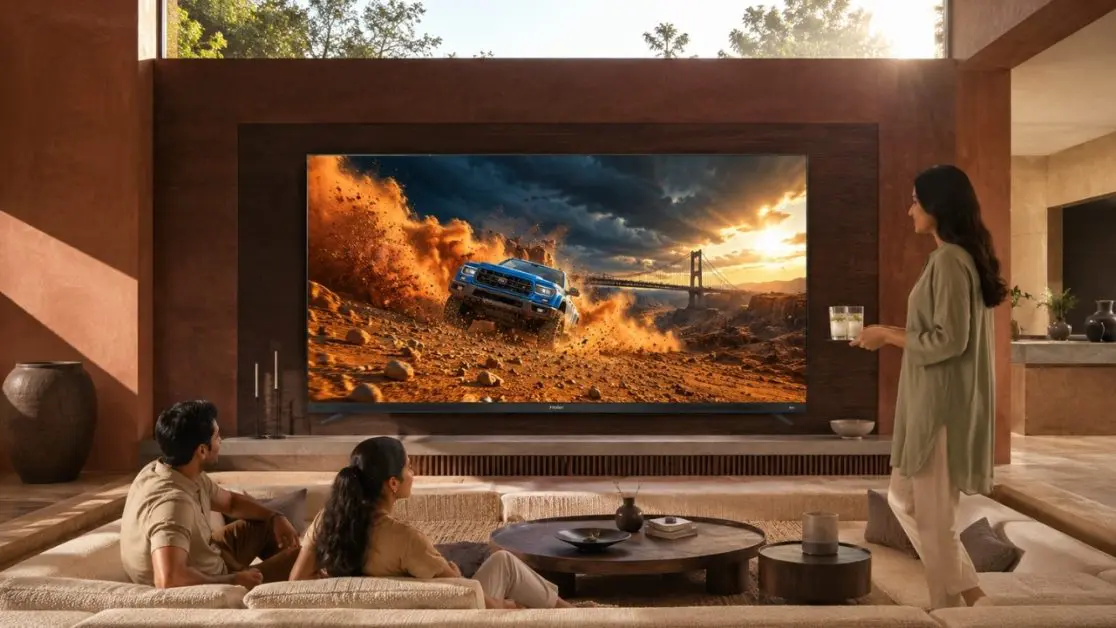
A visually impressive demo in a showroom is one thing. A television that looks good across cartoons, cricket, films, OTT shows and ordinary broadcast content is another.
For family viewing, the screen needs to handle variation well.
Technologies such as QD-Mini LED can provide more precise control over light and dark areas of the picture. Combine that with HDR support and intelligent image processing, and the television can better manage everything from bright outdoor sports footage to dimly lit movie scenes.
The Haier New M92 Series 189 cm (75) QD-Mini LED Smart AI Google TV (H75M92FUX), for instance, combines QD-Mini LED technology with an AI Ultra Sense Processor. Its AI picture technologies include scene recognition and intelligent tuning for motion, colour, contrast and depth.
Why does that matter at home?
Because nobody wants to adjust picture settings whenever Dad switches from cricket to a film or the children move from animation to gaming.
Ambient-aware viewing deserves more attention
Living rooms do not have fixed lighting.
A room flooded with afternoon sunlight behaves very differently from the same space at 10 pm. Features such as Dolby Vision IQ and AI Ambient Sense are therefore particularly relevant for everyday use.
On Haier’s M92 Series, AI Ambient Sense can adjust brightness and colour temperature according to the viewing environment, while Dolby Vision IQ adapts the picture according to room lighting.
There is also Flicker Free technology and TÜV Rheinland-certified Low Blue Light functionality listed for the model, features designed with viewing comfort in mind.
That combination makes more practical sense for a shared family television than simply chasing impressive specifications on paper.
A Family TV Should Sound Good Without Constant Volume Adjustments
There is a familiar living-room problem.
Dialogue is too quiet, so someone increases the volume. Thirty seconds later, music or an action sequence arrives and suddenly everyone is asking for it to be turned down.
Audio capability matters more than many TV buyers initially realise.
The M92 Series uses Sound by KEF, together with a 2.1-channel speaker system with subwoofer, Dolby Atmos and Total Sonics. The idea is to provide stronger bass, clearer audio and a fuller sound field from the television itself.
For a family, improved television audio can enhance:
- film nights where dialogue clarity is important;
- live sports, where crowd atmosphere adds to the experience;
- music and concert content;
- cartoons and entertainment programmes;
- everyday streaming without immediately depending on separate audio equipment.
For families looking for an even larger entertainment format, the Haier New M96 Series 254 cm (100) QD-Mini LED AI Smart Google TV (H100M96FUX) takes the audio experience further with Sound by KEF and a 6.2.2-channel speaker configuration on the 254 cm (100) model.
The Remote Shouldn’t Run the Living Room
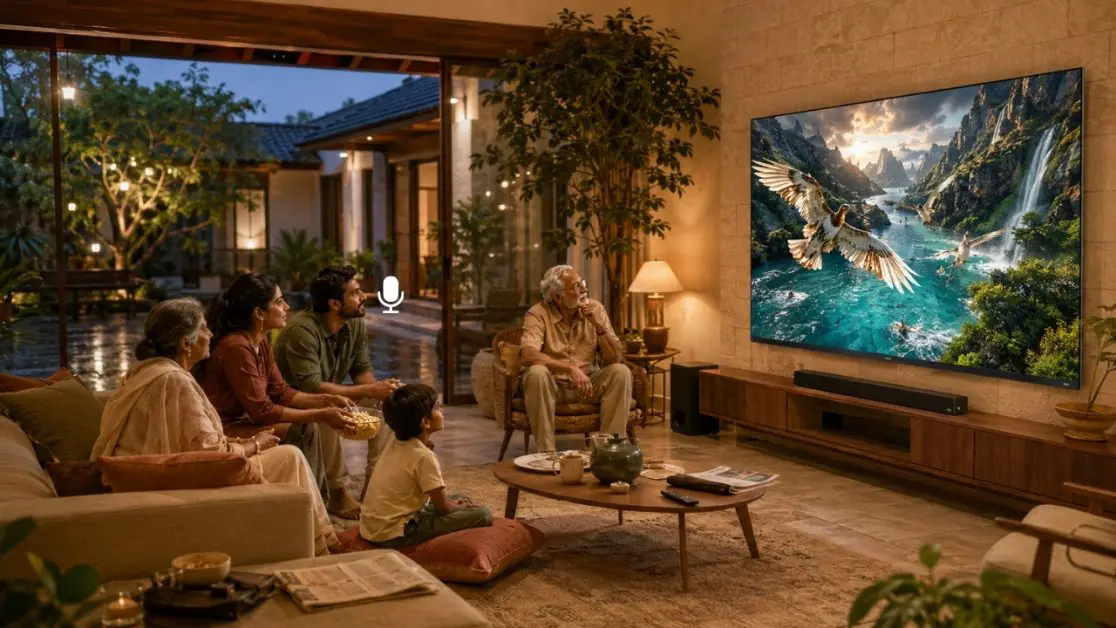
Where’s the remote?
Under a cushion. On the dining table. Somehow in another bedroom.
A small inconvenience, yes. Also one that happens far too often.
Hands-free voice control changes that interaction. On Haier’s M92 and M96 Series televisions, smart AI-enabled voice commands can be used for operating the TV and accessing content without depending entirely on the remote.
That means a family member can search for entertainment more naturally instead of navigating several menus.
The M92 also includes a Solar Remote, adding another convenience-oriented element to everyday operation.
These are the kinds of smart features that become useful precisely because they fade into the background. You stop thinking about how to operate the television and get to what you wanted to watch.
Google TV Helps Solve the “What Do We Watch?” Problem
The irony of modern entertainment is obvious: families have access to enormous amounts of content and can still spend 15 minutes deciding what to play.
A useful smart TV interface should reduce that friction.
Google TV brings content and personalised recommendations together, helping viewers discover entertainment based on their preferences. The M96 Series also supports Google Assistant, Google Chromecast Built-In and Google Play Store.
In a family environment, that creates a more flexible entertainment hub.
One evening could be a streaming series. Another could involve casting something from a mobile device. A Sunday afternoon may revolve around sports.
The screen remains the same; what the family asks from it keeps changing.
Then the Gamers Take Over
Gaming used to be a fairly separate consideration when buying a television. Not anymore.
In households with teenagers, young adults or gaming parents, responsiveness and motion handling can influence whether the main television works equally well for entertainment and console gaming.
The Haier M92 Series has a 144Hz refresh rate, HDMI 2.1 eARC, VRR, ALLM and AMD FreeSync Premium Pro. Its gaming functionality also includes Game Mode, with gaming refresh rates of up to 240Hz specified when Game Mode is enabled.
In practical terms, these technologies are aimed at smoother motion, lower latency and reduced screen tearing during compatible gaming scenarios.
So the family does not necessarily need one display for films and another for gaming. A capable premium TV can comfortably move between both roles.
What Should Families Actually Prioritise?
Ignore the temptation to judge a TV through one headline specification.
Instead, think about what happens in your living room during an ordinary week.
For mixed family entertainment
Prioritise:
- strong picture processing across different content;
- good built-in audio;
- an intuitive smart TV platform;
- voice-based controls;
- comfortable viewing technologies.
For sports-heavy households
Look closely at refresh rate and motion processing. Fast movement exposes weaknesses that slower cinematic content may not.
For gaming families
Features such as HDMI 2.1, VRR, ALLM and compatible adaptive-sync technology deserve attention alongside picture quality.
For a large living or entertainment room
Screen scale becomes part of the experience. Haier’s M92 offers a 189 cm (75) display, while the M96 extends the proposition to a substantial 254 cm (100) QD-Mini LED screen.
The right choice ultimately depends on room dimensions, seating distance and how the television will actually be used.
One Screen, Many Different Expectations
A family television has a surprisingly demanding job.
It has to be simple enough for casual viewing, sophisticated enough for premium entertainment and responsive enough when someone connects a gaming console. It should perform during a bright afternoon and remain comfortable when the lights go down.
Haier’s latest QD-Mini LED televisions approach that challenge by combining display technology with AI-led optimisation, immersive sound and smart functionality rather than treating each feature as an isolated specification.
The Haier New M92 Series 189 cm (75) QD-Mini LED Smart AI Google TV (H75M92FUX) is particularly suited to families looking for a large premium screen that balances movies, sports, streaming and gaming. For homes with the space and appetite for something significantly larger, the Haier New M96 Series 254 cm (100) QD-Mini LED AI Smart Google TV (H100M96FUX) pushes the home-entertainment experience into a much bigger format.
Because the best family TV isn’t necessarily the one with the longest feature sheet.
It’s the one whose features keep proving useful after everyone has stopped talking about them.
Frequently Asked Questions
1. Which TV features are most useful for everyday family viewing?
For family use, prioritise picture quality, clear sound, smart content discovery, voice control and comfortable viewing features. A higher refresh rate can also be valuable when the household regularly watches sports or plays games.
2. How does Google TV make family entertainment easier?
Google TV brings content and personalised recommendations together in one interface, making it easier to discover shows, films and other entertainment. Haier’s M92 and M96 Series televisions come with Google TV for a more streamlined smart viewing experience.
3. Why is a high refresh rate useful on a family TV?
A higher refresh rate can make fast-moving visuals appear smoother with reduced motion blur. The Haier M92 and M96 Series feature a 144Hz refresh rate, which is particularly useful for sports, action content and gaming.
4. What makes the Haier M92 suitable for family entertainment?
The Haier New M92 Series 189 cm (75) QD-Mini LED Smart AI Google TV (H75M92FUX) combines QD-Mini LED, AI Ultra Sense Processor, Google TV, Sound by KEF, Dolby Atmos, a 2.1-channel speaker system and smart gaming features. This gives one television the versatility to handle different entertainment preferences within a household.
5. Can Haier’s M92 and M96 TVs be used for gaming?
Yes. Both models include gaming-oriented technologies such as VRR, ALLM and AMD FreeSync Premium Pro. They also support gaming refresh rates of up to 240Hz when Game Mode is enabled, according to the product information.
6. Which Haier TV is suitable for families wanting a very large screen?
For a substantially larger home-entertainment setup, the Haier New M96 Series 254 cm (100) QD-Mini LED AI Smart Google TV (H100M96FUX) offers a 100-inch QD-Mini LED display along with AI picture processing, Google TV and an immersive 6.2.2-channel speaker configuration on the 100-inch model.