
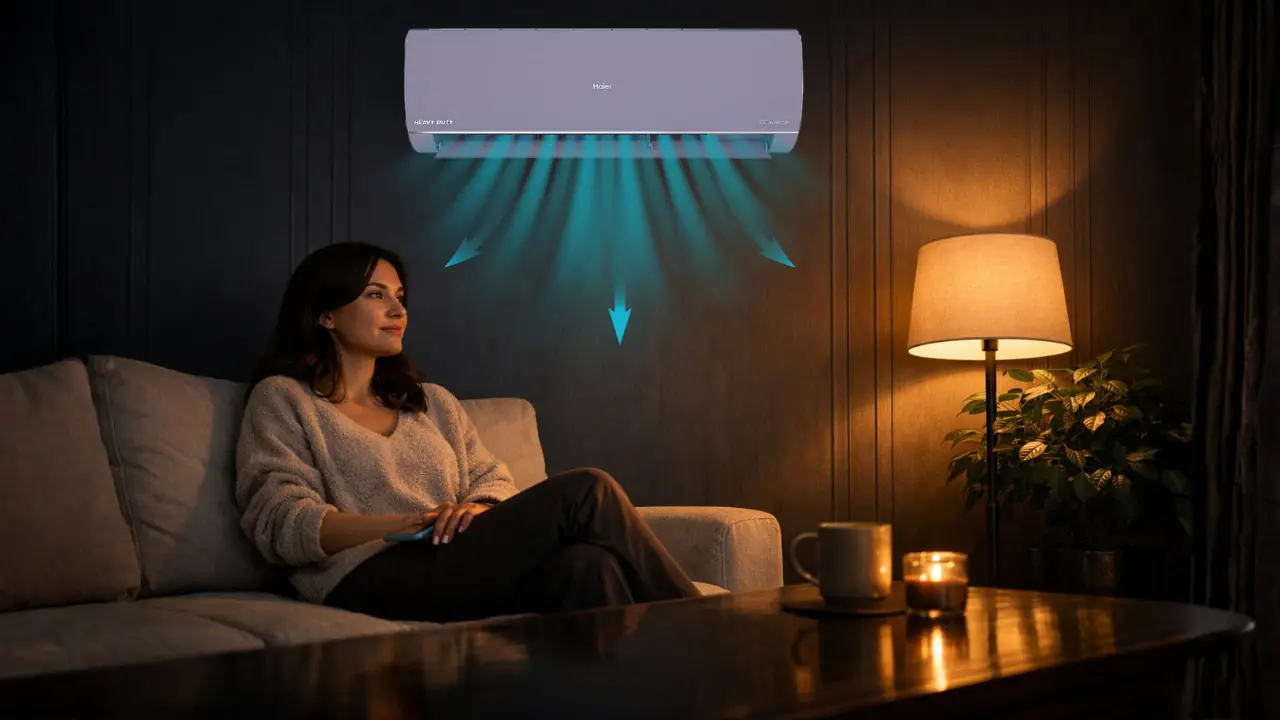

Some rooms feel right because the environment adjusts before you even think about it.
They stay cool without feeling cold. Bright without hurting your eyes. Quiet without feeling dull.
The air moves. The light balances. The temperature holds steady.
The remote stays untouched because the room is already doing the work.
That is not luck.
That is design.
And in modern Indian homes, that quiet intelligence is becoming the new luxury.
Comfort is not a setting. It is a system.
Walk into two different living rooms in July.
In one, the AC hums loudly. The temperature reads 22°C. Yet it feels uneven. One corner is cold. Another is stuffy. Someone reaches for the remote every 15 minutes.
On the other hand, the temperature feels stable. The air reaches you directly. No one argues about settings.
Same city. Same weather. Different systems.
According to the India Meteorological Department, average summer temperatures in Indian metros regularly cross 40°C. Add humidity levels above 70 percent in cities like Mumbai and Chennai. Comfort becomes a moving target.
A fixed setting cannot solve a dynamic problem.
That is why some rooms always feel right. They respond. They learn. They adjust.
Comfort today is not about degrees.
It is about awareness.
Why We Keep Touching the Remote
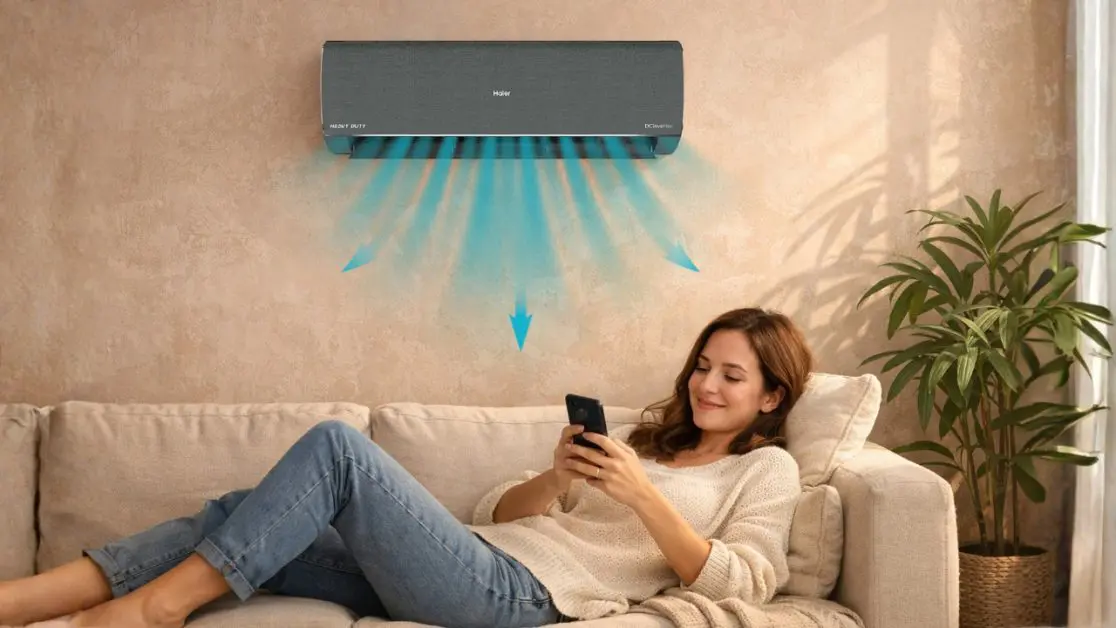
Let us be honest.
Most of us adjust the AC or TV not because we enjoy it, but because something feels off.
- Too bright in the afternoon
- Too cold at night
- Too warm after cooking
- Too humid during monsoon
The Bureau of Energy Efficiency notes that air conditioning alone accounts for nearly 40 percent of peak residential electricity demand in urban India.
Yet many homes still operate on manual control.
Manual systems assume three things:
- The weather stays stable.
- The room occupancy stays constant.
- Your routine never changes.
None of these are true in Indian homes.
We open balcony doors. Guests arrive. Children run in and out. Power supply fluctuates.
A static appliance struggles in a dynamic environment.
So we compensate.
With the remote.
The Hidden Pattern Behind Effortless Rooms
There is a pattern here.
Rooms feel right when three invisible layers work together:
1. Predictive Cooling
Instead of reacting after discomfort begins, the system anticipates it.
For example, AI Pre Cooling technology predicts arrival patterns and begins cooling before you enter the space. According to Haier’s Haier AI Atmox, the system uses geofencing within 100 metres to anticipate occupancy and initiate pre-cooling automatically.
The benefit is simple:
- No waiting
- No sudden temperature shock
- No manual timers
Comfort begins before you notice discomfort.
That shift changes behaviour. You stop planning around the appliance. The appliance plans around you.
2. Targeted Airflow Instead of Blanket Cooling
Traditional AC systems cool the entire room uniformly. It sounds fair. It wastes energy.
AI Target Cooling focuses air precisely where it is needed. According to Haier’s AI Atmox Neuro system, installation position data and cloud intelligence help deliver cooling directly to the desired area.
Here is the cost benefit difference:
| Cooling Style | Energy Use | Comfort Speed | Remote Dependency |
| Full room cooling | High | Slower | Frequent |
| Target cooling | Lower | Faster | Minimal |
When cool air reaches you directly, the room feels right faster.
Efficiency is not about less power.
It is about precise power.
3. Energy Awareness Without Guilt
One reason rooms feel uncomfortable is psychological.
We worry about the electricity bill.
India’s residential electricity tariffs vary by state, but in many metros, costs range between ₹6 to ₹10 per unit. Air conditioning can increase monthly bills by 20 to 30 percent during peak summer.
Modern systems like Atmox Power Manager display power usage in graphical and currency formats.
When you can see:
- Running duration
- Eco vs Normal mode usage
- Real time cost tracking
- Custom energy targets
You stop guessing.
Transparency reduces anxiety.
And reduced anxiety feels like comfort.
Why Some Bedrooms Feel Better at Night

Night comfort follows different rules.
Your body temperature naturally drops before sleep. The Sleep Foundation states that adults need 7 to 9 hours of quality sleep for proper recovery. Temperature stability directly affects this cycle.
AI Eco 2.0 modes adjust performance based on the gap between room and set temperature. If the difference exceeds 3°C, it switches levels automatically. If the room empties for 15 minutes, it shifts to deeper energy saving modes.
This does two things:
- Prevents overcooling
- Maintains steady comfort
You wake up less.
The remote remains untouched.
The best systems disappear at night.
What About Air Quality and Cleanliness?
Comfort is not only temperature.
It is fresh.
Urban India faces rising particulate levels. According to CPCB data, AQI levels in major cities often exceed safe limits during winter months.
Dust accumulation reduces AC efficiency and airflow quality. Haier’s AI IDU Frost Self Clean and ODU Cyclone Clean automatically clean indoor and outdoor units after defined operational hours.
Here is what that changes:
- Cleaner coils
- Better heat exchange
- Faster cooling
- Lower power bills
Maintenance shifts from reactive to proactive.
A room that feels right often starts with clean air.
The Three Choices Every Home Makes
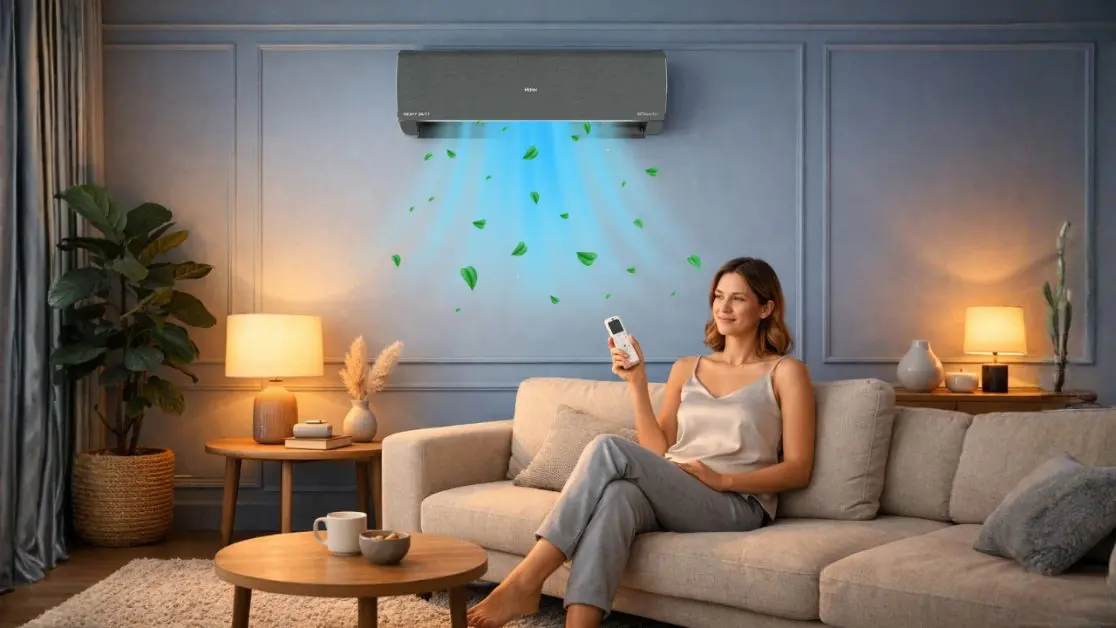
When setting up a modern room, there are only three real options.
Option One: Manual Control
You adjust settings constantly.
Cost:
- Time
- Attention
- Energy inefficiency
Benefit:
- Full personal control
This works for small spaces. It breaks in busy homes.
Option Two: Timers and Presets
You program cooling in advance.
Cost:
- Limited flexibility
- Poor adaptation to sudden change
Benefit:
- Some automation
This works if your life follows a strict schedule. Most lives do not.
Option Three: Adaptive Intelligence
The system learns patterns.
Cost:
- Slightly higher upfront investment
Benefit:
- Lower long term electricity usage
- Less manual adjustment
- Better comfort stability
According to multiple energy efficiency studies, smart climate control systems can reduce cooling energy consumption by up to 15 percent annually when compared to fixed thermostat systems.
Over five years, that difference compounds.
Comfort compounds too.
Why Living Rooms Feel Different During Cricket Nights
Consider a typical IPL evening.
Five people in one room. Snacks. Lights on. TV brightness is high. The door opens frequently.
The heat load increases.
Traditional ACs struggle because they cool based on a fixed assumption. AI Human Detection systems identify occupancy and adapt cooling intensity automatically.
That means:
- Cooling increases when more people enter
- Power reduces when the room empties
- No manual override required
The room keeps pace with emotion.
Comfort during celebration feels effortless because the system is reading the room, not the dial.
The Broader Pattern: Systems That Respect Your Attention
This is not only about air conditioners.
It is about attention.
Modern households juggle:
- Hybrid work calls
- School schedules
- Festive hosting
- Digital content consumption
- Rising energy costs
Every unnecessary decision drains energy.
Rooms that feel right remove micro decisions.
They reduce friction.
And friction is the silent cost most families never measure.
Designing Rooms That Feel Right
If you are setting up a new home or upgrading an existing one, consider three design principles.
1. Reduce Manual Touchpoints
Choose appliances that adapt automatically.
2. Make Energy Visible
Awareness drives responsible comfort.
3. Prioritise Predictive Systems
Anticipation feels better than reaction.
These principles apply whether you live in a studio apartment in Bengaluru or a family home in Jaipur.
Comfort scales.
The Memorable Insight
Rooms feel right when they respond to people, not presets.
The remote is not the problem.
Dependence is.
When systems learn, adjust, clean, and optimize quietly in the background, homes feel calmer.
And calm, in modern Indian life, is a rare asset.
Why This Matters Beyond Appliances
Every organisation, every family, every space faces the same question.
Do we design for control or for adaptability?
Control demands constant attention.
Adaptability frees it.
The rooms that feel right without touching the remote are not accidental. They are intentional systems built around human behaviour.
That is the future of smart living.
Not louder machines.
Not complicated dashboards.
Just environments that understand when to act and when to stay silent.
And once you live in a room like that, you rarely reach for the remote again.
Frequently Asked Questions
Why do I keep reaching for my AC remote every 15 minutes even after setting the temperature?
Because fixed thermostat settings don’t respond to real-time changes like humidity shifts, cooking heat, guest movement, or open balcony doors. Static systems assume stable conditions. Indian homes are anything but stable.
Is it normal that my room feels cold in one corner and stuffy in another?
Yes that usually means airflow distribution is uneven. Traditional ACs cool the room “on average,” not where you actually sit.
Why does my living room feel uncomfortable even at 22°C?
Comfort is not just about temperature. Humidity, airflow direction, insulation, and occupancy all affect how 22°C actually feels.
How can I reduce the mental load of constantly managing cooling at home?
By shifting from manual control to adaptive systems that anticipate changes, like occupancy-based cooling or predictive pre-cooling.
I’m tired of arguing about AC settings with my family. Is there a smarter solution?
Yes. Systems that adjust airflow toward occupied zones reduce the need for constant setting debates.