
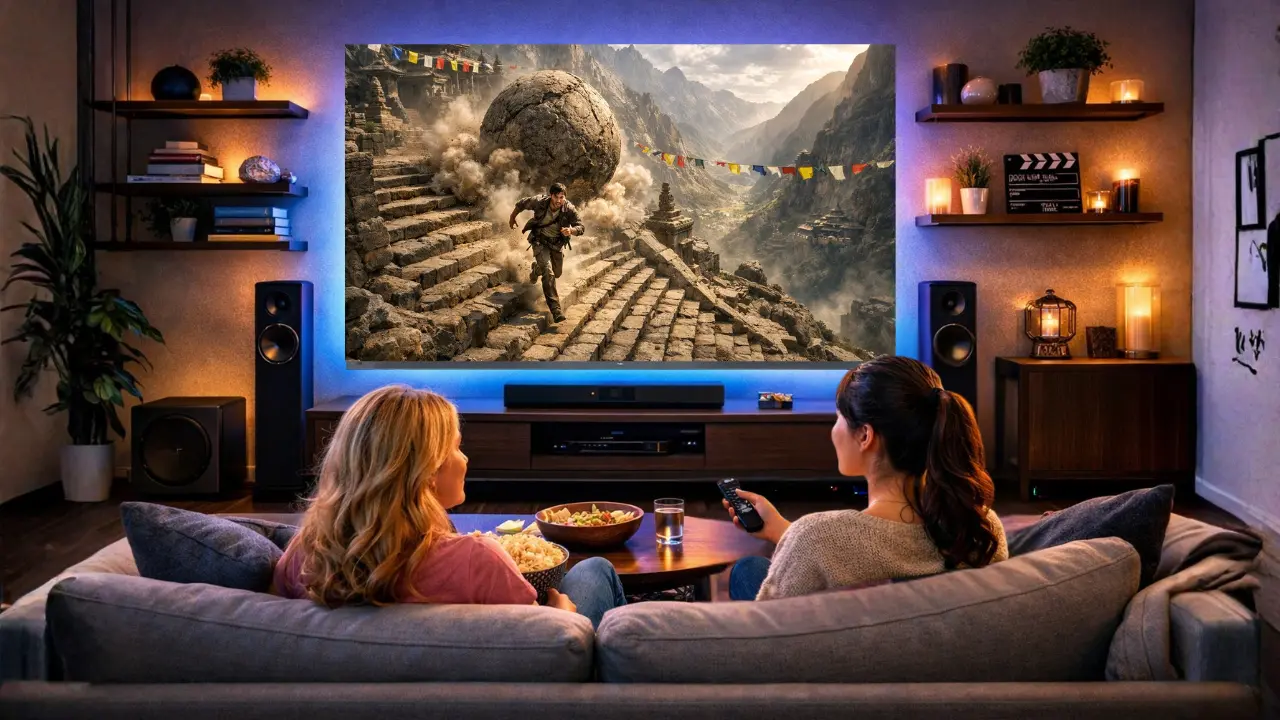

Big screens make movies feel more real because they reduce the distance between you and the story.
A larger screen fills more of your field of vision, pulls your focus away from the room, and recreates the scale directors intended.
When size combines with high brightness, local dimming, immersive audio, and AI picture tuning, your living room begins to behave like a theatre. Not louder. Not flashier. Just more believable.
That is the short answer.
Now let us talk about what actually changes inside a real Indian home.
The screen is not just bigger. It is closer to your brain.
Picture this.
It is a Saturday night in Mumbai. The lights are dim. Popcorn bowls on the centre table. The IPL match or a new Netflix release begins.
On a small screen, you watch the story.
On a big screen, you enter it.
This is not a drama. It is neuroscience.
Research from SMPTE shows that immersion increases when a screen fills at least 30 to 40 percent* of your field of view. IMAX theatres often exceed 60 percent*. The larger the visual angle, the less your brain notices your surroundings.
In simple words: scale reduces distraction.
That is why a 254cm(100) display like the Haier New M96 Series QD-Mini LED AI Smart Google TV does not just look large. It feels absorbing.
Field of View Changes Emotional Intensity
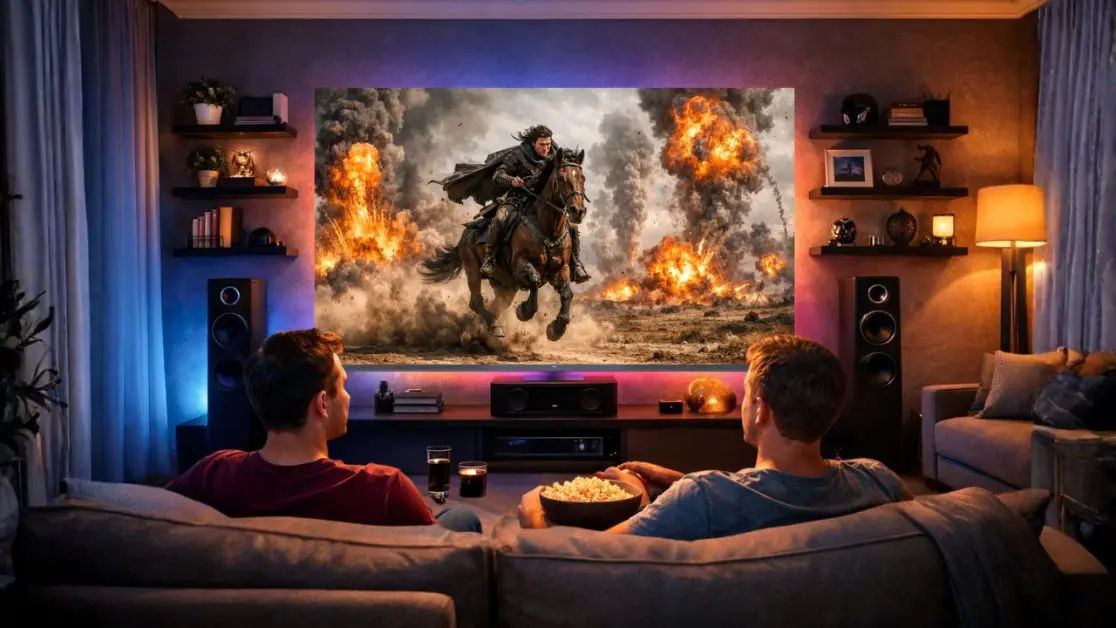
When the frame expands:
- Faces look life-sized
- Landscapes feel panoramic
- Action scenes feel kinetic
- Subtle expressions become visible
You stop glancing at your phone.
You stop hearing the ceiling fan.
You start noticing the actor’s eyes.
Immersion is not about volume. It is about visual dominance.
And dominance changes emotion.
Size Alone Is Not Enough. Clarity Decides Realism.
A large screen with poor contrast feels like a billboard.
A large screen with precision lighting feels like a window.
The difference is technology.
Why Mini LED and Local Dimming Matter
The M96 Series uses QD-Mini LED with 2000+ dimming zones and up to 2100 nits peak brightness.
Let us decode that.
- More dimming zones mean deeper blacks and controlled highlights
- Higher brightness means details remain visible even in daylight
- Quantum Dot layers expand color volume
This matters in Indian homes.
Because Indian living rooms are bright.
Open balconies. White walls. Tube lights on. Afternoon cricket matches.
If your TV cannot fight glare, realism collapses.
The M96 series also features a low-reflection screen with up to 67 percent screen reflectance reduction and 178-degree wide viewing angle, as shown in the product visuals.
Translation: the picture remains consistent whether you sit in front or to the side.
Realism Is a Balance of Three Forces
| Factor | What It Does | Why It Feels Real |
| Brightness | Preserves highlights | Sunlight looks like sunlight |
| Contrast | Deepens shadows | Night scenes feel cinematic |
| Color Accuracy | Enhances skin tones | Faces look human, not artificial |
When these align, your brain relaxes.
Because the image matches memory.
And realism is simply alignment between what we see and what we expect.
Motion Decides Whether Action Feels Fluid or Fake
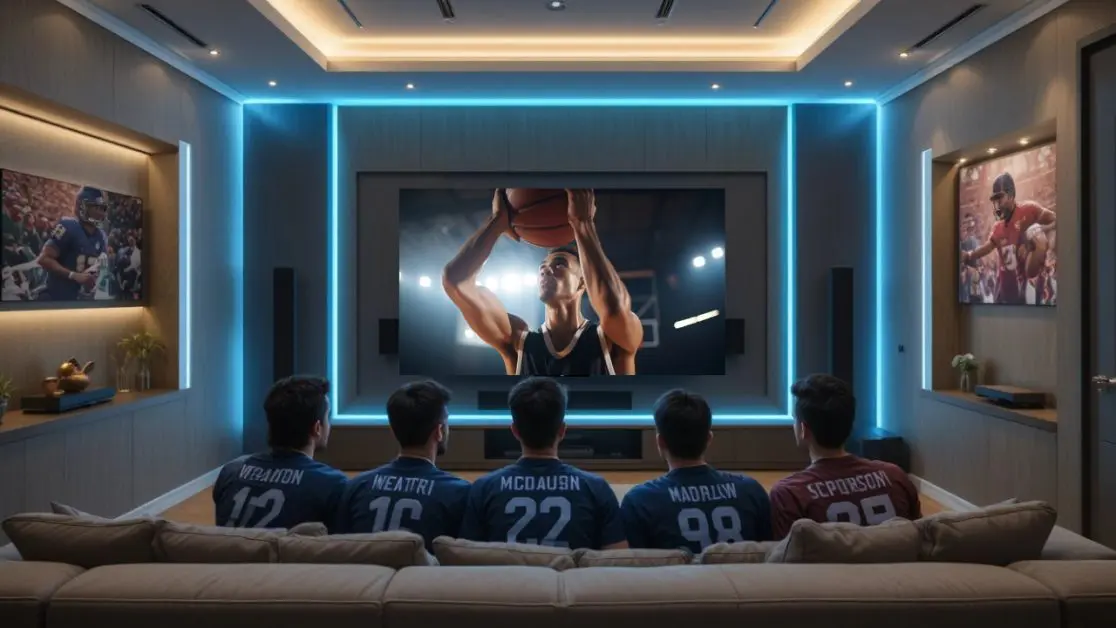
Watch a fast car chase on a 60Hz panel.
Now watch it on 144Hz.
The difference is not subtle.
The M96 Series supports 144Hz refresh rate and even gaming up to 240Hz in Game Mode.
Why does this matter for movies?
Because blur breaks belief.
Our eyes track motion constantly. When frames skip or smear, the brain notices distortion. That distortion reminds us we are watching a screen.
Higher refresh rates reduce that reminder.
For sports nights. For action thrillers. For Formula 1 fans. For PlayStation marathons.
Motion clarity preserves illusion.
And illusion sustains immersion.
Sound Completes What the Screen Starts
Close your eyes during a film.
What carries the story?
Sound.
The M96 integrates Sound by KEF, Dolby Atmos, and multi-channel speaker systems.
This is not about loudness.
It is about placement.
Dolby Atmos creates spatial audio. Effects move above and around you. Dialogues remain centred. Background ambience wraps the room.
Think about a rain scene.
On a standard TV, rain sounds flat.
On spatial audio, droplets scatter across space.
The difference is dimensionality.
And dimension equals presence.
Presence makes fiction feel personal.
AI Is the Invisible Director Inside the TV
Here is where things get interesting.
The M96 Series includes AI Ultra Sense Processor and AI Center MAX that integrates visual, sound, gaming, and entertainment algorithms.
What does that mean inside your home?
It means the TV adjusts.
Automatically.
AI Enhancements That Change Viewing
- AI Scene Detection recognizes landscapes and adjusts contrast
- AI Color Boost Pro enhances vibrancy
- AI HDR Enhancer improves highlights
- AI Ambient Sense adapts brightness based on room light
The effect is subtle.
But powerful.
Morning viewing looks natural.
Night viewing looks cinematic.
You do not fiddle with settings.
The screen reads the room.
That is the future of realism.
Not bigger menus.
Smarter automation.
Big Screens Redefine Social Viewing
Indian homes are social spaces.
Festival gatherings. India vs Pakistan matches. Weekend movie nights.
A 32-inch screen serves individuals.
A 254cm(100) screen serves families.
Scale changes participation.
When the screen is large:
- Everyone sees clearly from any seat
- Expressions are readable across the room
- Shared laughter becomes synchronized
This is not just technology.
It is community design.
According to BARC India reports, average TV viewing in Indian urban households often exceeds 3 to 4 hours daily during major sports events.
Now imagine those hours on a display that mirrors theatre scale.
Suddenly, the living room becomes the destination.
And home entertainment becomes an event.
Choosing the Right Screen Size Is a Strategic Decision
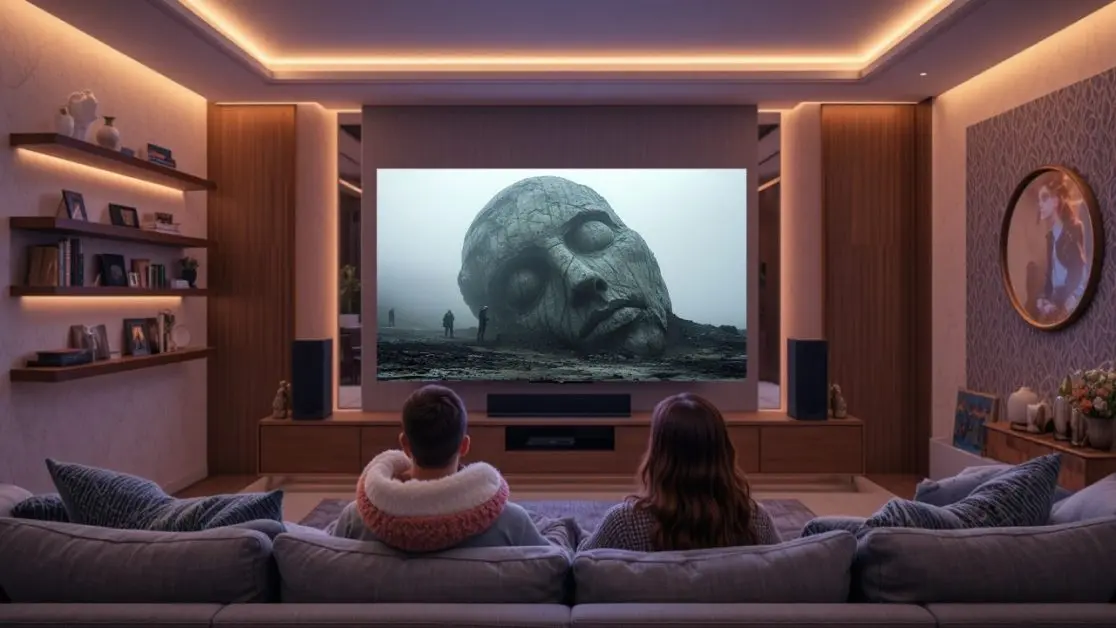
Not every home needs 100 inches.
But every home benefits from intentional choice.
One Option: Compact and Practical
- Ideal for bedrooms
- Lower cost
- Suitable for solo viewing
Second Option: Mid-Sized Balanced
- Works for nuclear families
- Blends space and performance
- Economically efficient
Third Option: Cinema-Scale Experience
- Designed for large living rooms
- Delivers theatre immersion
- High brightness for Indian daylight
Each choice carries cost and benefit.
Bigger screens require wall space and higher investment.
But they reduce the need for theatre outings, external soundbars, or projector setups.
In systems thinking, we ask:
Does this single decision simplify multiple future decisions?
Often, the answer is yes.
Realism Is Not Luxury. It Is Alignment.
We assume big screens are about status.
They are not.
They are about proportion.
A small story fits a small frame.
An epic story demands scale.
Directors shoot films in 4K HDR. Sports are broadcast in high dynamic range. Streaming platforms optimize for large displays.
When we compress that into a small screen, we shrink intent.
A large QD-Mini LED display with Dolby Vision IQ and HDR10+ preserves that intent.
It respects the source.
Respect creates authenticity.
Authenticity feels real.
The Hidden System: Why Bigger Screens Quietly Improve Downtime
Here is something rarely discussed.
After long workdays, decision fatigue builds up.
The brain wants effortless pleasure.
If picture clarity is poor or sound feels thin, the brain works harder to interpret.
Better screens reduce cognitive friction.
Sharper visuals.
Balanced sound.
Automatic optimization.
No menu diving.
Less mental strain.
This matters for working professionals living solo. For parents who finally sit down after bedtime routines. For couples carving out Friday night rituals.
The right screen does not shout.
It settles the room.
So What Changes When the Screen Gets Bigger?
Not just pixels.
Perspective.
You begin to treat home as a destination.
Cricket nights become events.
Animated films become magical for children.
Action movies feel theatrical.
And quiet dramas reveal subtle emotions.
A large screen with intelligent processing and immersive audio does not replace cinema.
It personalizes it.
And personalization is a real luxury.
Final Thought: Scale Shapes Experience
In architecture, ceiling height changes how a room feels.
In books, font size changes how a page reads.
In cinema, screen size changes how a story lands.
Big screens make movies feel more real because they remove distance.
Between viewer and story.
Between technology and emotion.
Between home and theatre.
And when technology quietly removes distance, life feels just a little more expansive.
That is not about television.
It is about how space shapes experience.
And in modern Indian homes, experience is everything.
Frequently Asked Questions
My living room gets a lot of sunlight during the day. Will a large TV still look clear?
Yes if the TV has high brightness and anti-reflection technology. High peak brightness (around 2000 nits) helps maintain clarity even in bright rooms.
I often watch TV with lights on. Will that ruin the cinematic feel?
Not necessarily. TVs with local dimming and high contrast maintain deep blacks and bright highlights even in partially lit rooms.
Does sitting off to the side ruin picture quality on big screens?
Modern TVs with wide viewing angles keep color and contrast consistent even when viewed from the sides.
Will a giant screen look pixelated if I sit close?
Not if the TV has 4K resolution and good image processing. Higher resolution maintains sharpness even on large displays.
Do AI picture settings actually improve viewing, or are they just marketing?
AI processing can automatically adjust brightness, contrast, and color depending on the scene and room lighting, reducing the need for manual settings.
Why does my TV sometimes look different during the day and night?
TVs with ambient light detection automatically adjust brightness and contrast based on room lighting.
Can AI really make old movies or streaming content look better?
Yes. AI image processing can upscale lower-resolution content and enhance color and contrast for better clarity.
Do I need to constantly adjust settings for different content?
Not with AI-powered TVs. Many modern models detect the type of content (sports, movies, animation) and adjust automatically.