
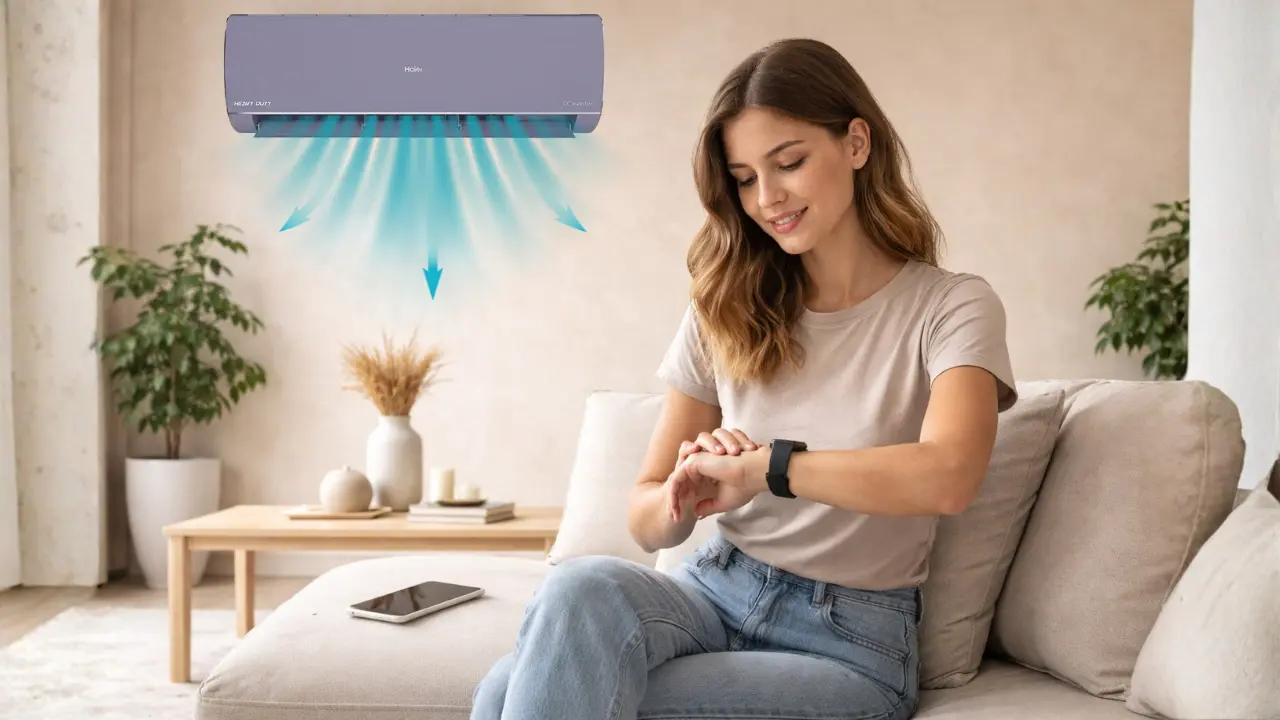

Why modern homes need cooling that adapts from morning heat to night humidity
Comfort in Indian homes changes throughout the day. Morning heat demands quick cooling. Afternoon temperatures demand power efficiency. Night humidity demands balanced air that feels light and breathable.
The real solution is not stronger cooling. The real solution is adaptive cooling that understands temperature, humidity, and human behavior. That is where AI powered air conditioners are quietly redefining everyday comfort.
The invisible rhythm of Indian weather inside our homes.
Step outside around 9 AM in an Indian summer.
The sun already feels sharp. Roads start shimmering. Ceiling fans spin faster.
By noon, the house begins trapping heat.
By evening, the temperature falls slightly. But the air becomes heavier. Humidity rises. That sticky feeling appears.
This daily pattern creates a hidden problem.
Most cooling systems treat the entire day the same.
But the environment does not behave that way.
Morning heat. Afternoon load. Night humidity.
Each phase demands a different cooling response.
That is the hidden system behind everyday comfort.
Why traditional cooling struggles with day to night weather shifts
Conventional air conditioners operate on one simple idea.
Cool the room to a fixed temperature.
But temperature alone does not define comfort.
Humidity, occupancy, airflow direction, and energy consumption all influence how the air actually feels.
Here is how the daily cycle typically looks in Indian homes:
| Time of Day | Environmental Condition | Comfort Challenge |
| Morning | Rising outdoor heat | Slow cooling when you first switch on the AC |
| Afternoon | Peak heat and electricity load | High energy consumption |
| Evening | Humidity begins rising | Sticky air feeling |
| Night | Lower temperature but high moisture | Overcooling or damp discomfort |
Cooling systems designed only for temperature struggle in this environment.
Because comfort is dynamic.
The real question: What does evolving comfort actually mean?
Evolving comfort means the cooling system adapts automatically as the environment changes.
Not once.
But continuously.
Modern AI driven climate systems now analyze multiple signals at the same time:
- Room temperature
- Outdoor conditions
- Occupancy patterns
- Usage history
- Power consumption
These signals allow the air conditioner to adjust cooling intelligently.
Instead of reacting.
It predicts.
Instead of fixed cooling.
It adapts.
That small shift changes everything.
Three everyday moments where adaptive cooling matters most
Comfort systems reveal their value in real life moments.
Not in specifications.
Consider three common situations in modern Indian homes.
1. The moment you arrive home after work
You step into your apartment at 7 PM.
The room feels warm. The air feels heavy.
A traditional AC starts cooling only after you switch it on.
The room becomes comfortable after 10 or 15 minutes.
But AI powered systems now anticipate your arrival.
Using geofencing and behavioral learning, the AC can start pre cooling the room when you are approaching home.
That means the space already feels comfortable when you walk in.
Comfort begins before you arrive.
2. The afternoon electricity spike
Indian homes experience peak electricity demand during the afternoon.
AC usage rises. Energy consumption increases. Bills climb quickly.
Traditional systems continue cooling at the same intensity.
But AI driven cooling systems adjust their output based on environmental data and real time room conditions.
For example:
- If the temperature gap is large, the system cools faster.
- If the room approaches the set temperature, cooling intensity reduces automatically.
This dynamic adjustment helps balance comfort and energy efficiency.
The principle is simple.
Smart cooling is not constant cooling.
3. Late night humidity discomfort
After midnight, outdoor temperatures drop slightly.
But humidity often increases.
This creates a strange experience.
The room feels cool, yet uncomfortable.
Many people reduce the AC temperature further. Which causes overcooling.
Adaptive climate systems approach the problem differently.
They analyze environment conditions and user habits to maintain balanced air quality and temperature without constant manual changes.
Comfort remains stable.
Sleep improves.
And energy waste drops.
How AI climate systems quietly learn household behavior
Modern cooling technology is not just reactive.
It learns.
AI climate platforms track how households use cooling across time:
- Preferred temperature settings
- Duration of operation
- Time of day usage patterns
- Power consumption data
Over time, these systems build a personalized cooling model.
The result is automatic optimization.
No daily adjustments.
No constant remote control changes.
Just consistent comfort.
AI powered climate systems analyze environmental data and user behavior in real time to optimize cooling and energy efficiency automatically.
This is the quiet shift happening in modern homes.
Cooling becomes intelligent infrastructure.
Where Haier’s AI climate technology fits into this shift
Smart climate control becomes meaningful only when it solves real household problems.
Haier’s AI powered climate platform, AI Atmox, focuses on exactly that.
Instead of offering isolated features, it integrates multiple adaptive systems.
Some of the key capabilities include:
- AI Climate Control that learns user habits
- AI Pre Cooling that predicts arrival and prepares the room
- AI Target Cooling that directs airflow to occupied zones
- AI Eco modes that adjust power levels automatically
- Electricity monitoring 2.0 that tracks energy consumption
- Human detection sensors that reduce cooling when rooms are empty
These systems work together to balance comfort, power efficiency, and everyday convenience.
Not through manual control.
Through intelligence.
The hidden benefit: smarter cooling also reduces energy waste
Energy efficiency is not just about saving electricity.
It is about eliminating unnecessary cooling.
Three mechanisms make the biggest difference:
1. Occupancy detection
AI sensors detect whether someone is present in the room.
If the space becomes empty, the system automatically reduces cooling intensity or switches to energy saving mode.
2. Targeted airflow
Instead of cooling the entire room, targeted cooling directs airflow toward occupied zones.
This speeds up comfort while reducing wasted energy.
3. Real time power monitoring
Modern systems can display electricity consumption visually through apps or dashboards.
This allows households to track cooling usage in real time and manage energy targets effectively.
The outcome is simple.
Comfort increases.
Energy waste decreases.
Why modern Indian homes are moving toward adaptive cooling

Urban lifestyles have changed dramatically.
Homes now function as:
- Workspaces
- Study zones
- Entertainment rooms
- Rest environments
Cooling requirements vary throughout the day.
A static system cannot handle dynamic living patterns.
Adaptive cooling systems respond to these lifestyle changes.
They shift output.
They optimize airflow.
They adjust energy use.
All automatically.
Technology disappears into the background. Comfort remains.
A simple framework for thinking about everyday comfort
When choosing climate solutions for modern homes, three principles matter most.
1. Responsiveness
How quickly does the system adapt to environmental changes?
2. Efficiency
Does cooling adjust based on actual conditions or run continuously?
3. Intelligence
Does the system learn and improve over time?
AI powered climate systems combine all three.
That combination defines the next generation of home comfort.
The bigger idea: comfort is no longer a fixed temperature
For decades, cooling meant one thing.
Lower the temperature.
But real comfort comes from balance.
Balance between heat and humidity.
Balance between airflow and stillness.
Balance between performance and energy use.
AI driven climate systems are designed around that idea.
They understand that comfort evolves.
From morning heat.
To afternoon demand.
To night humidity.
And the homes that adapt to this rhythm become more than functional spaces.
They become places where living simply feels easier.
Frequently Asked Questions
I feel like I’m constantly adjusting my AC throughout the day. Am I using it wrong?
You’re not using it wrong, your environment is changing. Traditional ACs don’t adapt to daily shifts (morning heat vs. night humidity), so you end up doing manual adjustments. Adaptive/AI systems remove that burden by auto-adjusting.
Should I prioritize faster cooling or energy saving when buying an AC?
Ideally, neither alone. Adaptive cooling balances both cooling fast when needed (morning/arrival) and reducing intensity when the room stabilizes (afternoon/night).
Why does my room still feel uncomfortable even when the temperature is low?
Because comfort isn’t just temperature it includes humidity, airflow, and air distribution. A cold but humid room can still feel sticky and heavy.
Do I really need an AI AC, or is it just a marketing thing?
If your daily comfort varies (which it does in most Indian homes), AI features solve real problems like overcooling, humidity discomfort, and energy waste, not just add-ons.
How does an AC ‘learn’ my behavior?
It tracks patterns like when you turn it on, preferred temperatures, and usage duration then builds a model to automate those choices.
Can my AC really predict when I’ll come home?
Yes through geofencing or learned routines. It detects patterns and starts cooling before your usual arrival time.
What is targeted cooling, and does it really make a difference?
It directs airflow toward where people are sitting instead of cooling the whole room faster and with less energy use.
Will I still need to use the remote if I have an AI AC?
Much less. The system gradually automates most adjustments based on your habits and environment.
How does occupancy detection help save electricity?
If no one is in the room, the AC reduces or pauses cooling automatically eliminating unnecessary energy use.