
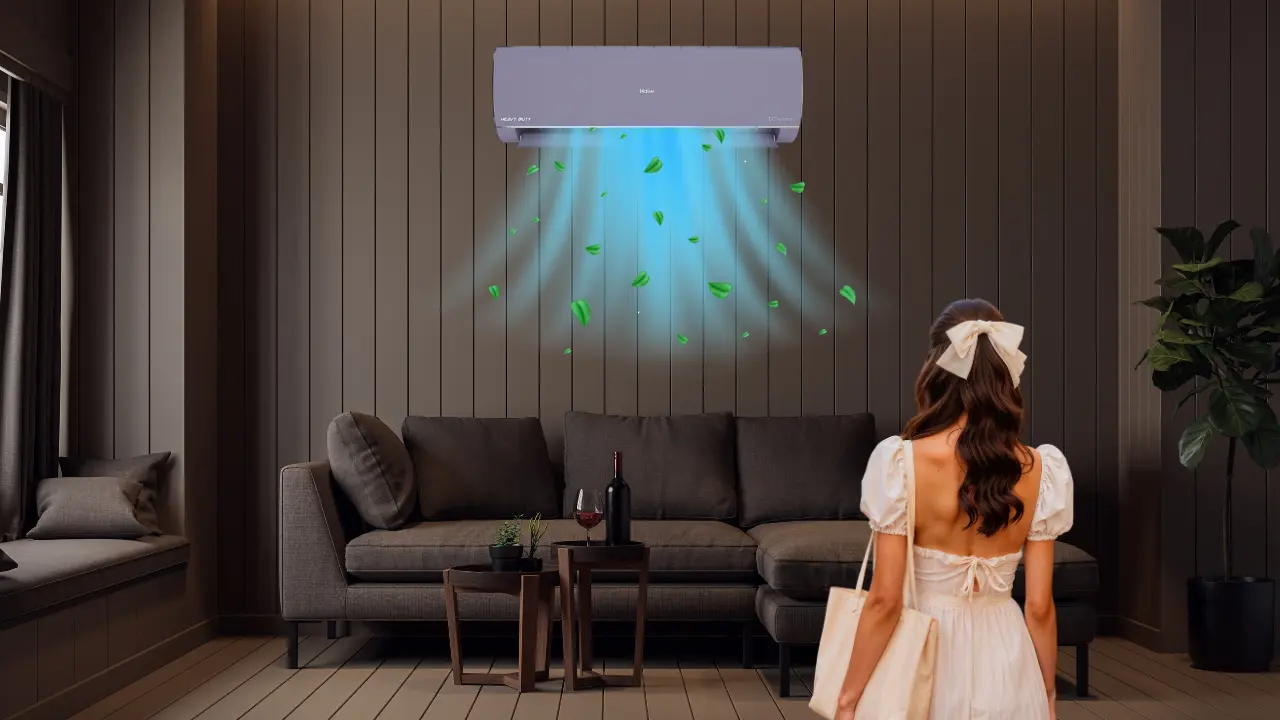

AI predictive pre-cooling lowers electricity consumption by learning your routine, predicting when you will arrive home, and cooling the room in advance at the most efficient moment.
Instead of forcing the AC to work at maximum power after you enter a hot room, the system gradually stabilizes the temperature earlier, reducing compressor load and overall energy usage.
A familiar Indian evening.
It is 7:20 pm.
You step out of the elevator after a long commute. The corridor still holds the heat of the day. Your phone buzzes. A delivery notification. A missed call from home.
You unlock the door.
And the living room is already cool.
Not freezing. Not blasting cold air. Just calm. Comfortable.
No remote pressed. No waiting. No sudden surge in electricity usage.
This moment feels small.
But behind it sits an invisible system that quietly saves power.
That system is AI predictive pre-cooling.
And once you understand how it works, you begin to see a bigger pattern.
Comfort and efficiency are not opposites. They are design choices.
Why traditional air conditioning wastes power
Most homes cool rooms only after someone enters.
You walk in. The room is 34°C. The AC is switched on.
Now the system has to do three things at once:
- Fight stored heat in walls and furniture
- Reduce room temperature rapidly
- Maintain the new temperature
This forces the compressor to run at maximum load.
Maximum load means maximum electricity.
Think of it like driving a car.
If you constantly accelerate hard from zero, you burn more fuel than if you gradually maintain speed.
Air conditioners behave the same way.
The hidden cost of reactive cooling
| Situation | What Happens | Power Impact |
| AC turned on in hot room | Compressor runs at full speed | High electricity usage |
| Room cools rapidly | System works harder than necessary | Higher load |
| Temperature stabilizes | Energy gradually reduces | Efficiency improves |
Reactive cooling solves comfort.
Predictive cooling solves comfort and efficiency.
The principle behind AI predictive pre cooling
Smart cooling works on a simple idea.
Anticipation beats reaction.
Instead of waiting for you to switch on the AC, the system predicts when cooling should begin.
In Haier air conditioners powered by AI Atmox, the technology observes usage patterns and environmental signals to make that decision.
The system studies three kinds of information.
1. Your daily behaviour
AI notices patterns such as:
- What time you return home
- When the AC is usually switched on
- How long cooling is required
Over time it creates a personalized cooling model.
The AC begins to understand your day.
2. Location signals
Some AI cooling systems use geofence detection.
When your smartphone enters a defined radius near home, the system predicts your arrival and begins cooling automatically.
In Haier’s AI Pre Cooling feature, this radius can be about 100 meters from home, triggering the cooling cycle before you enter.
By the time you reach your door, the room temperature is already comfortable.
3. Environmental conditions
Smart systems also read:
- Outdoor temperature
- Indoor heat buildup
- Seasonal climate patterns
AI analyzes these signals and adjusts cooling dynamically.
The AC does not simply run.
It decides how to run.
Why starting earlier actually saves electricity
At first this sounds counterintuitive.
If the AC starts earlier, shouldn’t it consume more power?
Not necessarily.
Because how the AC cools matters more than when it starts.
Three cooling scenarios
One option is reactive cooling.
You enter a hot room and turn the AC on.
- Compressor runs aggressively
- Rapid temperature drop required
- High electricity draw
The second option is timer-based cooling.
You schedule the AC.
- Works only if your schedule never changes
- Often cools empty rooms unnecessarily
The third option is AI predictive cooling.
- System predicts occupancy
- Cooling begins gradually
- Compressor runs at optimized load
The third option wins.
Not because it runs longer.
Because it runs smarter.
How predictive cooling reduces compressor stress
Air conditioners consume the most power during initial cooling cycles.
This phase is called the pull-down load.
During pull-down:
- Compressor works harder
- Fan speed increases
- Heat exchange intensifies
Predictive cooling softens this phase.
Instead of fighting extreme heat, the AC gradually stabilizes temperature.
Energy difference example
| Cooling Method | Compressor Behavior | Energy Use |
| Reactive cooling | Full load immediately | High |
| Scheduled timer | Often unnecessary cooling | Medium |
| AI predictive pre cooling | Gradual controlled cooling | Lower |
This small shift produces measurable energy savings over time.
The role of machine learning inside smart ACs
AI predictive pre-cooling works because the AC learns.
Not once.
Continuously.
In AI-driven climate systems, machine learning tracks real usage patterns such as:
- Mode selection
- Operating duration
- Temperature preferences
- Power consumption history
The system builds a dynamic consumption model that optimizes cooling efficiency automatically.
The result is simple.
The AC becomes more accurate with time.
The first week it guesses.
The third week it predicts.
By the second month it knows your habits better than a manual timer ever could.
Predictive cooling inside a larger AI Eco 2.0system
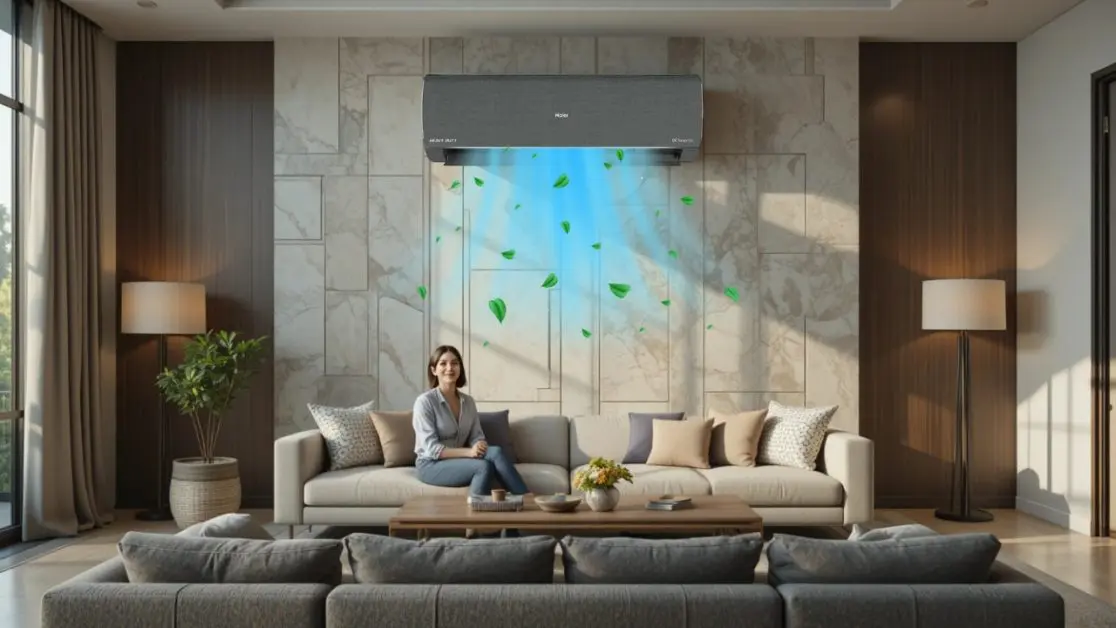
Predictive pre-cooling is rarely a standalone feature.
It usually sits inside a broader intelligent climate system.
For example, Haier’s AI Atmox platform combines multiple energy optimization layers.
These include:
- AI Climate Control
- AI Pre Cooling
- AI Target Cooling
- AI Eco 2.0 Mode
- Human detection sensors
- Electricity monitoring 2.0
Each feature improves a different part of the cooling cycle.
How these features work together
| Feature | What It Does | Benefit |
| AI Pre Cooling | Starts cooling before arrival | Lower peak load |
| AI Target Cooling | Focuses air where needed | Less wasted cooling |
| AI Eco 2.0 Mode | Adjusts power based on temperature gap | Energy savings |
| Human Detection | Reduces power when room is empty | Prevents waste |
| Electricity monitoring 2.0 | Tracks real consumption | Awareness and control |
Smart cooling is not one feature.
It is a system of coordinated decisions.
A small observation from everyday life
Walk into two different homes in May.
In one home, the AC is switched on only when someone arrives.
The room starts hot. Cooling takes time.
In another home, the room is already comfortable when people enter.
The second home feels calmer.
The AC feels quieter.
The electricity bill often feels lighter too.
The difference is not just technology.
It is timing intelligence.
What predictive cooling teaches about energy use
Most people assume saving electricity means using appliances less.
But modern systems reveal a different truth.
Efficiency is not about restriction. It is about coordination.
Predictive cooling coordinates:
- user behaviour
- environment data
- machine performance
When those three signals align, the system works less aggressively.
And energy consumption drops naturally.
Three simple benefits for modern Indian homes
1. Comfort without waiting
In many Indian cities, indoor temperatures can exceed 35°C during peak summer.
Predictive cooling ensures comfort the moment you enter.
No waiting. No blasting fan speeds.
2. Lower compressor strain
Gradual cooling reduces sudden load spikes.
This helps maintain long-term AC efficiency.
3. Reduced electricity consumption
By optimizing compressor cycles and preventing unnecessary overcooling, predictive cooling contributes to lower overall power usage.
Why this matters for the future of home appliances
Homes are becoming smarter.
But the real shift is not voice commands or mobile apps.
The real shift is anticipation.
Devices that understand behaviour.
Devices that adjust automatically.
Devices that reduce effort.
Air conditioners are quietly becoming climate systems.
Systems that learn.
Systems that adapt.
Systems that cool with purpose.
The bigger idea behind smarter cooling
Technology often solves visible problems.
But the best systems solve invisible ones.
AI predictive pre-cooling fixes a problem many people never noticed.
The waste created by reactive cooling.
By predicting occupancy and adjusting cooling in advance, intelligent systems reduce power spikes and maintain stable comfort.
And the lesson extends beyond air conditioners.
The future of home technology is not faster machines.
It is machines that think ahead.
Because the smartest homes are not the ones full of gadgets.
They are the ones where everything simply works.
Frequently Asked Questions
Do I really need AI pre-cooling, or is a timer good enough for my routine?
If your schedule is fixed, a timer can work. But real life isn’t always predictable: late meetings, traffic, spontaneous plans. AI pre-cooling adapts in real time, while timers blindly follow schedules and often waste electricity cooling empty rooms.
I already try to save electricity. Will this actually make a noticeable difference in my bill?
Yes, especially in hot climates. The biggest energy drain is when your AC starts in a very hot room. AI reduces that peak load by starting earlier at lower intensity, which adds up to measurable savings over time.
Is AI pre-cooling just a gimmick, or does it genuinely improve efficiency?
It’s not a gimmick. The efficiency comes from reducing “pull-down load” (the hardest working phase of the AC). Less stress = less power consumption.
How does my AC know when I’m close to home?
Through geofencing. Your phone entering a set radius (like ~100 meters) signals the AC to begin cooling.
Does it track my location all the time? Is that safe?
It uses permission-based location services via apps. You control access, and most systems only use proximity triggers, not continuous tracking.
Will the AC keep learning forever, or does it stop improving?
It continuously improves. The more you use it, the better it predicts and optimizes.