
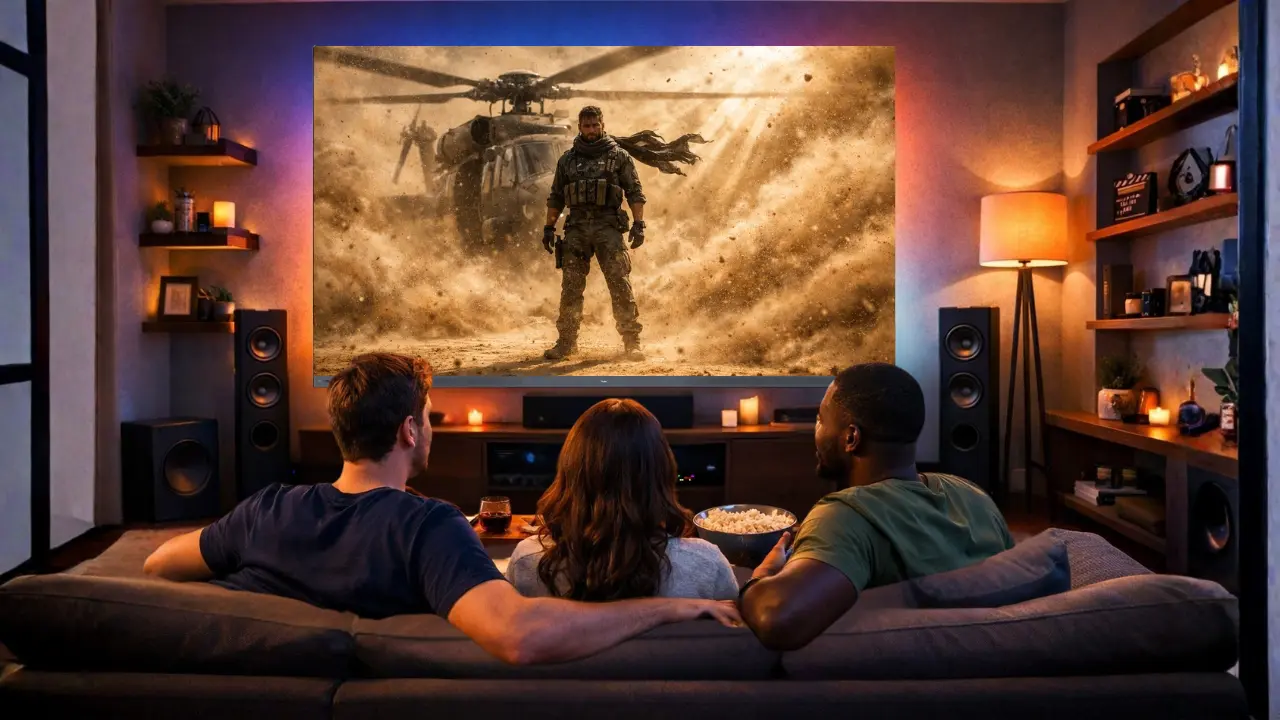

6.2.2 channel audio enhances action scenes by creating a three dimensional sound field around the viewer.
Multiple horizontal speakers, two subwoofers for deep bass, and overhead channels for height allow sound to move naturally across the room.
The result is clearer direction, stronger impact, and a cinema like experience at home.
Action scenes fail when sound feels flat.
Picture a familiar moment.
A Friday night.
Cricket match highlights.
Or a late night rewatch of a Bollywood action film.
The screen looks spectacular.
But something feels missing.
The helicopter appears on the screen, yet the sound comes from one place.
The explosion happens, but the room does not react.
The scene is big.
The sound is small.
This is the invisible gap between watching action and feeling action.
Most televisions historically used simple stereo systems. Two speakers. Left and right.
For news.
For sitcoms.
That works.
For action films?
It limits the experience.
A chase sequence, for example, is not just noise. It is a movement.
Sound must travel.
Across the street.
Above the viewer.
Behind the sofa.
This is where 6.2.2 channel audio changes the system completely.
What exactly does 6.2.2 channel audio mean?
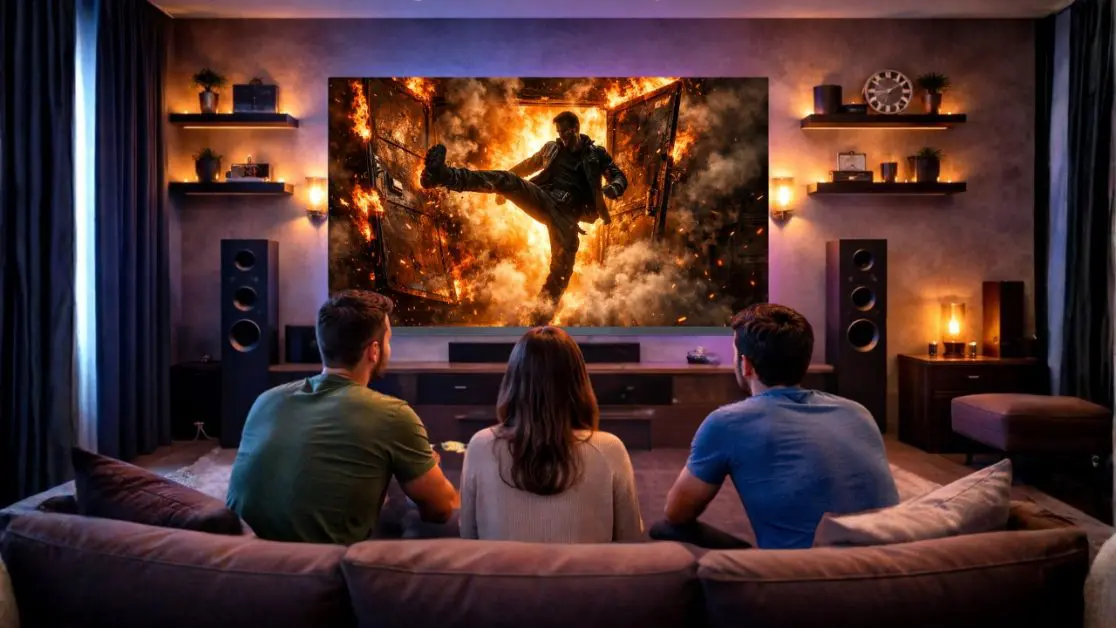
At first glance the number looks technical.
But it is actually simple.
Each number represents a part of the sound system.
| Component | Meaning | Role in Action Scenes |
| 6 | Six main speakers | Place sound across the room |
| 2 | Two subwoofers | Deliver deep bass for explosions |
| 2 | Two height speakers | Add overhead movement |
Together they create three dimensional audio.
Not left and right.
But front, side, rear, and above.
Systems like the Haier M96 Series 254 cm (100) QD Mini LED AI Smart Google TV (Model H100M96FUX) integrate this architecture with advanced audio engineering and KEF sound tuning to deliver layered sound fields for immersive viewing.
The difference is dramatic.
Sound stops behaving like a speaker.
It starts behaving like space.
The hidden system behind immersive sound
Most viewers assume better sound simply means louder sound.
That assumption misses the real principle.
Immersion comes from direction, not volume.
Action scenes rely on three invisible layers of audio.
1. Horizontal movement
Cars pass from left to right.
Footsteps move across the frame.
Bullets travel through space.
Six horizontal speakers distribute these sounds across the room so motion feels continuous.
Without this layer, movement collapses into one direction.
With it, motion becomes believable.
2. Impact through bass
Explosions are not just loud.
They are physical.
Low frequency bass is what creates that sensation.
Two dedicated subwoofers allow deeper bass reproduction.
Why two?
Because bass waves behave unpredictably in rooms.
Dual subwoofers stabilize low frequency response and reduce distortion during heavy action scenes.
The result:
- Explosions feel fuller
- Engine sounds feel deeper
- Drum beats feel physical
Sound stops being background noise.
It becomes energy.
3. Vertical immersion
This is the layer most people never experienced until recent years.
Height speakers.
When a helicopter flies overhead or rain falls in a storm scene, sound should arrive from above.
Formats like Dolby Atmos use height channels to create vertical placement.
Modern TVs and audio systems now integrate this feature to produce a true three dimensional sound field around viewers.
Suddenly the room feels taller.
The movie expands beyond the screen.
Why action scenes benefit the most
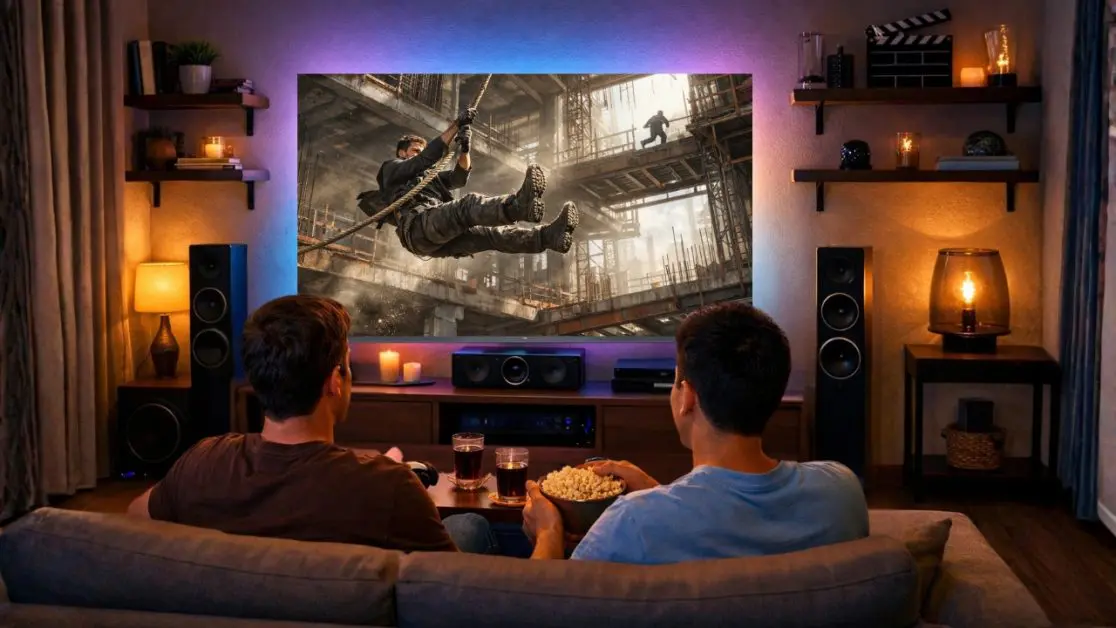
Not all content needs complex audio.
News. Talk shows. Podcasts.
Simple sound works.
Action scenes are different.
They are built around movement and scale.
Let us break down three common scenarios.
Scenario 1: The chase sequence
Imagine a motorcycle chase through narrow streets.
With stereo sound:
- Engine noise sits in the middle
- Movement feels flat
With 6.2.2 channel audio:
- The bike enters from the left rear
- Passes across the front
- Disappears to the right
The brain recognizes motion instantly.
It feels like the rider passed through the room.
Scenario 2: The explosion moment
Explosion scenes rely heavily on bass and spatial expansion.
A proper system distributes sound like this:
- Front speakers deliver the blast
- Subwoofers deliver impact
- Rear speakers deliver debris echoes
- Height channels simulate falling fragments
The brain processes this as scale.
Big visuals require big sound geometry.
Scenario 3: The aerial sequence
Think of a helicopter rescue scene.
Stereo sound places the helicopter on the screen.
6.2.2 channel audio places it above the viewer.
The rotor blades rotate overhead.
The brain reacts instantly.
Because humans locate sound in three dimensions.
Cinema audio simply mirrors how hearing works.
Why modern TVs are evolving beyond stereo
Home entertainment has changed rapidly in the last decade.
Three shifts are happening simultaneously.
1. Screen sizes are increasing
In India, televisions above 165cm (65) are becoming more common in urban homes.
Large screens reveal visual detail.
But they also expose audio limitations.
A massive screen with tiny sound feels mismatched.
2. Streaming platforms produce cinematic audio
OTT platforms now release films with Dolby Atmos and spatial audio formats.
Netflix, Amazon Prime Video, and Disney+ all support advanced audio encoding.
Without a multi channel system, much of that audio data never reaches the viewer.
3. Living rooms are becoming entertainment hubs
The modern Indian living room now hosts:
- Cricket nights
- Gaming sessions
- OTT binge watching
- Family movie evenings
A single system must support all of these experiences.
That is why televisions like the Haier M96 Series 254 cm QD Mini LED AI Smart Google TV (H100M96FUX) combine large display technology with multi-layered audio such as 6.2.2 channel architecture and KEF tuned sound systems.
The screen and sound evolve together.
The real benefit: Less effort, more immersion
Technology often adds complexity.
The best technology removes it.
Immersive audio systems do exactly that.
Instead of adjusting volume repeatedly or adding external speakers later, a well designed system creates balance automatically.
Three benefits stand out.
1. Clear dialogue during chaos
Action scenes often bury dialogue under sound effects.
Multi channel systems separate dialogue and effects across different speakers.
Voices remain clear even during loud scenes.
2. Balanced sound at lower volumes
Because sound spreads across multiple speakers, viewers do not need extreme volume levels.
Late night movie sessions become possible without disturbing the entire house.
3. Natural listening fatigue reduction
Flat audio tires the brain.
Spatial audio feels more natural because it matches real world hearing.
Long movies feel easier to watch.
Three ways households experience the difference

Not every viewer notices technology.
But everyone notices the experience.
Here are three common reactions.
The first time someone hears spatial sound
A helicopter scene plays.
Someone looks up.
That reaction says everything.
The cricket stadium moment
Crowd noise spreads across the room.
The stadium atmosphere feels wider.
The living room briefly becomes the stadium.
The late night action film
Explosions feel powerful.
Yet dialogue remains clear.
The experience feels cinematic without needing a theatre visit.
The bigger lesson: Great sound builds emotional scale
Screens show events.
Sound tells the brain how big those events are.
A whisper.
A thunderstorm.
A passing train.
The difference lies in acoustic space.
6.2.2 channel audio expands that space.
It allows movies to breathe.
And when the system works well, viewers stop thinking about speakers entirely.
They simply experience the story.
The future of home entertainment is layered
Home entertainment used to improve in single steps.
Better resolution.
Larger screens.
Now improvement happens across multiple layers simultaneously.
- AI picture processing
- high refresh rate panels
- spatial audio systems
- intelligent sound tuning
Products like the Haier M96 Series 254 cm QD Mini LED AI Smart Google TV (H100M96FUX) illustrate this shift by combining advanced visuals with KEF engineered sound and a 6.2.2 channel audio structure that creates a three dimensional listening environment.
Technology evolves.
But the goal stays simple.
Make the living room feel alive.
One final insight
People assume action scenes are about visuals.
They are not.
They are about impact.
And impact lives in sound.
When audio moves around the room, travels overhead, and lands with depth, the brain stops observing.
It participates.
That is the quiet power of 6.2.2 channel audio.
Not louder.
Just truer to life.
Frequently Asked Questions
I already have a big TV. Do I really need 6.2.2 audio too?
Yes, if you care about immersion. A large screen increases visual scale, but without spatial audio, sound feels disconnected. 6.2.2 fills that gap by matching sound movement to screen size.
Is 6.2.2 channel audio overkill for my living room?
Not really. Even medium-sized rooms benefit because the system distributes sound intelligently. You don’t need a theatre-sized space to feel the difference.
I mostly watch OTT content. Will I even notice the upgrade?
Definitely. Platforms like Netflix and Amazon Prime Video already stream Dolby Atmos content. Without multi-channel audio, you’re missing much of that detail.
Should I invest in external speakers or a TV with built-in 6.2.2 audio?
If you want simplicity, integrated systems (like premium TVs) offer balanced performance without setup complexity. External systems can go further, but require tuning and space.
How does Dolby Atmos work with 6.2.2 systems?
Dolby Atmos adds vertical positioning. The 2 height channels in 6.2.2 allow sound (like helicopters or rain) to come from above, completing the 3D effect.
What makes TVs like Haier M96 Series H100M96FUX different?
They integrate multi-channel audio directly into the TV with tuned acoustics (like KEF tuning), reducing the need for external setups.
Why are two subwoofers better than one?
Bass behaves unpredictably in rooms. Dual subwoofers balance low-frequency waves, reducing distortion and dead spots.