
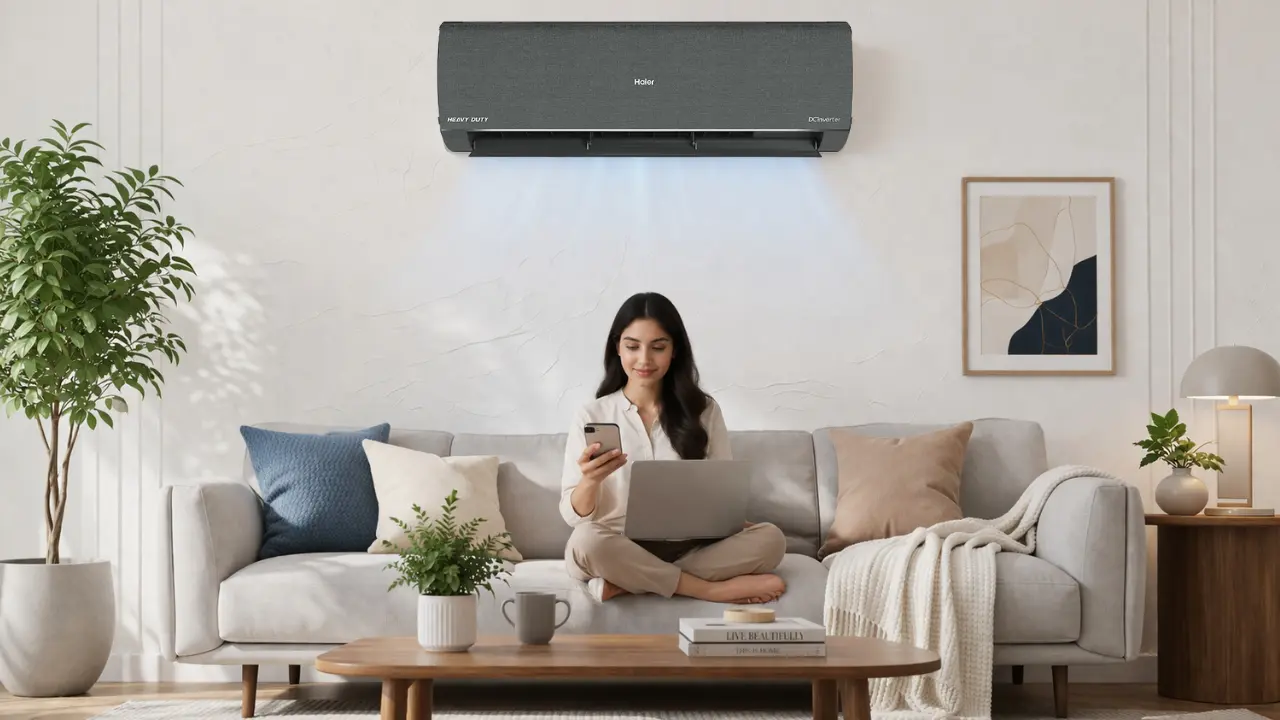

AI air conditioners adjust temperature automatically by analysing real-time room conditions, learning user habits, and continuously optimising cooling settings.
Instead of fixed manual inputs, they create a dynamic system that balances comfort, energy use, and external weather conditions without constant human intervention.
Why does AC temperature control feel harder than it should?
It is 2:30 PM in May.
The room feels warm. You lower the temperature.
At 6 PM, it suddenly feels too cold. You increase it again.
At night, you wake up and switch it off.
The AC is working.
But the system is broken.
Because comfort is not a fixed number. It is a moving target.
And most traditional air conditioners expect you to manage that movement manually.
That is the gap AI ACs are designed to close.
What actually changes when AI enters your AC?

An AI AC does one fundamental thing differently.
It observes before it acts.
Instead of reacting only to your remote commands, it builds a system around three inputs:
- Indoor temperature and humidity
- Outdoor weather conditions
- Your usage patterns over time
It uses AI Atmox to analyse your environment and learn your habits to deliver smarter comfort automatically
The shift is simple but powerful.
From manual control
To intelligent adaptation
The hidden system behind automatic temperature adjustment
Think of an AI AC like a good restaurant waiter.
You don’t keep calling them for every refill.
They notice. They anticipate. They act.
AI ACs follow a similar loop:
1. Sensing the environment
They continuously track:
- Room temperature fluctuations
- Humidity levels
- External heat conditions
Some advanced models even factor in occupancy and movement patterns.
2. Learning your behaviour
Over time, the system starts noticing patterns:
- You prefer cooler air after workouts
- Slightly warmer settings at night
- Lower cooling during early mornings
This is not guesswork.
It is pattern recognition.
3. Adjusting automatically
Based on this data, the AC:
- Changes cooling intensity
- Adjusts fan speed
- Switches operating modes
All without needing input every few hours.
Comfort stops being reactive. It becomes predictive.
Three ways temperature adjustment works in real life
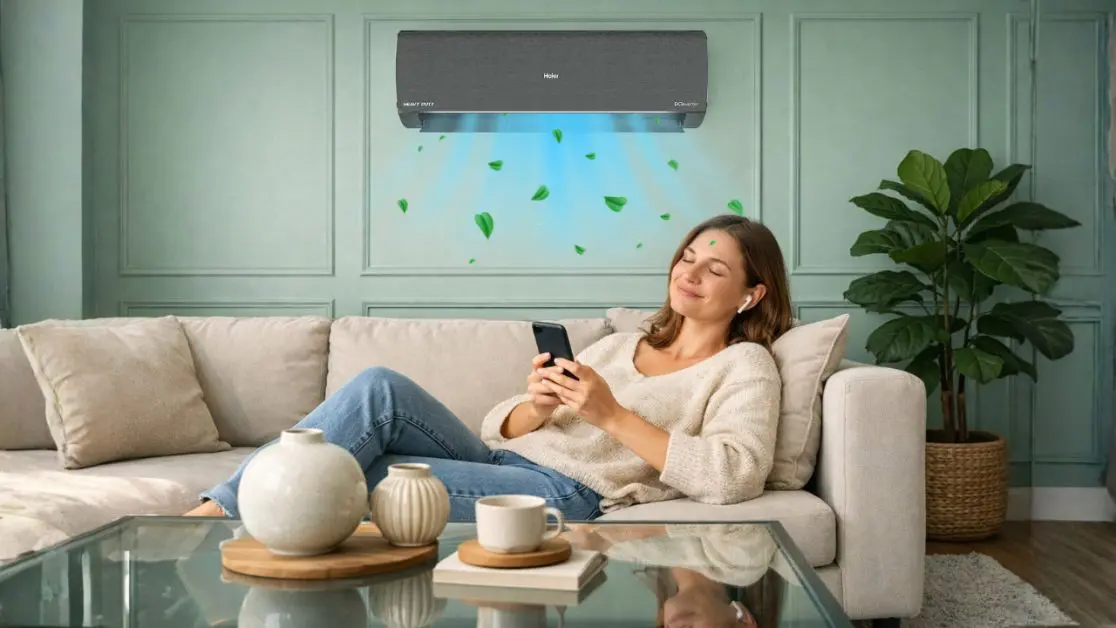
Most people think AI ACs are just about convenience.
They are not.
They are about decision systems.
Here are three distinct ways they operate:
One option is reactive cooling
- You manually change temperature
- The AC responds instantly
- Works, but needs constant attention
Cost: High effort, inconsistent comfort
Benefit: Full control
The second option is programmed cooling
- You set timers or schedules
- AC follows fixed patterns
- Limited flexibility
Cost: Less responsive to real conditions
Benefit: Reduces manual effort
The third option is AI-based adaptive cooling
- System learns and adjusts automatically
- Responds to real-time and historical data
- Requires minimal intervention
Cost: Slightly higher initial investment
Benefit: Maximum comfort with minimum effort
The insight is simple.
The best systems remove decisions, not just add features.
How AI ACs optimise comfort without overcooling
One of the biggest inefficiencies in Indian homes is overcooling.
Rooms become too cold. Then ACs are turned off. Then switched back on.
This cycle wastes energy and comfort.
AI ACs break this pattern.
They adjust in micro-steps, not big jumps
Instead of drastic changes:
- Cooling increases gradually
- Fan speed adapts dynamically
- Modes shift silently in the background
They factor in external heat
A 2 PM Delhi afternoon is different from a 9 PM evening.
AI systems analyse outdoor temperature and adjust accordingly to maintain stable indoor comfort
They maintain thermal balance
Not too hot. Not too cold.
Just right.
Consistency becomes the new luxury.
How AI ACs reduce electricity bills while adjusting temperature
This is where things get interesting.
Because automatic adjustment is not just about comfort.
It is about efficiency.
What happens behind the scenes
AI ACs monitor energy usage continuously and shift to more efficient modes when needed.
For example:
- Switching to AI ECO mode during stable conditions
- Reducing compressor load during low demand
- Avoiding unnecessary overcooling
The Haier 1.6 Ton 5 Star Gravity AI Air Conditioner (HSA19GHD-WAI5NB-I) uses this system to optimise consumption and can deliver significant energy savings by reducing wastage intelligently
Simple breakdown of impact
| Situation | Traditional AC | AI AC |
| Afternoon heat spike | Manual adjustment | Auto cooling boost |
| Night usage | Overcooling risk | Gradual temperature rise |
| Idle room | Continues running | Reduces power usage |
| Monthly bill | Unpredictable | Optimised |
Efficiency is not about using less. It is about wasting less.
What role does inverter technology play in this system?
AI alone is not enough.
It needs a responsive engine.
That is where inverter technology comes in.
How inverter and AI work together
- AI decides what needs to be done
- Inverter decides how smoothly it is done
Haier’s Hexa Inverter technology enables continuous adjustment of compressor speed, reducing energy use while maintaining stable temperatures across models like the Haier 1.6 Ton 5 Star Gravity AI Air Conditioner (HSA19GHD-SAI5NB-I)
Why this matters
Without inverter control:
- Cooling becomes on-off
- Temperature fluctuates
- Energy spikes increase
With inverter plus AI:
- Cooling becomes continuous
- Temperature stays stable
- Energy use stays controlled
Smooth systems always outperform powerful but inconsistent ones.
Real-life scenarios where AI temperature adjustment changes everything
Let’s move out of theory.
Into real homes.
Scenario 1: Working professional, late evenings
You come home at 9 PM.
Instead of blasting cold air:
- The AC gradually cools the room
- Matches your usual comfort level
- Avoids sudden temperature shock
Scenario 2: Family living room during summer
Multiple people. Different comfort levels.
AI adjusts airflow and cooling intensity to maintain balance across the room.
Scenario 3: Night-time sleep
Traditional ACs overcool at night.
AI ACs:
- Increase temperature gradually
- Reduce fan speed
- Maintain sleep-friendly comfort
Good sleep is not about cold air. It is about stable air.
How AI ACs adapt to extreme Indian conditions
India is not a single climate.
It is a spectrum.
From coastal humidity to North Indian heatwaves.
AI ACs are designed for this variability.
Key adaptive capabilities
- Cooling even at high ambient temperatures up to 60°C
- Adjusting capacity dynamically from 40% to 110%
- Responding to humidity changes in real time
These features are part of Haier’s Gravity AI Series, designed for Indian conditions and heavy-duty performance
The bigger shift: From controlling appliances to trusting systems
There is a deeper pattern here.
Earlier, we controlled everything.
Fan speed. Temperature. Modes.
Now, systems are learning to control themselves.
Not blindly.
But intelligently.
This creates three outcomes
- Less decision fatigue
- More consistent comfort
- Better energy efficiency
The best technology disappears into the background.
You stop noticing it.
Because it just works.
What should you actually look for in an AI AC?
Not all AI is equal.
Here is a simple framework.
Look for these three layers
- Sensing capability
- Real-time environment tracking
- Indoor and outdoor analysis
- Learning capability
- Habit recognition
- Usage pattern adaptation
- Execution capability
- Inverter-based control
- Automatic mode switching
If all three work together, the system feels seamless.
If one is missing, it feels like a feature, not a solution.
The one insight that changes how you see ACs
Most people think:
“An AC cools the room.”
That is outdated thinking.
A modern AI AC manages a climate system.
It balances:
- Temperature
- Energy
- Comfort
- Time
And it does it continuously.
Without asking you.
So what does this mean for modern Indian homes?
It means fewer interruptions.
Fewer adjustments.
Fewer compromises.
In homes where time is limited and expectations are high, systems like AI-based temperature adjustment are not luxury.
They are infrastructure.
Because the real upgrade is not smarter machines.
It is simpler living.
Frequently Asked Questions
Why do I keep changing my AC temperature throughout the day?
Because comfort isn’t static it shifts with time, activity, and weather. Traditional ACs expect fixed inputs, but your body doesn’t operate that way.
Why does my room feel perfect at 2 PM but too cold by evening?
External temperature drops and your body adapts, but your AC keeps cooling at the same rate unless adjusted.
I feel like I’m managing my AC all day shouldn’t it just handle this itself?
That’s exactly why AI ACs are designed for removing constant manual decisions by learning and adapting automatically.
Is it normal to wake up at night just to turn off my AC?
Very common. Traditional ACs overcool at night. AI systems gradually increase temperature to match sleep cycles.
What does “AI cooling” actually mean in an AC?
It means the AC senses, learns, and adjusts automatically instead of relying only on manual input.
How is AI different from just setting a timer or schedule?
Timers are fixed, AI adapts in real time based on changing conditions.
What is AI Atmox and how does it work?
It’s a system that analyzes environmental data and user habits to deliver optimized cooling automatically.
How does inverter technology improve AI performance?
AI decides what to do, inverter technology executes it smoothly by adjusting compressor speed continuously.
Do AI ACs really save electricity?
Yes, by avoiding overcooling, reducing compressor load, and switching to efficient modes automatically.