
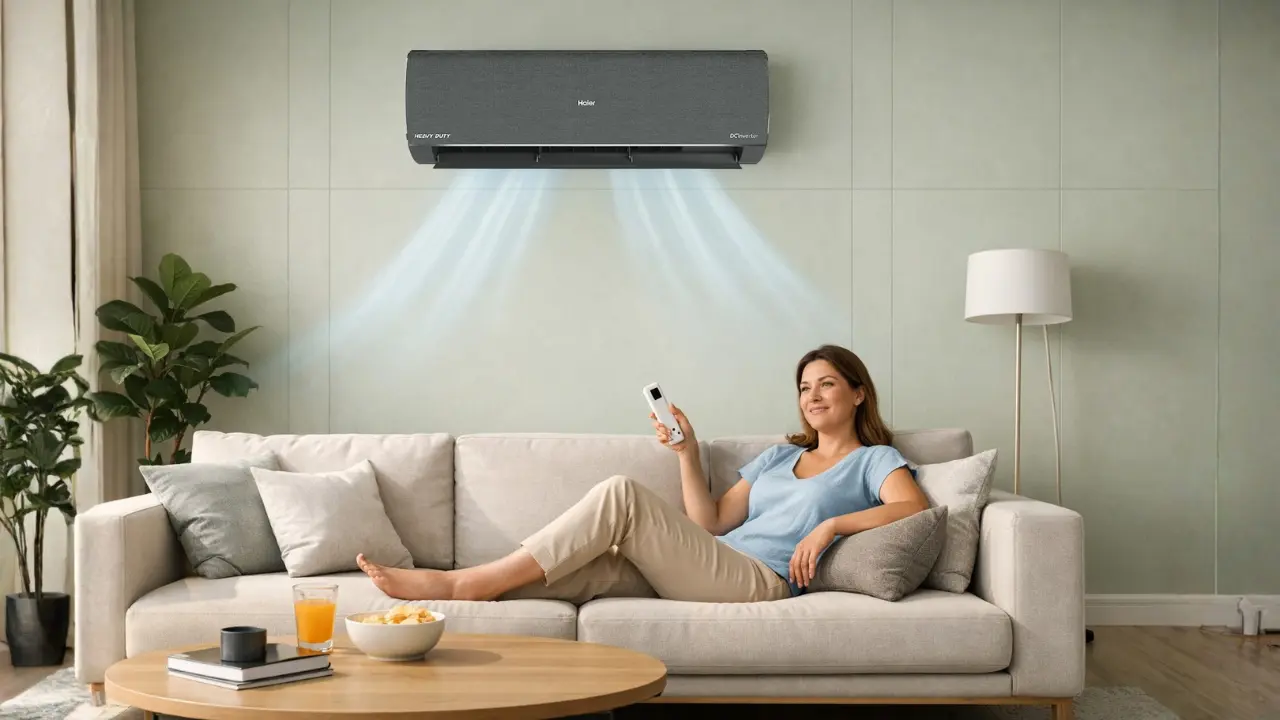

Pre-cooling feels instant because the technology starts cooling before you even notice the heat. By learning your habits, location, and room conditions, AI-powered air conditioners anticipate when cooling is needed and prepare the space in advance.
When you walk in, comfort is already waiting.
That is the simple answer.
The real story is more interesting.
Because what feels like instant comfort is actually the result of a quiet technology working ahead of time.
And modern homes increasingly rely on technology like this.
The moment every Indian summer creates.
The small ritual of entering a hot room
Picture a familiar moment.
You return home at 6:30 pm in May.
The outside air feels heavy. Your shirt sticks slightly to your back. The elevator ride feels longer than usual.
You unlock the door.
Inside, the room has been closed all afternoon.
Heat sits everywhere.
The sofa feels warm. The air feels slow. The walls hold the day’s sunlight like a memory.
You reach for the AC remote.
And then comes the wait.
Traditional air conditioning works exactly like that. It reacts after you ask it to.
Cooling begins only when the command arrives.
Which means comfort always arrives late.
Pre-cooling changes that pattern.
Instant comfort is rarely instant
It is the result of anticipation
Most people assume cooling speed depends on the machine.
Bigger compressor. Faster fan. Higher tonnage.
Those matter.
But the deeper shift comes from something else.
Timing.
Pre-cooling technology works on a simple principle.
Comfort improves when technology acts before the need appears.
Instead of waiting for a command, the technology studies patterns.
Daily routines. Environmental conditions. Room temperature changes.
AI climate technology analyzes this data continuously and automatically adjusts cooling performance.
The result feels magical.
But it is actually a careful prediction.
What Pre-cooling actually watches
Small signals that reveal your routine
Modern AI air conditioners track patterns the same way good assistants do.
Quietly.
Gradually.
Over time they begin to recognize signals.
For example:
| Signal Observed | What It Tells the technology |
| Time of day | When occupants usually return home |
| Outdoor temperature | How quickly rooms will heat up |
| Previous AC usage patterns | Preferred comfort settings |
| Room temperature changes | Cooling intensity needed |
| Occupancy detection | Whether someone is present |
These inputs form a behavioral pattern.
Not intrusive. Just practical.
The technology builds what engineers call a personalized cooling model that optimizes comfort and energy usage automatically.
Once this model exists, Pre-cooling becomes possible.
The idea behind Pre-cooling
Comfort should meet you at the door
Think about how movie theaters work.
They start cooling the hall before the audience arrives.
Because the goal is not to cool the room.
The goal is to welcome people into comfort.
Pre-cooling follows the same philosophy.
Instead of reacting to heat, the technology anticipates it.
One example is AI pre-cooling, where the air conditioner predicts your arrival and begins cooling in advance.
Some technologies even use geofencing.
When your phone enters a predefined radius around home, the technology prepares the room automatically.
The result feels immediate.
But it began several minutes earlier.
Three ways cooling technology can behave
Not all comfort technology think the same way
Cooling technology has evolved in stages.
Each stage solves a different problem.
1. Manual Cooling
You press a button.
The AC starts.
Cooling begins after the command.
Cost: waiting time
Benefit: simple operation
This is how most traditional AC technology functions.
2. Scheduled Cooling
You set timers.
The AC turns on at preset hours.
Cost: rigid timing
Benefit: partial convenience
This works well if daily routines never change.
Real life rarely follows that rule.
3. Pre-cooling
The technology studies patterns.
It learns when cooling is needed.
It prepares the room automatically.
Cost: requires smart technology and sensors
Benefit: comfort arrives first
Pre-cooling transforms air conditioning from a tool into a responsive environment.
And that difference changes daily life more than most people expect.
The hidden reason Pre-cooling feels faster
It removes the waiting moment
When people say an AC cools instantly, they are rarely measuring temperature.
They are measuring experience.
The real delay in traditional cooling comes from three stages:
- Room heat buildup
- AC activation
- Cooling distribution
Pre-cooling removes the first stage.
The room never reaches peak heat.
AI technology analyzes environmental conditions and adjusts cooling performance automatically to prevent overheating and maintain efficiency.
This makes the cooling curve feel dramatically shorter.
Because technology never starts from zero.
Targeted cooling changes the experience
Not every corner needs the same airflow
Traditional AC technology cools entire rooms evenly.
But people rarely sit everywhere.
You sit on the sofa. At the desk. On the bed.
Modern technology uses AI target cooling to direct airflow toward specific areas.
Instead of cooling empty corners, air reaches where people actually sit.
The advantages are clear:
- Faster personal comfort
- Lower energy consumption
- Less unnecessary cooling
AI-powered technology uses installation data and room layout information to direct cooling precisely where it is needed.
That focused airflow makes cooling feel quicker even when the room temperature changes gradually.
Pre-cooling also changes energy behavior
Comfort and efficiency finally work together
For decades, people believed something simple.
More cooling equals more electricity.
That assumption came from older technology.
Pre-cooling flips the equation.
AI-driven AC technology dynamically adjusts operation using environmental data and usage patterns, ensuring efficient performance without manual input.
Some technologies also include AI Eco 2.0 modes, adjusting compressor output based on the temperature gap between room conditions and target settings.
For example:
| Temperature Gap | Cooling Mode |
| More than 3°C | High efficiency cooling |
| 1–3°C | Moderate adjustment |
| Less than 1°C | Minimal power usage |
This approach maintains comfort while reducing electricity consumption.
In other words:
Smart cooling reduces the need for aggressive cooling.
Smart homes depend on invisible technology
The best technology disappears into daily life
Look around a modern Indian home.
Smart TVs adjust brightness automatically.
Washing machines detect fabric type.
Refrigerators manage internal humidity.
Air conditioning is moving in the same direction.
The future of appliances is not louder machines.
It is quieter intelligence.
Haier’s AI-driven climate ecotechnology, powered by AI Atmox, focuses on this idea by combining features such as AI Climate Control, AI Pre-Cooling, and AI Target Cooling into one intelligent technology.
These technologies observe, learn, and adjust.
Without requiring constant commands.
The technology fades into the background.
Comfort stays in the foreground.
Why Pre-cooling matters in Indian homes
Because climate here is unpredictable
Indian weather behaves differently across regions.
A Delhi afternoon in June.
A Mumbai monsoon evening.
A Hyderabad heat wave.
Each creates different cooling needs.
AI climate technology analyzes real-time temperature conditions and adjusts performance accordingly.
This dynamic adjustment helps maintain consistent indoor comfort across changing climates.
Which makes Pre-cooling especially valuable in Indian households.
Because consistency becomes a real luxury.
The quiet shift happening in modern homes
Appliances are moving from reactive to predictive
Think about the broader pattern.
Cars now predict traffic.
Phones predict typing.
Streaming platforms predict what you want to watch next.
Cooling technology is following the same path.
Not reactive.
Predictive.
That shift creates a different relationship between people and technology.
Instead of managing machines, people live inside technology that quietly supports them.
The insight most people miss
Instant comfort is designed long before the moment arrives
Pre-cooling feels instant because the work has already happened.
The room cooled earlier.
The airflow adjusted earlier.
The technology understood your routine earlier.
The moment you feel comfort is simply when the preparation becomes visible.
That idea applies far beyond air conditioning.
The best technology in life works before you notice them.
In homes.
In businesses.
In technology.
Pre-cooling is just one example.
But it reveals a larger truth.
Comfort is rarely accidental.
It is the result of technology designed to think ahead.
Frequently Asked Questions
Is pre-cooling just a fancy marketing term or actually useful?
It’s real and practical. Pre-cooling uses habit learning and sensors (time, temperature, usage patterns) to start cooling before you arrive. The benefit is noticeable daily, especially in peak summer.
Will I actually notice the difference, or is it subtle?
You’ll notice it immediately the moment you enter the room. The biggest change is psychological:
No waiting
No “heat shock”
Comfort feels ready for you
I come home sweaty and exhausted. Will pre-cooling actually help me feel better faster?
Yes, because your body cools faster in an already-cooled environment. Instead of waiting while sweating, your recovery begins instantly.
I forgot to turn on my AC before leaving. Does pre-cooling fix that problem?
Exactly. That’s one of its main purposes. The system predicts your return and handles it automatically.
How does my AC know when I’m coming home?
It uses combinations of:
Time-based patterns
Past usage behavior
Outdoor temperature trends
Optional phone location (geofencing)
Is this kind of tracking intrusive or unsafe?
No personal surveillance is involved. It typically uses:
Anonymous usage patterns
Device-level data
Optional permissions (like location)
You stay in control of what’s enabled.
What is the difference between pre-cooling and scheduled cooling?
Scheduled: Fixed time (rigid)
Pre-cooling: Adaptive (learns and adjusts)
Pre-cooling evolves with your lifestyle.
Can pre-cooling adjust based on weather changes?
Yes. AI systems monitor:
Outdoor temperature
Humidity
Heat gain patterns
So cooling starts earlier on hotter days and later on milder ones.