

Choosing the right AC tonnage ensures faster cooling, lower electricity bills, and longer appliance life.
An undersized AC struggles and overworks. An oversized AC cools unevenly and wastes power. The right tonnage creates balance. Comfort feels natural, and efficiency becomes invisible.
The evening when the AC just doesn’t feel right.
It is 9:30 PM in May.
The room is closed. The AC is running. The temperature is 24°C.
And yet, something feels off.
One corner is too cold. Another still feels warm. The compressor keeps turning on and off. The electricity meter spins quietly in the background.
This is not a cooling problem.
This is a tonnage problem.
Most people think air conditioners are about brand, features, or star ratings.
Very few realise that capacity is the technology behind everything.
Get tonnage wrong, and everything else struggles.
What Does AC Tonnage Actually Mean
Let’s simplify it.
Tonnage is not weight. It has a cooling capacity.
- 1 Ton AC removes about 12,000 BTUs of heat per hour
- 1.5 Ton AC removes about 18,000 BTUs per hour
- 2 Ton AC removes about 24,000 BTUs per hour
In simple terms:
Tonnage decides how much heat your AC can remove from your room.
Not how cold it feels instantly. Not how powerful it sounds.
But how effectively it handles your space.
That distinction changes everything.
Why Most People Choose the Wrong Tonnage
Because the decision feels simple.
And simple decisions often hide complex consequences.
Three common shortcuts people take
- “Bigger is better” thinking
People assume higher tonnage means faster cooling. - Copying someone else’s choice
“My neighbour uses 1.5 Ton, so I will too.” - Ignoring room dynamics
Size matters. But so do sunlight, ceiling height, and usage.
The result?
A technology that never truly fits.
The Hidden Cost of Choosing the Wrong AC Tonnage
Option 1: Undersized AC
It looks economical. It costs less upfront.
But the technology works harder than it should.
Costs:
- Continuous running
- Higher electricity bills
- Faster wear and tear
- Slower cooling
Reality:
The AC never gets a chance to rest.
Option 2: Oversized AC
It cools quickly. Almost too quickly.
Then it shuts off.
Then it starts again.
And repeats.
Costs:
- Uneven cooling
- Humidity issues
- Frequent compressor cycling
- Energy waste
Reality:
The room cools fast, but never stabilizes.
Option 3: Right-Sized AC
This is where technology aligns.
Benefits:
- Consistent cooling
- Balanced humidity
- Lower power consumption
- Longer lifespan
Reality:
The AC disappears into the background.
And that is the goal.
How Indian Homes Complicate the Equation
Most global guidelines assume controlled environments.
Indian homes are different.
- Harsh summer temperatures often cross 40°C
- Voltage fluctuations affect performance
- Kitchens, balconies, and windows introduce heat pockets
- Joint families increase occupancy load
A 120 sq. ft. room in Delhi behaves differently than one in Bengaluru.
Which means:
Tonnage is not just about size. It is about context.
A Simple Framework to Choose the Right AC Tonnage
Instead of guessing, use technology.
Room Size Guide
| Room Size (sq. ft.) | Recommended Tonnage |
| Up to 120 | 1 Ton |
| 120 to 180 | 1.5 Ton |
| 180 to 260 | 2 Ton |
But this is only the starting point.
Adjust based on real-life factors
Add capacity if:
- Room gets direct sunlight
- Ceiling is higher than 10 feet
- More than 3 people use the room regularly
- Electronic appliances generate heat
Reduce load if:
- Room is well insulated
- Limited usage hours
- Minimal sunlight exposure
The insight is simple:
Rooms don’t just have dimensions.
They have behaviour.
Why Tonnage Impacts Electricity Bills More Than You Think
Electricity consumption is not just about star rating.
It is about runtime behaviour.
An undersized AC runs longer.
An oversized AC cycles more frequently.
Both waste energy.
Now layer this with smart technology.
Modern ACs like those powered by AI-driven climate control continuously adjust cooling based on environment, usage, and temperature patterns .
But even AI needs the right base capacity.
Intelligence amplifies decisions. It cannot fix the wrong ones.
The Shift from Cooling Machines to Cooling technology
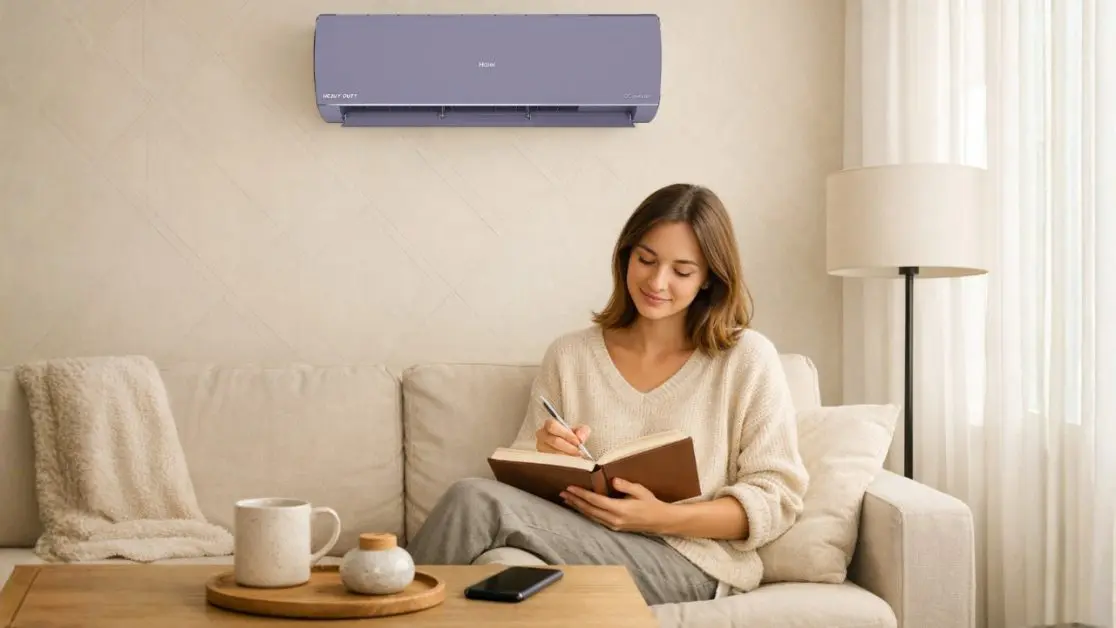
Traditional ACs followed a simple loop.
The user presses a button. The machine reacts.
Modern technology is observed first.
They learn patterns, detect occupancy, and adjust automatically.
For example:
- AI pre-cooling prepares the room before arrival
- Target cooling directs airflow where it is needed
- Eco modes adjust performance based on temperature gaps
These technologies work because they operate within the right capacity range.
If tonnage is mismatched, even smart features struggle to perform efficiently.
Technology optimises. But capacity defines the boundary.
A Practical Comparison: Same Room, Different Tonnage
Let’s imagine a 150 sq. ft. bedroom in peak summer.
Scenario 1: 1 Ton AC
- Takes longer to cool
- Runs continuously
- Higher monthly bill
- Uneven comfort
Scenario 2: 2 Ton AC
- Cools quickly
- Stops too soon
- Humidity remains
- Frequent restarts
Scenario 3: 1.5 Ton AC
- Balanced cooling time
- Stable temperature
- Lower energy usage
- Comfortable sleep
The difference is not technical.
It is experiential.
The One Insight Most People Miss
Cooling is not about speed. It is about stability.
A room that cools slowly but stays consistent feels better than one that swings between extremes.
Tonnage controls that stability.
Where Haier Fits Into This Conversation
Haier approaches cooling as a technology, not just a machine.
That is where features like AI Atmox come into play.
- It learns user habits in real time
- Adjusts cooling based on environment and occupancy
- Balances comfort with energy savings
- Reduces unnecessary power usage
These capabilities matter most when the AC is correctly sized.
Because the right tonnage allows these technologies to operate in their optimal range.
Not struggling. Not overcompensating.
Just working.
Choosing Tonnage Is Actually About Choosing Experience
People think they are buying an AC.
They are actually choosing how their evenings feel.
- Will the room cool evenly?
- Will sleep feel uninterrupted?
- Will bills stay predictable?
- Will the technology last for years?
Tonnage decides all of this silently.
A Simple Decision Checklist
Before buying an AC, ask:
- What is the exact room size?
- How much sunlight enters daily?
- How many people use the room regularly?
- What appliances generate heat inside?
- Is insulation strong or weak?
Then decide.
Not based on price.
Not based on guesswork.
But based on fit.
The Bigger Pattern Most People Overlook
This is not just about air conditioners.
It is about technology thinking.
Every technology works best when capacity matches demand.
- Too little, and it struggles
- Too much, and it wastes
- Just right, and it disappears into efficiency
AC tonnage is one example of a larger truth.
Efficiency is not about adding more. It is about choosing right.
Final Thought: Comfort Should Not Need Constant Adjustment
The best cooling technology does something quietly powerful.
They make themselves invisible.
No constant remote changes.
No second-guessing temperature.
No discomfort.
Just a room that feels right.
That starts with one decision.
Choose the right tonnage. Everything else follows.
Frequently Asked Questions
How do I know if my AC tonnage is wrong for my room?
If your room cools unevenly, the AC runs constantly, or keeps switching on/off frequently, your tonnage is likely mismatched.
Is it safer to just buy a bigger AC to avoid undercooling?
No. Bigger ACs cool too fast and shut off early, leading to humidity issues and uneven comfort.
Why does my room still feel uncomfortable even when the temperature is set correctly?
Because tonnage controls heat removal, not just the temperature reading.
Do AI features like smart cooling actually make a difference?
Yes, but only when the AC is correctly sized.
Can smart ACs adjust for wrong tonnage automatically?
No. They optimize performance but cannot compensate for incorrect capacity.
Is investing in smart AC features worth it?
Yes if your base tonnage is correct, they can significantly improve comfort and efficiency.