
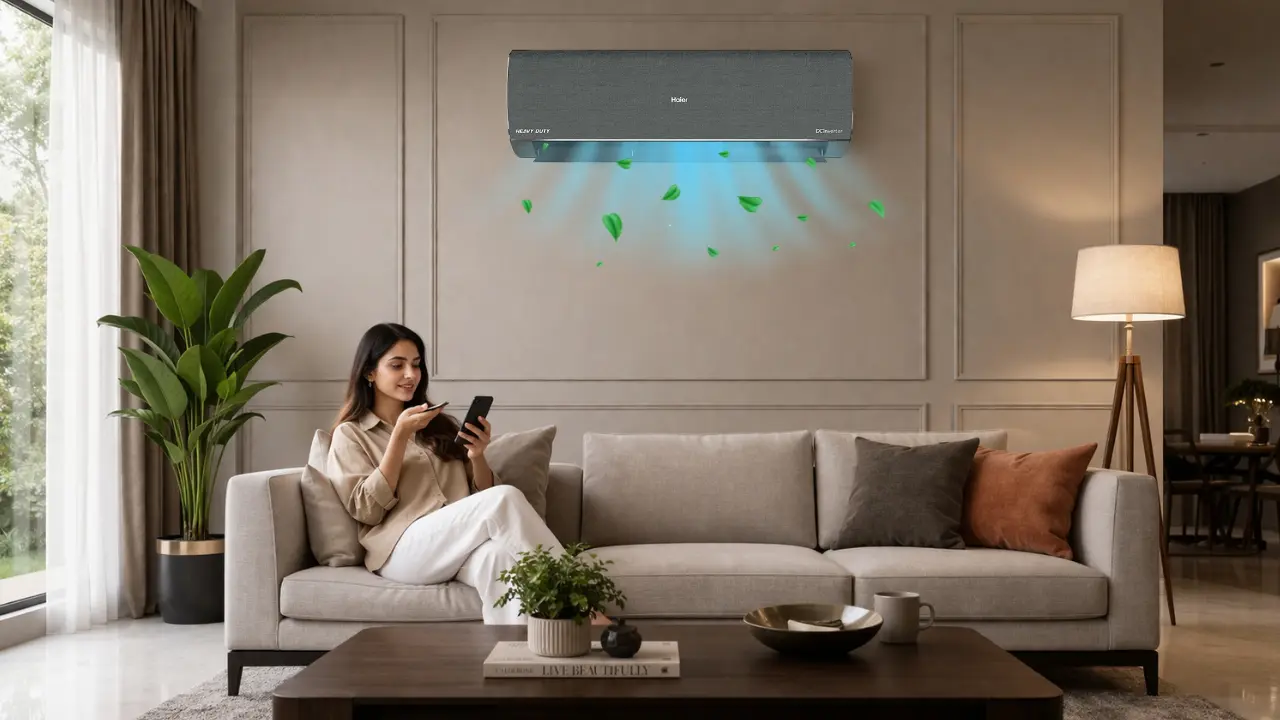

The right AC capacity depends on your room size, ceiling height, sunlight exposure, and usage patterns. As a rule, smaller rooms (up to 120 sq ft) need 1 ton, medium rooms (120 to 180 sq ft) need 1.5 tons, and larger rooms (180 to 300 sq ft) need 2 tons.
But real comfort comes from matching capacity to how the room actually behaves.
Why does AC capacity feel confusing even when the math looks simple?
Walk into a 2BHK in May.
One room cools in minutes. Another feels warm even after 30 minutes.
Same AC brand. Same temperature setting.
Different experiences.
This is where most people get it wrong.
Room size is not just square feet. It is behavior.
- How many people sit inside
- How much sunlight hits the walls
- How often doors open
- How heat builds up during the day
Cooling is not about size alone. It is about load.
And once you see it this way, AC capacity stops being confusing.
It becomes predictable.
What does AC capacity actually mean?
Understanding tonnage in simple terms
AC capacity is measured in tons. But it has nothing to do with weight.
1 ton AC = cooling capacity to remove 12,000 BTU per hour.
That is the amount of heat it can pull out of a room.
Think of it like this.
A small bucket removes water slowly.
A bigger bucket clears it faster.
Capacity is simply how fast your AC can remove heat.
Standard AC capacity vs room size chart
| Room Size (sq ft) | Recommended AC Capacity |
| Up to 120 sq ft | 1 Ton |
| 120 to 180 sq ft | 1.5 Ton |
| 180 to 300 sq ft | 2 Ton |
This is the starting point.
Not the final answer.
What most people ignore when choosing AC capacity
The hidden variables that change everything
Two identical rooms on paper can behave completely differently.
Here are the real factors that shift AC performance:
- Sunlight exposure
West-facing rooms heat up faster. Add 10 to 20 percent more capacity. - Ceiling height
Higher ceilings mean more air volume. Standard assumption is 10 feet. - Number of occupants
Each person adds heat. A family of four changes the equation. - Appliances inside the room
TVs, laptops, lights all generate heat. - Insulation quality
Poor insulation leaks cool air constantly.
Rooms are systems. Capacity must match the system.
Three ways people choose AC capacity

One option is: Follow the standard chart
- Simple
- Quick decision
- Works for most average rooms
Cost: Low effort
Risk: Slight underperformance in extreme conditions
The second option: Oversize the AC
Many people assume bigger is always better.
It is not.
- Faster cooling initially
- But frequent on-off cycles
- Higher electricity bills
- Less humidity control
Cost: Higher electricity usage
Benefit: Quick cooling bursts
The third option: Right-size with real conditions
This is the smartest approach.
- Match capacity with sunlight, usage, and layout
- Use inverter ACs for flexibility
- Let technology adapt cooling dynamically
Cost: Slightly more thought upfront
Benefit: Long-term comfort + energy savings
Why undersized ACs quietly fail
An undersized AC does not just cool slower.
It works harder.
All the time.
- Compressor runs continuously
- Electricity consumption increases
- Cooling feels uneven
- Lifespan reduces
An AC that struggles costs more than an AC that fits.
Why oversized ACs feel uncomfortable
This is counterintuitive.
A bigger AC cools faster. But comfort is not just temperature.
It is also humid.
Oversized ACs:
- Cool too quickly
- Do not run long enough to remove humidity
- Leave the room feeling cold but sticky
Comfort is not speed. It is balanced.
Real Indian home scenarios that change AC capacity decisions
Scenario 1: The compact bedroom (110 sq ft)
- 2 people
- Low sunlight
- Minimal electronics
Best fit: 1 Ton AC
Scenario 2: The living room that hosts everything (180 sq ft)
- 4 to 6 people
- TV, lights, constant movement
- Frequent door opening
Best fit: 1.5 Ton or even 2 Ton depending on usage
Scenario 3: The top-floor bedroom in summer (150 sq ft)
- Direct roof heat
- High ambient temperature
Best fit: 1.5 Ton with strong inverter support
The role of inverter ACs in modern capacity decisions
Traditional thinking was rigid.
Choose a tonnage. Stick with it.
But inverter ACs change the system.
They adjust power dynamically.
Instead of switching on and off, they scale up or down.
This means:
- Better energy efficiency
- More stable cooling
- Less dependency on exact sizing
Where smart cooling changes the game
Modern systems like AI-based cooling take this further.
According to the AI Atmox system, the AC can:
- Analyze room temperature and environment
- Learn usage patterns over time
- Adjust cooling automatically for comfort and savings
This shifts the question.
From:
“What size AC should I buy?”
To:
“How intelligently does my AC adapt to my room?”
A simple decision framework you can actually use
Step 1: Start with room size
Use the standard chart.
Step 2: Adjust for real-world factors
Add capacity if:
- Room gets strong sunlight
- Ceiling is higher than 10 feet
- Room has many people or appliances
Step 3: Choose flexibility over rigidity
Pick inverter or AI-powered ACs.
They correct small sizing errors automatically.
Step 4: Think long-term, not just upfront
Ask:
- Will this AC run for 8 hours daily?
- Will electricity costs matter over years?
- Will comfort matter more than initial price?
Common mistakes people make
Mistake 1: Buying based on price alone
Lower capacity looks cheaper upfront.
Higher bills later.
Mistake 2: Assuming all rooms behave the same
Every room has its own thermal personality.
Mistake 3: Ignoring usage patterns
A guest room and a daily-use room need different thinking.
Mistake 4: Not factoring Indian climate extremes
Indian summers regularly cross 40°C.
Capacity decisions must reflect that.
Room size vs AC capacity quick reference
- Small bedroom: 1 Ton
- Medium bedroom or study: 1.5 Ton
- Living room or large bedroom: 2 Ton
- Top floor or high sunlight: Add 0.5 Ton buffer
The bigger idea most people miss
Choosing AC capacity is not about buying a machine.
It is about designing comfort.
A well-sized AC:
- Cools evenly
- Runs efficiently
- Lasts longer
- Feels invisible
A poorly sized AC:
- Demands attention
- Needs constant adjustment
- Creates discomfort
Good cooling disappears into your life. Bad cooling keeps reminding you it exists.
What this means for modern Indian homes
Homes are changing.
- Smaller spaces in cities
- Multi-use rooms
- Work-from-home setups
- Higher appliance usage
This makes static decisions outdated.
The future is adaptive cooling.
Systems that:
- Learn
- Adjust
- Optimize
Quietly.
Final thought: Capacity is a decision about control
You are not choosing between 1 ton and 1.5 tons.
You are choosing between:
- Constant adjustment
- Or effortless comfort
Between:
- Reactive cooling
- Or intelligent cooling
And once you experience the difference, you stop thinking about tonnage.
You start thinking about how the room feels.
That is the shift.
That is the system.
And that is where real comfort begins.
Frequently Asked Questions
Does the number of people in my room really affect AC performance?
Yes. Each person adds body heat. A room with 4 people needs more cooling than the same room with 1 person.
I have a TV, laptop, and lights running all day. Does that matter?
Absolutely. Electronics generate heat, increasing the cooling load.
My ceiling is higher than normal. Should I increase AC capacity?
Yes. More height = more air volume = more cooling needed.
How much does sunlight exposure affect AC capacity?
A lot. West-facing or top-floor rooms may need 10–20% more capacity.
My AC runs all the time but doesn’t cool properly. Why?
Likely undersized. It’s constantly trying to catch up but never reaches the desired temperature.
My AC cools quickly but turns on and off frequently. Is that bad?
Yes. That’s short cycling, usually due to oversized capacity. It wastes energy and reduces lifespan.
Is inverter AC worth it if I’m unsure about tonnage?
Yes. Inverter ACs:
Adjust power dynamically
Reduce energy consumption
Handle slight sizing mismatches better
What does AI cooling actually do?
Systems like AI-based cooling:
Learn your usage patterns
Adjust temperature automatically
Optimize comfort and efficiency over time
Can smart ACs reduce electricity bills?
Yes, because they avoid constant on-off cycles and run more efficiently.