
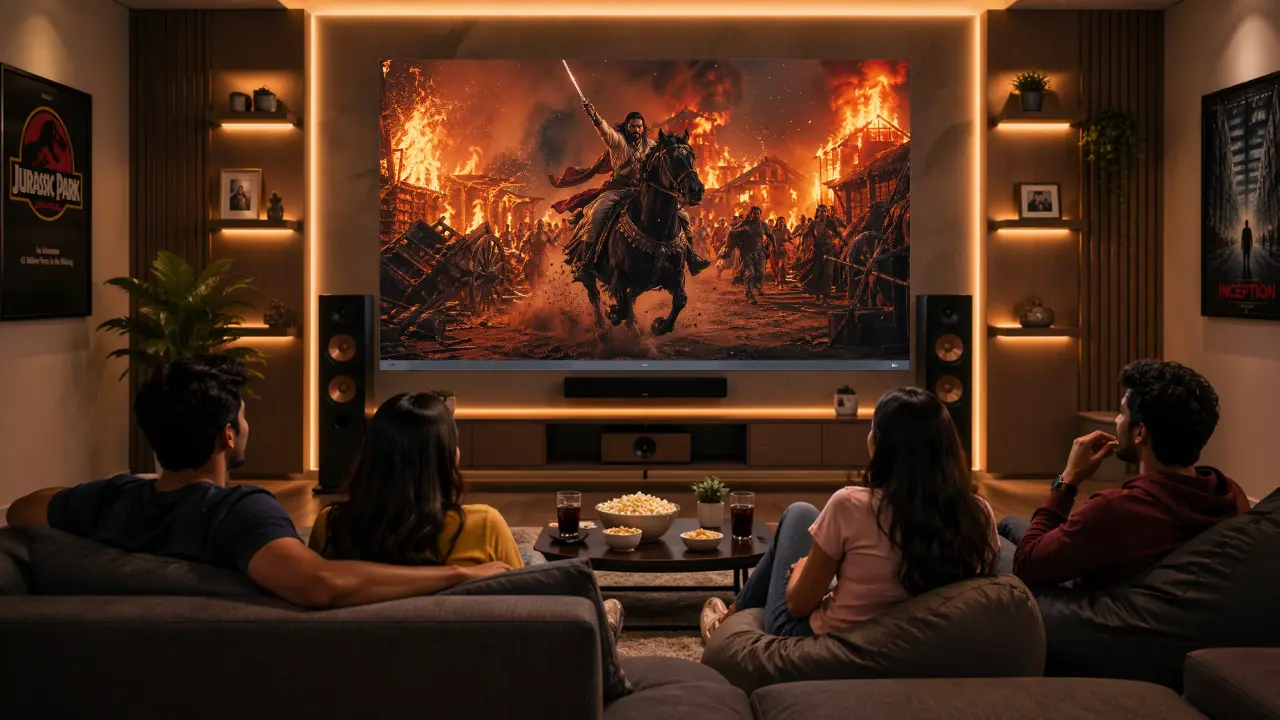

Yes, Dolby Atmos is worth it in TVs if you care about immersive, room-filling sound. It transforms flat audio into a layered, three-dimensional experience.
But its real value depends on your room, your content habits, and whether your TV has the right hardware to support it fully.
You don’t notice sound until it disappoints you
Picture this.
It’s a Sunday evening. India vs Pakistan. The room is full. Snacks are sorted. The screen looks stunning.
And then the sound feels thin.
The stadium doesn’t feel like a stadium. The crowd feels distant. The moment feels smaller than it should.
That’s the gap Dolby Atmos tries to fix.
Not a louder sound. Better placed sound.
Because sound is not just volume. Its direction. It’s deep. It’s presence.
And once you notice the difference, it’s hard to go back.
What exactly does Dolby Atmos do differently
Most TV audio is flat.
It comes from a fixed direction. Usually from below or behind the screen.
Dolby Atmos changes that.
Instead of treating sound like a straight line, it treats it like space.
Here’s what that means in real life
- Dialogue feels anchored to the screen, not floating somewhere vague
- Background sounds move around you, not just across you
- Effects feel layered, not stacked
In simple terms, Dolby Atmos creates a three-dimensional sound field.
You don’t just hear the scene. You feel inside it.
The hidden system: Why immersive sound matters more today
Streaming changed how we consume content.
But it also changed how content is produced.
Platforms like Netflix, Prime Video, and Disney+ now mix audio in Dolby Atmos for premium content.
That means:
- Movies are designed for spatial sound
- Series use layered audio cues for storytelling
- Sports broadcasts simulate stadium environments
If your TV cannot reproduce that, you are not watching the full experience.
You are watching a compressed version of it.
Not all Dolby Atmos TVs feel the same
This is where most buying decisions go wrong.
People assume Dolby Atmos is a simple yes or no feature.
It’s not.
It’s a system.
Three factors decide the real experience
1. Speaker setup inside the TV
For example, TVs with a 2.1 channel speaker system and dedicated woofer delivering 50W output create deeper bass and clearer separation.
This is essential because Dolby Atmos relies on layering.
2. Audio tuning and partnerships
Some TVs integrate sound systems engineered by audio brands.
For instance, Sound by KEF enhances clarity, precision, and bass performance, elevating the Dolby Atmos effect.
Speaker engineering directly affects how sound fills your room.
3. Processing and optimisation
Modern TVs use AI processors to adjust sound based on scenes.
Dialogue. Action. Music.
Each requires different tuning.
Without this, even Dolby Atmos feels inconsistent.
So when is Dolby Atmos actually worth it
Let’s make this practical.
One option: You watch mostly casual content
- Daily news
- YouTube
- Background viewing
Verdict: Not critical
Second option: You binge shows and movies regularly
- OTT platforms
- Weekend movie nights
Verdict: Worth it
Most OTT content supports Dolby Atmos.
You will notice richer sound and better immersion.
Third option: You care about experience
- Sports nights
- Gaming sessions
- Cinematic viewing
Verdict: Absolutely worth it
It turns watching into experiencing.
Cost vs benefit: What are you really paying for
| Factor | Without Dolby Atmos | With Dolby Atmos |
| Sound direction | Flat | Multi-dimensional |
| Dialogue clarity | Average | Sharp |
| Immersion | Limited | High |
| Content compatibility | Basic | Future-ready |
| Overall experience | Functional | Cinematic |
The real trade-off
- Slightly higher upfront cost
- Significantly better daily experience
This is not a feature upgrade. It is a perception upgrade.
Where Haier TVs bring this together
Modern TVs are no longer just screens.
They are complete entertainment systems.
Take the Haier M80F Mini LED 189cm (75) Google TV (H75M80FUX).
It combines:
- Dolby Atmos for spatial audio
- Sound by KEF for refined acoustic performance
- 2.1 channel speakers with 50W output for depth and clarity
Or consider the Haier M92 Series 164cm (65) QD-Mini LED AI Smart Google TV (H65M92FUX).
It adds:
- Dolby Atmos with Total Sonic enhancement
- AI-driven sound optimisation
- Advanced picture and audio integration through AI Center MAX
Here, Dolby Atmos is not working alone.
It is supported by hardware, AI processing, and acoustic tuning.
That is what makes the difference visible and audible.
The myth: “I’ll just buy a soundbar later”
This sounds practical.
But most people delay it.
Or skip it entirely.
What actually happens
- You buy a great TV
- You postpone audio upgrades
- You adjust to average sound
Convenience quietly wins.
A better way to think about it
Think of Dolby Atmos like lighting in a home.
One tube light works.
But layered lighting transforms the space.
Sound works the same way.
Common questions people don’t ask
Does room size matter
Yes. Smaller rooms enhance the effect faster.
Does content matter
Yes. OTT platforms are optimised for Dolby Atmos.
Is it about volume
No. It is about positioning and depth.
The deeper pattern: What this choice really reflects
This is not just about Dolby Atmos.
It is about how we choose everyday experiences.
Do we settle for functional?
Or do we invest in how life feels daily?
Your TV is not just a device.
It is where moments happen.
So, is Dolby Atmos worth it in TVs
Yes.
If your TV is central to your lifestyle, Dolby Atmos is not optional.
It is foundational.
The one insight to remember
Good visuals show you the story. A great sound puts you inside it.
And once you step inside, everything else feels incomplete.
Frequently Asked Questions
Do I really need Dolby Atmos in my TV, or is it just marketing?
It’s not just marketing. If you watch movies, sports, or OTT content regularly, Dolby Atmos noticeably improves immersion by adding depth and direction to sound, not just loudness.
Is Dolby Atmos worth the extra money for everyday TV use?
If your usage is mostly news or casual YouTube, not really. But for movies, series, or sports, it’s a meaningful upgrade you’ll notice daily.
Will I regret not choosing a Dolby Atmos TV later?
Likely yes especially as more content is produced in Atmos. Once you experience it, going back to flat sound feels underwhelming.
Does Dolby Atmos really make a difference on TV speakers alone?
Yes but only if the TV has good hardware (like a 2.1 channel system and decent output). Otherwise, the effect is limited.
Is Dolby Atmos about louder sound?
No. It’s about spatial placement where sound comes from, not how loud it is.
Do I need a special room setup for Dolby Atmos?
Not necessarily. Smaller to medium rooms actually enhance the effect because sound reflects more effectively.
Do streaming apps actually support Dolby Atmos?
Yes, platforms like Netflix, Amazon Prime Video, and Disney+ offer Atmos content on premium titles.
Does AI in TVs improve Dolby Atmos sound?
Yes. AI processors adjust sound dynamically for dialogue, action, and music, making Atmos more consistent.