
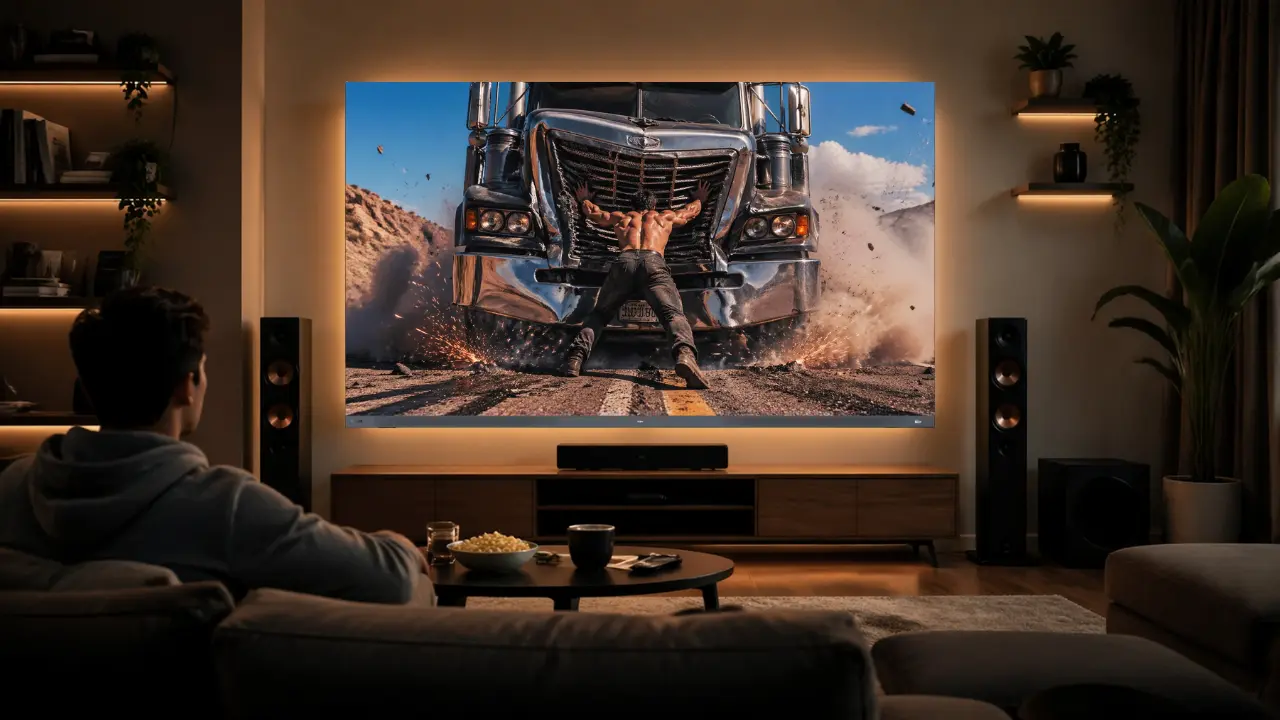

Dolby Atmos on Haier TVs creates a 3D sound experience where audio moves around you, not just from the screen, making movies, cricket matches, and music feel immersive and real inside your living room.
It is not a louder sound.
It is a smarter sound.
And once you notice it, normal TV audio starts to feel flat.
Why does regular TV sound feel… limited?
Picture this.
India vs Pakistan. Final over. Everyone in the room is silent.
The bowler runs in.
You hear the crowd. The commentator. The bat.
But everything feels like it’s coming from one place.
The TV.
That is the limitation of traditional audio.
- Sound comes forward
- It lacks direction
- It does not create space
Now compare that to a cinema.
You hear the crowd around you. The ball hits feel sharper. The stadium feels alive.
That difference is not just speakers.
It is how sound is designed.
What exactly is Dolby Atmos?
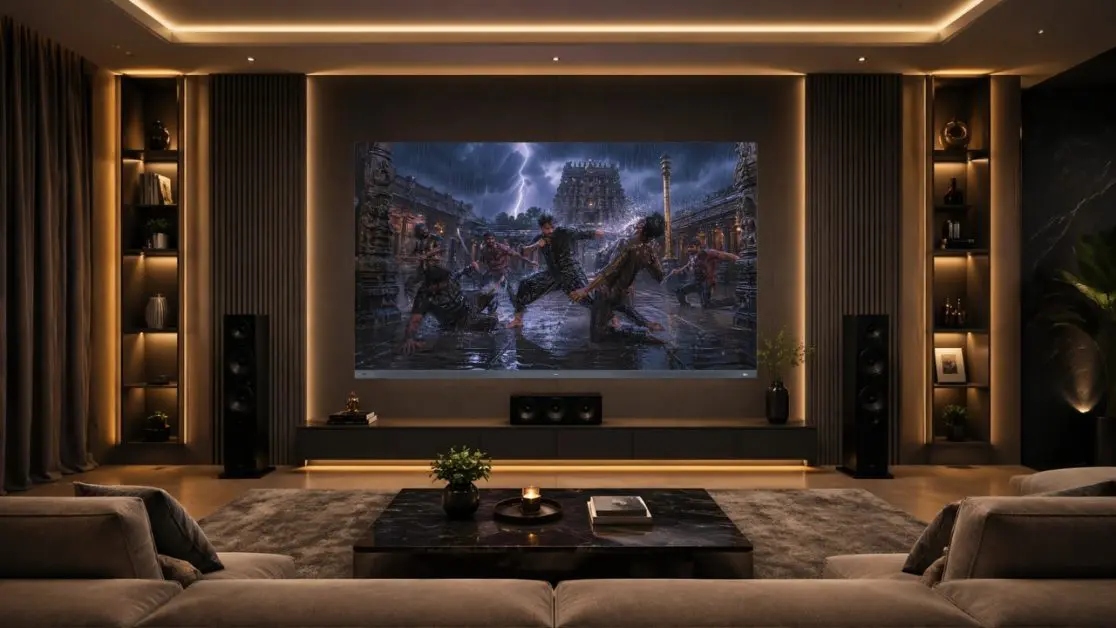
Dolby Atmos changes one simple assumption.
Sound does not belong to speakers.
Sound belongs to space.
Instead of assigning sound to fixed channels, Dolby Atmos treats audio as individual objects.
Each sound is placed in a 3D environment.
- A helicopter sounds like it is above you
- Rain feels like it is falling around you
- Dialogue stays anchored to the screen
That is why it is called three-dimensional audio
The shift in thinking
| Traditional Audio | Dolby Atmos |
| Sound tied to speakers | Sound moves in space |
| Flat left-right output | 360-degree immersion |
| Limited depth | Height, width, depth |
| Predictable | Dynamic and adaptive |
Insight:
When sound stops coming from a place and starts existing in space, immersion becomes inevitable.
How does Dolby Atmos work inside a TV?
Most people assume you need a big home theatre system.
That used to be true.
Not anymore.
Modern Haier TVs combine three layers:
1. Processing intelligence
AI processors analyse scenes and decide how sound should behave.
For example:
- Action scene = wider soundstage
- Dialogue scene = clearer voice focus
2. Speaker design
Many models use 2.1 channel systems with subwoofers, delivering deeper bass and fuller sound
That means:
- Bass for explosions
- Clarity for dialogue
- Balance for music
3. Spatial mapping (Dolby Atmos)
This is where the magic happens.
Sound is positioned:
- Around you
- Across the room
- Even above you (virtually)
In models like the
Haier M80F Mini LED 189cm (75) Google TV (H75M80FUX), Dolby Atmos combines with KEF-engineered audio to deliver precise, layered sound
Why does Dolby Atmos matter in Indian homes?
Because our homes are not theatres.
They are dynamic spaces.
- Kids talking in the background
- Kitchen noise during IPL matches
- Ceiling fans, AC hum, daily life
The challenge is not just sound quality.
It is clarity within chaos.
Dolby Atmos solves three real problems
1. Dialogue clarity
You no longer increase volume to hear conversations.
Voices stay sharp and centered.
2. Directional awareness
You feel where sound is coming from.
This matters in:
- Thrillers
- Sports
- Gaming
3. Immersion without extra setup
No wires across the room.
No complicated speaker placement.
Just one TV doing more.
Where do you actually feel the difference?

Not in specs.
In moments.
1. Cricket nights
You hear:
- Stadium chants from the sides
- Commentary upfront
- Bat impact with depth
It feels like being inside the stadium.
2. Movie nights
Explosions do not just sound loud.
They expand.
Background scores wrap around you.
Silence becomes more powerful.
3. Music streaming
Vocals feel centered.
Instruments spread out.
It feels like a live performance, not compressed audio.
The system behind the experience
Let’s break it down simply.
Haier Dolby Atmos setup typically includes:
- 2.1 channel speakers with subwoofer
- AI-driven audio optimization
- KEF sound engineering in select models
- Dolby Atmos spatial mapping
Some advanced models also include:
- Total Sonic technology for richer detail layering
- AI sound tuning for scene-based adjustment
- High power output around 50W for room-filling audio
What this means in real life
| Feature | Real-life impact |
| Subwoofer | Deeper bass in movies |
| AI Sound | Auto-adjusted clarity |
| Dolby Atmos | Surround-like experience |
| KEF tuning | Balanced audio profile |
Insight:
Technology matters only when it disappears. Dolby Atmos works when you stop noticing the TV and start feeling the scene.
One decision, three ways to think about it
When choosing a TV with Dolby Atmos, there are three paths.
Option 1: Basic TV + external speakers
- Lower upfront TV cost
- Additional setup required
- Wires, space, tuning effort
Option 2: Soundbar upgrade later
- Moderate improvement
- Extra purchase needed
- Still limited integration
Option 3: Built-in Dolby Atmos TV
- Clean setup
- Optimized performance
- No additional devices
Cost vs Benefit
| Option | Cost | Effort | Experience |
| Basic TV | Low | Medium | Average |
| Soundbar setup | Medium | Medium | Good |
| Dolby Atmos TV | Higher upfront | Low | Best |
Insight:
The cheapest system costs more over time when it keeps asking for upgrades.
How Haier fits into this shift
Haier does not treat sound as an afterthought.
It treats it as part of the system.
In models like:
- Haier M80F Mini LED Series
- Haier M92 QD-Mini LED Series
You see a pattern:
- Dolby Vision for visuals
- Dolby Atmos for sound
- AI processors connecting both
For example, the M92 series integrates Dolby Atmos with AI-driven sound tuning and Total Sonic layering for more detailed output
That combination matters.
Because sound without context is noise.
And context is what AI adds.
What most people misunderstand about sound
People chase volume.
But volume is not immersion.
A louder TV does not mean a better experience.
A better experience comes from:
- Direction
- Clarity
- Balance
- Depth
Dolby Atmos focuses on these.
Not just loudness.
Insight:
Good sound fills the room. Great sound disappears into it.
So what does this change for you?
It changes how you evaluate a TV.
Not by size.
Not by price.
But by how it makes you feel in the moment.
When you sit down after a long day.
When your family gathers for a match.
When a movie pulls you in completely.
That is when sound matters most.
The bigger idea behind Dolby Atmos
This is not just about TVs.
It is about expectations.
We are moving from:
- Watching content
to - Experiencing environments
From:
- Devices
to - systems
From:
- features
to - feelings
And Dolby Atmos sits right at that shift.
Final thought
You do not upgrade sound for specs.
You upgrade it for moments.
The moment when a crowd feels real.
When a scene gives you goosebumps.
When silence suddenly feels louder than noise.
That is when you realise:
It was never about the screen alone.
It was always about the space around you.
Frequently Asked Questions
I’m already spending a lot on a TV. Do I really need Dolby Atmos?
If you care about feeling the content, not just watching it, then yes. Dolby Atmos isn’t about louder sound, it’s about spatial realism. Once you experience it, standard audio often feels flat and one-dimensional.
Should I buy a cheaper TV and add a soundbar later instead?
That works, but it usually ends up costing more and adds clutter. A TV like Haier M80F Mini LED 189cm Google TV gives you an integrated experience with no wires, no syncing issues, and better optimization.
Will I even notice the difference in daily use?
You’ll notice it most during moments like tight cricket matches, intense movies, or music sessions. Dialogue becomes clearer, and sound starts to “move” around you.
My home isn’t a theatre. Will Dolby Atmos still make a difference?
Yes and that’s exactly where it helps most. It improves clarity in noisy environments, so voices stay sharp even with fans, kitchen sounds, or conversations around.
Do I need extra speakers around the room?
No. Modern Haier TVs simulate spatial sound using built-in speakers and processing. It’s not identical to a full theatre setup, but it’s impressively close for a single device.
Will it work in a small room?
Absolutely. In fact, smaller rooms often enhance the effect because sound reflections help create that immersive feel.