
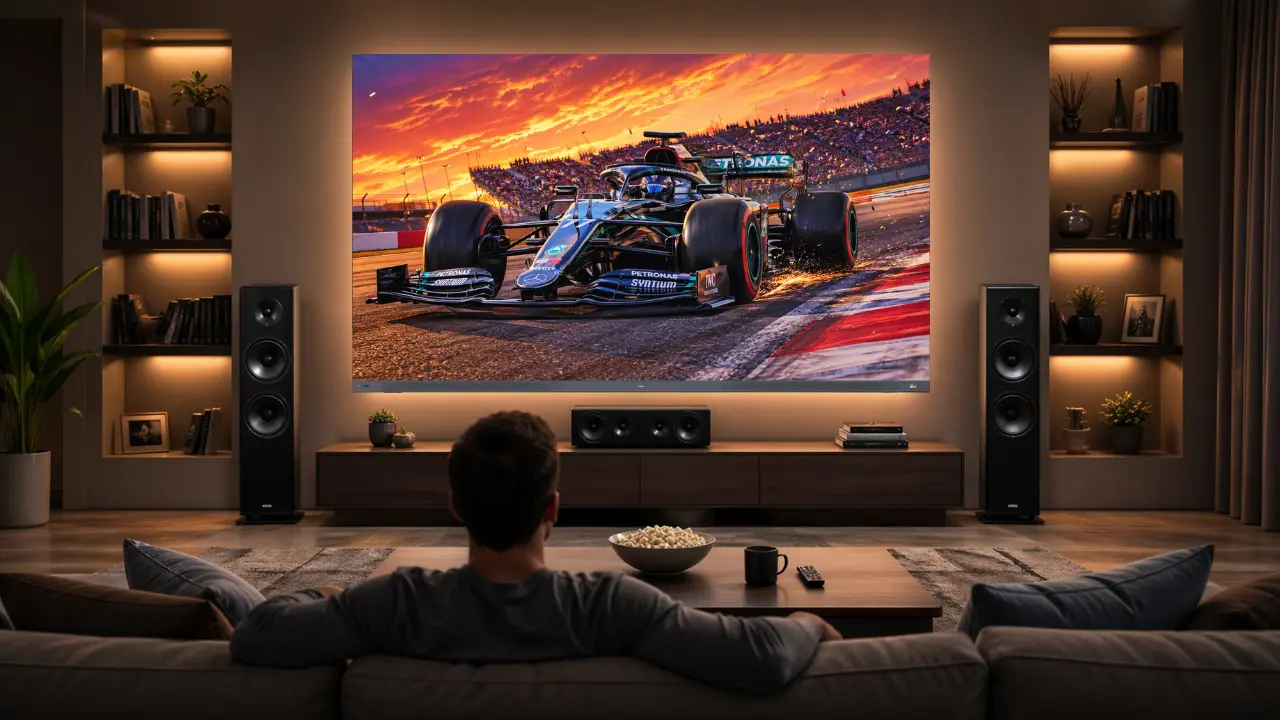

Haier TVs are ideal for sports viewing because they combine high refresh rates, AI-powered picture processing, immersive Sound by KEF-tuned sound, and large Mini LED displays.
The result is sharper motion, richer audio, and a viewing experience that feels closer to being in the stadium than sitting on a sofa.
The real problem with watching sports at home.
It is Sunday evening.
India vs Australia. Last over.
The room is full. Snacks are passed around. Someone is already predicting the outcome.
But then it happens.
The ball blurs mid-air. The sound feels distant. The moment loses its edge.
That is when you realize something important.
Sports are not just watched. They are experienced in real time.
And most TVs fail when speed and emotion peak together.
What Actually Makes a TV Great for Sports?
Most people assume a bigger screen solves everything.
It does not.
A great sports viewing experience is a combination of systems working together.
The 3 systems that define sports viewing
- Motion clarity
The ability to track fast-moving action without blur - Sound immersion
The ability to feel crowd noise, commentary, and impact - Visual intelligence
The ability to adapt to lighting and scene changes instantly
Miss one, and the experience feels incomplete.
Why Haier Solves the Motion Problem First
Fast sports expose slow TVs.
A cricket delivery, a football sprint, or a badminton smash happens in milliseconds.
What Haier changes
- Up to 144Hz refresh rate on models like
Haier New M96 Series 254cm (100) QD-Mini LED AI Smart Google TV (H100M96FUX) - Smooth motion processing powered by AI
What this means in real life
- The ball stays sharp during a fast delivery
- A football pass remains fluid across the screen
- Action feels continuous, not broken
The real trade-off
- Standard TV: affordable, but struggles with fast motion
- High refresh rate TV: sharper, more immersive, built for sports
If the motion is unclear, the moment is lost.
Why Sound Is Half the Experience
Close your eyes during a match.
You can still feel the tension.
That is sound doing its job.
What Haier does differently
- Sound by KEF for detailed, rich audio
- Dolby Atmos for 3D surround sound
- Multi-channel output for layered audio depth
Available across models like:
- Haier M80F Mini LED 215cm (85) Google TV (H85M80FUX)
- Haier New M92 Series 189cm (75) QD-Mini LED Smart AI Google TV (H75M92FUX)
What this changes
- Crowd noise surrounds you instead of sitting flat
- Commentary remains clear during intense moments
- Every hit and impact carries weight
Good visuals show the game. A great sound puts you inside it.
The Role of AI in Sports Viewing
Here is what most viewers do not notice.
Every match has changing light, fast camera cuts, and unpredictable motion.
Haier uses AI to handle this complexity
- AI Ultra Sense Processor improves motion, contrast, and color in real time
- AI Center MAX integrates visuals, sound, and gaming into one system
Seen in models like:
- Haier New M96 Series 254cm (100) QD-Mini LED AI Smart Google TV (H100M96FUX)
- Haier New M92 Series 189cm (75) QD-Mini LED Smart AI Google TV (H75M92FUX)
What AI actually does
- Detects scenes and adjusts picture instantly
- Enhances clarity during fast movement
- Balances brightness in changing lighting
The best technology is the one you never have to adjust manually.
Why Brightness and Contrast Matter in Indian Homes
Indian living rooms are not dark theatres.
They are bright, active spaces.
What Haier optimizes for
- Dolby Vision IQ and HDR10+ for dynamic contrast
- High brightness levels for daytime viewing
- AI-based ambient light adjustment
What this solves
| Situation | Standard TV | Haier TV |
| Day matches | Washed visuals | Bright and clear |
| Night matches | Flat contrast | Deep blacks |
| Mixed lighting | Uneven display | Balanced output |
A TV should adapt to your room. Not force you to change your room.
Big Screens Change How People Watch Together
Sports are rarely a solo activity.
They are social.
Where size meets experience
Large displays like:
- Haier New M96 Series 254cm (100) QD-Mini LED AI Smart Google TV (H100M96FUX)
- Haier M80F Mini LED 215cm (85) Google TV (H85M80FUX)
create a shared viewing environment.
What makes these screens different
- Wide viewing angles up to 178 degrees
- Low reflection screens
- Consistent color across seating positions
What this means at home
- Everyone gets a clear view
- No glare during daytime matches
- No bad seats in the room
A big screen is not about size. It is about inclusivity.
Smart Features That Keep Up With Modern Viewing
Sports today are not just live TV.
It is highlights, replays, streaming, and stats.
What Haier integrates
- Google TV for personalized content
- Voice control for quick navigation
- Seamless casting and connectivity
Real-life flow
- Switch from live match to highlights
- Cast clips from your phone
- Jump between apps instantly
Speed is the new convenience.
Choosing the Right Haier TV for Sports

Not every home needs the same setup.
One option is: Compact setup
- 55 to 65 TVs
- Ideal for smaller rooms
- Efficient and budget-friendly
The second option: Family viewing
- 75 to 85 TVs
- Balanced for group watching
- Best for regular sports fans
Examples:
- Haier New M92 Series 189cm (75) QD-Mini LED Smart AI Google TV (H75M92FUX)
The third option: Premium experience
- 85 to 100 TVs
- Cinematic sports viewing
Example:
- Haier New M96 Series 254cm (100) QD-Mini LED AI Smart Google TV (H100M96FUX)
Cost vs experience
- Smaller screens: affordable, less immersive
- Mid-range: balanced
- Large screens: premium, highly immersive
Your choice reflects how seriously you watch sports.
What Most Buyers Get Wrong
They buy based on size.
They ignore experience.
Common mistakes
- Choosing only on price
- Ignoring refresh rate
- Overlooking sound quality
Better approach
Think in systems.
- Motion
- Sound
- AI
- Display
A TV is not just a device. It is an experience system.
Final Thought
You do not remember every match.
You remember moments.
The last over. The winning goal. The sudden silence before impact.
The right TV does not just show those moments.
It sharpens them.
And that is why Haier stands out.
Not because it is bigger.
But because it understands how sports are meant to be experienced in real homes.
Frequently Asked Questions
I just want a good TV for cricket and football. Why is choosing one so confusing?
Because most TVs advertise size and price, not experience. Sports viewing depends on motion clarity, sound, and real-time picture processing. Without understanding these, everything starts to look the same even when performance differs a lot.
Should I spend more on a high-end TV or just get a bigger screen?
A bigger screen alone won’t fix blurry motion or weak sound. A slightly smaller TV with a higher refresh rate (like 120Hz–144Hz), better audio, and AI processing will give you a far better sports experience.
Why does the cricket ball blur on my TV during fast deliveries?
Your TV likely has a low refresh rate (60Hz). Fast-moving objects update too slowly, causing blur. TVs with 120Hz or 144Hz refresh rates keep motion sharp and smooth.
Does refresh rate really matter for sports, or is it just marketing?
It matters a lot. Sports involve constant fast motion balls, players, camera pans. Higher refresh rates make movement continuous instead of jittery or blurry.
Will I actually notice the difference between 60Hz and 144Hz?
Yes, especially during fast scenes. A football pass, cricket shot, or badminton smash looks much clearer and more natural on 144Hz.
Do I really need AI in a TV, or is it just hype?
AI helps your TV adjust instantly to fast-changing scenes like lighting shifts, quick camera cuts, and motion. Without it, you may need manual adjustments or experience inconsistent visuals.
Why does my TV look fine sometimes but bad during certain scenes?
Because it lacks real-time processing. Sports content changes rapidly, and without AI, your TV can’t adapt fast enough.
How does Google TV actually help during sports viewing?
It simplifies switching between live matches, highlights, apps, and casting. You spend less time navigating and more time watching.