

Digital interfaces improve user experience by reducing decision effort, increasing clarity, and turning complex appliance operations into simple, intuitive actions.
They replace guesswork with guided choices, making everyday tasks faster, more accurate, and less mentally exhausting.
Why does using a machine still feel like work sometimes?
It is 9:45 pm.
Dinner is done. The sink is full. A load of laundry waits.
You walk to the washing machine. And then it begins.
Which mode?
What temperature?
How much time?
Did I choose the right setting?
The machine is powerful.
But the experience is confusing.
That gap matters.
Because technology does not fail when it lacks features. It fails when it demands too many decisions.
The real problem is not complexity. It is invisible friction.
Every appliance today can do more than ever before.
A washing machine can detect load size.
An AC can sense room temperature.
A refrigerator can optimize cooling zones.
But if the interface does not translate that intelligence clearly, it creates friction.
Here is how that friction shows up:
- Users repeat the same trial-and-error cycles
- Settings feel overwhelming instead of helpful
- Time is lost in small decisions
- Features go unused
That is not a design upgrade.
That is a behavioural shift.
Digital interfaces turn machines into systems
A traditional appliance gives you controls.
A digital interface gives you a system.
That difference changes everything.
What does a system actually do?
- It reduces decision fatigue
- It guides actions in real time
- It adapts to your behaviour
Think about it like this.
A local kirana store owner knows exactly where everything is. No labels needed.
A supermarket? It needs signs, categories, navigation.
Modern appliances are becoming supermarkets.
Digital interfaces are the signage.
The shift from buttons to intelligence
Let’s break this down into three clear options.
Option 1: Manual control systems
- Requires user knowledge
- High effort
- Low adaptability
Option 2: Semi-digital systems
- Some presets
- Moderate effort
- Limited personalisation
Option 3: Intelligent digital interfaces
- Guided decisions
- Low effort
- High adaptability
The third option wins for one simple reason.
It respects your time.
How Haier uses digital interfaces to simplify real life
Look at something like the Haier 12 Kg F11 Front Load Washer & Dryer Washing Machine (HWD120-DM14F11BKU1).
It is not just a washing machine.
It is an interface-led system.
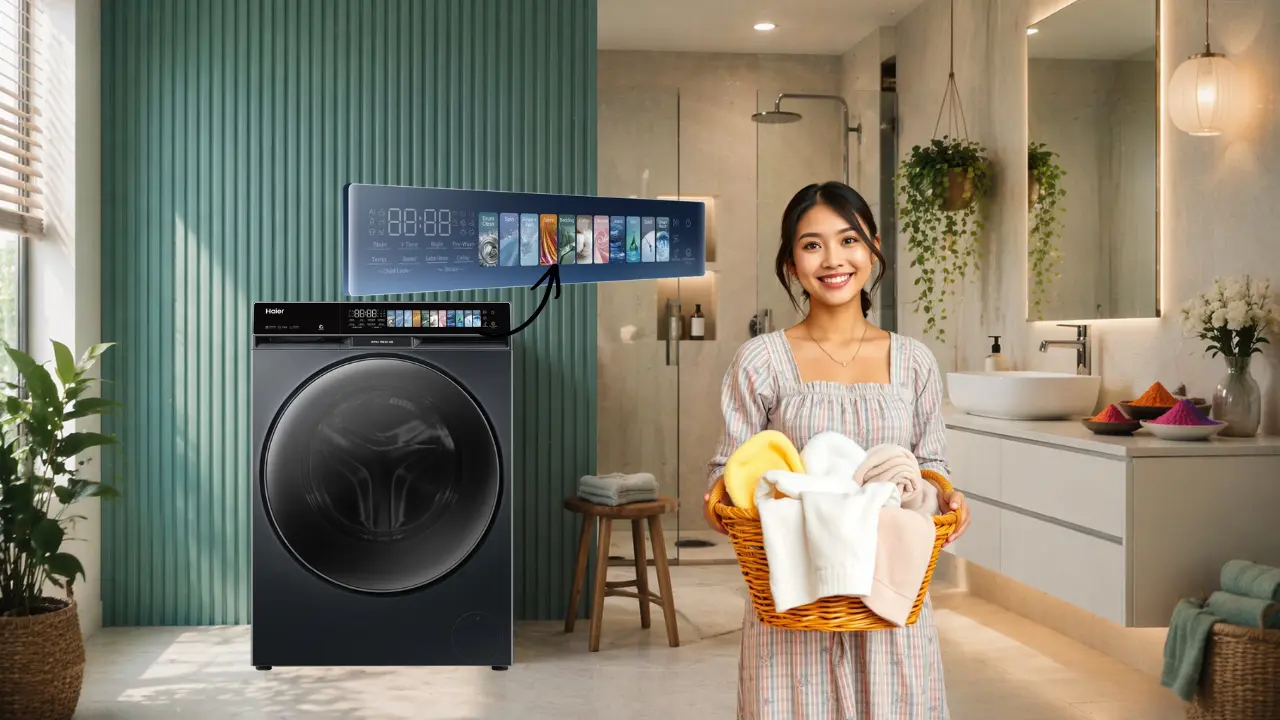
With its AI Colour Full Panel, the machine offers a visually guided, intuitive experience that replaces guesswork with clarity.
What does that change in real life?
Instead of reading labels and guessing cycles, users see:
- Fabric-specific icons
- Colour-coded programs
- Real-time feedback
The machine stops asking questions.
It starts answering them.
When one touch replaces five decisions
Let’s take a familiar situation.
Mixed laundry.
Different fabrics.
Different dirt levels.
This used to mean:
- Sorting clothes
- Selecting mode
- Adjusting temperature
- Timing the cycle
Now compare that to One Touch AI Wash in the Haier 10 Kg F9 Pro Front Load Washer Washing Machine (HW100-DM14F9PBKU1).
With a single input, the system:
- Detects fabric type
- Adjusts water level
- Sets wash duration
- Optimises energy use
This is not automation.
This is decision removal.
And that distinction matters.
Because removing decisions is how systems scale.
The hidden economics of good interfaces
Most people think digital interfaces are about convenience.
They are wrong.
They are about efficiency.
Here is a simple breakdown:
| Factor | Traditional Interface | Digital Interface |
| Time spent per task | High | Low |
| Error rate | Higher | Lower |
| Feature usage | Limited | High |
| Energy efficiency | Manual | Optimised |
In a home, that translates to:
- Lower electricity bills
- Less water waste
- Longer appliance life
Small improvements.
Compounded daily.
Why clarity beats control
There is a common assumption.
More control means better experience.
It does not.
Clarity beats control.
Every time.
Consider this.
A remote with 40 buttons vs a remote with 6 smart options.
Which one do people actually use?
Digital interfaces simplify by doing three things well:
- Showing only what matters
- Hiding complexity until needed
- Guiding decisions visually
That is why modern touch panels feel easier.
Not because they are simpler internally.
Because they are simpler externally.
Interfaces that think reduce stress you don’t notice
Some problems are visible.
Others are silent.
Decision fatigue is silent.
You do not notice it building.
You only feel the exhaustion.
A typical urban user makes over 30,000 decisions per day, according to cognitive research.
Every small appliance choice adds to that.
Now imagine removing even 10 of those daily decisions.
That is what a well-designed interface does.
It creates mental space.
Where digital interfaces go beyond washing machines
This pattern is not limited to laundry.
Look across modern homes.
In refrigerators
- Smart displays guide storage zones
- Temperature adjusts automatically
- Alerts prevent food waste
In air conditioners
- AI adapts cooling based on usage patterns
- Interfaces show real-time energy consumption
- One-touch modes simplify operation
In televisions
- Content is recommended based on viewing habits
- Navigation reduces search time
- Interfaces learn preferences
Across categories, the pattern repeats.
The interface becomes the intelligence layer.
The cost of ignoring interface design
There are only two paths for any appliance.
Path 1: Feature-heavy, interface-poor
- Confusing experience
- Low usage of advanced features
- High user frustration
Path 2: Interface-led design
- Guided usage
- Higher satisfaction
- Better long-term value
Most brands invest in features.
Few invest in experience.
That gap is where real differentiation happens.
A small detail that changes everything
Look again at the Haier 12 Kg F11 Front Load Washer Washing Machine (HW120-DM14F11BKU1).
Features like Ultra Fresh Air Technology maintain freshness for up to 12 hours with continuous airflow cycles.
But here is the real insight.
That feature becomes valuable only when:
- The interface explains it clearly
- The user understands when it works
- The system communicates status simply
Without the interface, it is just a feature.
With the interface, it becomes an experience.
The larger pattern most people miss
Digital interfaces are not about screens.
They are about behaviour design.
They answer three invisible questions:
- What should I do next?
- Am I doing this right?
- Can I trust the system?
When these questions are answered clearly, everything changes.
Tasks feel easier.
Time feels saved.
Technology feels invisible.
The one idea worth remembering
Good design removes effort. Great design removes decisions.
That is the difference digital interfaces bring into modern homes.
They do not just make appliances smarter.
They make life feel lighter.
So what does this mean for the way we choose appliances?
It shifts the question.
From:
- How many features does this appliance have?
To:
- How easily can I use what it offers?
Because in the end, unused features are just expensive decorations.
But a well-designed interface?
That is something you use every single day.
Final thought: The future of homes is not just smart. It is intuitive
The best homes are not filled with the most technology.
They are filled with the least friction.
Digital interfaces are quietly making that possible.
One tap at a time.
Frequently Asked Questions
Why does using my washing machine still feel mentally exhausting even though it’s “advanced”?
Because most machines still rely on manual decision-making you’re forced to choose modes, temperature, and timing. The problem isn’t lack of features; it’s too many micro-decisions, which creates invisible cognitive load.
I feel tired just choosing settings after dinner. Am I overthinking laundry?
Not really. You’re experiencing decision fatigue. After a full day, even small choices (like wash cycles) feel heavy. Good digital interfaces reduce this by guiding or automating decisions.
I just want clean clothes without thinking too much. Why is that still hard?
Because most machines are built around user input, not user intent. You want “clean clothes,” but the machine asks for technical inputs. Smart interfaces translate your intent into the right actions.
I mixed different fabrics in one load. Did I mess up?
Not necessarily. Traditional machines require sorting, but intelligent systems can detect fabric types and adjust automatically, reducing the risk of damage.
What’s the real benefit of a digital interface in appliances?
It reduces decision effort, increases clarity, and improves efficiency. Instead of controlling the machine, you interact with a guided system.
Are digital interfaces just about touchscreens?
No. They’re about behavior design guiding what you should do next, confirming if you’re doing it right, and building trust in the system.
What’s the biggest hidden cost of a bad interface?
Not money, time, effort, and mental energy. Over time, this leads to frustration and underuse of the appliance.