


Smart dosing improves washing efficiency by automatically measuring the exact amount of detergent based on load size, fabric type, and dirt level.
This reduces waste, saves water and energy, protects clothes, and removes the guesswork that slows down everyday laundry decisions.
Why does laundry still feel harder than it should?
It is 10:15 PM.
Dinner is done. The house is quiet. Someone remembers the laundry.
You load the machine. Add detergent. Pause.
Too much? Too little?
That moment. That hesitation. That tiny doubt.
That is where efficiency breaks.
Laundry is not hard.
Decision-making around laundry is.
And every time you guess, you pay for it.
The hidden system behind inefficient washing
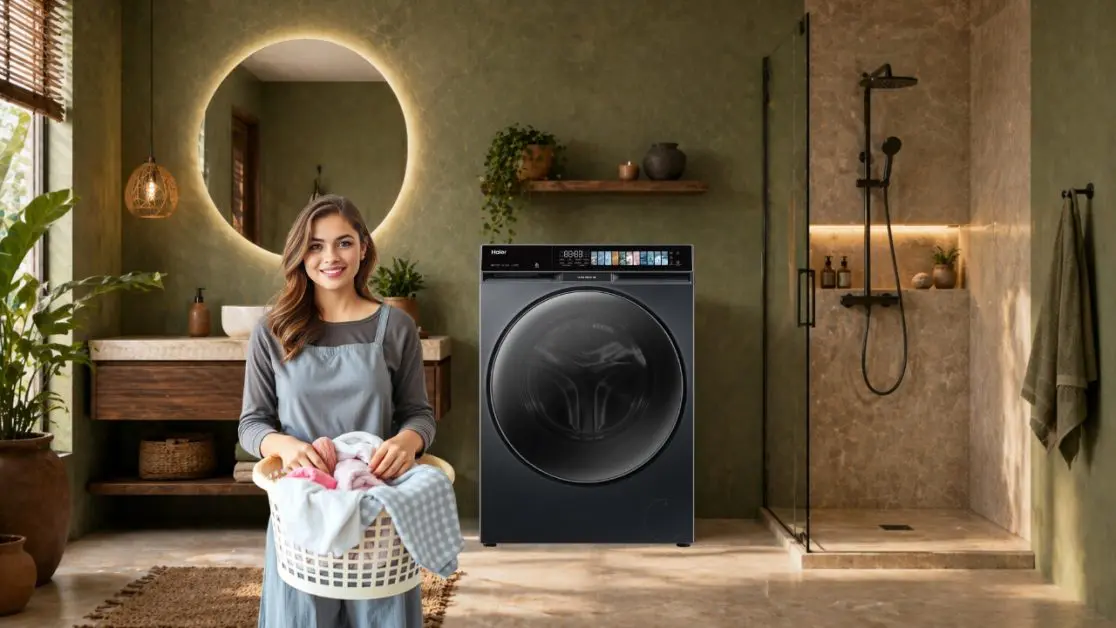
Most people think washing efficiency depends on the machine.
It does not.
It depends on three invisible variables:
- Detergent quantity
- Water usage
- Cycle precision
Get any one of these wrong, and efficiency drops.
- Too much detergent leads to residue, extra rinsing, and wasted water
- Too little detergent leads to poor cleaning and repeat washes
- Wrong combinations increase electricity consumption by up to 15 to 20 percent in typical Indian households
The problem is simple.
Humans are bad at measuring invisible things.
What is Smart Dosing, really?
Smart dosing is not a feature. It is a decision system.
Instead of asking you to decide detergent quantity every time, the machine calculates it.
It looks at:
- Load weight
- Fabric type
- Dirt intensity
Then it decides the exact amount of detergent needed.
On advanced machines like the Haier F11 series, smart dosing systems can even adjust detergent levels dynamically, ensuring precision across different loads.
One insight stands out:
Efficiency is not about doing more. It is about removing unnecessary decisions.
Three ways people approach detergent today
Let’s break it down.
1. The guesswork method
One scoop. Sometimes two. Sometimes more.
- Cost: inconsistent results
- Impact: higher water usage, detergent waste
- Outcome: unpredictable cleaning
2. The fixed-measure method
Same quantity every time.
- Cost: overuse on small loads, underuse on heavy loads
- Impact: reduced efficiency
- Outcome: average results
3. The smart dosing system
The machine calculates and adjusts every cycle.
- Cost: minimal manual effort
- Impact: optimized detergent, water, and time
- Outcome: consistent, efficient washing
The pattern is clear.
The more decisions you remove, the better the system performs.
How Smart Dosing directly improves washing efficiency
Efficiency is not one thing. It is a combination.
Let’s break it into four measurable gains.
1. Precision detergent usage
Smart dosing ensures exact measurement.
- Reduces detergent waste by up to 30 percent
- Prevents residue build-up on clothes
- Maintains fabric softness over time
2. Lower water consumption
Less detergent means fewer rinse cycles.
- Saves water per load
- Reduces overall wash time
- Improves rinse efficiency
3. Energy savings
Shorter cycles and optimized rinsing reduce power usage.
- Lower electricity consumption
- Better long-term cost efficiency
- Improved sustainability footprint
4. Better cleaning performance
The right detergent quantity improves stain removal.
Machines like the Haier 12 Kg F11 Front Load Washing Machine (HW120-DM14F11BKU1) combine smart dosing with systems like Essence Wash, which pre-mixes detergent for deeper penetration into fabrics.
That means:
- Faster stain removal
- Reduced wash cycles
- Cleaner results in less time
Efficiency is not speed. It is alignment
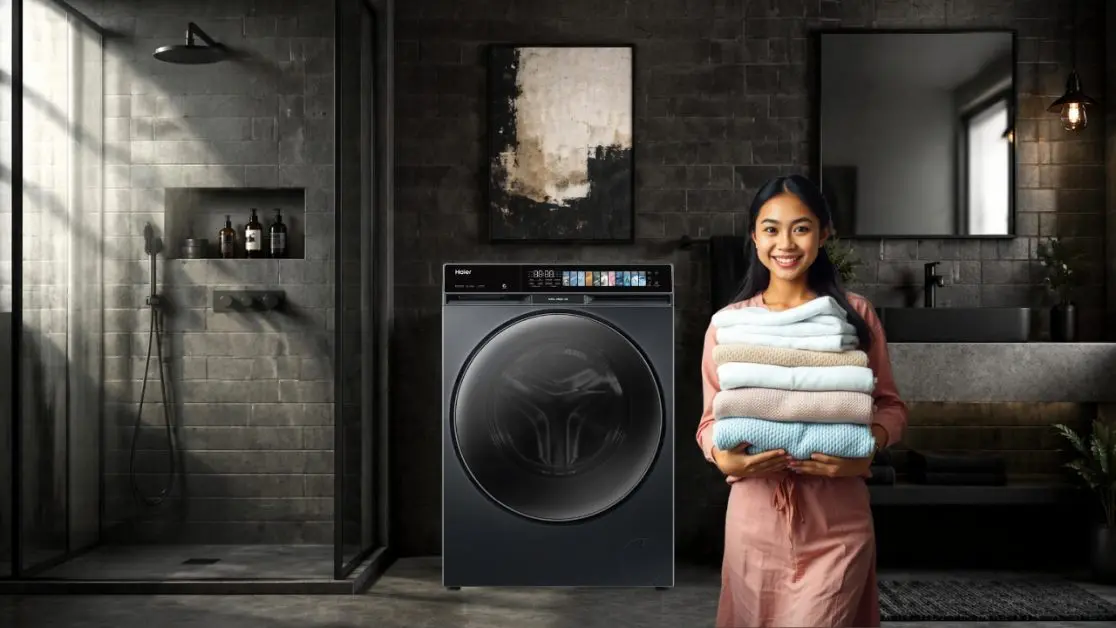
Most people think faster washing means better efficiency.
It does not.
Efficiency comes from alignment between:
- Load size
- Detergent quantity
- Water level
- Cycle duration
Smart dosing aligns all four.
Think of it like cooking.
Too much salt ruins the dish. Too little makes it bland. The right amount makes everything work.
Laundry follows the same principle.
The real cost of overusing detergent
Let’s make it tangible.
| Habit | Immediate Effect | Long-Term Cost |
| Extra detergent | More foam | Residue on clothes |
| Excess foam | Extra rinse cycles | Higher water bills |
| Frequent rinsing | Longer cycles | Increased electricity use |
| Residue build-up | Fabric damage | Shorter clothing lifespan |
Now multiply this across 4 to 5 washes a week.
That is where inefficiency hides.
Quiet. Invisible. Expensive.
How smart systems change behaviour without asking
Here is the interesting part.
Smart dosing does not just improve machines.
It improves habits.
You stop thinking about detergent.
You stop overcompensating.
You stop second-guessing.
Over time, your entire laundry process becomes:
- Faster
- Simpler
- More consistent
Machines like the Haier 12 Kg F11 Washer and Dryer (HWD120-DM14F11BKU1) take this further by combining smart dosing with one-touch AI washing, which automatically selects the right wash settings based on load conditions.
That is not automation for the sake of it.
That is decision removal at scale.
Smart Dosing and the Indian household reality

Let’s bring this closer to home.
In Indian households, laundry is rarely uniform.
One day it is office shirts.
Next day it is gym clothes.
Then bedsheets. Then festive wear.
Each load is different.
But most people treat them the same.
That mismatch is where inefficiency begins.
Smart dosing solves this by adapting in real time.
No two loads are treated the same.
And that is the point.
What makes Smart Dosing different from traditional automation?
Most automation adds steps.
Smart dosing removes them.
That distinction matters.
Traditional approach:
- Select mode
- Measure detergent
- Adjust water
- Monitor cycle
Smart dosing approach:
- Load clothes
- Press start
That is it.
Good technology reduces thinking, not increases it.
A simple framework to evaluate washing efficiency
If you are thinking about upgrading your laundry setup, use this lens.
Ask three questions:
1. Does the system reduce decisions?
If you still have to guess detergent every time, efficiency is capped.
2. Does it adapt to different loads?
Fixed systems cannot handle variable Indian laundry patterns.
3. Does it optimize resources automatically?
Water, electricity, detergent should all adjust without manual input.
Smart dosing checks all three.
The bigger shift: From appliances to systems
There is a larger pattern here.
Washing machines are no longer just machines.
They are becoming systems that think.
- AI detects load conditions
- Smart dosing adjusts detergent
- Programs optimize washing cycles
For example, Haier’s One-Touch AI Wash automatically senses fabric type, load, and dirt level to choose optimal settings.
Each layer removes friction.
Each layer improves efficiency.
So what changes for you?
Not everything.
Just the part that used to slow you down.
Laundry becomes:
- Less about decisions
- More about outcomes
You stop measuring.
You stop adjusting.
You start trusting the system.
And slowly, something interesting happens.
Laundry stops feeling like a task.
The insight most people miss
People try to become better at laundry.
They learn settings. Watch tutorials. Experiment with detergent.
But the real shift is simpler.
You do not need to get better at laundry.
Your system needs to get better at thinking for you.
Final thought: Efficiency is a design choice
Every home has systems.
Some are manual. Some are automatic. Some are intelligent.
The difference is not effort.
It is design.
Smart dosing is not about saving detergent.
It is about designing a system where nothing is wasted:
- Not time
- Not energy
- Not attention
And once you see that, you stop asking:
“How much detergent should I use?”
You start asking:
“Why should I decide this at all?”
Frequently Asked Questions
Why do I always feel unsure about how much detergent to use?
Because detergent measurement depends on variables you cannot easily see, load size, fabric type, and dirt level. Most people rely on guessing, which creates inconsistency and hesitation every wash cycle.
Does using more detergent actually clean clothes better?
Not always. Excess detergent often creates more foam, requires extra rinsing, and leaves residue on fabrics instead of improving cleaning performance.
Why does laundry still feel mentally exhausting even with modern washing machines?
The machine may automate washing, but people still make multiple micro-decisions, detergent quantity, cycle selection, water level, and fabric care. Smart dosing removes one of the biggest recurring decisions.
How does smart dosing reduce laundry stress?
It eliminates guesswork by automatically calculating the right detergent amount for every load, so you no longer need to estimate manually.
Why do small laundry mistakes become expensive over time?
Tiny inefficiencies compound across multiple weekly washes through wasted detergent, higher water use, longer cycles, and fabric damage.
What is smart dosing in a washing machine?
Smart dosing is an automated system that calculates and dispenses the exact detergent amount based on load conditions.
How is smart dosing different from traditional automation?
Traditional automation often adds settings and complexity. Smart dosing removes decisions entirely by handling detergent measurement automatically.
What does AI wash technology actually do?
AI washing systems detect fabric type, load weight, and dirt level to optimize detergent usage and washing cycles automatically.
Do smart washing machines really think for you?
Modern systems use sensors and algorithms to reduce manual decisions and optimize efficiency without requiring constant adjustments.
Why are washing machines becoming more intelligent?
Appliance design is shifting from manual control toward adaptive systems that reduce waste, save time, and simplify household routines.