


The right AC capacity for your living room depends on room size, ceiling height, sunlight exposure, and usage patterns.
A simple rule works: 1 ton for 100 to 130 sq ft, 1.5 ton for 130 to 190 sq ft, and 2 tons for larger spaces. But real comfort comes from adjusting this baseline using how your home actually behaves.
Why does AC capacity feel confusing in real homes?
It is 8:45 pm.
The TV is on. The lights are warm. Someone just walked in after a long day.
The AC is running.
But the room still feels… slightly uncomfortable.
Not hot. Not cool. Just off.
This is not a machine problem.
It is a capacity problem.
Cooling is not about switching on an AC. It is about matching the system to the space.
And most people skip that thinking.
What does “AC capacity” actually mean?

Capacity is not power consumption.
It is not electricity usage.
It is a cooling ability.
Measured in tons.
One ton of AC can remove a certain amount of heat per hour. Roughly 12,000 BTU.
That sounds technical.
Here is the simple version:
Capacity decides how quickly and how effectively your room cools.
- Too small → AC runs constantly, struggles, wastes electricity
- Too big → AC cools too fast, switches off early, wastes energy and comfort
The right capacity is not about more. It is about fit.
The baseline rule most people use
Let us start simple.
Because most decisions start simple.
Living Room AC Capacity Table
| Room Size (sq ft) | Recommended Capacity |
| Up to 120 | 1 Ton |
| 120 to 180 | 1.5 Ton |
| 180 to 260 | 2 Ton |
This works.
But only as a starting point.
Because homes are not boxes. They are ecosystems.
Why the same size room feels different in two homes
Walk into two living rooms.
Same square footage.
Same layout.
Different experiences.
Why?
Because heat is not just about space. It is about what enters and what stays.
The hidden variables most people ignore
- Sunlight exposure from windows
- Number of people regularly in the room
- Electronics like TVs, gaming consoles, lights
- Ceiling height
- Open kitchen or connected spaces
Each of these adds heat.
Each of these shifts your requirement.
Capacity is not a number. It is a response to conditions.
The three ways to calculate AC capacity

Most people follow one method.
Smart buyers compare three.
1. The Quick Rule Method
You already saw this.
- Fast decision
- Good for standard rooms
- Ignores real-world variations
Best for: Basic estimation
2. The Adjusted Rule Method
This is where thinking begins.
Start with the basic tonnage.
Then adjust.
Add capacity if:
- Room gets direct sunlight for most of the day
- Ceiling height is above 10 feet
- More than 5 people use the room regularly
- Open kitchen or large windows
Reduce capacity if:
- Room stays shaded
- Insulated walls or curtains block heat
- Limited usage
This is how real homes make better decisions.
3. The Detailed Calculation Method
This is precise.
Used by professionals.
But you can still understand the logic.
Simple Formula
Room Area × 25 BTU per sq ft (for Indian conditions)
Then adjust for:
- Sunlight: +10 to 20 percent
- People: +600 BTU per person
- Electronics: +500 to 1000 BTU
Convert BTU to tons.
1 ton = 12,000 BTU.
This is not just math. This is modeling your lifestyle.
What happens when you choose the wrong capacity
This is where decisions become visible.
Case 1: Undersized AC
- Takes longer to cool
- Runs continuously
- Higher electricity bills
- Reduced lifespan
Feels like effort without result.
Case 2: Oversized AC
- Cools too quickly
- Turns off frequently
- Uneven cooling
- Higher upfront cost
Feels efficient, but wastes comfort.
Case 3: Right-sized AC
- Stable temperature
- Balanced energy use
- Consistent comfort
Feels invisible. And that is the goal.
Why modern living rooms need smarter capacity thinking
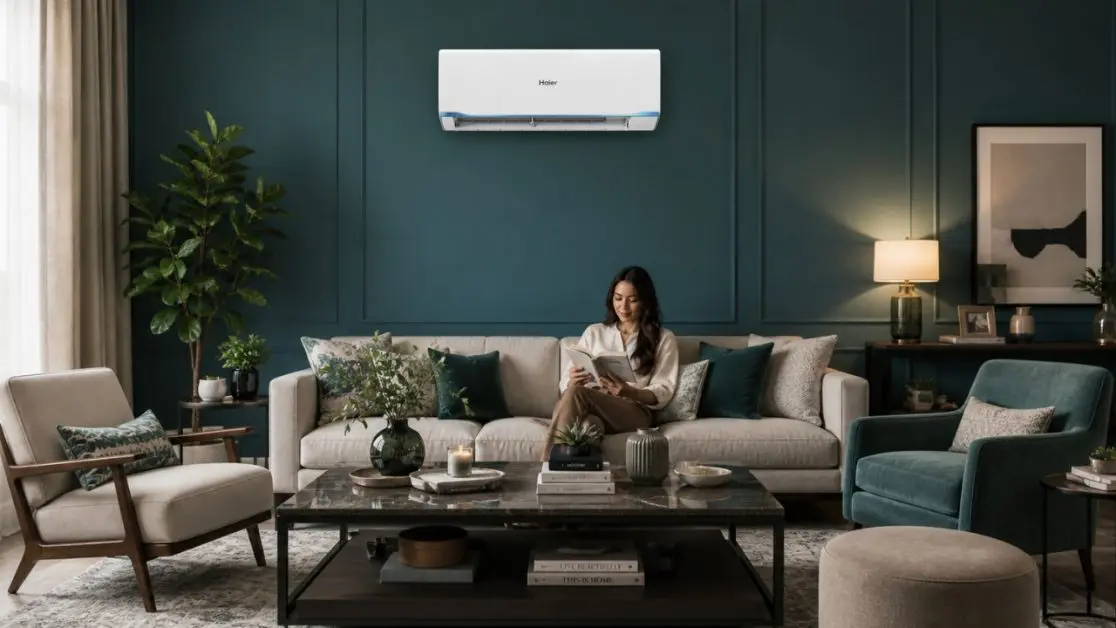
Living rooms today are different.
They are not just sitting spaces.
They are:
- Work-from-home zones
- Weekend movie theatres
- Family gathering areas
- Gaming spaces
Which means:
Heat load is dynamic. Not static.
A single capacity setting is not enough anymore.
How smart ACs change the equation
Earlier, choosing capacity was a one-time decision.
Now, it is a dynamic system.
Take something like the Haier 1.8 Ton 5 Star Desert Rose Air Conditioner.
You can explore the full product here:
What changes?
1. Convertible Capacity
Instead of fixed tonnage, systems adjust cooling capacity between 40 percent to 110 percent.
So your AC adapts to:
- Number of people
- Weather changes
- Usage patterns
Capacity becomes flexible. Not fixed.
2. AI-driven adjustments
Modern systems analyse:
- Indoor temperature
- Outdoor weather
- Usage habits
And automatically select the most efficient mode.
You stop guessing. The system learns.
3. Energy optimization
AI Eco modes can reduce energy wastage significantly, sometimes up to 50 percent in real scenarios.
Which means:
- Lower bills
- Better efficiency
- Consistent comfort
The right capacity is no longer static. It evolves.
A practical example most Indian homes relate to
Consider a 180 sq ft living room.
Standard recommendation: 1.5 ton.
Now add reality:
- West-facing windows
- Evening sunlight
- 4 to 6 people during peak hours
- TV and lighting
What happens?
Your actual requirement shifts closer to 1.8 tons or even 2 tons.
Which is why products like the Haier 1.8 Ton 5 Star Gold Desert Rose AC exist.
They sit between standard categories.
They solve real-world gaps.
Explore more here:
The cost vs comfort trade-off nobody talks about
Every AC decision is a trade-off.
But most people only see price.
Let us break it down.
Option 1: Lower capacity AC
- Lower upfront cost
- Higher long-term electricity usage
- Reduced comfort
Option 2: Higher capacity AC
- Higher upfront cost
- Better cooling performance
- Potential inefficiency if not used properly
Option 3: Smart capacity AC
- Balanced upfront cost
- Adaptive cooling
- Lower long-term energy waste
The cheapest option rarely feels cheapest after a season.
A simple checklist before you decide
Instead of guessing, ask:
- What is my room size?
- How much sunlight does it get?
- How many people use it regularly?
- Is the space open or enclosed?
- Do I want fixed or flexible capacity?
If you answer these, capacity becomes obvious.
Why this decision shapes everyday comfort
This is not about buying an appliance.
It is about shaping a daily experience.
Every evening.
Every weekend.
Every gathering.
The right AC capacity disappears into the background. The wrong one becomes a constant reminder.
The larger insight most buyers miss
We think appliances create comfort.
They do not.
Systems create comfort.
And capacity is the core of that system.
When capacity matches reality:
- Energy becomes efficient
- Cooling becomes consistent
- Life feels smoother
When it does not:
- Everything feels slightly off
The one insight to remember
Cooling is not about power. It is about proportion.
Match the system to the space.
Adjust for life.
And let the technology handle the rest.
That is how modern Indian homes stay comfortable without thinking about it.
Frequently Asked Questions
Is a 1.5 Ton AC Enough for a 180 Sq Ft Living Room?
It depends on the heat load.
A 180 sq ft room with:
direct sunlight,
large windows,
frequent guests,
TV usage,
open kitchen layout,
may perform better with a 1.8 ton or 2 ton AC.
If the room stays shaded and enclosed, 1.5 ton is usually enough.
Is a Bigger AC Always Better?
No.
An oversized AC cools the room too quickly and shuts off before removing enough humidity. The room may feel cold but oddly uncomfortable.
The goal is balanced cooling, not maximum cooling.
What Happens if My AC Capacity Is Too Small?
An undersized AC usually:
runs continuously,
takes longer to cool,
increases electricity bills,
wears out faster,
still leaves the room uncomfortable.
It feels like the AC is “working hard but not working well.”
I Have Large Windows in My Living Room. Should I Increase AC Capacity?
Usually yes.
Large glass areas allow more heat to enter the room, especially during Indian summers.
You can either:
increase capacity slightly, or
reduce heat gain using curtains, films, or insulation.
Does Ceiling Height Matter When Choosing an AC?
Absolutely.
Higher ceilings mean more air volume to cool.
A room with a 12-foot ceiling may need higher cooling capacity than a room with the same floor area but a standard 9-foot ceiling.
Does Higher Tonnage Always Increase Electricity Bills?
Not necessarily.
An undersized AC can actually consume more electricity because it runs continuously.
A correctly sized inverter AC often uses less energy overall than a smaller unit struggling all day.
Why Do Inverter ACs Feel More Comfortable?
Inverter ACs adjust compressor speed dynamically instead of constantly switching on and off.
This creates:
steadier temperatures,
lower noise,
better humidity control,
improved energy efficiency.
What Is Convertible Cooling Capacity?
Convertible ACs can adjust cooling output based on usage conditions.
For example:
lower capacity during mild weather,
higher cooling during peak summer or crowded evenings.
This creates more flexibility than fixed-capacity systems.
Is a 5-Star AC Worth It for a Living Room?
Usually yes if:
the AC runs daily,
summers are long,
electricity costs matter.
Higher efficiency models cost more initially but often reduce long-term electricity bills significantly.