
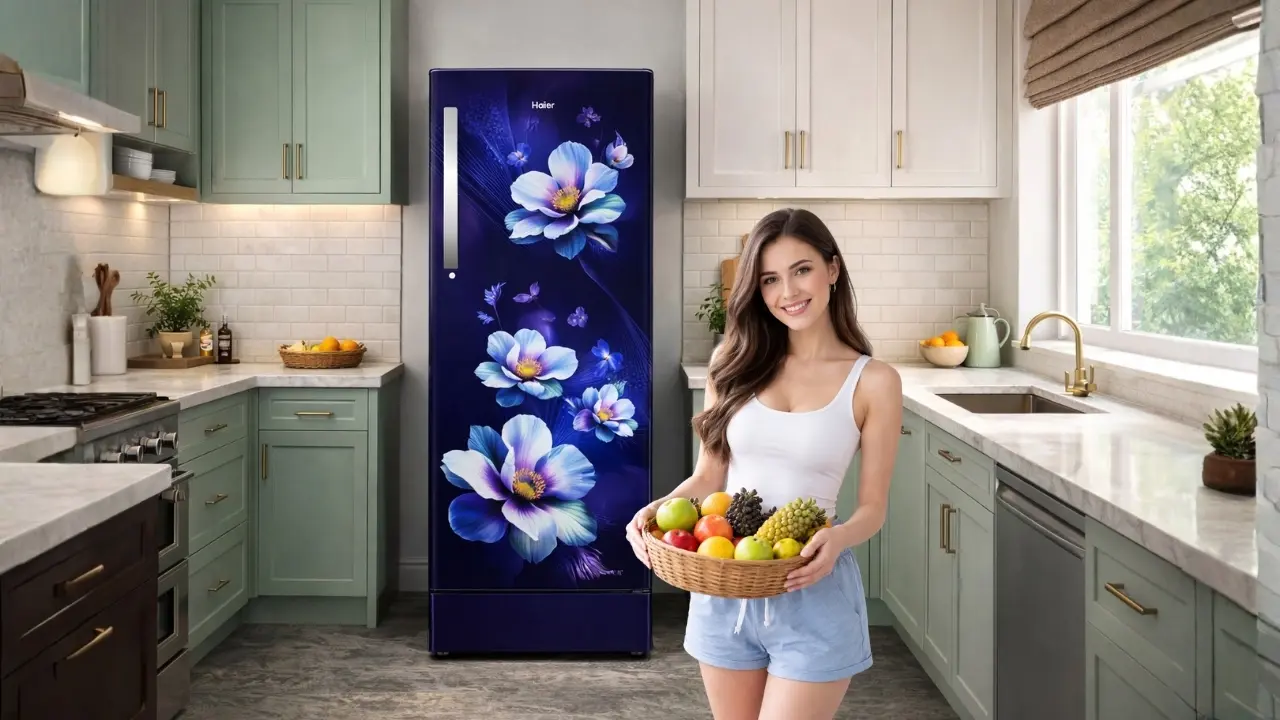

A small refrigerator works best when every inch has a role. Storage optimization is not about fitting more. It is about being smarter.
Grouping food by usage, using vertical space, and choosing the right containers can increase usable capacity by up to 30 percent while reducing food waste and daily friction.
Why does a small fridge feel full even when it isn’t?
It is Sunday night.
Leftover dal sits in a steel bowl. Half-cut vegetables occupy a tray. Milk packets lie sideways. A water bottle blocks the door.
The fridge is not full.
It is unstructured.
That is the real problem with small refrigerators. Not capacity. Clarity.
A 190L refrigerator, like the Haier 190 L 5 Star Marine Hilton Single Door Refrigerator (HRD-2105PMHA-P), is designed with multiple shelves, door racks, and a vegetable box to handle everyday needs efficiently. But the system only works if the user does.
Insight: Space is rarely the constraint. Systems are.
The hidden system inside every small refrigerator
A refrigerator is not one box.
It is three systems working together:
- Temperature zones
- Usage frequency
- Visibility layers
Most homes ignore this.
And that is where inefficiency begins.u
1. Temperature zones decide shelf logic
Not all shelves are equal.
- Top shelves stay warmer
- Bottom shelves stay colder
- Door racks fluctuate the most
This is not design. It is physics.
So placement must follow logic:
- Dairy and leftovers on top shelves
- Raw items on bottom shelves
- Condiments in door racks
Cost: Requires habit change
Benefit: Better freshness and fewer spoilage losses
Why vertical space is your biggest opportunity
Open your fridge.
Notice the gaps between shelves.
That empty air is wasted capacity.
One option is stacking without structure
Steel bowls on top of each other.
Result: Unstable, hard to access.
The second option is container-based stacking
Flat containers. Uniform size.
Suddenly, three layers become possible.
The third option is modular storage thinking
Use stackable boxes, fridge bins, and separators.
This converts space into levels.
Cost: Small upfront investment
Benefit: 20 to 40 percent more usable space
Insight: A shelf is not a surface. It is a platform.
How Indian kitchens create unique storage challenges
Western fridge advice does not always work here.
Because Indian kitchens behave differently.
What makes Indian fridge usage unique?
- Multiple cooked dishes stored at once
- Use of steel containers with lids
- Frequent access during the day
- Seasonal bulk storage during festivals
Take a typical weekday.
Sabzi. Dal. Roti dough. Chutney. Cut fruits.
Each demands space. None wants to be stacked carelessly.
This is where thoughtful design matters.
Models like the Haier 190 L 5 Star Marine Blossom Single Door Refrigerator (HRD-2105PMBA-P) offer separate vegetable boxes and multiple toughened glass shelves that support better categorisation.
Insight: Storage is cultural. Optimization must respect habits.
The three-layer method that changes everything
Think of your refrigerator in layers.
Not shelves. Layers.
Layer 1: Daily essentials
Items you reach 5 to 10 times a day.
- Milk
- Water bottles
- Fruits
Placement: Eye level or easy access shelves
Layer 2: Cooked food and leftovers
Items used within 24 to 48 hours.
- Sabzi
- Rice
- Curry
Placement: Middle shelves
Layer 3: Raw and long-term storage
Items used occasionally.
- Vegetables
- Raw meat
- Frozen items
Placement: Bottom shelves and vegetable boxes
Cost: Requires discipline in placement
Benefit: Faster access, less door opening, lower energy consumption
Insight: The fridge should match your routine, not fight it.
What most people get wrong about vegetable storage
Vegetables suffer the most in small refrigerators.
Why?
Because they are treated as a single category.
But they are not.
Three types of vegetables need three approaches
- Leafy greens need moisture control
- Root vegetables need airflow
- Cut vegetables need airtight storage
A dedicated vegetable box, like the ones included in Haier 190L models, creates a microclimate that helps retain freshness longer.
But usage matters more than design.
Simple system that works
- Wrap leafy greens in paper towels
- Store roots loosely in bins
- Use transparent boxes for cut items
Cost: Slight increase in prep time
Benefit: Up to 25 percent reduction in food waste
Insight: Freshness is not a feature. It is a habit.
Door storage is not what you think it is

Most people overload the fridge door.
Sauces. Milk. Juices. Eggs.
It feels convenient.
But the door is the warmest zone.
Better way to use door racks
- Store condiments and sauces
- Avoid keeping milk for long durations
- Use smaller bottles for daily use
In models with structured door racks, like Haier’s single door refrigerators, you get multiple compartments including bottle racks and smaller sections for segregation.
Cost: Requires shifting habits
Benefit: Better temperature stability for critical items
Insight: Convenience without awareness leads to waste.
The base drawer most people ignore
Look at the bottom of your fridge.
There is a drawer.
Often underused.
One option is to ignore it
Use it rarely. Forget what is inside.
The second option is to use it for overflow
Extra vegetables, occasional storage.
The third option is to treat it as bulk storage
Onions. Potatoes. Seasonal produce.
In refrigerators like the Haier 190L 3 Star Marine Hilton Single Door Refrigerator (HRD-2103PMHA-P), the base drawer is designed for additional storage capacity without cluttering main shelves.
Cost: Requires intentional usage
Benefit: Frees up premium shelf space
Insight: Hidden spaces create visible order.
A simple storage map you can follow today
| Section | What to Store | Why it Works |
| Top Shelf | Dairy, leftovers | Stable temperature |
| Middle Shelf | Cooked meals | Easy access |
| Bottom Shelf | Raw food | Coldest zone |
| Vegetable Drawer | Fresh produce | Controlled humidity |
| Door Racks | Sauces, drinks | Frequent access |
| Base Drawer | Bulk vegetables | Extra capacity |
This is not a theory.
This is a working system.
What storage optimization actually solves
Most people think it saves space.
That is only half the story.
It solves three deeper problems
- Decision fatigue
- Food waste
- Energy inefficiency
When items are visible and accessible:
- You open the door less often
- You find things faster
- You waste less
That matters.
Because refrigerators run 24 hours a day.
Even small inefficiencies compound.
The role of design in making optimization easier
Not all small refrigerators behave the same.
Design decisions shape usability.
Take features like:
- Toughened glass shelves for heavier Indian utensils
- Stabilizer-free operation for consistent performance
- 1 Hour Icing Technology for faster freezing cycles
These are not just features.
They remove friction.
They allow the system to work with you.
Not against you.
So what should you do differently starting today?
Do not buy more space.
Use the space you already have better.
Start with three small changes
- Group food by usage, not type
- Use flat, stackable containers
- Assign fixed zones for recurring items
These are not hacks.
They are systems.
And systems scale.
The final insight most people miss
A small refrigerator does not limit you.
It forces clarity.
It forces better decisions.
And that is where the real advantage lies.
Because when space is limited, thinking improves.
And when thinking improves, everything else follows.
Insight: A well-organised small fridge beats a chaotic large one every single day.
Frequently Asked Questions
Why does my small refrigerator feel full even when there is still space left?
Most small fridges feel crowded because items are placed randomly instead of by usage and visibility. Poor structure creates hidden dead space.
How do I organize my small fridge so I can find things faster?
Use fixed zones for dairy, leftovers, vegetables, and condiments. Grouping by frequency of use reduces clutter and repeated searching.
Why do I keep forgetting food inside my refrigerator?
Items stored in deep steel containers or hidden behind larger bowls become invisible. Transparent containers and layered placement solve this.
Is buying a larger refrigerator better than reorganizing my current one?
Not always. Many households recover 20–40% usable space simply through stackable storage and shelf planning.
Why are toughened glass shelves useful in Indian refrigerators?
They support heavy utensils and stacked cookware more safely.
What is stabilizer-free operation in refrigerators?
It allows refrigerators to handle voltage fluctuations without an external stabilizer.
What is 1 Hour Icing Technology?
It accelerates cooling and ice formation for faster freezing cycles.