
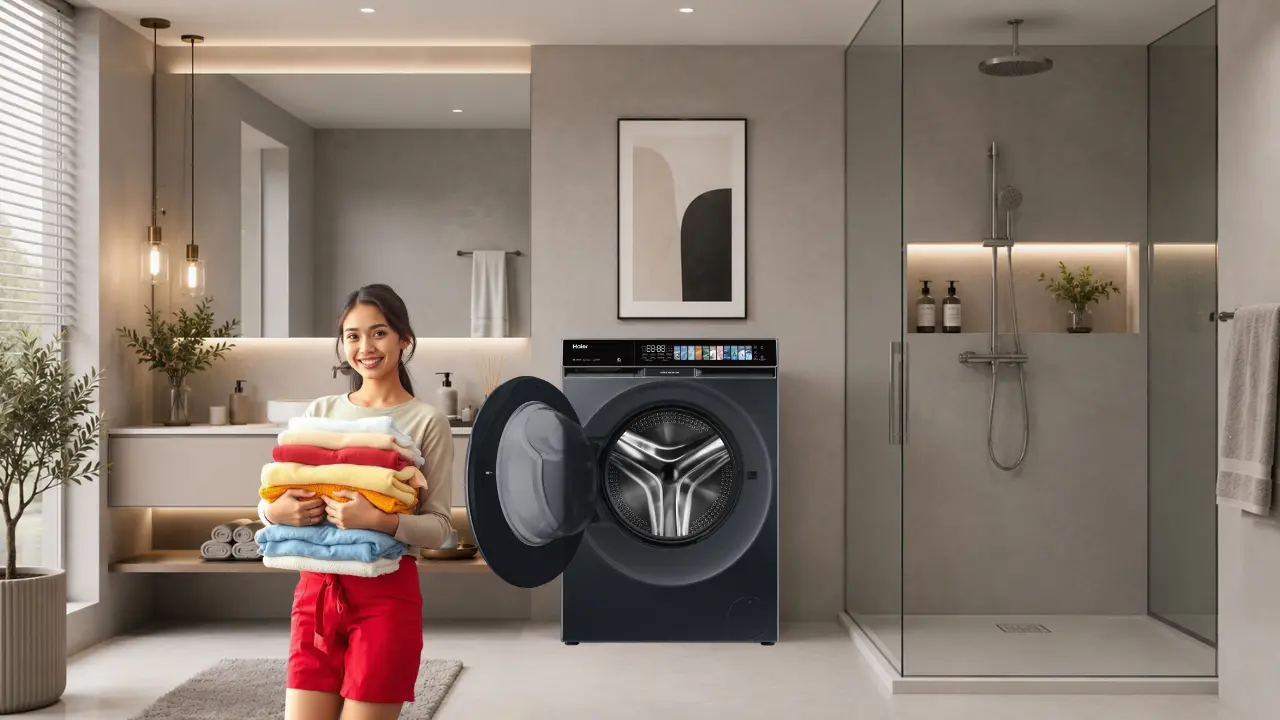

If hygiene is your priority, the Haier F11 stands apart by actively maintaining freshness even after the wash cycle ends, using continuous airflow, intelligent washing, and residue reduction systems.
Most washing machines clean clothes. The F11 focuses on what happens after. That difference changes everything.
Why is “clean” not the same as “hygienic”?
It is Sunday evening.
The laundry is done. Clothes sit inside the drum. You get distracted. Dinner happens. A call comes in.
Two hours later, you open the machine.
The smell hits first.
This is the quiet problem most homes live with.
Machines clean. But they don’t protect.
Hygiene doesn’t fail during washing. It fails after.
And that is where most washing machines, even premium ones, stop short.
The hidden system: What hygiene actually means in washing machines
We often assume hygiene is about stain removal or detergent strength.
That’s only one part of the system.
Real hygiene in a washing machine depends on three layers:
- Removal
Dirt, stains, bacteria washed away during cycles. - Residue management
Detergent foam, lint, and moisture cleared out completely. - Post-wash environment
What happens after the cycle ends. Moisture, airflow, odor control.
Most machines focus heavily on the first.
Few address the third.
The gap lives there.
How Haier F11 approaches hygiene differently
The Haier 12 Kg F11 Front Load Washer is built around a simple shift:
Don’t just clean clothes. Maintain their environment.
Let’s break that system.
1. Continuous freshness after wash
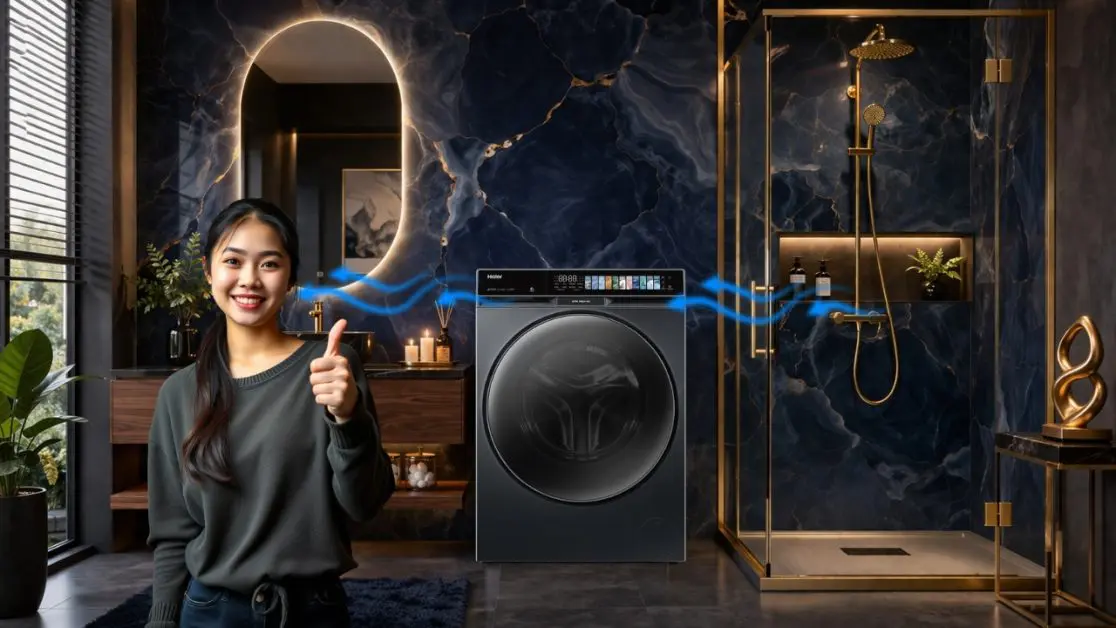
The standout feature is Ultra Fresh Air Technology.
- Keeps clothes fresh for up to 12 hours after wash
- Uses 360° micro-pressure air circulation
- Refreshes the drum every 2 minutes for 12 hours
This solves the exact moment most machines ignore.
You don’t need to rush to unload laundry.
The machine adapts to your schedule.
Insight: Hygiene is not about speed. It is about timing flexibility.
2. Residue-free washing system
The Essence Wash and Dual Spray system focuses on something most people overlook.
Detergent residue.
- Pre-mixes detergent into a concentrated essence
- Sprays directly onto fabrics for deeper penetration
- Uses fresh water and centrifugal rinsing to remove foam completely
Compare that with standard machines.
Detergent sits in corners of fabric. Especially in thick clothes like jeans or towels.
That residue becomes a hygiene risk over time.
Cleaner isn’t cleaner if it leaves something behind.
3. Intelligent hygiene decisions
The One-Touch AI Wash system automates what most people guess.
- Detects fabric type
- Adjusts wash intensity
- Balances water, detergent, and time
Now compare that with typical usage.
You choose “quick wash” for everything.
Sometimes it works. Sometimes it doesn’t.
AI removes that inconsistency.
Consistency is hygiene at scale.
4. Targeted stain removal system
The F11 includes dedicated stain programs:
- Sweat
- Coffee
- Milk
- Mud
- Blood
- Oil
Most machines treat stains as a general problem.
The F11 treats them as specific systems.
Each stain behaves differently. The wash responds accordingly.
Haier F11 vs Other Washing Machines: Hygiene Comparison Table
| Feature | Haier F11 | Typical Front Load Machines | Semi-Automatic Machines |
| Post-wash freshness | Up to 12 hours airflow system | None | None |
| Detergent residue removal | Essence Wash + Dual Spray | Standard rinse | Manual rinse |
| AI wash optimization | Yes | Limited or absent | No |
| Stain-specific programs | 6 dedicated modes | General modes | Manual scrubbing |
| Drum hygiene | Continuous air refresh | Periodic cleaning required | High manual dependency |
| User effort | Low | Medium | High |
Pattern:
The more automated the hygiene system, the less effort required from you.
Three ways Indian households approach laundry hygiene
Not all homes think about hygiene the same way.
And that shapes the machine they choose.
One option: Manual control
This is the traditional system.
- Semi-automatic machines
- Manual rinsing
- Sun drying as the main hygiene layer
Cost: Low upfront
Effort: High
Risk: Inconsistent hygiene
The second option: Standard automation
This is where most urban homes sit.
- Front load or top load machines
- Basic wash programs
- Limited hygiene control
Cost: Moderate
Effort: Medium
Risk: Hidden moisture and odor issues
The third option: Intelligent hygiene systems
This is where machines like the Haier F11 operate.
- AI-driven wash
- Residue management
- Post-wash freshness control
Cost: Higher upfront
Effort: Minimal
Benefit: Predictable hygiene
Why Indian homes need a different hygiene approach
Laundry in India is not a single use case.
It is a mix of extremes.
- Sweat-heavy clothes in summer
- Damp drying during monsoon
- Oil and spice stains in daily wear
- Delicate fabrics during festive seasons
This creates a unique challenge.
Moisture and residue don’t behave the same way as in colder climates.
Which is why airflow and post-wash care matter more here.
A washing machine is not just a cleaner. It is a climate manager for your clothes.
The overlooked problem: Drum hygiene
Most people focus on clothes.
Few think about the drum.
But the drum is where hygiene begins.
- Moisture stays trapped
- Bacteria builds up
- Odor transfers back to clothes
The F11 addresses this with continuous airflow and drum refresh cycles.
Traditional machines rely on periodic cleaning.
Which most people forget.
What changes when hygiene becomes automatic
The shift is subtle.
But powerful.
You stop thinking about laundry as a task.
You stop worrying about smell, rewash, or dampness.
You trust the system.
And that trust changes behavior.
- You delay unloading without stress
- You wash mixed loads confidently
- You reduce detergent usage without fear
Good systems reduce decisions. Great systems remove them.
Cost vs benefit: Is advanced hygiene worth it
Let’s break it down.
Costs
- Higher upfront investment
- Slight learning curve for features
Benefits
- Fewer rewash cycles
- Lower detergent waste
- Better fabric longevity
- Reduced odor and bacterial growth
- Time flexibility
Over time, the system pays back in ways that are not obvious on day one.
The bigger pattern: Machines that think beyond the cycle
Most appliances are built around a moment.
A washing machine cleans.
A fridge cools.
An AC lowers temperature.
But the shift happening now is different.
Machines are starting to manage states.
- Freshness
- Hygiene
- Comfort
Not just actions.
The Haier F11 fits into that shift.
It does not just complete a wash cycle.
It manages what happens before and after.
So, which one should you choose
The decision is not about brand vs brand.
It is about system vs system.
Ask a simpler question.
Do you want to manage hygiene manually or automate it?
If your answer is automation, the comparison becomes clear.
Final insight: Hygiene is what happens when you are not looking
You don’t stand next to your washing machine.
You don’t monitor every cycle.
You trust it.
And that trust depends on what the machine does when you are not paying attention.
That is the real comparison.
Not features. Not specs.
But behavior.
The best washing machine is the one that keeps your clothes fresh even when life interrupts you.
Frequently Asked Questions
I always forget to unload my laundry on time. Is the Haier F11 better for me than a normal washing machine?
Yes. The Haier F11 is built for this problem because its Ultra Fresh Air Technology keeps clothes fresh for up to 12 hours after the wash ends.
Should I choose a washing machine based on wash quality or post-wash freshness?
If hygiene is your priority, post-wash freshness matters just as much as cleaning because odor and bacteria often build up after the cycle ends.
I don’t want to think too much about wash settings. Can the Haier F11 handle that automatically?
Yes. Its One-Touch AI Wash detects fabric type and adjusts water, detergent, time, and intensity.
I left my clothes in the washer for a few hours. Do I need to rewash them?
In regular machines, maybe. In the Haier F11, the airflow system helps keep clothes fresh for up to 12 hours, reducing the need to rewash.
Why do my clothes smell even after washing?
The smell may come from trapped moisture, detergent residue, or a damp drum after the cycle ends.