
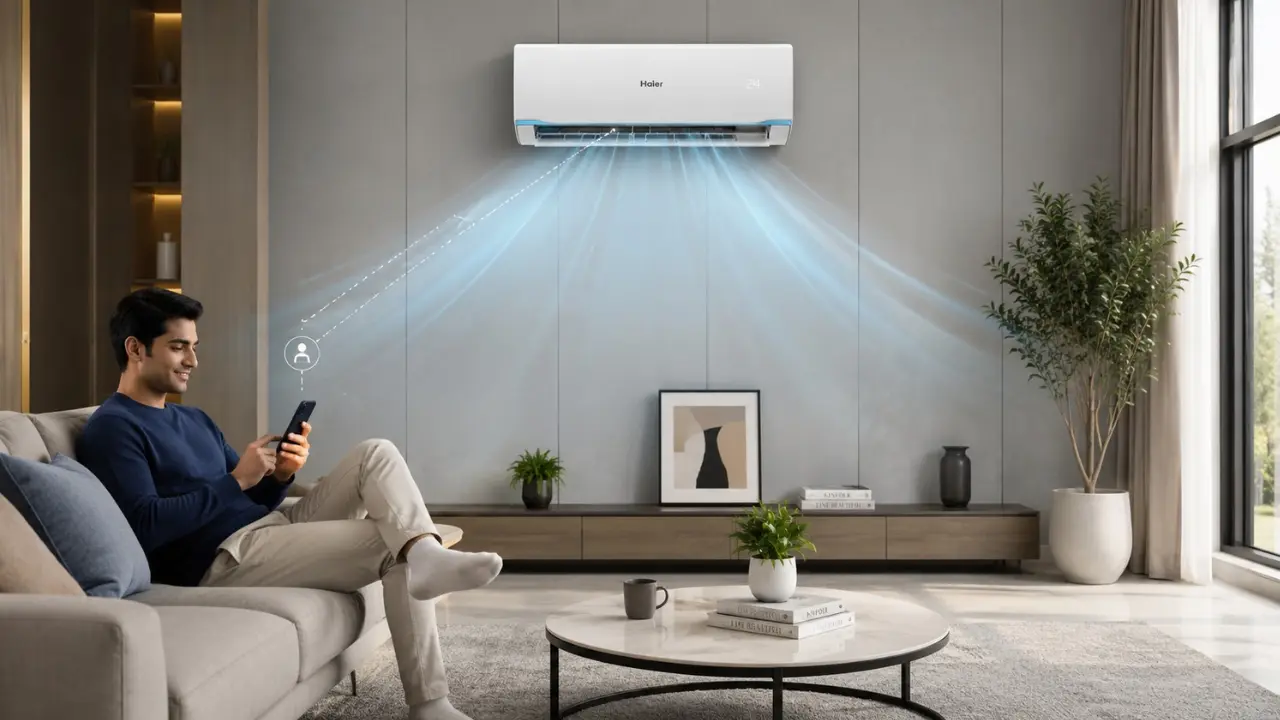

AI sensors save energy by reducing waste before it happens
AI sensors help appliances save energy by detecting human presence, learning usage patterns, monitoring environmental conditions, and automatically adjusting performance in real time.
Instead of running at full power all the time, appliances respond intelligently to how people actually live. The result is lower electricity bills, less manual effort, and more efficient comfort across modern Indian homes.
A fan spinning in an empty room tells you something important.
Most homes waste energy quietly.
Not dramatically. Not visibly.
An AC cools an empty bedroom for two hours. A refrigerator overworks during peak summer heat. A washing machine runs inefficient cycles because nobody adjusted the settings properly.
The problem is not technology.
The problem is that traditional appliances follow instructions. Smart appliances observe behaviour.
And that changes everything.
Why energy waste in homes is usually invisible
Energy waste rarely feels urgent at the moment.
It feels small.
One forgotten AC. One overcooled room. One appliance running harder than necessary.
But repeated daily, small inefficiencies become large monthly bills.
This is the hidden system behind electricity consumption in Indian homes:
- Appliances operate at fixed patterns
- Human behaviour constantly changes
- Traditional systems cannot adapt fast enough
AI sensors exist to close that gap.
Not by making appliances “smarter” in a flashy way.
But by helping them respond like a thoughtful person would.
Turn down cooling when fewer people are present.
Reduce compressor load at night.
Shift modes based on weather conditions.
Detecting waste before humans notice it.
That is the real role of AI in energy saving.
What are AI sensors actually doing inside appliances?
Most people imagine AI as a voice assistant or app control.
That is surface-level intelligence.
The real work happens inside sensors.
Sensors collect information continuously. AI systems interpret that information and make decisions automatically.
Think of it like traffic management in a busy city.
A traffic signal without sensors follows fixed timing. A sensor-based system adapts to real traffic flow.
Appliances work the same way.
The four most common AI sensor functions
| AI Sensor Function | What It Detects | Energy Saving Impact |
| Human Detection | Presence or movement | Reduces cooling or operation in empty rooms |
| Temperature Analysis | Indoor and outdoor climate | Optimises compressor workload |
| Usage Learning | Daily habits and schedules | Avoids unnecessary power spikes |
| Load Monitoring | Real-time electricity consumption | Shifts appliances into energy-saving modes |
Insight: The smartest appliance is not the most powerful one. It is the one that knows when to slow down.
AI sensors inside air conditioners are changing energy consumption patterns
Air conditioners reveal the clearest example of AI-led energy saving.
Especially in India.
Because Indian summers are not predictable anymore.
Some afternoons cross 45°C. Nights stay humid. Monsoon shifts cooling requirements hourly.
Traditional ACs respond mechanically.
AI-powered ACs respond contextually.
Take the Haier 1.8 Ton 5 Star Desert Rose Air Conditioner (HSA20DSD-NAI5NB-I), for example. Its AI-ATMOX platform analyses environmental conditions and learns usage habits to deliver adaptive cooling. The system also includes AI Human Detection to reduce unnecessary energy usage when no one is present in the room.
That sounds technical.
But the real-world effect is simple.
The AC stops behaving like a machine and starts behaving like a system.
A late-night bedroom explains this perfectly
It is 2:10 am.
The room is already cool.
Most people are asleep under blankets.
Yet traditional ACs continue running aggressively because the temperature setting remains unchanged.
AI sensors detect the difference between requested cooling and needed cooling.
That distinction matters.
Because comfort and energy are deeply connected.
Three ways AI sensors reduce AC energy usage
- Presence-based cooling
AI Human Detection identifies whether someone is actually inside the room. If the room is empty, the system reduces cooling intensity automatically. Haier specifically positions this as “Precise Presence Detection, Zero Energy Waste.” - Adaptive cooling modes
AI systems analyse weather conditions and indoor temperatures continuously instead of operating at fixed capacity. - Smart energy optimisation
Features like AI ECO mode monitor electricity consumption and adjust operations dynamically to reduce wastage. Haier claims savings of up to 56% through AI-based optimisation systems.
The important point is this:
Energy saving no longer depends entirely on human discipline.
The appliance participates actively.
The future of energy saving is predictive, not reactive
Old appliances wait for commands.
AI-powered appliances anticipate behaviour.
That shift changes how homes consume electricity.
A good example is AI pre-cooling.
Instead of waiting for someone to enter a hot room and manually reduce the temperature, AI systems begin cooling intelligently before arrival. Haier’s AI Pre-Cooling feature is designed around this exact principle. The system recognises proximity and prepares the room in advance.
This sounds like convenience.
But it is actually an energy strategy.
Why?
Because sudden temperature drops consume more electricity than gradual stabilisation.
Insight: Efficient systems do not work harder. They work earlier.
Reactive systems vs predictive systems
| Traditional Appliance | AI Sensor-Based Appliance |
| Waits for manual commands | Learns patterns automatically |
| Runs fixed cycles | Adjusts dynamically |
| Uses full power frequently | Balances performance intelligently |
| Wastes energy during idle periods | Reduces unnecessary operation |
This is why AI sensors matter beyond marketing language.
They redesign appliance behaviour itself.
Why younger Indian households are adopting AI-powered appliances faster
Because modern households operate differently now.
Dinner timings shift.
Work-from-home schedules fluctuate.
People sleep later.
Electricity usage patterns no longer follow predictable family routines from ten years ago.
A fixed appliance struggles inside an unpredictable lifestyle.
AI systems thrive in it.
Three household patterns driving AI sensor adoption
1. Hybrid work lifestyles
Rooms remain occupied inconsistently through the day.
AI sensors help appliances adapt without constant manual adjustments.
2. Smaller urban homes
Compact spaces heat faster and cool faster.
Intelligent cooling avoids overconsumption.
3. Energy-cost awareness
Electricity bills are no longer background expenses.
People actively track consumption now.
Haier’s AI For Savings system even monitors usage and alerts users when energy consumption rises unusually.
That changes behaviour.
Because visibility changes habits.
AI sensors are not just saving power. They are reducing decision fatigue
This part matters more than most people realise.
Every appliance decision consumes mental energy.
Should the fan speed change?
Should the AC temperature be reduced?
Should the mode shift to eco?
Repeated hundreds of times, these micro-decisions create friction.
AI systems remove that friction.
Not perfectly. But meaningfully.
And modern households increasingly value reduced effort as much as reduced electricity bills.
The hidden psychological benefit of AI automation
| Traditional Experience | AI-Assisted Experience |
| Constant manual adjustments | Automatic optimisation |
| Frequent monitoring | Self-correcting systems |
| Reactive comfort | Adaptive comfort |
| Decision-heavy routines | Low-friction living |
Insight: The best technology disappears into the background.
That is what AI sensors are slowly doing inside homes.
Energy saving is becoming a systems problem, not a hardware problem
For years, people evaluated appliances using only hardware specifications.
Star ratings.
Compressor quality.
Cooling capacity.
Those still matter.
But AI sensors introduce a second layer.
Intelligence.
A highly efficient compressor still wastes power if the appliance behaves inefficiently.
This is why newer systems combine inverter technology with AI-based optimisation.
For example, the Haier 1.8 Ton 5 Star Gold Desert Rose Air Conditioner (HSA20DSD-GAI5NB-I) combines Hexa Inverter technology with AI-led climate analysis and adaptive cooling systems.
The appliance is not simply powerful.
It is responsive.
And responsiveness is becoming the new benchmark for efficiency.
What should buyers actually look for in AI-powered appliances?
Not every “smart” appliance saves energy meaningfully.
Some simply add app connectivity.
That is not enough.
The real value comes from sensor-led automation.
Look for these AI energy-saving features
- Human presence detection
- Adaptive cooling or heating
- Real-time electricity monitoring
- AI ECO modes
- Predictive optimisation
- Usage learning capability
- Intelligent maintenance systems
One useful example is ODU Cyclone Clean technology in Haier ACs, where the outdoor fan reverses after shutdown to clear debris from condenser fins and maintain heat-transfer efficiency over time.
Small efficiency improvements compound over years.
That is how meaningful savings actually happen.
Not through one dramatic feature.
But through hundreds of invisible corrections.
The bigger shift is philosophical
For decades, appliances waited for humans to operate them.
Now appliances increasingly collaborate with humans.
That is the deeper shift AI sensors represent.
Not automation for the sake of novelty.
But systems that understand context.
A home is not static.
Different people use spaces differently. Seasons change. Schedules change. Electricity costs change.
Static appliances struggle in dynamic environments.
Adaptive systems do not.
And that is why AI sensors are becoming central to energy saving in modern Indian homes.
Not because people suddenly love technology more.
But because people are tired of waste.
Waste of electricity.
Waste of effort.
Waste of attention.
The future of energy saving will belong to systems that quietly notice what humans overlook.
That future has already started.
Frequently Asked Questions
I keep forgetting to change my AC settings at night. Can AI sensors help?
Yes. AI sensors can detect room conditions, usage patterns, and occupancy, then reduce cooling intensity automatically when full power is not needed.
Do AI-powered appliances really reduce the number of small decisions I make daily?
Yes. They automate repeated choices like cooling mode, fan speed, eco settings, and energy-saving adjustments.
I want lower bills without constantly monitoring appliances. Are AI sensors useful for me?
They are useful because they adjust performance in real time instead of depending completely on manual control.
Why does my AC still feel wasteful even when it has a good star rating?
Star ratings show hardware efficiency, but AI sensors improve behavioural efficiency by reducing unnecessary operation.
My AC often runs when no one is in the room. Can AI sensors stop that waste?
Yes. Human presence detection can identify empty rooms and reduce cooling automatically.
Why does home energy waste feel invisible until the bill arrives?
Because small habits like overcooling, idle operation, and fixed appliance cycles add up quietly over time.