
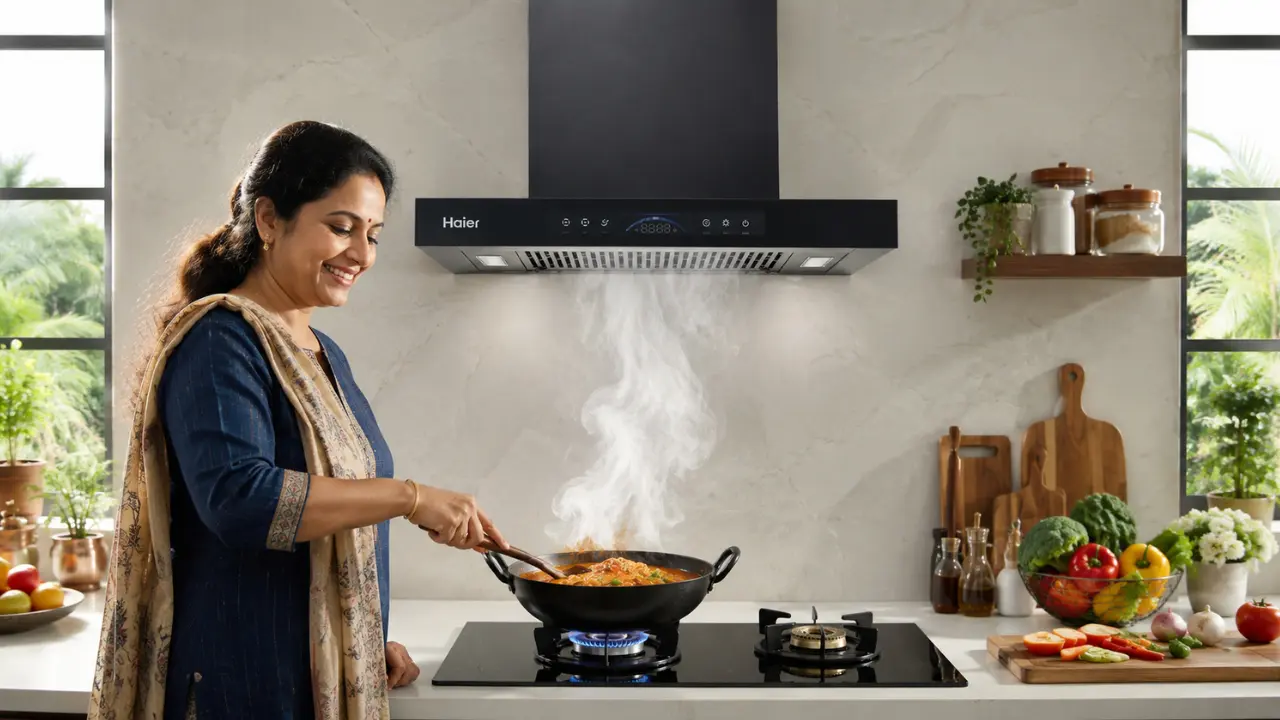

The modern Indian kitchen has changed. The smoke has not.
A pressure cooker whistles. Garlic hits hot oil. Tadka rises instantly. Within minutes, the kitchen fills with invisible particles most people never think about.
That is the strange thing about indoor smoke. You stop noticing it long before your body does.
In Indian homes, cooking smoke is not just about discomfort or strong smells. It affects breathing, wall surfaces, air quality, and over time, even long-term health. A modern kitchen chimney does more than keep the kitchen clean. It changes the air your family lives in.
And increasingly, that matters.
Why cooking smoke becomes a health issue in Indian homes?
Indian cooking is intense by design.
High heat.
Deep frying.
Heavy masalas.
Repeated tempering.
Oil-rich cooking methods.
These are not edge cases. They are daily routines.
According to the World Health Organization, indoor air pollution remains a major contributor to respiratory stress globally, especially in spaces with poor ventilation. Cooking fumes contain grease particles, carbon residue, smoke vapours, and airborne irritants that linger longer than most people realise.
The problem is rarely dramatic. It is cumulative.
One evening of frying fish may not matter much.
Five years of trapped kitchen smoke does.
What prolonged exposure to cooking smoke often leads to
- Eye irritation during cooking
- Lingering throat discomfort
- Sticky grease accumulation on cabinets
- Headaches caused by poor ventilation
- Strong odours spreading across rooms
- Increased respiratory irritation for children and elderly family members
A kitchen absorbs habits.
And air quality becomes one of them.
Smoke does not stay in the kitchen anymore
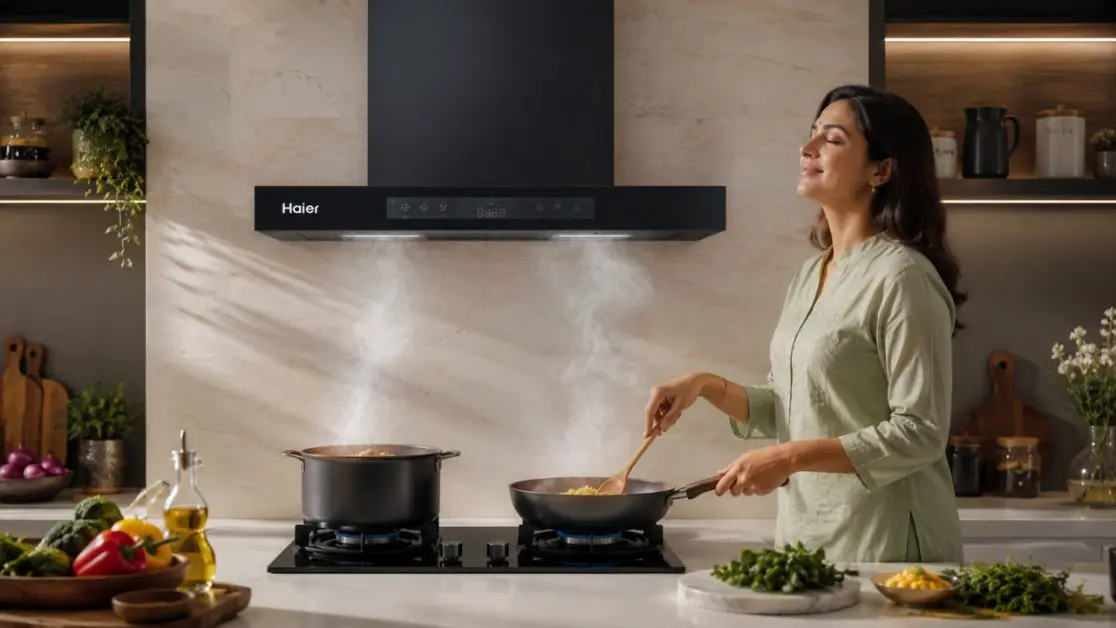
Older Indian homes had separate kitchens. Modern apartments do not.
Today, kitchens flow into dining areas and living rooms. Studio apartments merge cooking and sleeping spaces. Open kitchens look beautiful, but they also spread smoke faster.
Which creates a hidden design problem.
The same openness that makes homes feel larger can also trap cooking particles inside shared living spaces.
A chimney changes this equation.
It creates directional airflow. Smoke gets captured before it spreads. Grease stays controlled. Heat reduces faster.
That changes the experience of the entire home.
Not just the kitchen.
What a kitchen chimney actually removes
People often assume chimneys only remove visible smoke.
That is incomplete.
A modern chimney handles multiple layers of kitchen pollution simultaneously.
A chimney typically helps reduce:
- Oil vapours
- Common during frying and tadka preparation
- Grease particles
- These settle on cabinets, tiles, curtains, and walls
- Heat concentration
- Especially during long cooking sessions
- Odours
- Fish, garlic, onion, masala-heavy cooking
- Suspended smoke particles
- The fine particles you cannot always see
This is why suction power matters.
A low-capacity chimney struggles during intense Indian cooking. Higher suction models are designed for heavier smoke and oil usage patterns common in Indian households.
That distinction matters more than aesthetics.
A clean kitchen is often a ventilation story
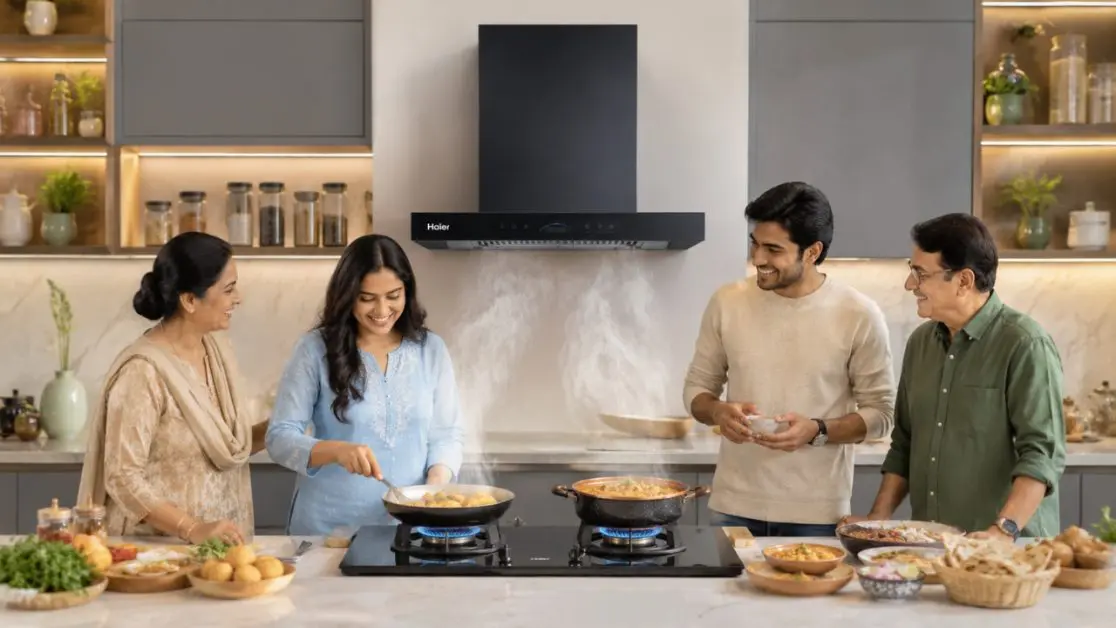
People spend money repainting kitchens every few years without questioning why the walls become sticky so quickly.
Grease travels.
It settles silently on ceilings, appliances, cabinet handles, and even dining furniture near open kitchens.
Over time, poor ventilation creates a cycle:
- More grease accumulation
- More cleaning effort
- More lingering odours
- Faster surface wear
- Lower indoor comfort
A good chimney interrupts this cycle early.
That is why many modern Indian households now treat chimneys less like luxury appliances and more like foundational kitchen infrastructure.
Like plumbing.
Or lighting.
Or water purification.
Not optional. Essential.
Why filterless chimneys are changing Indian kitchens
Traditional chimneys often required constant filter cleaning.
And that created another problem.
People delayed maintenance.
Performance dropped.
Smoke stayed trapped.
Noise increased.
Modern filterless chimney systems are designed differently.
For example, several Haier chimney models now focus on filterless operation combined with high suction power and Heat Auto Clean technology to reduce grease build-up and simplify maintenance. Features like gesture control and self-cleaning reminders also make daily use easier for busy households.
That matters because appliances only improve life when people actually use them properly.
Convenience is not a luxury feature.
It is a behaviour feature.
One option is low suction. The second is balanced airflow. The third is future-ready ventilation.
Most chimney buying decisions revolve around appearance.
That is usually the wrong starting point.
The better question is:
How much smoke does your kitchen actually generate?
Option 1: Basic ventilation setups
Suitable for:
- Light cooking
- Smaller households
- Minimal frying
Limitations:
- Struggles during heavy cooking
- Slower smoke removal
- Less effective in open kitchens
Option 2: Mid-to-high suction chimneys
Suitable for:
- Daily Indian cooking
- Families cooking multiple meals
- Apartments with limited natural ventilation
Benefits:
- Faster smoke extraction
- Better odour control
- Reduced grease spread
Several Haier chimney models feature suction capacities between 1500 m³/h and 1600 m³/h specifically designed for Indian cooking intensity.
Option 3: Smart airflow systems with BLDC motors
Suitable for:
- Open kitchens
- Premium modular kitchens
- Frequent cooking households
Benefits:
- Lower noise levels
- Better energy efficiency
- More consistent airflow performance
Haier’s HIH-T1900-BLDC-IN model, for instance, combines 1600 m³/h suction power with a BLDC motor and lower noise output under 48 dB.
The hidden insight?
Better kitchen air changes how long people comfortably stay in shared spaces.
That affects family interaction more than people expect.
The healthiest kitchens are usually the quietest ones
Noise matters.
Loud chimneys create a strange trade-off:
cleaner air versus peaceful conversation.
Most families tolerate it because they assume high suction always means high noise.
Not anymore.
Newer BLDC motor systems are designed to reduce maintenance while operating more quietly. That matters during early morning cooking, late-night meal prep, or homes where the kitchen and living room share space.
Because comfort is rarely one big feature.
It is the absence of small irritations.
Healthier air also changes how kitchens feel emotionally
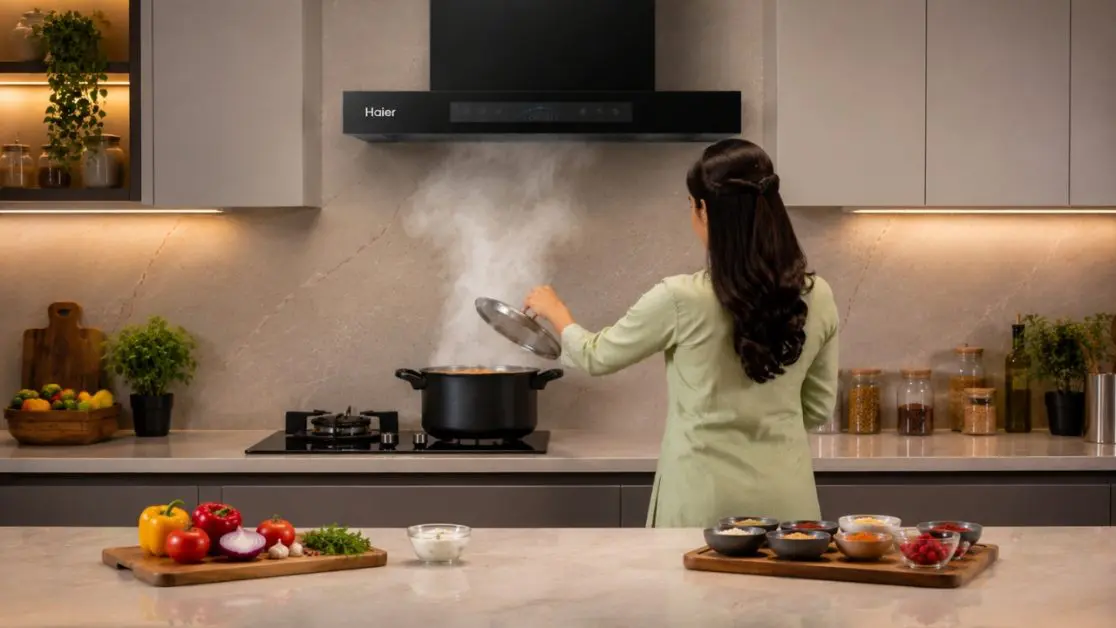
This part rarely appears in product discussions.
But it matters.
A smoky kitchen feels exhausting faster.
Cooking becomes something to “finish quickly.”
People avoid staying there longer.
Heat builds tension.
Odours linger into bedrooms.
Clean airflow changes the emotional rhythm of the home.
Cooking feels lighter.
The home smells fresher.
Guests stay comfortable longer.
Children spend more time around shared meals.
Technology works best when it quietly removes friction from ordinary life.
That is the real role of a chimney.
Not decoration.
Not status.
Relief.
Modern kitchens are becoming air-managed spaces
The future kitchen is not just smart.
It is responsive.
We already expect refrigerators to manage freshness.
Air conditioners to optimise cooling.
Washing machines to automate cycles.
Kitchen ventilation is evolving the same way.
Features like:
- Gesture controls
- Auto-clean reminders
- Heat Auto Clean systems
- Multi-speed controls
- Delay-off functions
all point toward a larger shift.
Homes are becoming systems.
And systems work best when invisible problems get solved early.
Smoke is one of those invisible problems.
The real question is not whether smoke exists. It is whether your home keeps absorbing it.
Every Indian kitchen creates smoke.
That will not change.
What changes is how intelligently homes respond to it.
One household opens windows and hopes for the best.
Another installs ventilation built for Indian cooking patterns.
A third designs the kitchen around long-term comfort, hygiene, and air quality.
Those decisions compound quietly over years.
Because healthier homes are rarely built through dramatic transformations.
They are built through small systems that work every single day without demanding attention.
A chimney is one of those systems.
And once you experience a kitchen without trapped smoke, heavy odours, and greasy air, it becomes difficult to go back.
That is how useful technology works.
Not by demanding attention.
But by removing problems before they become part of everyday life.
Frequently Asked Questions
I cook every day, but I don’t see much smoke. Do I still need a chimney?
Yes. The biggest health concern isn’t always visible smoke. Indian cooking releases fine oil particles, grease vapours, and airborne irritants that often remain invisible. Over time, these pollutants can affect indoor air quality, contribute to respiratory irritation, and spread throughout the home.
Can cooking smoke actually affect my family’s health?
Prolonged exposure to cooking fumes may contribute to eye irritation, throat discomfort, headaches, and respiratory irritation, especially for children, elderly family members, and people with breathing sensitivities. Good ventilation helps reduce these exposures.
My eyes burn while making tadka. Will a chimney help?
In many cases, yes. A chimney captures smoke, oil vapours, and airborne particles near the cooking source, helping reduce the amount that reaches your eyes and breathing zone.
Why does my kitchen still smell like garlic or fish hours after cooking?
Strong cooking odours often linger when smoke and vapours are not removed quickly. A chimney with adequate suction power helps extract these odours before they spread into other rooms.
I have children at home. Is kitchen ventilation more important for families?
Yes. Children and older adults are generally more sensitive to indoor air pollutants. Better kitchen ventilation helps create a cleaner indoor environment for everyone in the household.