


It’s a common sight in many Indian households. The kadai is on full fire, the oil has heated up and the first batch of the pakoras or pooris is added to it. The kitchen becomes steamy within seconds and the small oil particles vaporize and the pungent smell of deep frying is instantly apparent.
Delicious? Absolutely.
Comfortable? Not always.
The easiest way to tell if your kitchen chimney is not working well to remove airborne particles is if you notice greasy kitchen cabinets, lingering food smells, and smoke lingering after you’ve turned off the oven. But that’s not all when it comes to deep frying, suction is more important than most people think.
Rather than just considering the appearance and/or design, it is useful to consider how having a high suction capacity can help make everyday cooking cleaner, more comfortable and easier to manage.
A Quick Reality Check
Not every cooking style demands the same chimney performance.
Here’s a simple way to think about it.
| Your Cooking Style | Typical Smoke & Oil Vapours | Suction Requirement |
| Boiling or steaming | Low | Moderate |
| Light sautéing | Medium | Medium |
| Regular tadka | Medium to High | High |
| Deep frying | Very High | Very High |
| Heavy Indian cooking with multiple dishes | Extremely High | High-capacity chimney |
If your kitchen regularly prepares samosas, puris, fish fry, chicken fry, bhajiyas or festive snacks, the amount of airborne grease generated is significantly higher than during everyday cooking.
That is exactly where higher suction becomes valuable.
What Actually Happens During Deep Frying?
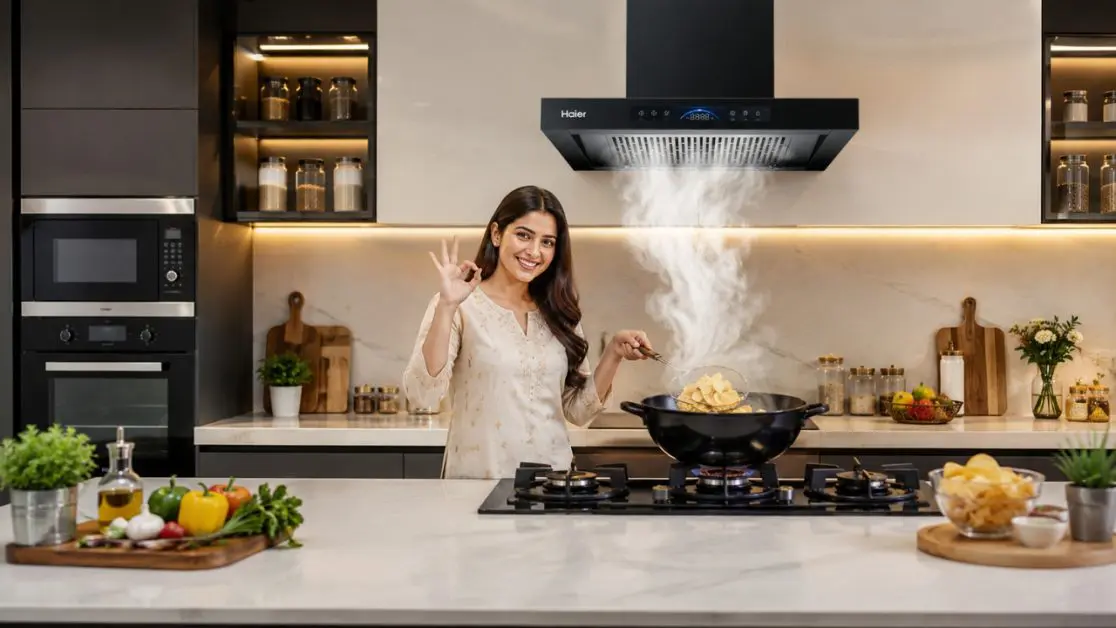
Most people think they’re only dealing with smoke.
Not quite.
When oil reaches high temperatures, several things happen simultaneously:
- Fine grease particles become airborne.
- Steam rises rapidly.
- Strong food aromas spread across the kitchen.
- Heat builds around the cooking zone.
These tiny grease particles eventually settle on nearby surfaces if they aren’t extracted quickly enough.
That’s why kitchen walls, overhead cabinets and even ceiling corners slowly develop sticky deposits over time.
A chimney with stronger suction is designed to capture these particles before they spread throughout the kitchen.
Signs Your Existing Chimney May Not Be Powerful Enough
Sometimes the chimney is working.
It just isn’t working efficiently for your cooking habits.
You may notice:
- Smoke escaping around the cooking area.
- Strong food smells lasting for hours.
- Oil residue forming on cabinets.
- Greasy countertops despite regular cleaning.
- Steam collecting around overhead furniture.
- Kitchen feeling unusually warm after frying.
If several of these sound familiar, suction capacity deserves attention before anything else.
Why High Suction Makes Such a Difference
Think of suction as the chimney’s ability to pull contaminated air away from your cooking zone before it spreads.
The faster this happens, the cleaner the surrounding environment remains.
Better Smoke Extraction
During deep frying, smoke rises rapidly.
Higher suction helps draw it upward instead of allowing it to drift across the kitchen.
Improved Grease Capture
Oil vapours are surprisingly light.
Without sufficient airflow, they escape into the room and eventually settle on surfaces.
Higher suction improves the chances of collecting these particles before they spread.
Reduced Lingering Odours
We’ve all experienced it.
You fry fish at lunch, and by evening the curtains still remind you of it.
A chimney with strong extraction can help reduce cooking odours more efficiently by removing smoke and vapours while cooking is still in progress.
Better Cooking Comfort
There is already a lot of heat produced during deep frying.
Cooking can be made to feel more comfortable as they remove hot air and steam from the cooking space continuously by efficiently extracting the air.
More Suction Doesn’t Mean More Noise

It is a widely held misconception.
It used to be the case that the more suction, the louder the machine.
Modern chimneys for the kitchen are not designed the same.
For instance, Haier Fan Range is equipped with BLDC motors which enhances the efficiency of the range and at the same time reduces the maintenance and operating noises emitted by the chimney.
This doesn’t have to mean a noisy kitchen, but rather that good airflow doesn’t mean loudness.
Features That Complement High Suction
Suction is important.
But by itself, it isn’t the whole story.
The overall experience depends on several supporting features working together.
Heat Auto Clean
Cleaning accumulated grease is one of the least enjoyable kitchen chores.
Selected Haier chimney models feature Heat Auto Clean, which melts accumulated grease into the oil collector, helping maintain hygiene and simplifying maintenance.
Filterless Design
Traditional filters gradually collect grease and require periodic cleaning.
Several Haier chimney models use a Filterless Concept, reducing the need to clean conventional mesh filters while supporting uninterrupted airflow.
Touch & Gesture Control
Hands covered with flour?
Busy preparing the next batch?
Instead of touching multiple buttons, supported models allow operation through Touch & Gesture Control, making adjustments simpler during cooking.
Multiple Speed Levels
Not every recipe needs maximum airflow.
Depending on what you’re preparing, different Haier models offer multiple speed options with an additional Boost or Grand Turbo mode for intensive cooking sessions.
Choosing the Right Suction Capacity for Your Kitchen
One size rarely fits every home. The right suction capacity depends on how often you cook, what you cook, and how intensive your cooking style is.
| Cooking Habits | What Works Well |
| Light cooking, occasional frying | Moderate suction chimney |
| Daily Indian cooking with tadka | High suction chimney |
| Frequent deep frying and heavy masala cooking | High-capacity chimney with advanced airflow |
| Large families or open kitchens | Powerful chimney with higher suction and multiple speed settings |
If deep frying is part of your weekly routine rather than an occasional indulgence, choosing a chimney with higher suction can make a noticeable difference in day-to-day kitchen comfort.
Haier Chimneys Built for Indian Cooking
Stylish design is not enough for Indian kitchens. They require an appliance that is capable of handling everything from a quick meal on a weekday to a fancy cooking job on a holiday.
Haier provides several models of kitchen chimney with varying suction rates and cleaning methods that can suit homeowners’ cooking habits.
For Everyday Heavy Cooking
The Haier 1600 m³/h Heat Auto Clean Filterless Chimney (HIH-T1900-BLDC-IN) combines:
- 1600 m³/h suction capacity
- BLDC motor
- Heat Auto Clean
- Filterless design
- Touch & Gesture Control
- 8 Speed + Boost operation
- Cleaning Reminder
- Low-noise operation
It’s designed to deliver strong airflow while keeping maintenance simple through its filterless concept and Heat Auto Clean system.
For Homes That Want Higher Airflow
If your kitchen sees frequent frying sessions, the Haier 1750 m³/h Spin Clean Filterless Flat Chimney (HIH-T1901) offers:
- 1750 m³/h suction
- Spin Clean technology
- Filterless flat design
- Touch & Gesture Control
- 300W motor
- Large oil collector
- Multiple speed settings with Boost mode
These features are intended to support smoke extraction while simplifying routine maintenance.
For Demanding Indian Kitchens
Haier also offers models with even higher suction capacities for homes where intensive cooking is common.
Options include:
- Haier Unique Butterfly Filter Chimney with 1800 m³/h suction, Heat Auto Clean, Touch & Gesture Control, Cleaning Reminder and Grand Turbo mode.
- Haier Unique Pyramid Filter Chimney featuring 2000 m³/h suction, Heat Auto Clean, Touch & Gesture Control, Grand Turbo mode and a double-layered pyramid filter design.
This range allows homeowners to select a chimney based on the intensity of their cooking rather than relying on appearance alone.
Small Habits That Help Your Chimney Perform Better

Even a high-performance chimney benefits from proper usage.
Keep these simple practices in mind:
- Switch on the chimney a minute before you begin cooking.
- Match the speed setting to the cooking intensity.
- Use Boost mode during heavy frying, if available.
- Empty the oil collector regularly.
- Follow cleaning reminders where supported.
- Allow the delay-off function to complete after cooking so remaining smoke can be extracted.
These small habits can help maintain consistent performance over time.
What to Look for Beyond Suction
When comparing kitchen chimneys, don’t stop at the suction number.
Consider the complete package.
- High suction suitable for Indian cooking
- Easy cleaning technology
- Convenient controls
- Multiple speed settings
- Efficient motor
- Low operating noise
- Maintenance reminders
- Reliable warranty support
A chimney that balances these features is likely to deliver a better long-term cooking experience.
The Bottom Line
Deep fryers are here to stay in Indian kitchens. These dishes tend to release more smoke, grease and cooking fumes than lighter dishes as it can be festive sweets, crispy snacks, fish fry at the weekend or homemade pooris.
Hence, suction power should not be simply included as another specification on a product page. It directly impacts on the effectiveness of managing smoke, airborne grease and odours during cooking.
To match this, Haier offers the kitchen chimney range that offers a range of suction between 1600, 1750, 1800, and up to 2000 m³/h, and comes with a number of thoughtful features such as Heat Auto Clean, Touch & Gesture Control, Cleaning Reminder, advanced motor technologies and multiple airflow settings to support various cooking requirements.
If you are a home cook who likes to prepare your authentic Indian meal daily, then buying the right chimney is more than just a smoke removal device. It’s about having a cleaner kitchen, less housekeeping around the house, and more comfort when it comes to cooking.
Frequently Asked Questions
Why do I need higher chimney suction when I deep-fry food?
Deep frying releases more smoke, steam, odour and airborne grease than boiling or light sautéing. Higher suction helps pull these particles away from the cooking area before they spread across the kitchen or settle on cabinets, walls and countertops.
Is high suction really necessary if I only deep-fry once a week?
It can still be useful, especially if you fry fish, pooris, pakoras, samosas or similar foods that generate strong odours and grease. Multiple speed settings allow you to use lower airflow for everyday cooking and switch to a higher setting only during frying.
How can I tell if my current chimney is not powerful enough for frying?
Common warning signs include smoke escaping around the hob, strong smells lingering for hours, sticky cabinets, greasy countertops, steam collecting near overhead furniture and the kitchen feeling unusually hot after cooking.
Will a high-suction chimney remove all frying smells?
It can significantly reduce odours by extracting smoke and oil vapours while cooking is in progress. Results also depend on chimney width, installation height, ducting, speed selection and whether the chimney is switched on early enough.
Does higher suction help reduce grease on my kitchen cabinets?
Yes. Stronger airflow improves the chimney’s ability to capture airborne oil particles before they settle on cabinets, walls, ceilings and other nearby surfaces.
Can higher suction make deep frying more comfortable?
Yes. Efficient extraction helps remove hot air, smoke and steam from the cooking zone, which can make the kitchen feel less stuffy during long frying sessions.