
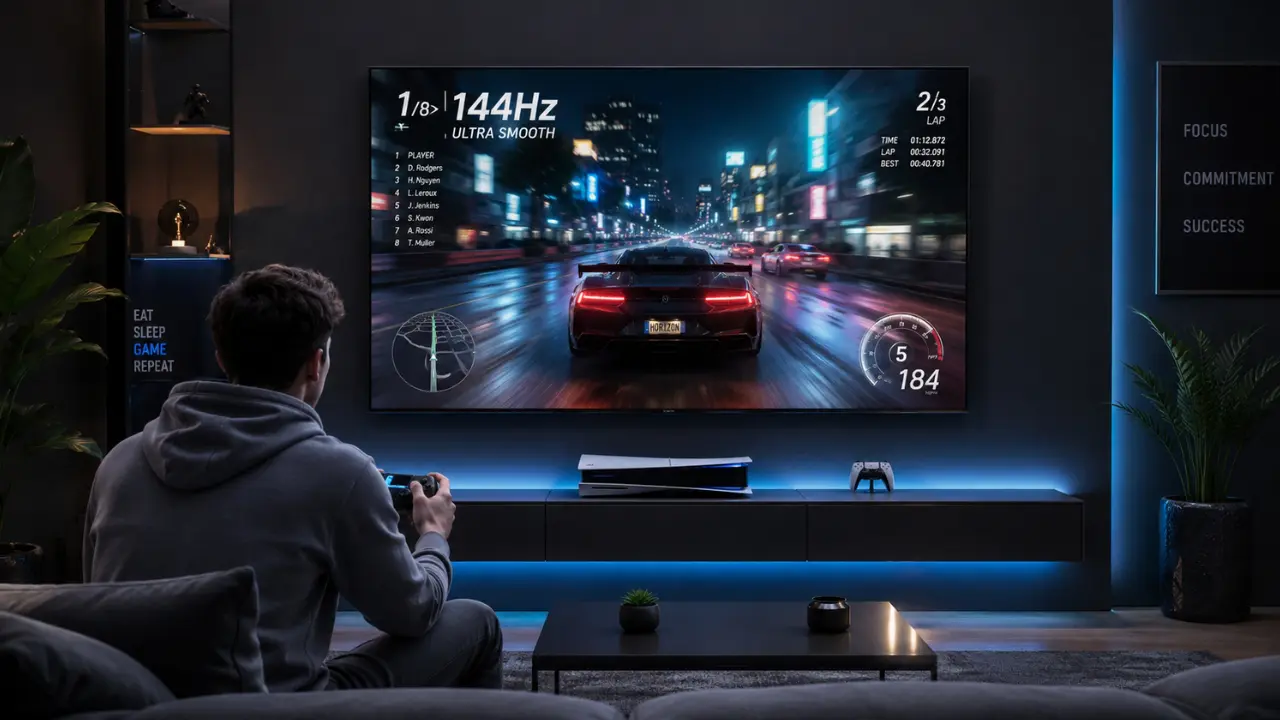

A TV’s refresh rate decides how smoothly motion appears on screen.
60Hz works well for regular viewing.
120Hz improves sports and gaming. 144Hz pushes responsiveness further for competitive gamers. 240Hz sits in ultra-high-performance territory where speed matters more than anything else.
But numbers alone rarely explain the real experience.
Because refresh rates are not about specifications.
They are about how motion feels inside a room.
Why do refresh rates suddenly matter in modern homes?
Ten years ago, most people never asked about refresh rates.
They asked:
- How big is the TV?
- Is it Full HD?
- What’s the price?
Today the questions changed.
Now households stream IPL in 4K.
Teenagers connect gaming consoles.
Parents binge OTT thrillers at night.
Even YouTube videos now run at higher frame rates.
Content evolved faster than most people realise.
And motion quality quietly became one of the biggest differences between an average TV and an immersive one.
A blurry cricket ball during a final over feels wrong instantly.
Not because viewers understand display engineering.
Because the human eye notices broken motion emotionally before it notices missing pixels.
That is the hidden system.
What does refresh rate actually mean?
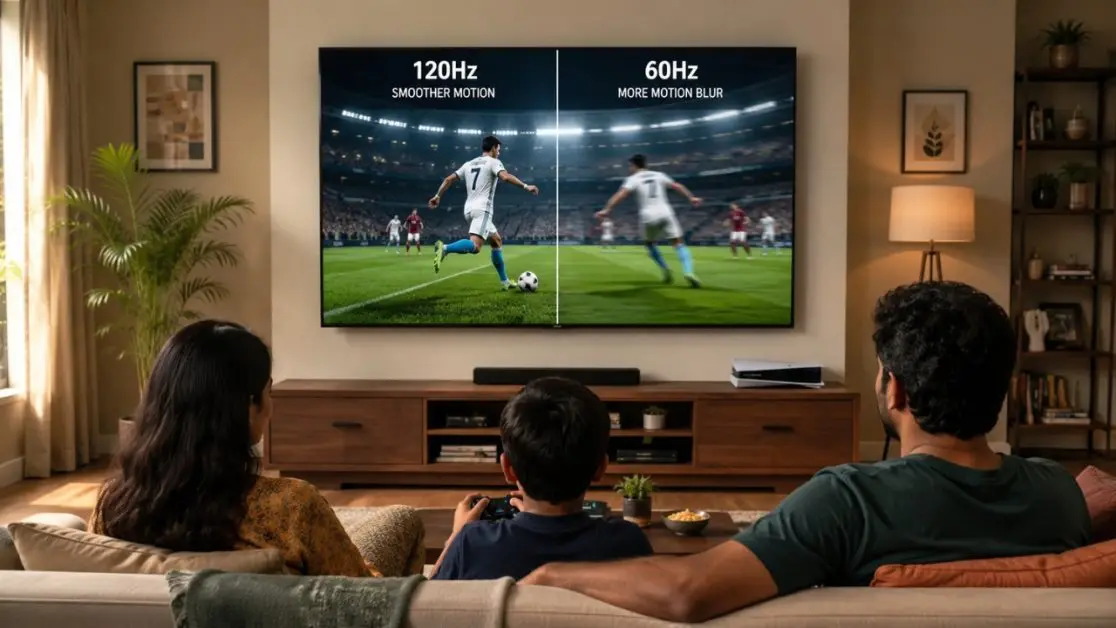
Refresh rate simply means how many times a TV updates the image every second.
- 60Hz = 60 image refreshes per second
- 120Hz = 120 refreshes per second
- 144Hz = 144 refreshes per second
- 240Hz = 240 refreshes per second
More refreshes create smoother motion.
The difference becomes visible during:
- Fast sports
- Action movies
- Gaming
- Camera panning shots
- Racing content
- Fast-scrolling visuals
Think of it like flipping pages in a notebook.
Flip slowly and motion feels choppy.
Flip faster and movement starts looking natural.
Televisions work similarly.
60Hz: The everyday standard most homes still use
60Hz remains the most common refresh rate globally.
And for many people, it is still enough.
Especially if viewing habits include:
- Daily news
- Soap operas
- YouTube
- Casual OTT streaming
- Family movies
- Educational content
A good 60Hz panel paired with smart motion optimisation can still look excellent.
That matters because raw numbers do not tell the full story.
Processing matters too.
For example, several modern Haier Mini LED TVs combine 60Hz refresh rates with MEMC motion enhancement to reduce blur during fast-moving scenes.
That combination matters more than people assume.
Where 60Hz starts showing limitations
The cracks appear during high-motion content.
Especially:
- Cricket broadcasts
- Football tracking shots
- Racing games
- PS5 or Xbox gaming
- Action-heavy films
At 60Hz:
- Motion blur becomes more noticeable
- Fast camera pans can feel less stable
- Competitive gaming feels slightly delayed
- Fast objects lose edge sharpness
Not terrible.
Just less fluid.
And once someone experiences higher refresh rates consistently, going back becomes difficult.
Like shifting from a smooth highway back onto a broken road.
120Hz: The sweet spot modern TVs are moving toward
120Hz changed television conversations globally.
Because it solves the exact problem modern entertainment created.
Sports became faster.
Games became smoother.
Streaming became sharper.
And suddenly 60 frames no longer felt enough.
Why 120Hz feels dramatically smoother
At 120Hz:
- Motion blur reduces significantly
- Sports tracking looks cleaner
- Gaming responsiveness improves
- Fast scenes feel more cinematic
- Camera movement appears natural
This becomes especially obvious during:
- IPL matches
- Formula 1 races
- FIFA or Call of Duty gaming
- Action films with rapid movement
The ball stays clearer.
The camera feels steadier.
Movement feels intentional instead of rushed.
One refresh rate upgrade changes how the entire room experiences entertainment.
DLG 120Hz and modern TV optimisation
Some TVs now use technologies like DLG 120Hz to improve perceived motion smoothness during fast content. Haier’s M80F Mini LED Google TV lineup includes DLG 120Hz support designed for sports and gaming experiences.
That distinction matters.
Because consumers often confuse:
- Native refresh rate
- Motion enhancement
- Gaming optimisation
- Frame interpolation
Manufacturers approach smoothness differently.
A TV is no longer just a screen.
It is now a motion management system.
144Hz: Where gaming becomes the priority
144Hz exists because gamers pushed technology further.
Not movie lovers.
Not casual viewers.
Gamers.
Especially PC gamers.
Why gamers care so deeply about refresh rates
In competitive gaming:
- Every millisecond matters
- Faster refresh rates reduce perceived lag
- Motion clarity improves aiming precision
- Screen tearing reduces
- Gameplay feels more immediate
At 144Hz:
- Motion feels exceptionally fluid
- Cursor movement becomes sharper
- Fast reactions feel more connected
- Competitive shooters benefit heavily
This is why esports monitors adopted 144Hz aggressively.
The improvement is not theoretical.
It is physical.
Players feel it instantly.
But does every household need 144Hz?
No.
That is where marketing often oversimplifies reality.
Most OTT platforms still stream around 24fps to 60fps.
Most cable broadcasts remain below 120fps.
Which means many households may never fully utilise 144Hz consistently.
One option is casual entertainment.
60Hz works fine.
The second option is mixed usage with sports and console gaming.
120Hz becomes valuable.
The third option is serious gaming.
That is where 144Hz starts making practical sense.
Technology works best when matched to behaviour.
Not an aspiration.
240Hz: The extreme performance category
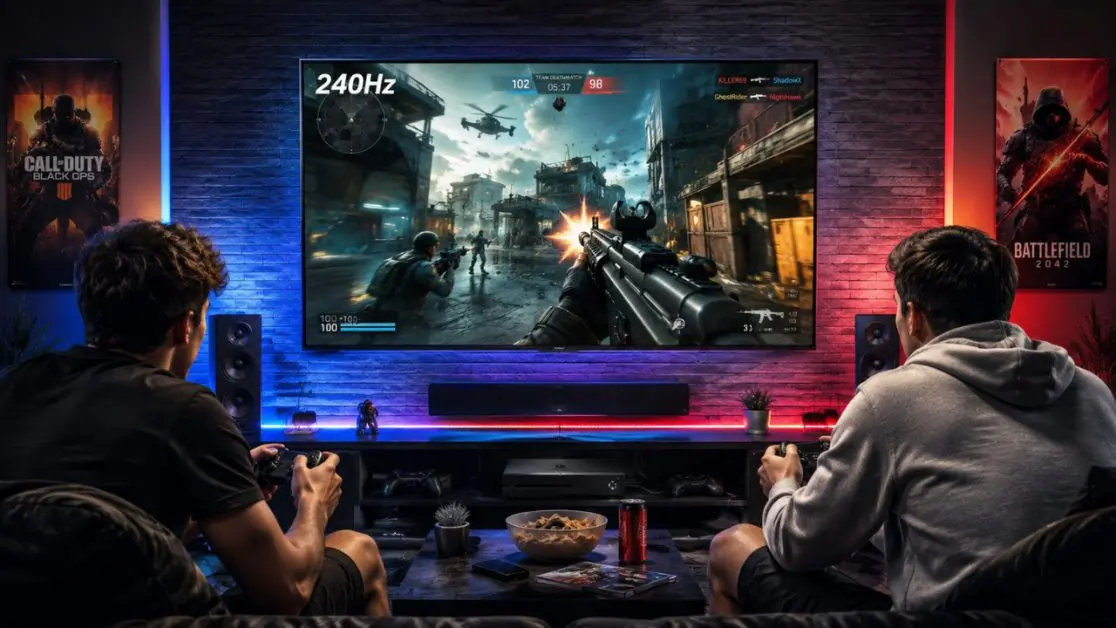
240Hz sounds futuristic because for most homes, it still is.
This refresh rate primarily targets:
- Competitive esports
- Professional gaming setups
- High-end gaming monitors
- Elite responsiveness demands
At 240Hz:
- Motion persistence reduces dramatically
- Input responsiveness becomes extremely fast
- Fast object tracking feels ultra-precise
But there is an important truth most spec sheets ignore.
The law of diminishing returns appears quickly
The jump from:
- 60Hz to 120Hz feels massive
- 120Hz to 144Hz feels noticeable
- 144Hz to 240Hz feels increasingly specialised
That is how human perception works.
The first improvements solve major friction.
Later improvements solve smaller imperfections.
Like audio systems.
Moving from phone speakers to theatre speakers feels transformative.
Moving from premium speakers to ultra-premium speakers becomes more nuanced.
The same principle applies here.
Refresh rates are only one part of motion quality
This is the part most comparison videos skip.
Refresh rate alone does not guarantee smooth viewing.
Several hidden systems affect motion:
- Response time
- Motion interpolation
- MEMC processing
- HDMI bandwidth
- VRR support
- Input lag
- Display panel quality
A poorly optimised 120Hz TV can still perform worse than a well-tuned 60Hz TV.
That surprises people.
But systems matter more than isolated numbers.
MEMC and motion enhancement technologies
Modern TVs increasingly use MEMC technology to insert additional frames between scenes and reduce visible blur during movement. Haier’s M80F Mini LED series highlights MEMC support specifically for smoother sports and action visuals.
This matters because refresh rates and motion enhancement often work together.
Not separately.
That is why two TVs with identical refresh rates can still feel completely different during live sports.
How refresh rates change different kinds of content
Not all content benefits equally.
That is the hidden pattern buyers miss.
For cricket and sports
Higher refresh rates help:
- Ball tracking
- Camera pans
- Crowd shots
- Fast transitions
Sports expose weak motion handling immediately.
Especially cricket.
Because the camera constantly tracks fast-moving objects against bright backgrounds.
For movies
Movies usually run at 24fps.
Which means ultra-high refresh rates matter less unless motion smoothing is enabled.
Some viewers actually dislike excessive smoothness in films because it creates the “soap opera effect”.
Cinema traditionally embraces slight motion blur.
Perfection is not always immersion.
For gaming
Gaming benefits the most.
Especially:
- Racing games
- FPS shooters
- Sports games
- Multiplayer titles
Higher refresh rates improve:
- Responsiveness
- Motion clarity
- Competitive reaction timing
- Gameplay smoothness
That is why gaming drove the refresh rate race globally.
What refresh rate should most Indian households actually choose?
This is the practical question.
Not the spec-sheet question.
Choose 60Hz if:
- You mostly watch OTT content
- TV usage is casual
- Budget matters more
- Gaming is occasional
- You prioritise display quality over speed
Choose 120Hz if:
- You watch sports regularly
- You own a PS5 or Xbox
- You stream high-motion content often
- You want smoother premium viewing
- The TV is a long-term investment
Choose 144Hz if:
- You are a serious gamer
- You own a gaming PC
- Competitive responsiveness matters
- You play fast multiplayer games regularly
Choose 240Hz if:
- Gaming is the primary use case
- You play esports professionally
- You already optimise high-end gaming setups
Most households do not need 240Hz.
And that is okay.
The smartest technology decisions are not about buying the highest number.
They are about buying the right friction reduction for your lifestyle.
The real shift is not technical. It is emotional
Refresh rates sound technical on paper.
But the real impact is emotional.
A smoother cricket match keeps people engaged longer.
A more responsive game feels immersive instead of frustrating.
A fast action film feels cinematic instead of chaotic.
Technology succeeds when people stop noticing the technology itself.
That is the deeper pattern behind modern televisions.
The best TVs do not scream specifications every second.
They quietly remove friction from everyday experiences.
And refresh rate is one of those invisible systems shaping how entertainment now feels inside Indian homes.
Because modern screens are no longer passive displays.
They are emotional infrastructure for how families relax, celebrate, compete, and spend time together.
That changes what “smooth” really means.
Frequently Asked Questions
What does refresh rate mean on a TV?
Refresh rate refers to how many times a television updates the image every second. A 60Hz TV refreshes 60 times per second, while a 120Hz TV refreshes 120 times per second. Higher refresh rates generally create smoother motion.
Why are refresh rates suddenly becoming important?
Modern entertainment involves more fast-moving content than ever before, including IPL matches, football, Formula 1, console gaming, and high-frame-rate videos. Better refresh rates help keep motion smooth and clear.
Does refresh rate affect picture quality?
Not directly. Resolution affects image detail, while refresh rate affects motion smoothness. A TV can have excellent picture quality but still struggle with fast-moving scenes if its refresh rate or motion processing is limited.
Can I notice refresh rate differences without being a tech expert?
Yes. Most people notice smoother movement, clearer sports action, and more responsive gaming even if they don’t know the technical reasons behind it.
Is refresh rate more important than 4K resolution?
For fast-moving content like sports and gaming, refresh rate can have a bigger impact on the viewing experience than additional resolution.