
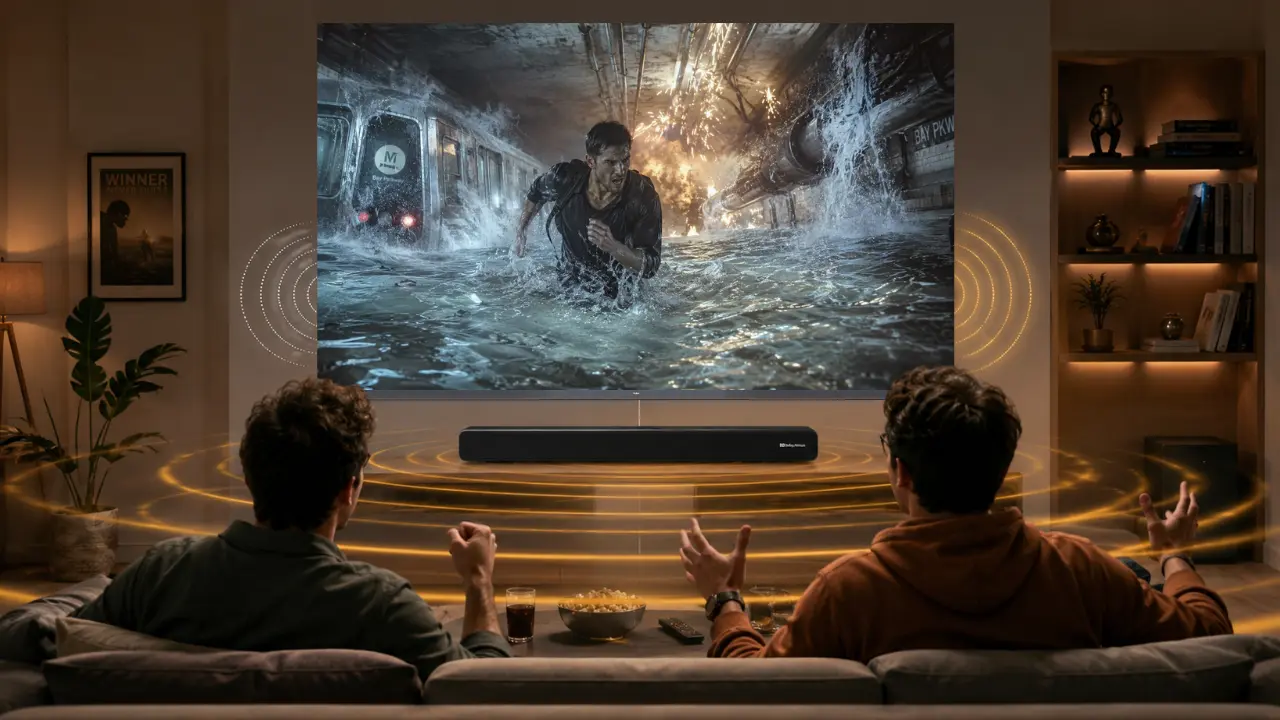

Built-in TV speakers are no longer “bad.” But they are designed for convenience first. Soundbars are designed for immersion first.
That is the real difference.
Modern televisions have become thinner, brighter, smarter, and larger. But physics still matters. A slim television has limited space for large speaker chambers. Which means even the best built-in speakers must balance design constraints with sound performance.
At the same time, audio expectations inside Indian homes have changed.
People stream IPL matches at high volume. Families binge-watch thrillers on weekends. Gamers want engine sounds to feel directional. OTT platforms now mix content in Dolby Atmos. The living room quietly became a mini theatre.
And suddenly, sound matters more than most people expected.
The hidden truth: most people notice bad sound faster than bad picture quality.
A blurry scene can pass unnoticed for a few seconds.
Muffled dialogue cannot.
That is why sound shapes emotional immersion more than people realise. A cricket stadium feels alive because of crowd noise. Horror films feel tense because of silence and sudden bass. Even comedy depends on timing, clarity, and room-filling audio.
Television audio changed from “functional” to “experiential.”
The question is no longer:
“Does the TV have speakers?”
The better question is:
What kind of experience does the room actually need?
Why built-in TV speakers improved dramatically in recent years
Ten years ago, built-in speakers mostly existed to “get the job done.”
Today, premium televisions treat audio as a serious engineering layer.
Brands now integrate:
- Dolby Atmos processing
- AI sound optimisation
- Dedicated subwoofers
- Multi-channel speaker setups
- Audio partnerships with specialist brands
- Real-time scene detection for sound balancing
That changes the equation completely.
For example, the Haier New M92 Series QD Mini LED AI Smart Google TVs integrate Sound by KEF, Dolby Atmos, and 2.1 channel speaker systems with subwoofers.
The larger Haier New M96 Series 254cm(100) QD Mini LED AI Smart Google TV pushes this further with a 6.2.2 channel speaker setup and 90W audio output designed for a more cinematic soundstage.
That matters because not every household wants extra devices, wires, wall drilling, or separate remotes.
Sometimes simplicity wins.
Built-in speakers work best when convenience matters most
There is a pattern visible across modern Indian homes.
Not everyone wants a full entertainment setup.
One option is the minimalist apartment setup.
A single TV. Clean wall. No extra hardware. Less clutter.
Another option is the family-first setup.
Parents want clear dialogue during serials. Kids watch cartoons. Grandparents stream devotional content. Nobody wants complicated audio controls.
A third option is the rental-home setup.
Frequent shifting makes external speaker systems inconvenient.
In all three cases, modern built-in TV speakers often work surprisingly well.
Especially when the television includes:
- Dolby Atmos support
- AI sound tuning
- Front-firing speakers
- Dedicated bass channels
- Higher wattage output
- Audio optimisation by sound specialists
The goal changes from “theatre-level sound” to effortless everyday clarity.
And that is an important distinction.
A good home setup removes friction, not just noise
People underestimate this.
Technology succeeds quietly when it reduces small daily annoyances.
No cable management.
No second remote.
No Bluetooth pairing issues.
No speaker placement stress.
Just turn on the TV and watch.
That simplicity has value.
But soundbars solve a different problem entirely
Built-in speakers create contained sound.
Soundbars create spatial sound.
The difference feels subtle in specifications. It feels dramatic in real life.
Imagine watching an IPL final.
With standard speakers, commentary sounds clear.
With a good soundbar, the stadium feels wider. Crowd noise spreads across the room. Bat impacts sound heavier. The atmosphere expands beyond the television itself.
That is the real role of a soundbar.
It creates scale.
Why televisions struggle with deep bass
Thin TVs face one unavoidable limitation:
Air movement.
Bass requires physical space. Bigger drivers move more air. Slim televisions prioritise aesthetics, which restricts internal speaker chamber size.
This is where soundbars gain a natural advantage.
Especially soundbars with wireless subwoofers.
They add:
- Deeper bass response
- Wider soundstage
- Better directional effects
- Louder output without distortion
- Stronger cinematic immersion
You feel this most during:
- Action films
- Live sports
- Concert videos
- Gaming sessions
- Dolby Atmos content
A television can simulate surround sound.
A soundbar physically expands it.
The biggest mistake people make when comparing speakers and soundbars
They compare volume.
That misses the point completely.
Sound quality is not about loudness alone.
It is about:
- Dialogue clarity
- Separation between sounds
- Bass depth
- Positional accuracy
- Room coverage
- Listening comfort over time
Cheap speakers often sound “loud” but tiring.
Better sound systems sound fuller at lower volume.
That changes late-night viewing completely.
Especially in apartments.
Modern TVs are already closing the gap
This is the interesting shift most buyers have not fully noticed yet.
Premium televisions increasingly behave like hybrid entertainment systems.
The Haier M92 Series, for instance, combines:
- Sound by KEF
- Dolby Atmos
- Total Sonic sound enhancement
- 2.1 channel speakers with subwoofer
- AI-powered sound optimisation
The Haier M96 Series goes further with:
- 6.2.2 channel audio
- KEF-tuned sound
- 90W audio output
- Dolby Atmos integration
That changes the buying conversation.
Because now the question becomes:
Do you still need a soundbar immediately?
For many households, the answer is surprisingly nuanced.
One option is “TV-only.” Another is “TV-first.”
This distinction matters.
Option 1: TV-only setup
This works best for:
- Casual OTT viewing
- News consumption
- YouTube streaming
- Small apartments
- Bedrooms
- Minimalist setups
Modern premium TVs already deliver strong performance here.
Especially models with integrated Dolby Atmos and dedicated subwoofers.
Option 2: TV-first setup
This is increasingly common.
People first invest in a high-quality television with strong built-in audio. Later, if their entertainment habits evolve, they add a soundbar.
This spreads cost intelligently over time.
And importantly, it avoids overbuying early.
Option 3: Full home theatre mindset
This suits:
- Movie enthusiasts
- Serious gamers
- Large living rooms
- Dedicated entertainment spaces
- Frequent sports watchers
Here, external audio systems still dominate.
Because immersion becomes the priority.
Room size changes everything
People obsess over specifications and ignore acoustics.
A 50W built-in speaker setup may feel excellent in a compact apartment.
The same setup may feel underpowered in a large open living room.
Sound behaves like water.
The room shapes the experience.
That is why soundbar recommendations without room context often fail.
Smaller rooms benefit from controlled sound
In compact spaces:
- Built-in speakers often feel balanced
- Dialogue stays clear
- Bass feels tighter
- Volume requirements stay lower
Larger rooms expose limitations quickly
In bigger rooms:
- Sound dispersion matters more
- Bass disappears faster
- Dialogue loses clarity at distance
- Atmospheric effects weaken
This is where soundbars justify themselves immediately.
Gaming changed audio expectations permanently
Gaming quietly reshaped television audio priorities.
Fast-paced games depend on directional sound.
You hear footsteps.
Engine movement.
Environmental cues.
Gunfire positioning.
Audio becomes information.
Not just entertainment.
That is why gaming-focused televisions now combine:
- High refresh rates
- VRR
- ALLM
- Dolby Atmos
- Enhanced speaker systems
The Haier M92 and M96 series TVs integrate gaming-focused technologies alongside advanced sound systems for this exact reason.
Because modern entertainment systems no longer separate picture from sound.
They work together.
People rarely regret buying better sound
This pattern appears repeatedly.
Consumers delay audio upgrades because visuals feel easier to compare inside showrooms.
But once better sound enters the home, people adapt instantly.
Dialogue feels cleaner.
Sports feel larger.
Music feels warmer.
Films feel more emotional.
Sound changes emotional scale.
And emotional scale is what people remember.
A television fills a wall. Audio fills a room.
That is the hidden system.
Screens attract attention first.
Sound controls immersion afterward.
The smartest setups understand both.
For some homes, built-in speakers are already enough. Especially with newer AI-powered televisions that integrate Dolby Atmos, KEF-tuned audio, and dedicated speaker systems.
For other homes, soundbars unlock the final layer of cinematic depth.
Neither option is universally correct.
The better decision comes from understanding the room, the viewing habits, the lifestyle, and the kind of experience people actually want after a long day.
Because the goal was never “more sound.”
The goal was always feeling more inside the moment.
Frequently Asked Questions
Are built-in TV speakers good enough in modern TVs?
Yes, many modern premium TVs now offer significantly better audio than older televisions. Features like Dolby Atmos, AI sound optimisation, dedicated subwoofers, and multi-channel speaker systems provide clear dialogue and balanced sound for everyday viewing.
Do I really need a soundbar if my TV already supports Dolby Atmos?
Not necessarily. If your TV includes high-quality speakers, Dolby Atmos processing, and sufficient audio output, you may be satisfied without a soundbar. A soundbar becomes more valuable if you want deeper bass, wider sound staging, or a more cinematic experience.
Should I buy a better TV with strong speakers or a cheaper TV plus a soundbar?
It depends on your priorities. If you prefer simplicity and fewer devices, investing in a TV with excellent built-in audio can be a smart choice. If home theatre immersion is important, combining a TV with a soundbar often delivers superior results.
Is it okay to start with the TV speakers and add a soundbar later?
Yes. Many buyers choose a “TV-first” approach purchasing a premium television with strong audio and upgrading to a soundbar only if their entertainment needs grow over time.
Why do soundbars feel more cinematic?
They create a wider soundstage, stronger bass, and better spatial effects that extend beyond the TV screen.