
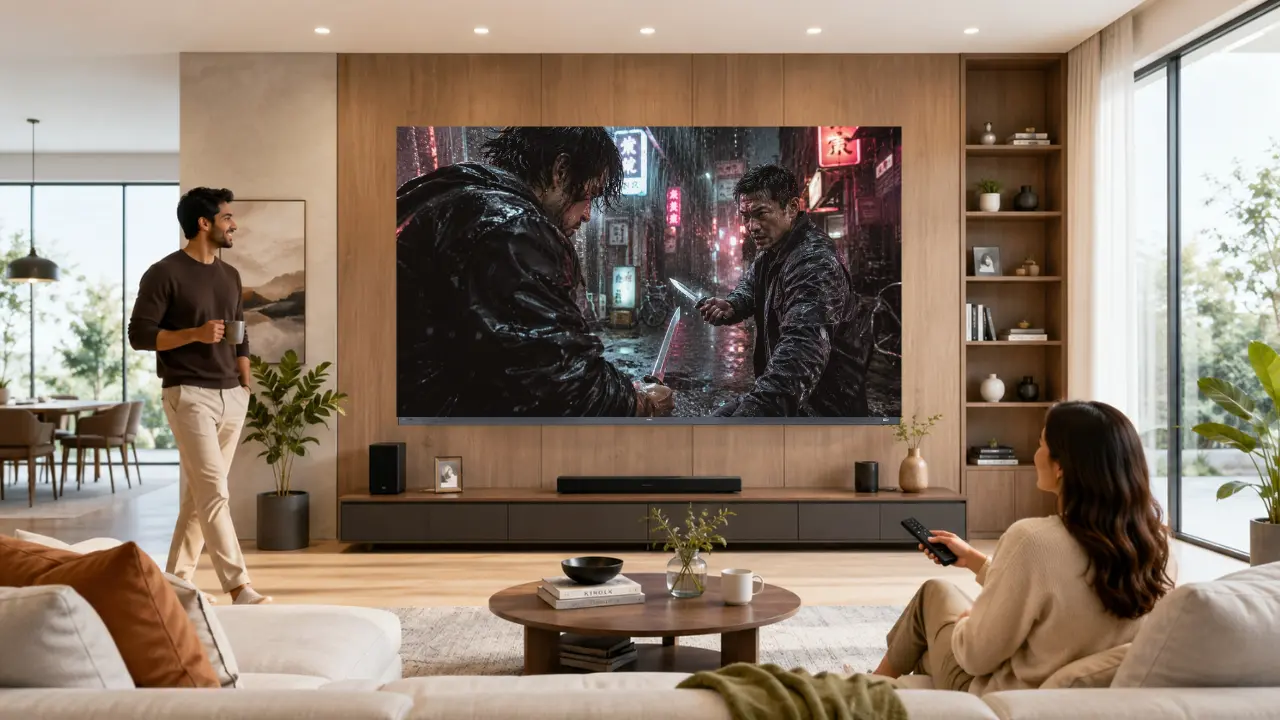

A TV that is too small disappears into the room. A TV that is too large overwhelms it. The right TV size sits in a sweet spot where comfort, immersion, room layout, and viewing habits work together. The best choice is not about buying the biggest screen. It is about buying the right experience for the space you actually live in.
Modern Indian homes are changing.
Living rooms are becoming entertainment hubs. Bedrooms double up as late-night streaming zones. Studio apartments turn into gaming arenas after work hours. And suddenly, the old “one TV for the whole family” formula no longer applies.
That changes how we think about TV size.
A compact TV that once felt premium now feels cramped in many urban homes. At the same time, an ultra-large display in a compact room can feel exhausting. Bigger is not always better.
Comfort is better.
The hidden mistake most people make while buying a TV
Most people start with a budget.
Then brand.
Then features.
Room size comes last.
That is backwards.
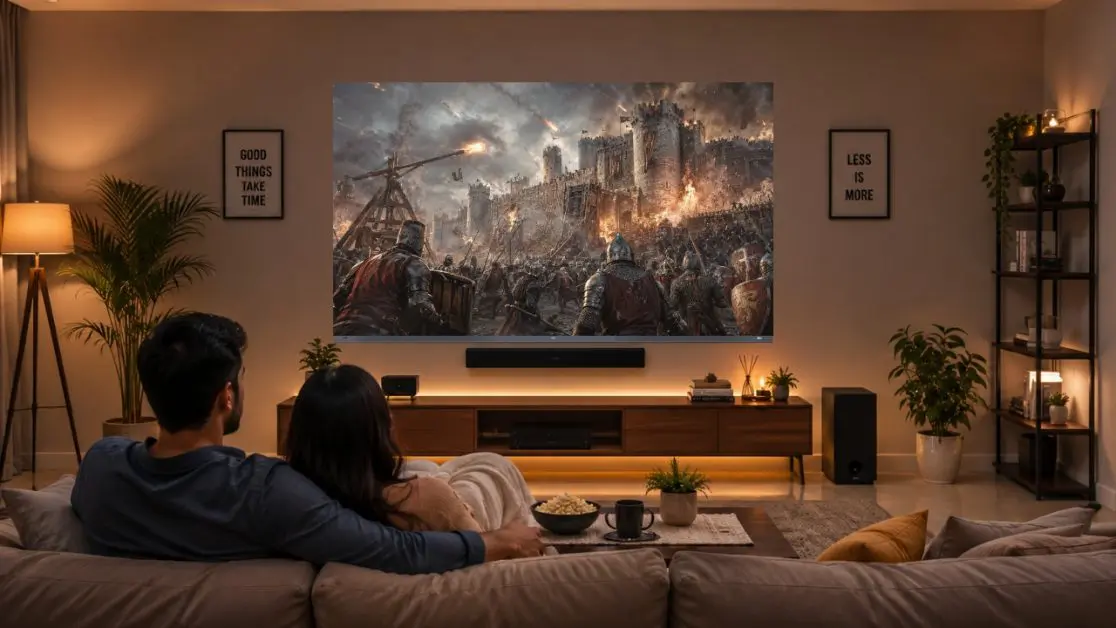
The room decides the experience long before the TV does.
Think about a cinema hall. The best seats are never in the first row. They are positioned at a distance where your eyes can absorb the entire frame comfortably.
The same principle applies at home.
The right TV size depends on three things:
- Viewing distance
- Room dimensions
- Usage pattern
Miss one of them, and even an expensive TV feels wrong.
Why viewing distance matters more than screen size
Your eyes need breathing room.
Sit too close to a massive TV, and fast-moving scenes become tiring. Sit too far from a smaller TV, and details disappear.
A simple rule works well for most Indian homes:
- Standard televisions require slightly more viewing distance
- Modern 4K and Mini LED TVs allow closer viewing because visuals stay sharper and more detailed
That changes everything.
A larger 4K TV may actually feel more comfortable than a smaller traditional TV if the room layout supports it.
A practical TV size guide for Indian homes
Here’s a simple viewing framework:
- Compact TVs
- Ideal for bedrooms, compact apartments, study rooms
- Best for close-range viewing
- Mid-sized TVs
- Ideal for medium-sized living rooms
- Comfortable for everyday family entertainment
- Large-screen TVs
- Ideal for spacious family areas and immersive viewing
- Great for sports, OTT streaming, and cinematic content
- Ultra-large TVs
- Ideal for home theatre-like experiences
- Best for expansive living rooms and premium setups
The point is simple.
The room is not just a container for the TV. The room is part of the viewing technology itself.
The rise of larger TVs in Indian homes
Five years ago, a large-screen TV felt excessive.
Today, bigger displays feel increasingly normal.
Why?
Because streaming changed viewing behaviour.
People no longer watch only cable channels. They binge-watch films, sports, gaming content, concerts, documentaries, and OTT series designed for cinematic viewing.
Content evolved. Screens evolved with it.
This is exactly why larger formats like the Haier M80F Mini LED Google TV Sound By KEF (H75M80FUX) are becoming increasingly relevant for modern entertainment-focused households. Features like Mini LED display technology, Dolby Vision, Dolby Atmos, and KEF-powered audio are designed around immersive viewing rather than passive watching.
A television is no longer background noise.
It is often the centrepiece of downtime.
Small rooms do not always need small TVs
This sounds counterintuitive. But it is true.
A compact room with proper viewing angles can comfortably handle a larger 4K TV because higher resolution allows closer viewing without visible pixelation.
The old fear of “too big for the room” came from older display technology.
Modern 4K and Mini LED displays change that equation.
One option is compact practicality
For renters, solo professionals, or bedroom setups:
- Easier wall mounting
- Lower power consumption
- Better for mixed usage like work, YouTube, casual OTT viewing
This is the “balanced everyday” category.
The second option is family-first viewing
For households where TV time is shared:
- Larger screens create stronger immersion
- Better for cricket matches, movies, festivals, gaming nights
- More comfortable for group seating
This is where living rooms become social spaces.
The third option is cinematic immersion
Some people do not want television.
They want theatre.
That is where ultra-large screens enter the picture.
The Haier M80F Mini LED Google TV Sound By KEF (H85M80FUX) is built for precisely this kind of setup, combining Mini LED visuals with Dolby Vision, KEF-powered sound, Dolby Atmos, and gaming-focused technologies like VRR and ALLM.
At this scale, the TV stops feeling like furniture.
It starts feeling architectural.
A bigger TV changes behaviour inside the room
People underestimate this.
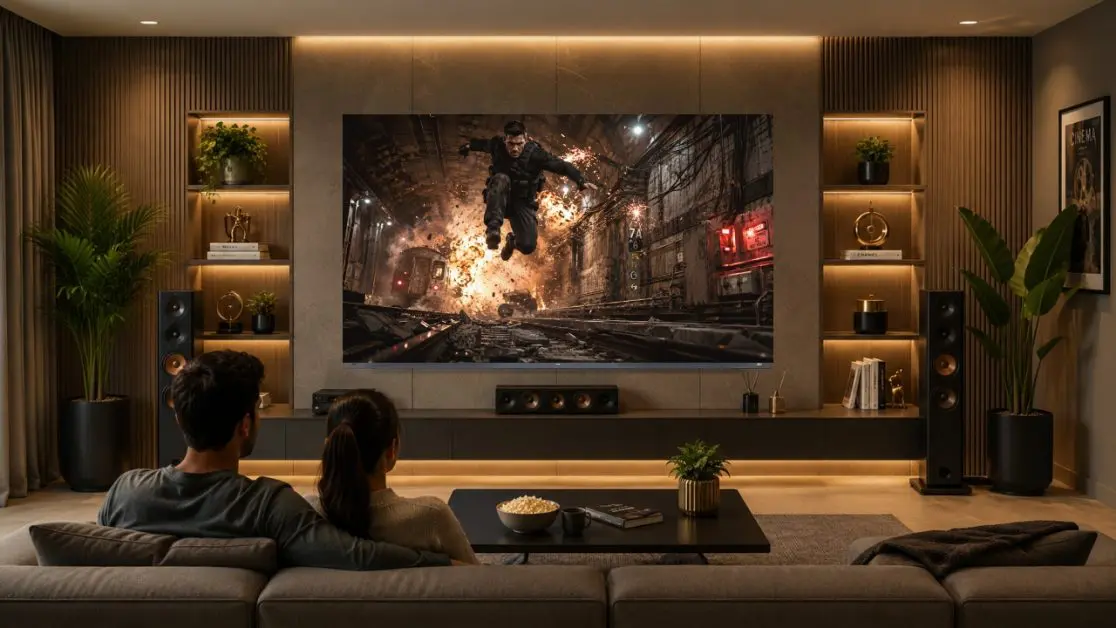
Large screens subtly reshape how families gather.
Movie nights happen more often.
Sports become communal.
Gaming feels more social.
Even silence changes. A nature documentary on a large Mini LED display creates a completely different atmosphere compared to a smaller screen.
Technology influences culture quietly.
That is what smart home appliances increasingly do.
Wall size matters as much as floor size
People calculate sofa distance.
But forget the wall itself.
A large TV needs visual breathing room around it.
If the wall is crowded with shelves, photo frames, cabinets, or decorative panels, the screen feels cramped regardless of actual size.
Minimal walls make TVs feel more premium.
This is why modern interior design increasingly integrates televisions into clean, uncluttered spaces.
The TV becomes part of the room aesthetic.
Not an interruption inside it.
Gaming changes the TV size conversation completely
Gamers sit closer.
Fast response matters more.
Refresh rate becomes critical.
This is why gaming-ready televisions now include features like:
- High refresh rates
- VRR
- ALLM
- MEMC
- HDMI 2.1
The Haier New M96 Series QD-Mini LED AI Smart Google TV (H100M96FUX) pushes this idea further with a 144Hz refresh rate, AMD FreeSync Premium Pro, AI picture processing, and an ultra-large QD-Mini LED display.
A setup like this is not just about watching content.
It is about entering it.
And that reflects a broader shift.
The line between television, gaming monitor, and home theatre is disappearing.
The smartest TV buyers think long-term

A television usually stays in a home for years.
People upgrade phones every few years.
TVs stay much longer.
That means buying only for today is short-sighted.
A newly married couple may move into a larger apartment later.
A solo professional may eventually build a dedicated entertainment setup.
Children grow. Viewing habits change. Streaming platforms evolve.
The right TV size should accommodate where life is heading, not just where it currently stands.
Future-proofing is not excess. It is planned.
What most TV buying advice gets wrong
Most buying guides reduce the conversation to dimensions.
But television size is emotional.
It affects:
- How relaxed you feel while watching
- How immersive films become
- How people gather socially
- How premium the room feels
- How connected technology feels to everyday life
This is why two homes with the same TV can feel completely different.
Context shapes experience.
Not just hardware.
A simple framework before choosing your next TV
Before buying, ask these five questions:
1. How far is the seating area?
Measure actual viewing distance.
Not estimated distance.
2. What content dominates your usage?
Sports, gaming, OTT, casual news viewing, or cinematic movies all demand different experiences.
3. Is the room bright or dark?
Brighter rooms benefit from high-brightness displays and better contrast technologies.
4. Will multiple people watch together?
Group viewing benefits from larger screens and wider viewing angles.
5. Are you buying for now or for the next five years?
The answer changes the decision dramatically.
The future of TVs is not just bigger. It is smarter
The interesting shift is not screen size alone.
It is intelligence.
Modern televisions increasingly optimize visuals, sound, gaming, recommendations, and even ambient viewing automatically.
The TV is becoming adaptive.
AI-powered processing, voice controls, Mini LED backlighting, advanced dimming zones, immersive sound systems, and integrated smart ecosystems are slowly transforming televisions into experience engines.
The screen is no longer passive.
It responds.
That is the real evolution happening inside Indian homes.
And perhaps that is the bigger insight here.
People do not actually buy televisions.
They buy moments.
Cricket finals with family.
Late-night thrillers after work.
Sunday cartoons with children.
Festival gatherings.
Gaming marathons.
Quiet documentaries on rainy evenings.
The right TV size simply determines how deeply those moments are felt.
Choose accordingly.
Frequently Asked Questions
How do I know what TV size is right for my room?
Start by measuring your actual viewing distance, the space between your primary seating position and the TV. Then consider your room dimensions, wall space, and viewing habits. The ideal TV size balances comfort, immersion, and room aesthetics rather than simply maximizing screen size.
Is a bigger TV always better?
No. A TV that is too large for your seating distance can feel overwhelming and tiring to watch. The best TV size is the one that feels comfortable for extended viewing sessions while providing an immersive experience.
Can a small room handle a large TV?
Yes. Modern 4K and Mini LED TVs allow closer viewing distances because of their higher resolution and improved picture clarity. A larger TV can work surprisingly well in a compact room if the seating layout is appropriate.
Should I prioritize room size or TV features when buying?
Room size and viewing distance should come first. Even the most advanced TV can feel disappointing if it doesn’t fit the room properly. Features enhance the experience, but room compatibility determines comfort.
Does wall size matter when choosing a TV?
Absolutely. A TV needs visual breathing room around it. Crowded walls with shelves, frames, or cabinets can make even a premium TV feel cramped.