

Big screens are no longer luxury products. They are becoming the new living room default.
A few years ago, a 140cm (55) TV felt enormous. Today, Indian families are comparing 189cm(75) , 215cm (85), and even 254cm(100) screens for everyday viewing. Cricket seasons look cinematic. Gaming feels immersive. OTT platforms are producing content designed for bigger displays.
The question has quietly changed.
It is no longer “Should we buy a large-screen TV?”
Now it is: “Which brand actually understands how Indian homes use large screens?”
That is where the comparison between Haier and its competitors becomes interesting.
The large-screen TV market is changing faster than people realise.
Most brands still approach large TVs like electronics.
Haier increasingly approaches them like living-room experiences.
That difference matters.
Because people do not buy a 215cm (85) TV only for specifications. They buy it for Sunday IPL gatherings. For PS5 marathons after work. For movie nights that feel bigger than the room itself.
Large screens change behaviour inside homes.
A bigger screen often means:
- Families spend more shared time together
- OTT replaces traditional cable habits
- Audio quality suddenly matters more
- Wall aesthetics become important
- Gaming performance becomes visible instantly
- Eye comfort becomes a daily concern
A TV is no longer background furniture.
It becomes the emotional centre of the room.
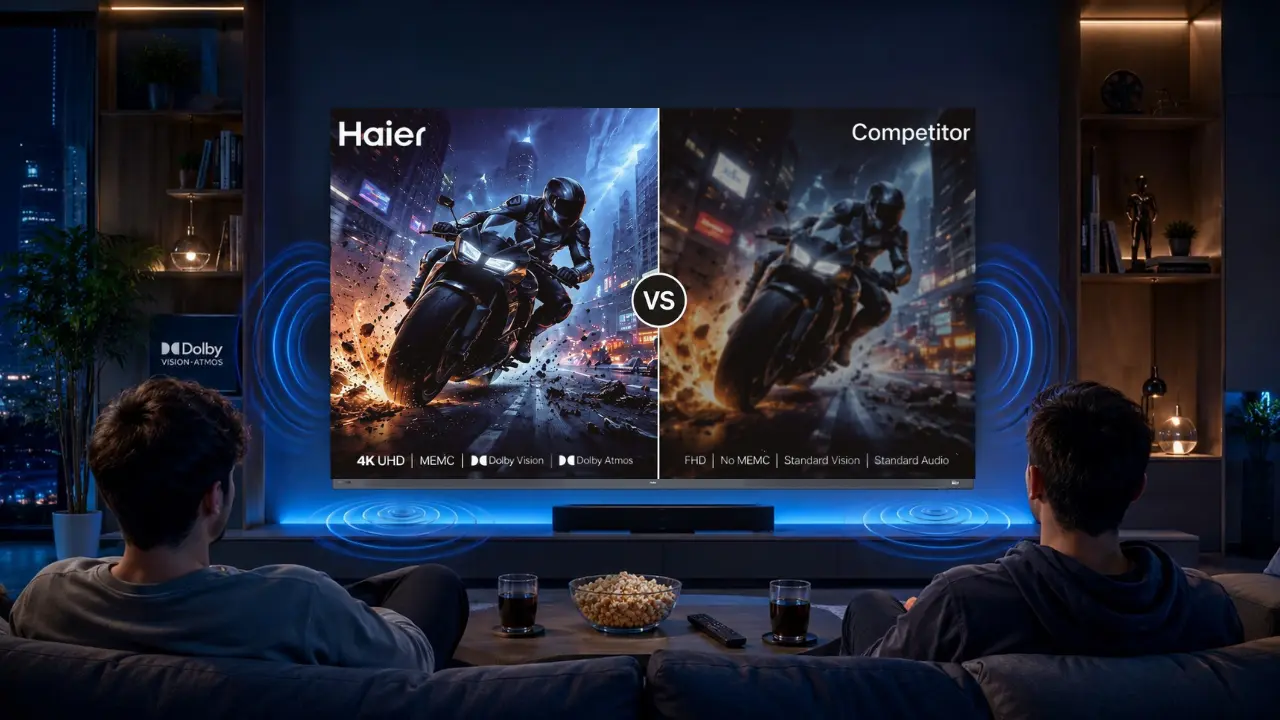
Most competitors focus on brightness. Haier focuses on balance.
Credits: Haier India, Most competitors focus on brightness
The large-screen category has become a specification war.
One brand pushes refresh rates.
Another pushes AI processors.
Another pushes ultra-thin bezels.
Useful? Yes.
Complete? Not always.
Because a 254cm(100) TV with poor sound still feels incomplete. A bright screen with inconsistent motion handling still breaks immersion. A gaming TV with weak colour balance creates fatigue over time.
The hidden system here is simple:
Large screens amplify strengths. They also amplify weaknesses.
That is why balance matters more in this category than raw numbers.
Haier’s recent large-screen lineup reflects that understanding.
Why Mini LED is becoming the real battleground
Five years ago, consumers mostly compared LED vs OLED.
Today, Mini LEDs are changing the conversation.
And for good reason.
Mini LED technology allows:
- Better brightness control
- Improved contrast
- More precise local dimming
- Reduced blooming around bright objects
- Better HDR performance
- Stronger large-screen consistency
On smaller screens, these differences feel subtle.
On 189cm(75) and 254cm(100) screens, they become obvious.
This is where brands either look premium or exposed.
The Haier M80F Series enters a different conversation
The Haier M80F Mini LED 189cm (75) Google TV and Haier M80F Mini LED 215cm (85) Google TV position themselves around immersive viewing rather than pure specification stacking.
That distinction matters.
Features like:
- Mini LED display technology
- Google TV integration
- Large cinematic display sizes
- Sound by KEF audio collaboration
- Premium HDR-focused viewing
- AI-powered smart viewing enhancements
create a more complete ecosystem experience instead of isolated feature marketing.
Many competitors still treat audio like an afterthought in large TVs.
But sound becomes critical once screen sizes cross 189cm(75).
A massive screen paired with flat sound feels like watching fireworks through closed windows.
Audio is the hidden differentiator nobody talks about enough
Walk into most Indian electronics stores and notice something.
Customers compare display quality first.
Then they go home and complain about the audio later.
This pattern repeats constantly.
Large-screen TVs expose weak audio faster than smaller models because the viewing distance increases. The room becomes larger psychologically. Expectations rise.
Haier’s partnership with KEF on select models signals an important shift.
Instead of assuming customers will separately buy soundbars later, the TV itself attempts to deliver a richer cinematic foundation.
That changes usability.
Especially for:
- Apartment living rooms
- Young couples setting up homes
- Solo professionals in rented spaces
- Families avoiding complicated audio setups
Convenience is often underrated.
But convenience is what actually gets used daily.
The 254cm(100) category changes how people think about televisions
The moment screens reach 254cm(100), the comparison changes completely.
At that size, consumers are not comparing TVs anymore.
They are comparing experiences.
The Haier M96 Series 254cm (100) QD Mini LED AI Smart Google TV enters precisely that territory.
And this is where competitors face a difficult challenge.
Because ultra-large TVs require solving multiple problems simultaneously:
- Viewing consistency
- Brightness management
- Motion clarity
- Sound staging
- Upscaling quality
- Room integration
- Eye comfort
- Smart interface responsiveness
Most brands solve two or three well.
Few solve the ecosystem holistically.
Bigger screens expose lazy engineering
Here is something people rarely discuss openly.
A mediocre processor can survive inside a 43-inch TV.
It struggles badly on a 254cm(100) display.
Poor upscaling becomes visible instantly.
Motion judder becomes distracting.
Compressed OTT content looks messy.
Colour inconsistencies become impossible to ignore.
Large screens punish shortcuts.
That is why processing intelligence matters more now than ever before.
Indian viewing habits are shaping TV innovation differently
Western TV usage and Indian TV usage are not identical.
Indian homes typically involve:
- Mixed-age viewing
- Long daily viewing hours
- Cricket-heavy motion content
- Bright living rooms
- Shared family seating
- Streaming + DTH coexistence
- Frequent festival gatherings
That creates different expectations.
One option is designing TVs purely for dark-room cinema lovers.
The second option is building displays for gaming-first audiences.
The third option is creating balanced televisions that adapt to varied Indian usage patterns.
Haier appears increasingly aligned with the third model.
That balance is practical.
And practical products usually win over time.
Smart TVs are becoming operating systems for the home
People still call them televisions.
But modern large-screen TVs behave more like digital control centres.
Think about what already happens through one screen:
- OTT streaming
- YouTube learning
- Fitness videos
- Video calls
- Music streaming
- Gaming
- Sports
- Ambient décor visuals
The television has quietly become infrastructure.
And infrastructure succeeds when friction disappears.
Google TV integration matters here because interface simplicity affects daily usage more than flashy advertisements suggest.
A smart TV people understand instantly gets used more frequently.
Simple systems survive.
Price alone is becoming a weaker buying signal
For years, Indian consumers chased the lowest-price large TVs.
That pattern is changing.
Because people now keep TVs longer.
A refrigerator impacts food.
An AC impacts comfort.
A TV impacts mood.
That emotional equation changes buying behaviour.
Consumers increasingly ask:
- Will this still feel premium after three years?
- Does the audio require external upgrades?
- Will OTT content actually look cinematic?
- Does the UI remain smooth over time?
- Can this handle gaming properly?
- Does it suit modern interiors?
The cheapest large TV often becomes the most expensive frustration.
Especially once screen sizes become massive.
Cheap mistakes look larger on larger screens.
Competitors still compete in categories. Haier increasingly competes in lifestyle moments.
That distinction is subtle but important.
Many brands still market televisions using isolated technical language.
Haier increasingly frames large-screen entertainment around living experiences:
- Family movie nights
- Sports immersion
- Gaming intensity
- Design aesthetics
- Smarter viewing ecosystems
That approach aligns more naturally with how people actually buy products.
Nobody invites guests over to admire refresh rates.
They invite them over for experiences.
The future of large-screen TVs belongs to brands that reduce friction
Not every innovation matters equally.
Some features impress during demos but disappear in real life.
The winning brands in the large-screen category will likely focus on three things:
1. Simplicity
Technology should disappear into the experience.
2. Immersion
Picture and sound must feel unified.
3. Adaptability
TVs must work across gaming, cinema, sports, and everyday family viewing.
This is where the large-screen category becomes less about electronics and more about emotional architecture.
The screen shapes how a room feels.
So, how does Haier compare?
Not by trying to shout louder.
That is the interesting part.
In a category crowded with specification battles, Haier increasingly positions itself around balanced premium experiences:
- Mini LED visual performance
- Large cinematic formats
- Smart ecosystem usability
- Stronger integrated audio experiences
- Design-conscious living-room integration
That combination matters because Indian homes are evolving.
Living rooms are becoming theatres.
Bedrooms are becoming gaming zones.
And televisions are becoming emotional anchors inside modern households.
The brands that understand this shift will not just sell bigger screens.
They will shape how people spend time together.
And that is ultimately what the large-screen category is really about.
Frequently Asked Questions
Is Haier a good choice for a large-screen TV compared to other brands?
Haier focuses on delivering a balanced large-screen experience through Mini LED technology, integrated smart features, premium audio partnerships like KEF, and Google TV integration. Instead of competing only on specifications, it aims to improve everyday viewing experiences such as movies, sports, gaming, and family entertainment.
Why is Mini LED becoming so popular in large-screen TVs?
Mini LED offers improved brightness control, better contrast, enhanced HDR performance, and more precise local dimming. These advantages become especially noticeable on larger displays where image imperfections are easier to spot.
Is Mini LED better than traditional LED for sports and movies?
In most cases, yes. Mini LED improves black levels, brightness consistency, and overall picture depth, making fast-moving sports and cinematic content appear more realistic and immersive.
Do I still need a soundbar if I buy a large-screen TV?
That depends on the TV’s built-in audio system. Models with enhanced speaker systems and premium audio tuning may provide a satisfying experience without additional equipment, especially for everyday viewing.
Why does sound matter more on large-screen TVs?
As screens get bigger, viewer expectations increase. A cinematic picture paired with weak audio can reduce immersion, making sound quality a critical part of the overall experience.
What is the advantage of KEF audio integration in Haier TVs?
KEF is known for premium audio engineering. Its collaboration with Haier aims to provide richer, more immersive sound directly from the TV, reducing the need for external audio systems.