

Most customers regret their AC purchase within the first summer. Not because the machine fails, but because they picked the wrong one for their room. Many choose a model only because it was discounted, then wonder why cooling feels uneven, and electricity bills keep climbing.
This AC buying guide covers three decisions that go wrong most often: tonnage, star ratings, and purchase timing.
BEE revised AC efficiency standards in 2026, so reading the star label is not as simple now. This guide explains what those changes mean for buyers. You’ll know which AC suits your home, what checks matter before purchase, and why the brand you choose can affect performance over the years.
What Is the Best AC Tonnage for Your Room Size?
Tonnage tells you how much cooling an AC can deliver in an hour. It is not related to the unit’s weight, which many buyers still assume. Choosing the wrong capacity creates problems fast. A smaller AC keeps running longer, while a larger one cools quickly but often leaves the room feeling uncomfortable.
The baseline starts with floor area in square feet. But the floor area alone does not capture the full picture.
| Room Area (sq ft) | Recommended Tonnage |
| Up to 100 | 1 Ton |
| 100 to 150 | 1.5 Ton |
| 150 to 200 | 1.5 to 2 Ton |
| 200 to 250 | 2 Ton |
| 250 and above | 2 Ton+ ( consider a tower AC for large or open-plan spaces) |
Room size gives you a starting point, but it should not be the only factor you consider. Large windows, higher ceilings, or an attached kitchen all add heat load. The best 1-ton AC suits most bedrooms with low sun exposure. Medium rooms with more people or direct sunlight need the best AC 1.5 ton. For halls above 250 sq ft., a tower AC provides rapid cooling where mall-mounted units are impractical.
How AC Star Ratings Work in India?
The star label measures efficiency, not a quality badge. More stars mean the unit draws less electricity for the same cooling output, and that shows up on your power bill. BEE tracks this using ISEER scores for each model. In January 2026, BEE raised the thresholds across every star level, so a 5-star unit under 2025 standards now qualifies as 4-star. Existing dealer stock still carries old labels.
| Star Rating | 2025 ISEER | 2026 ISEER |
| ★★ | 3.3-3.49 | 3.5-3.79 |
| ★★★ | 3.5-3.79 | 3.8-4.39 |
| ★★★★ | 3.8-4.39 | 4.4-4.99 |
| ★★★★★ | 4.4+ | 5.0-5.59 |
The 2026 BEE update removed the 1-star category and raised thresholds across every level. A 5-star unit under 2025 standards now falls to 4-star, and India now runs some of the toughest AC efficiency benchmarks among major markets. Counting only the stars can mislead you at the showroom.
Check the ISEER value printed on the energy label instead, since that reflects real seasonal performance, not just lab results. A 2026-rated 4-star model can use less electricity than a 2025-rated 5-star unit in dealer stock. Higher ratings still mean better efficiency, but only when both models belong to the same framework.
Inverter vs Non-Inverter AC: What’s the Difference?
When you are comparing an inverter vs a non-inverter AC, the key difference comes down to the compressor. A non-inverter runs at full speed, cuts off when the room cools, then restarts. Every restart pulls a power surge, and you feel the temperature swing each time. An inverter adjusts speed based on cooling demand, keeping your electricity draw steady. The table below shows the comparison between Inverter and Non-Inverter AC:
| Comparison | Inverter AC | Non-Inverter AC |
| Compressor operation | Variable speed | On/Off cycling |
| Energy consumption | Lower running cost over a season | Higher monthly cost |
| Temperature consistency | Stable throughout | Minor fluctuations |
| Noise during use | Lower | Higher on restart |
| Upfront cost | Higher | Lower |
| Best suited for | Daily use, 5+ hours | Occasional/seasonal use |
For any room running the AC five or more hours per day through summer, inverter technology typically recovers the price difference within two to three billing cycles over a full season. For a guest room that gets used a few weeks a year, the lower upfront cost of a non-inverter makes a reasonable case on its own terms.
Room-by-Room Buying Logic
The same 1.5-ton unit performs differently depending on where it sits and how the space is used. Here is how the buying logic shifts for each room type in a typical Indian home.
- Bedroom (100 to 150 sq ft)
For bedrooms, quiet performance matters more than many buyers expect. A noisy AC can disturb sleep night after night, even when cooling seems fine. In most homes, a 1.5-ton inverter model handles bedroom cooling comfortably. Rooms that face strong afternoon sun usually need extra capacity. Trying to cool a sun-exposed bedroom with a smaller unit often creates uneven cooling, longer run times, and more stress on the system over time.
- Living Room (150 to 250 sq ft)
Most living rooms need between 1.5 and 2 tons of cooling, but room size is only one part of the calculation. The number of people using the space matters more than many buyers realise. A packed room feels warmer and puts extra load on the AC. In open-plan homes, do not measure only the seating area. The dining space adds to the cooling requirement, too, and ignoring it can leave the entire area less comfortable than expected.
- Study or Home Office (80 to 120 sq ft)
For most study rooms, a 1-ton AC is usually enough and handles daily use comfortably. More than extra cooling power, convenience features often make a bigger difference here. Wi-Fi controls or scheduling let the room cool before work begins. That way, the AC is not running for hours when nobody is even using the space.
Different rooms place different demands on an AC over time. Haier offers models for varied spaces, from sunny bedrooms to busy living rooms, so finding a suitable option becomes much easier.
Best Time to Buy an AC in India
The Indian AC market follows a predictable seasonal rhythm, and buying at the wrong point in that cycle costs real money.
- March through June is peak demand season. Prices are at their highest, stock moves fast, and dealers have very little flexibility to negotiate. Most families respond to the first heat wave by rushing to buy immediately, which is exactly when the pricing leverage sits entirely with the seller.
- October through February is the practical buying window. Dealers need to move inventory before the next model cycle, and off-season demand is low enough that pricing flexibility opens up, in addition to manufacturer EMI or cashback offers active during this period.
Smart Features Available in Haier ACs
Haier has held the number one spot in major appliances globally for 14 consecutive years, according to Euromonitor, and leads in self-cleaning AC technology. The brand has also strengthened its position in India. While the Indian AC industry contracted in 2025, Haier India grew 18% and ranked #2 in the 4 and 5-star AC segment. Each model passes more than 200 tests at a joint R&D centre with Mitsubishi Electric. Here is how those features translate into everyday performance at home.
- AI-AtmoX Technology
The AC learns your room’s routine and adjusts cooling on its own, no manual tweaks needed. Auto Clean keeps both the indoor and outdoor units maintained, so you spend less on annual servicing.
- Supersonic Cooling
The compressor reaches full speed in 0.24 seconds, so you feel cold air the moment you switch on, not after the usual 10 to 15-minute wait.
- 60°C Ambient Reliability
The outdoor unit is tested to run at 60°C, which means it holds up through peak Indian summers without shutting down or throttling, especially useful for rooftop or top-floor installations.
- Hyper PCB
The control board has a below -1% failure rate against an industry average above 12%, which directly lowers your risk of an expensive out-of-warranty repair.
- Super Micro Filter
Full-face filtration catches more dust per cycle than partial-coverage filters, keeping your room air cleaner and reducing how often you need to clean the unit manually.
- Airflow and Built-In Connectivity
A 20-metre air throw covers large rooms without dead corners, and built-in Wi-Fi lets you schedule or adjust cooling remotely, no dongle, no extra purchase needed.
These six features are built around how people use an AC every day. Each one addresses something that tends to matter after installation, whether it is cooling consistency, easier maintenance, or dependable performance over the years. You may not pay attention to them at first, but their impact becomes quite clear with regular use. That is often where the difference between a good AC and a well-designed one starts showing.
Haier AC Series Guide: Which AC is best for the home
Haier’s current lineup is organised across four named series. Each targets a specific buyer profile rather than trying to serve everyone with the same configuration. Here is how they map to real buying scenarios.
| Series | Ideal For | Key Differentiator |
|---|---|---|
| Desert Rose AI | Premium homes, flagship performance | 7-yr product / 12-yr compressor warranty |
| Gravity AI | Design-forward, heavy-duty performance | Premium fabric finish, 5 colour variants |
| Kinouchi AI | Most Indian family homes | 1 to 2 ton, 3-star to 5-star range |
| Spartan Tower | Large rooms, luxury interiors | Floor-standing tower format |
Installation Points Worth Knowing Before the Technician Arrives
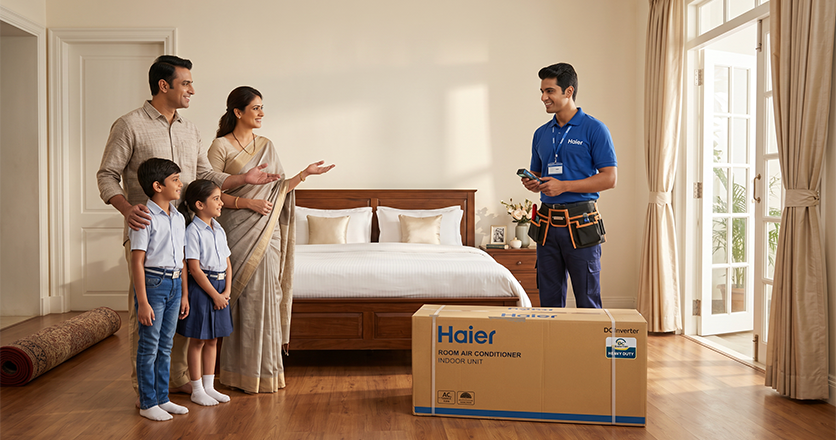
Installation quality affects both day-one performance and long-term reliability, and a few basics are worth knowing before you book the service appointment.
- The indoor unit should be mounted at 7 to 8 feet from the floor on a wall that gives the airflow a clear, unobstructed path across the room. Avoid placement directly above beds or regular seating areas where the downward airflow at full blast is uncomfortable for occupants.
- The outdoor unit needs a minimum of 15 to 30 centimetres of clear space on all sides. Restricted airflow around the outdoor unit forces it to work at higher temperatures, which stresses the compressor and reduces the efficiency the unit was rated for.
- A dedicated electrical circuit for the AC is the correct setup, not sharing a line with other high-load appliances in the same room or floor. Voltage drops on shared circuits appear as compressor performance issues that often get misattributed to the AC unit itself rather than the wiring.
- The connecting copper pipe between the indoor and outdoor unit should stay within 10 to 15 metres for most residential installations. Longer pipe runs require a refrigerant recharge and reduce system efficiency by a measurable margin.
Conclusion
Choosing an AC is not only about staying comfortable for the next summer. It is something you live with for years, and the impact shows up in comfort, electricity bills, and daily use. A well-informed decision today can prevent unnecessary issues in the future. The right tonnage matters, but so does energy efficiency and how the room is used.
This AC buying guide has covered all the factors that matter most before purchasing the AC. Room size, tonnage, energy ratings, cooling requirements, and usage patterns all play a role. Ignoring these factors can affect your overall experience.
The best AC brand in India is not always the one with the biggest discount or the loudest sales pitch. It is the one that matches your room, delivers steady cooling, and stays efficient season after season.
Ready to make your choice? Explore Haier’s full AC range and find a model that suits your space, usage needs, and budget for the long run.
Frequently Asked Questions
How do I calculate the right AC tonnage for my room?
To determine the right AC tonnage, evaluate room size, ceiling height, sunlight exposure, occupancy, and local climate conditions. As a general guideline, 1-ton ACs suit rooms up to 120 sq ft, 1.5-ton ACs work for 120-180 sq ft, and 2-ton ACs are better for larger spaces. Rooms with intense sunlight or more occupants may require higher cooling capacity.
What features should I look for when buying an AC?
When buying an AC, look for inverter technology and a high ISEER rating, as these help reduce electricity consumption. Make sure you choose the right tonnage for your room size. Other useful features include Wi-Fi connectivity for remote control, auto-clean technology for easier maintenance, and a good warranty for long-term peace of mind.
Does the inverter vs non-inverter AC choice make a measurable difference to monthly electricity bills?
Yes, inverter ACs generally use less electricity because the compressor adjusts its speed according to cooling demand instead of repeatedly turning on and off. This improves energy efficiency and reduces power consumption, making inverter models more cost-effective for long daily usage.
When is the best time to buy an AC in India?
AC demand usually remains lower from October to February. If you are looking to buy an AC, this period often brings better prices as brands clear older stock and roll out seasonal offers before summer demand starts rising.