
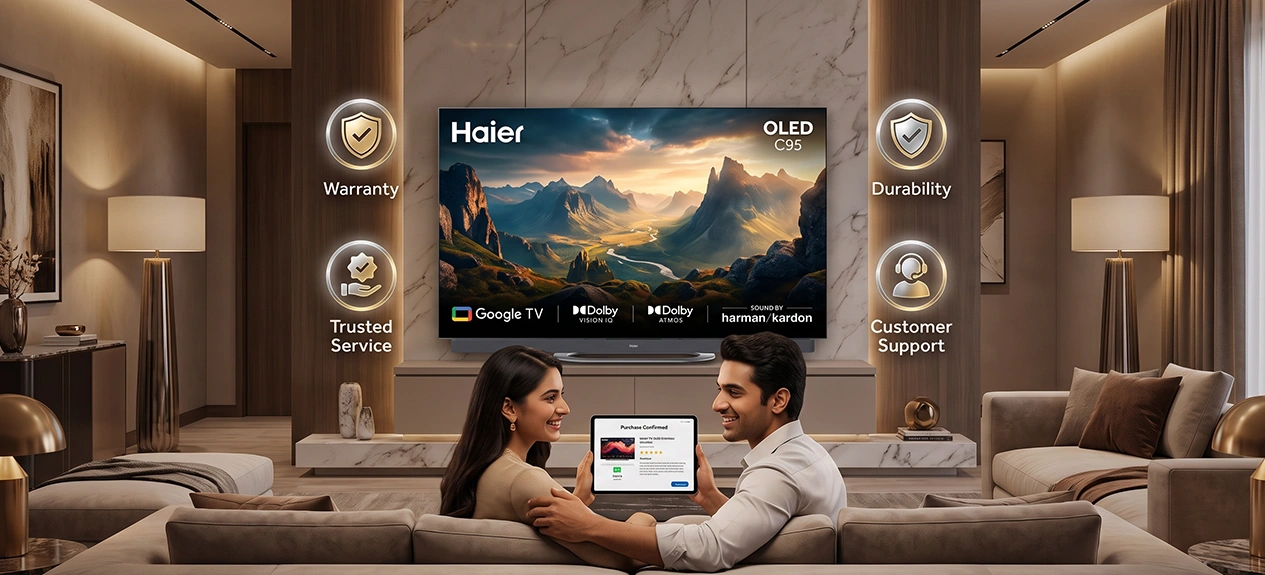

Most people shop for a TV the way they shop for anything else, screen size, price, maybe a discount code. Reliability rarely enters the conversation until something goes wrong, a dead pixel eighteen months in, a service centre that takes three weeks to respond, a warranty claim that turns into a fight. This smart TV buying guide treats reliability as its own decision, separate from picture quality or price, because that’s exactly what it is.
What Actually Makes a TV Brand Reliable?
Reliability isn’t a single number on a specification sheet. It comes down to four things working together, and a brand strong in one but weak in the others isn’t actually reliable, it just looks reliable until something breaks. This is the real foundation of any useful TV buying guide, not screen size or price, but what happens after the sale.
- Service network depth: how many service centres and certified engineers actually exist across the country, not just at the top of a press release
- Warranty structure: what’s covered, for how long, and how many steps it takes to file a claim
- Build consistency: whether quality holds steady across the price range, not just the flagship model
- Component longevity: how long the panel, power supply, and internal parts hold up under daily use
A reliable TV brand gets all four right at once, and it shows up years later, not on day one.
After-Sales Service: The Part Most Buyers Overlook Until They Need It
Most people don’t think about after-sales service until they’re already frustrated. By then, it’s too late to choose differently. A few things worth checking before buying, not after:
- How many authorised service centres actually exist in the country, and how far the nearest one is from home
- Whether certified engineers handle repairs, or whether it’s outsourced to third parties with inconsistent training
- How many pin codes the service network genuinely reaches, since a city having “service” often means only the metro core, not the outskirts
- Installation turnaround time, since a TV sitting unopened for two weeks because installation is backlogged isn’t a great start
A wide, well-staffed service network is what a best television brand actually looks like once the sale is done.
What Warranty Terms Actually Tell You About a Brand
A warranty is really a confidence signal. A brand offering a longer warranty, or a clearer, faster claims process, is telling buyers something meaningful about how much it stands behind its own product. The clearer and more generous the terms, the more that confidence shows through. Before comparing brands, it helps to know exactly what to look for in the fine print:
- What exactly is covered, panel, internal components, labour, or all three
- Whether the warranty requires the original purchase invoice and registration, or works with just the serial number
- How claims actually get processed, in-home service versus mail-in repair versus carry-in only
- Whether extended warranty options exist, and how they’re priced
For the fuller breakdown of extended warranty options specifically:
Read this blog: The Pros and Cons of Extended Warranties for TVs
Build Quality and Component Longevity: What Actually Wears Out First
TVs don’t fail all at once, they degrade in a fairly predictable order. Power supply components and capacitors are usually the first to show strain, especially in homes with unstable voltage, common across much of India. Backlights dim gradually over years of daily use. Speakers lose clarity before the panel itself shows any real wear.
A reliable TV brand accounts for this upfront, not as an afterthought:
- Voltage stabilisation built into the power supply, so fluctuations common in Indian grids don’t shorten component life
- Panel technology suited to Indian conditions, since heat and humidity affect longevity differently than in cooler climates
- Consistent quality control across the full range, not just top-tier models getting the careful engineering
The most reliable TV brands are rarely the ones shouting the loudest at launch, they’re the ones still performing quietly five years later.
Where Display Technology Fits Into the Reliability Picture
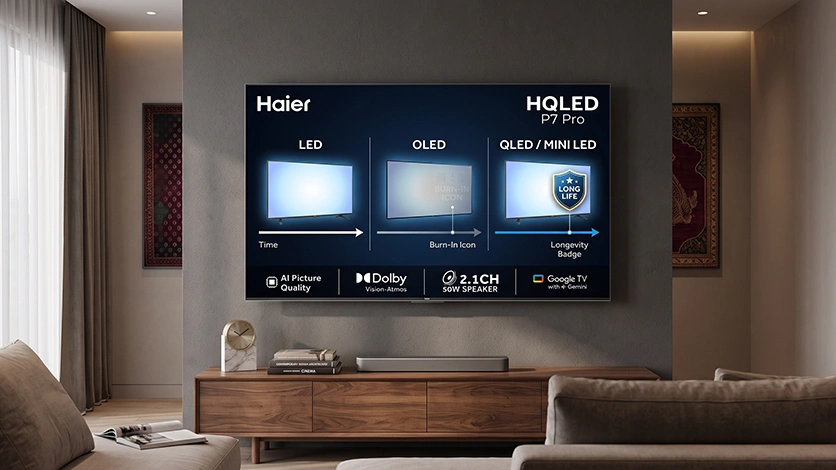
Display technology affects reliability differently than most buyers expect. It’s not about which panel looks best, it’s about which one degrades slowest under real conditions.
- LED panels are the most stable long-term, since they carry no organic materials that degrade over time
- OLED panels carry a small, well-documented burn-in risk with static images left on screen for extended periods
- QLED and Mini LED panels use inorganic quantum dots and LED backlights, both rated for tens of thousands of hours without meaningful degradation
None of this makes one display type universally better, it just means reliability and picture quality are two separate questions worth answering separately.
For the full picture-quality comparison between the two most common choices:
Read this blog: Choosing Between OLED and QLED TVs
What This Framework Looks Like at Haier
We built our service network around how India actually buys electronics, not just where the major cities are. Across the country, we operate over 1,000 service centres, backed by more than 4,400 certified engineers, reaching over 19,000 pin codes. Installation support is available within 24 hours of delivery in most serviceable areas, not weeks later. This is what a best television brand should look like in practice, not just a promise on a warranty card.
This isn’t a claim we make once and move past, it’s the actual infrastructure behind every TV we sell, from entry-level models through our flagship range. Ours is built to be there once the sale is done, which is the real test of a best LED TV brand in India, not the slogan on a billboard.
The engineering backs this up too. Our TVs are rated to run on a wide 176-240V power input, built specifically for the voltage swings common across Indian homes rather than assuming stable grid power like many imported designs do. Globally, Haier has held the number one position in major appliances for 14 consecutive years, according to Euromonitor, a track record that doesn’t happen without consistent build quality across every category we sell in, TVs included.
Our full TV range itself reflects the same consistency this framework is built around, spanning HD through flagship QLED, Mini LED, and OLED, across screen sizes from 32″ up to 100″. The engineering discipline that goes into a compact 32″ model is the same discipline behind our 100-inch flagship, not a scaled-down version of it.
A Feature That Extends Reliability Beyond the TV Itself
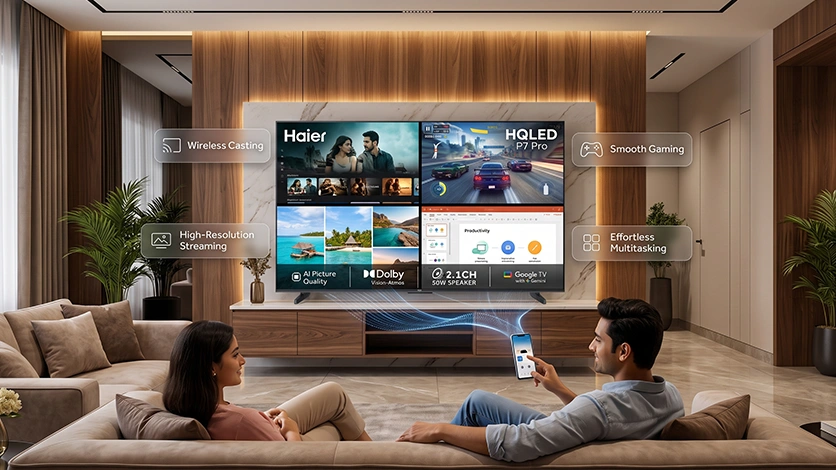
Reliability isn’t only about hardware holding up over time, it’s also about the software staying genuinely useful for years rather than becoming outdated within a couple of updates. One feature runs consistently across our range with exactly that in mind:
Haicast enables seamless high-resolution casting, smooth gaming, and effortless multitasking between a phone and the TV, keeping that connection dependable well past the first year of ownership rather than degrading into a laggy, unreliable mirror.
This is an ongoing software commitment, not a one-time feature that stops mattering after setup, which is really an extension of the same reliability this entire framework is built around.
Control It All From the Haismart App
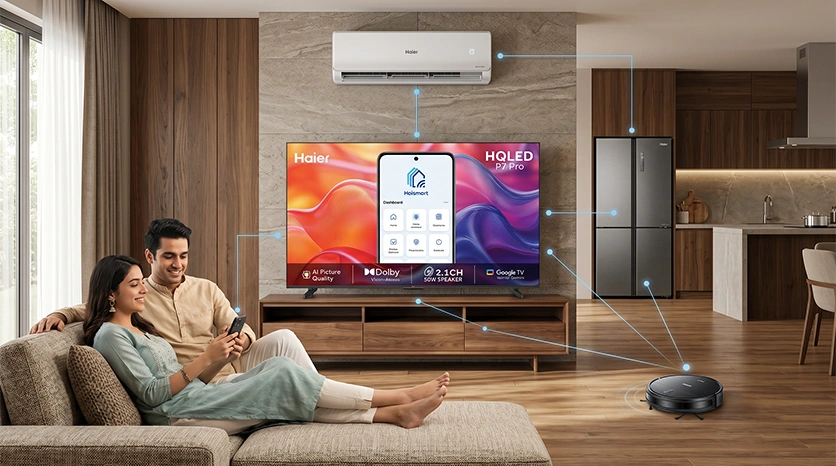
Haismart extends what’s already built into the TV, turning it into more than a screen and into a genuine smart home companion. Once connected, it’s possible to control other Haier smart appliances across the home, air conditioners, refrigerators, robot vacuums, all from the same ecosystem the TV already sits at the centre of. For a household adding more connected appliances over time, this is what keeps everything working together rather than as separate, disconnected devices, and it’s exactly the kind of long-term thinking that defines a best LED TV brand in India.
Download Haismart Application:
- iOS – Search Haismart on the App Store
- Android – Search Haismart on Google Play
Conclusion
A TV brand’s reliability isn’t visible on the box, it shows up months or years later, in how quickly a service call gets answered, how clean the warranty claims process actually is, and how well the components hold up against daily use and unstable power. Picture quality and price get most of the attention in the store, but the after-sales network is what determines whether that purchase still feels like a good decision a year in. That’s the entire point of a good smart TV buying guide, fewer surprises after the purchase, not more.
Whichever brand ends up on the shortlist, the most reliable TV brands are the ones willing to be judged on service records, not just specification sheets, and that’s a fair standard to hold every option to.
FAQs
Which TV brand is best in India?
It depends on the priority, picture quality, price, or service network, but the strongest overall picks combine build quality with a genuinely wide after-sales network, not just a good showroom demo.
Which TV brand has the best after-sales service in India?
Look for brands with a large certified engineer base and wide pin code coverage, not just service centres concentrated in major metros.
Which TV brand lasts the longest?
Brands that engineer for local conditions, voltage stabilisation, humidity resistance, consistent quality control across the range, tend to hold up longest over years of daily use.
How important is a TV’s warranty when making a purchase?
Extremely important. Warranty length and claims process are a direct signal of how confident a brand is in its own product, and how much friction to expect if something goes wrong.
Which display technology is better: LED, QLED, OLED, or Mini LED?
For long-term reliability, LED and QLED tend to be the most stable choices. For picture quality, OLED and Mini LED both offer distinct advantages depending on room lighting.