
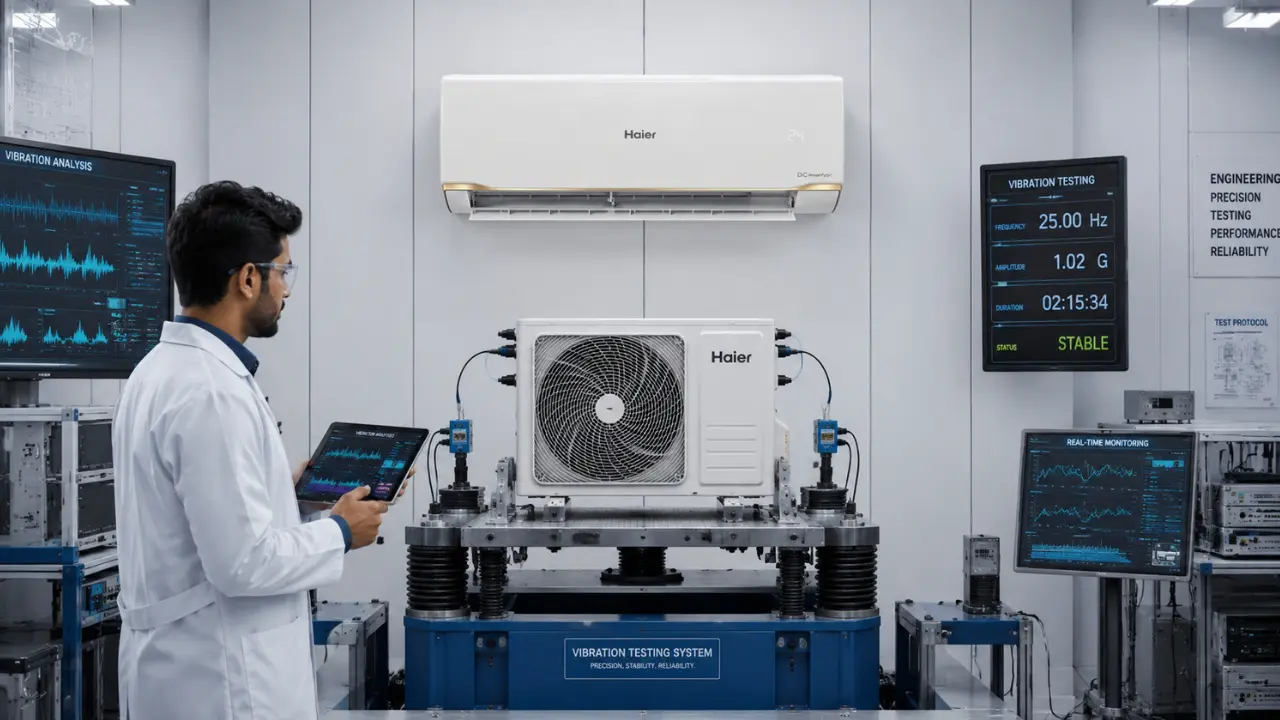

You rarely notice it. That is exactly what it is.
If an air conditioner works as it’s supposed to, you don’t worry about the compressor, fan motor or the outside unit humming in the background. It’s just a cool room after coming in from a hot post lunch in India. But, behind that quiet operation is something that manufacturers spend countless hours perfecting: vibration testing.
It is one of those engineering processes that does not show up on the box, but unobtrusively affects the lifetime of an AC, its noise levels and even its cooling efficiency over the years.
So, if the question is why some air conditioners remain stable from season to season, while others start rattling, vibrating or making strange noises, it has a lot to do with vibration testing.
A Quick Snapshot
| Vibration Testing Helps Ensure | Why It Matters to You |
| Stable operation | Reduces unwanted shaking and rattling |
| Longer component life | Less wear on internal parts |
| Better cooling consistency | Components stay properly aligned |
| Lower operating noise | Smoother fan and compressor performance |
| Reliable performance | Handles everyday usage with confidence |
Why Does an Air Conditioner Vibrate in the First Place?
An air conditioner is full of moving parts.
Every time you switch it on, multiple components begin working together:
- Compressor
- Indoor blower fan
- Outdoor fan motor
- Refrigerant circulation system
- Copper tubing
- Mounting brackets
Now imagine these components running continuously for eight to ten hours during peak summer.
Even the slightest imbalance can create vibrations. Left unchecked, these vibrations may gradually loosen fittings, create unwanted noise and increase mechanical stress.
This is exactly why manufacturers don’t simply assemble an AC and ship it. They test it repeatedly under different operating conditions before it reaches your home.
Vibration Isn’t Always Visible – But Its Effects Can Be
Many people associate vibration with a noisy outdoor unit.
That’s only one symptom.
Excessive vibration can also lead to:
- Increased operational noise
- Faster wear on moving parts
- Loose screws and mounting hardware
- Additional stress on compressor assemblies
- Reduced comfort due to inconsistent airflow
- Lower long-term reliability
In short, vibration affects much more than sound. It affects durability.
What Happens During AC Vibration Testing?
Think of it like quality control under pressure.
Instead of checking whether an AC simply cools a room, engineers observe how every critical component behaves while the system operates.
Typical evaluation areas include:
Compressor Stability
Since the compressor is one of the heaviest moving parts, engineers ensure it remains properly balanced during operation.
Fan Performance
Indoor and outdoor fans rotate at high speed.
Testing helps identify:
- Blade imbalance
- Motor stability
- Airflow consistency
- Rotational smoothness
Structural Strength
Engineers also evaluate whether:
- Panels remain secure
- Internal assemblies stay aligned
- Mounting structures absorb operational movement effectively
The objective isn’t to eliminate every vibration that isn’t realistic. The goal is to keep vibration within carefully controlled limits for dependable performance.
Why It Matters in Indian Homes
Let’s be honest.
Indian air conditioners don’t get an easy life.
They’re expected to operate through:
- Extreme summer temperatures
- Long daily usage
- Voltage fluctuations
- Dust-heavy environments
- High humidity during monsoons
- Continuous operation during heatwaves
These conditions naturally place additional stress on the entire cooling system.
A well-engineered AC is therefore designed not only for cooling performance but also for structural stability under demanding conditions.
Small Vibrations Today Can Become Bigger Problems Tomorrow
Mechanical wear rarely appears overnight.
Instead, it develops gradually.
A component that’s slightly out of balance today may create:
- Additional movement
- Extra friction
- Faster ageing of surrounding components
Eventually, homeowners may begin noticing:
- Unusual buzzing
- Increased outdoor unit noise
- Loose panels
- Reduced comfort
Proper vibration testing helps reduce the likelihood of these issues developing over time.
Engineering Goes Beyond Cooling Capacity
Many buyers compare only:
- Star rating
- Tonnage
- Electricity savings
Those are important.
But they don’t tell the complete story.
Modern premium air conditioners are engineered across multiple parameters, including:
| Engineering Focus | Customer Benefit |
| Airflow optimisation | More even cooling |
| Component balancing | Reduced operational vibration |
| Heat management | Stable cooling performance |
| Compressor control | Better efficiency |
| Structural durability | Longer operational life |
The overall experience depends on how well all these systems work together, not just how cold the air feels.
The Role of Premium Design
Good engineering is often invisible.
Take the indoor unit, for example.
The fan, air duct and motor must operate together without creating unnecessary turbulence or imbalance.
Similarly, the outdoor unit needs to remain mechanically stable while handling changing cooling loads.
A thoughtfully designed system helps maintain smoother airflow, lower operational disturbance and consistent performance throughout its service life.
Where Haier Brings This Philosophy Together
Engineering quality becomes meaningful only when it translates into everyday comfort.
That’s where the Haier 1.7 Ton 5 Star Gold Desert Rose Series Heavy Duty AI Smart AC (HSA20DSD-GAI5NB-I) and the Haier 1.7 Ton 5 Star Desert Rose Series Heavy Duty AI Smart AC (HSA20DSD-NAI5NB-I) reflect a design approach focused on dependable operation.
These models combine several technologies that support reliable everyday performance, including:
AI Climate Control
The AI-powered system analyses indoor conditions, user habits and changing weather to optimise cooling automatically for greater comfort.
HEXA Inverter Technology
The Full DC HEXA Inverter is designed to deliver powerful cooling while improving energy efficiency, with claimed savings of up to 65% under specified operating conditions.
AI Human Detection
Instead of running unnecessarily, the AC can detect occupancy and help reduce energy wastage when the room is unoccupied.
ODU Cyclone Clean
The outdoor fan reverses after shutdown to remove debris from the condenser and heat-exchange fins, helping maintain efficient heat transfer.
Frost Self Clean
The indoor unit performs an automatic cleaning cycle to help maintain cleaner airflow and operational efficiency.
Long Air Throw
Thanks to a better motor and fan design, plus air duct improvements, up to 20 metres of throw can be achieved, meaning that cool air reaches further into larger living areas.
Heavy-Duty Cooling
These ACs are specifically designed to perform well even at high ambient temperatures of up to 60°C, which can be quite challenging during Indian summers.
Super Anti-Corrosion Protection
Indoor and outdoor Blue Fin technology, protective coatings and anti-corrosion features help to create long term durability, especially in adverse environmental conditions.
These features reflect a larger engineering approach: one that emphasizes stability, efficiency, and reliable cooling over a specific feature.
Signs Your Existing AC May Be Experiencing Excessive Vibration
If your current air conditioner shows any of the following symptoms, it may be worth scheduling a professional inspection:
- New rattling sounds
- Outdoor unit shaking more than usual
- Buzzing during startup
- Loose wall mounting
- Increased operating noise
- Reduced cooling despite normal settings
Early inspection often prevents larger mechanical issues later.
Cooling You Can Depend On Starts With Engineering You Can’t See
Most homeowners judge an air conditioner by the temperature on the remote.
Engineers judge it very differently.
They look at stability under load, structural integrity, airflow balance, compressor behaviour and countless hours of testing that happen long before the product reaches your home.
That’s why vibration testing matters. It contributes to quieter operation, smoother performance and greater confidence that your AC will continue delivering reliable cooling through demanding Indian summers.
For homeowners looking beyond basic specifications, Haier’s Heavy Duty AI Smart AC range demonstrates how thoughtful engineering and intelligent features can work together to create an air conditioner designed for everyday comfort, durability and long-term performance.
Frequently Asked Questions
What is AC vibration testing?
AC vibration testing is a quality assurance process where manufacturers evaluate how the air conditioner’s internal components behave during operation. It helps ensure the compressor, fan motors, and other moving parts operate smoothly with minimal vibration, contributing to better durability, quieter performance, and reliable cooling.
Why is vibration testing important for an air conditioner?
Vibration testing helps identify and minimise excessive movement within the AC. Properly tested units are less likely to develop rattling noises, loose components, or premature wear, which can improve long-term reliability and overall user comfort.
Can excessive vibration reduce an AC’s lifespan?
Yes. Continuous excessive vibration can place additional stress on internal components, mounting brackets, and refrigerant lines. Over time, this may increase wear and affect the air conditioner’s overall performance if not addressed.
Does vibration testing make an air conditioner quieter?
While several factors influence operating noise, vibration testing helps engineers reduce unnecessary mechanical movement. This contributes to smoother operation and a more comfortable indoor environment.
Which Haier AC features support reliable long-term performance?
The Haier 1.7 Ton 5 Star Gold Desert Rose Series Heavy Duty AI Smart AC (HSA20DSD-GAI5NB-I) and Haier 1.7 Ton 5 Star Desert Rose Series Heavy Duty AI Smart AC (HSA20DSD-NAI5NB-I) combine features such as HEXA Inverter technology, AI Climate Control, AI Human Detection, ODU Cyclone Clean, Frost Self Clean, Super Anti-Corrosion protection, and cooling capability at ambient temperatures up to 60°C to support dependable everyday performance.
How can I tell if my AC has a vibration-related issue?
Common signs include unusual rattling sounds, excessive shaking of the outdoor unit, buzzing during operation, loose panels, or an increase in operating noise. If you notice these symptoms, it’s advisable to have the unit inspected by an authorised service professional.