


An air conditioner does more than just cool a room. It’s the one appliance most Indian households rely on to get through months of rising heat and humidity without their daily routine falling apart. As summers stretch longer and electricity rates keep climbing, the AC you choose starts to matter far beyond just how cold it can get a room.
This is exactly where Haier has approached the problem differently from most other brands. Instead of just building bigger compressors, Haier focuses on how an AC behaves over months of real use, using AI-backed technology that adjusts cooling to your habits rather than running on one fixed setting. That difference is also what helps you figure out whether an inverter AC or a non-inverter AC is the right fit for your home.
What is an Inverter AC?
An inverter AC has a compressor that adjusts its speed according to the cooling requirements of the room. Rather than turning off when the desired temperature is achieved, it reduces speed and silently continues to operate in the background.
Traditional units waste the most power at startup, and an inverter compressor avoids that repeated restart altogether. The result is steadier cooling, lower noise, and a visible drop in electricity use over a season. Haier’s AI-ATMOX technology goes one step further by learning the usage patterns and changing the settings automatically, rather than using one fixed program.
What is a Non-Inverter AC?
A non-inverter AC (also known as a fixed-speed AC) runs on a simple on-off cycle, meaning the compressor runs at full power, turns off when the room cools, then kicks in at full power again when the temperature climbs back up.
This mechanism is simpler, which is why non-inverter units are usually cheaper to buy and can work fine for smaller rooms or occasional use. The trade-off is that constant restarting uses more electricity than a compressor that just eases its speed up or down.
Inverter AC vs Non-Inverter AC
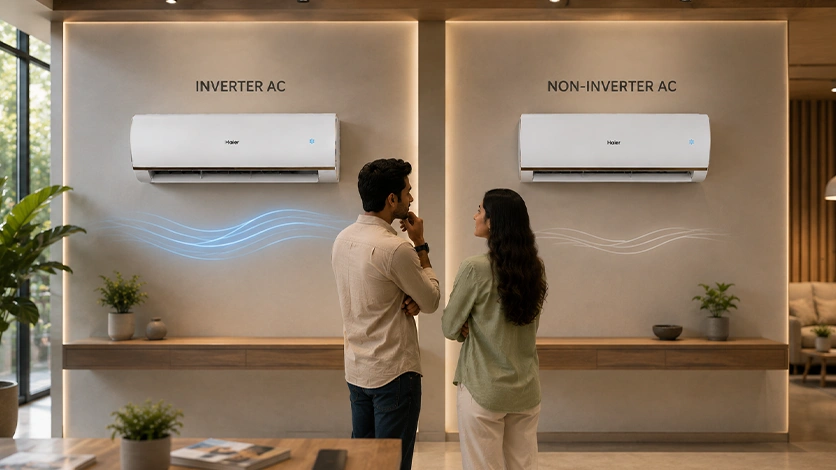
| Factor | Inverter AC | Non-Inverter AC |
| Compressor operation | Variable speed, runs continuously at low output | Fixed speed, switches fully on and off |
| Energy efficiency | Higher, avoids restart power spikes | Lower, more power used per cycle |
| Noise levels | Quieter, especially at night | Louder cycling sound |
| Upfront cost | Slightly higher | More budget-friendly |
| Compressor lifespan | Longer, less mechanical strain | Shorter, more wear from cycling |
| Best suited for | Long daily use, larger rooms, hot regions | Occasional use, smaller spaces |
Power and Cooling Effectiveness
Non-inverter units can feel faster in the first few minutes since they run at full power from the start. But once the set temperature is reached, the room cools too much, then warms up again before the compressor restarts.
Inverter ACs take a steadier approach. Haier’s AI for Comfort feature reads real-time indoor and outdoor conditions and adjusts the operating mode on its own, keeping the room consistent instead of swinging between too cold and too warm.
Energy Efficiency and Electricity Bills
This is usually where the decision gets made. A non-inverter AC running six or more hours a day adds up quickly, mostly because of how often the compressor restarts at full load.
An inverter AC avoids most of that cost. Haier’s AI for Savings feature monitors consumption in real time and shifts to AI ECO mode automatically, cutting energy use by up to 56% depending on the model and usage pattern.
Want lower AC running costs
Read More: This Inverter AC Keeps You Cool Without Ruining Your Electricity Bill
Noise Levels and Comfort
A fixed-speed compressor makes itself known every time it restarts, fine during the day but noticeable in a quiet bedroom at night. Inverter units run at a lower, steadier hum since the compressor rarely switches fully on and off, which often tips the decision for bedrooms and home offices.
Durability and Maintenance
Constant starting and stopping strains a compressor over time, part of why non-inverter units often need servicing sooner. Haier ACs include ODU Cyclone Clean, where the outdoor fan briefly reverses after shutdown to clear condenser dust, keeping performance steady as the unit ages.
Haier Inverter AC Models Worth Considering
If you’re deciding between models rather than just technologies, two Haier options stand out for different needs.
The Haier 1.7 Ton 5 Star Desert Rose Air Conditioner is well-suited for regular home use in hot regions. It uses AI-ATMOX to learn your habits,AI Human Detection to avoid cooling an empty room, and AI for Savings to cut consumption by up to 56%, backed by ODU Cyclone Clean for long-term performance.
For larger spaces like halls or offices, the Haier 2 Ton 3 Star Spartan Tower AI AC uses Hexa Inverter technology to save up to 65% energy while cooling evenly across a larger area, carrying the same AI-driven comfort features as the Desert Rose line.
Which AC Is the Better Choice for Your Needs?
An inverter AC is a better choice if:
- You use your AC for long hours every day, whether at home or at work.
- You live in a region that experiences long, hot summers.
- Quiet operation is important, especially in bedrooms or home offices.
- You want to reduce electricity bills over time through better energy efficiency.
A non-inverter AC is still a practical option for occasional use, smaller rooms, or if you’re working with a limited budget. Many buyers also consider a non-inverter AC 1.5 ton for guest rooms or spaces that don’t require continuous cooling. However, if the AC will run for several hours daily, the lower running costs of an inverter AC often make up for its higher upfront price in the long run.
Conclusion
Choosing between an inverter and non-inverter AC comes down to how much you use it and how much long-term comfort matters to you. Once electricity bills, noise, and everyday comfort are factored in, an inverter AC tends to be the stronger choice for most households. Brands like Haier make that choice easier by building AI-driven efficiency directly into the compressor, so the AC doesn’t just cool a room, it learns how you use it. Whichever model you land on, understanding this difference upfront saves both money and guesswork later.