
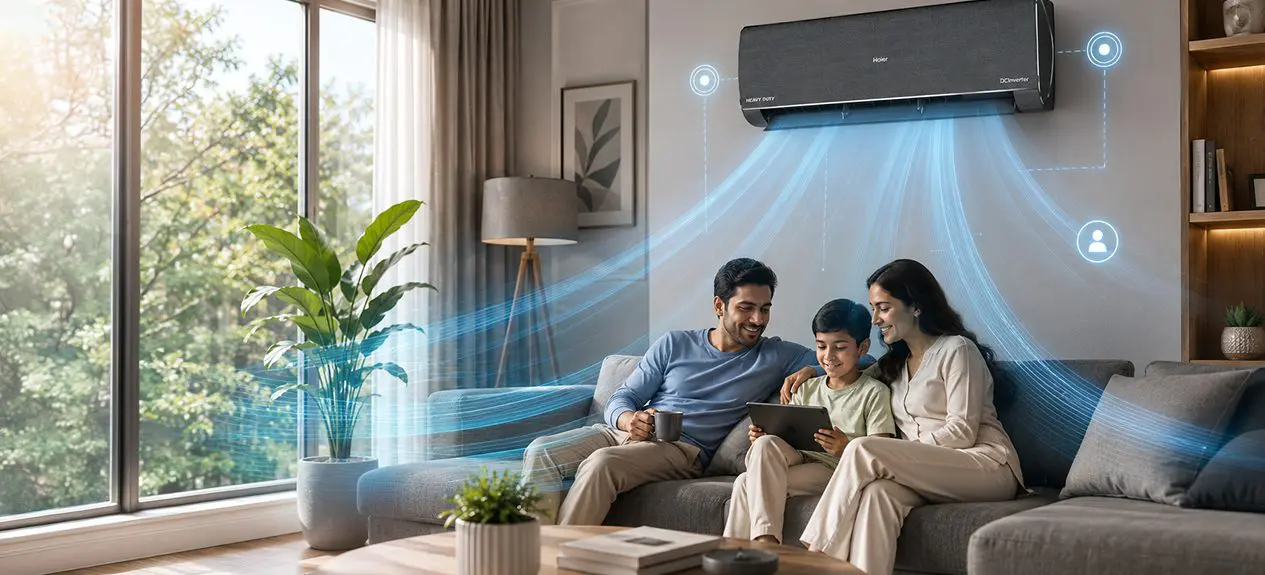

Most of us have had this experience. You walk into a room, switch on the air conditioner, and wait. Sometimes the room takes forever to cool. Sometimes it gets too cold and you have to keep adjusting the remote. And at the end of the month, the electricity bill still surprises you, even though you feel like you barely used the AC.
This is the everyday problem with regular air conditioners. They cool a room, but they do not really understand it. They run at fixed settings, they do not know who is in the room, and they do not adjust unless a person manually tells them to. This is exactly the gap that AI AC technology has been built to close.
Air conditioning brands have spent the last few years working on machines that do not just cool spaces, they read them. This shift is quietly changing how people choose their next AC, and it is worth understanding before you make your next purchase.
The Problem With Traditional Air Conditioners
A conventional AC works on a simple principle. You set a temperature, and the compressor works to reach and hold that number. It does not matter if the room is empty, if the humidity outside has changed, or if you are sitting right next to the vent or far from it. The AC treats the whole room the same way, all the time.
This leads to a few common issues that most Indian households are familiar with. Rooms take longer to cool during peak summer months. Energy is wasted cooling empty rooms. And comfort depends entirely on how often someone is willing to get up and press buttons on a remote.
This is where the conversation around AI ac has picked up pace. Buyers are no longer only asking about star ratings and tonnage. They are asking whether the AC can think a little on its own.
What Makes an AI AC Different
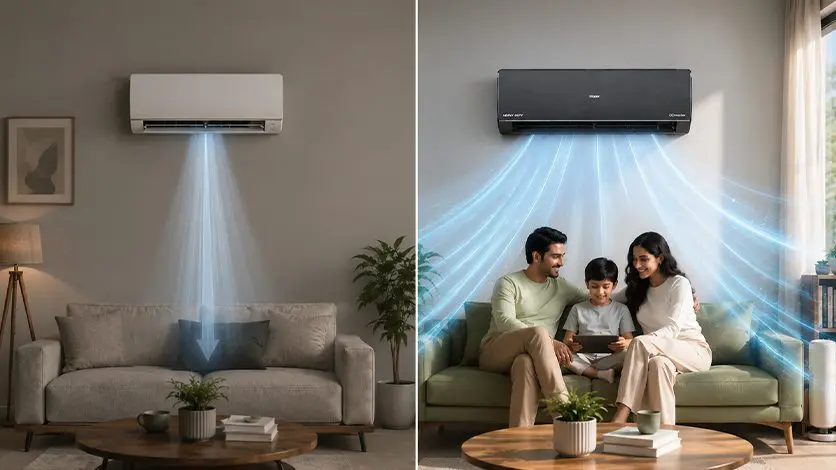
An AI ac uses sensors and small learning algorithms to understand the room instead of just reacting to a set temperature. It reads outdoor temperature, indoor humidity, and how long the room has been occupied. Over time, it also studies patterns, like what temperature a person prefers in the evening compared to late night, and adjusts cooling without being told each time.
This is different from a normal AC in a very practical way. A regular AC waits for an instruction. An AI ac tries to predict what is needed and acts before you notice the discomfort. That difference sounds small on paper, but it changes how a room actually feels through the day.
Want to make a smarter AC buying decision?
Read More: Is AI Target Cooling Worth It When Buying an AC?
How AI Technology Actually Cools a Room
The real work happens through a few connected functions rather than one single feature.
First, environment sensing constantly checks outdoor and indoor conditions, so the compressor is not overworking or underworking at any point. Second, learning based control studies daily usage habits and starts adjusting cooling before a person has to manually change settings. Third, many AI ACs now support pre-cooling through a mobile app, so the room is already comfortable by the time someone reaches home, and the unit switches off on its own if nobody arrives within a set time, avoiding wasted electricity.
There is also a growing focus on targeted cooling, where the AC identifies where a person is sitting or sleeping and directs airflow toward that specific zone instead of cooling the entire room evenly. Combined with voice control for hands free operation, this is what modern AI cooling actually looks like in daily use, not a single gimmick, but a set of small decisions the machine keeps making quietly in the background.
How Haier Brings AI Cooling Together
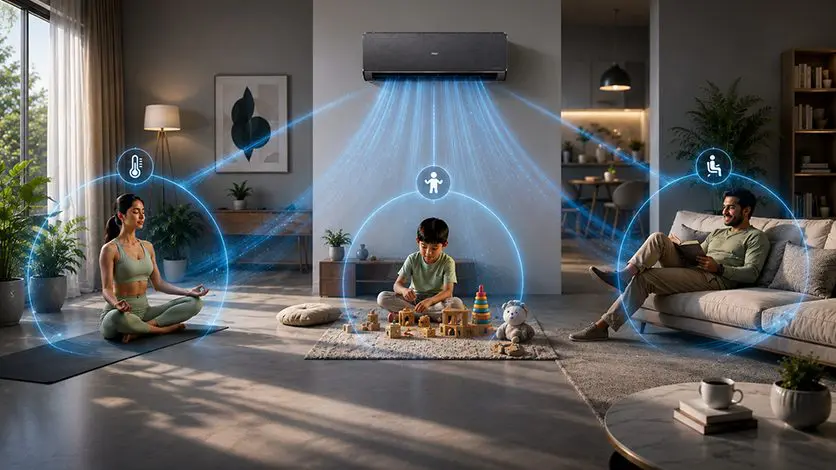
Haier has built its AI ac lineup around this exact idea of a machine that senses, learns and adjusts, and this shows up across several feature groups rather than one standalone function.
AI Neuro, the core cooling intelligence
- AI Climate Control: uses environment sensing and a learning algorithm to build a cooling pattern around the user instead of a fixed temperature number
- AI Pre-Cooling: starts cooling remotely through the HaiSmart App before a person reaches home, and switches off on its own if the house stays empty, so electricity is not wasted
- AI Target Cooling: directs airflow to where a person actually is in the room, instead of cooling wall to wall
- AI Direct Voice Control: allows hands free operation through real time speech recognition, backed by sound source localisation to detect where the command is coming from
AI Power Manager, the energy saving layer
- AI Eco: switches between cooling capacities based on live indoor and outdoor readings
- AI Electricity Monitoring: shows real time consumption through the app and helps estimate bills based on actual tariffs
- AI Human Detection: senses whether the room is occupied and adjusts or shuts down cooling automatically when nobody is present
AI Auto Clean, the upkeep layer
- AI IDU Frost Self Clean: clears dust and contaminants from the indoor unit through a cold expansion and express washing process
- AI ODU Cyclone Clean: uses reverse fan motor technology to blow away accumulated dust from the outdoor unit without manual servicing
Put together, these three groups cover comfort, running cost and long term maintenance, which is really what buyers should be checking for when comparing any haier ai ac against other options in the market.
Want to upgrade to smarter, AI-powered cooling?
Read More: Best Haier AI AC Models in India
Things to Check Before You Buy an AI AC
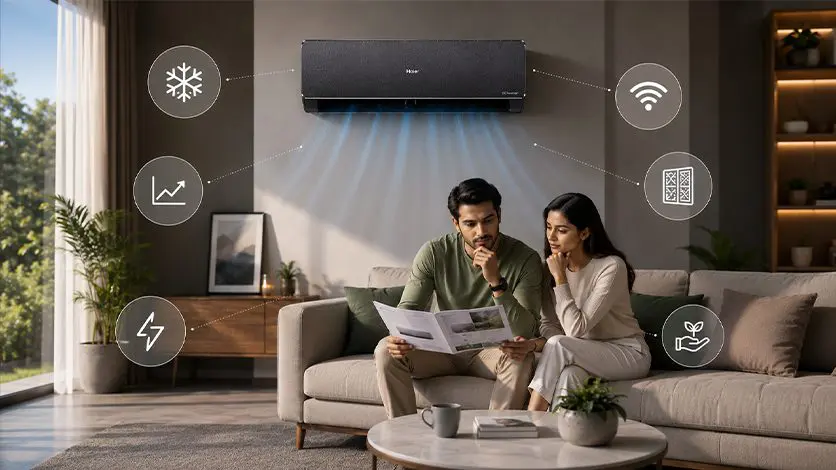
Buyers researching ai ac price often assume that AI features only exist on expensive, top end models. That is not entirely true anymore. AI features have started appearing across mid range models as well, particularly in the ai ac 1.5 ton segment, which remains the most commonly bought capacity for regular Indian bedrooms and living rooms.
Before buying, it helps to check which AI features are actually built into the compressor and sensors, and which ones only exist inside the mobile app. A genuine AI ac should show a visible difference in comfort and electricity usage within the first billing cycle, not just offer app based scheduling.
Frequently Asked Questions
What is AI cooling in an AC and how is it different from a normal AC?
This is known as AI cooling, where the air conditioner uses sensors and learning algorithms to learn the room conditions and user’s habits and then automatically adjusts the cooling. A normal AC will only cool based on a set temperature and will not make any adjustments unless a person changes it manually.
Does AI cooling in an AC actually save electricity?
Yes, when the features are genuinely built in. Functions like human detection, auto eco mode and pre-cooling with auto shut off help avoid cooling empty rooms and reduce unnecessary compressor load, which usually reflects in lower electricity bills over time.
How does an AI AC sense the room and adjust temperature automatically?
It uses environment sensors that track outdoor temperature, indoor humidity and occupancy, combined with a learning algorithm that studies past usage patterns. Based on this, the AC adjusts cooling capacity and airflow direction without needing constant manual input.
Is AI cooling just marketing or does it make a real difference?
It varies by brand and model. Some ACs throw around the term loosely for basic app connectivity. Genuine AI ACs, like those with dedicated environment sensing, target cooling and occupancy detection, show a real difference in comfort and energy use, and this can be checked through the actual specification sheet rather than the marketing name alone.