
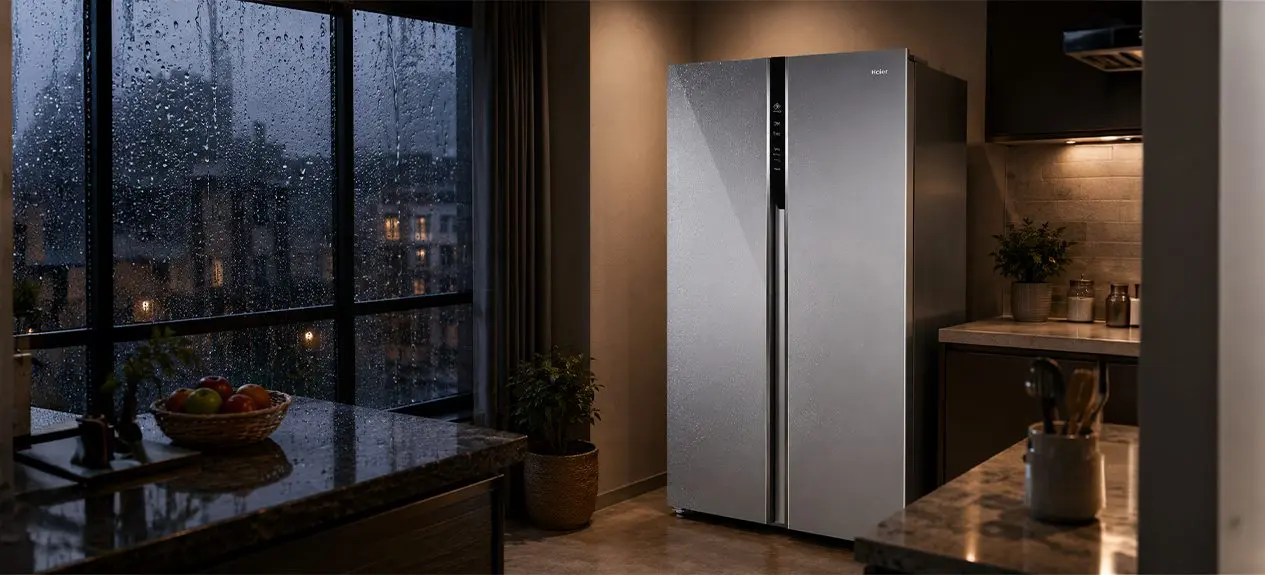

Most households observe an increase in their electricity bill once the monsoon season begins. Fans tend to run for longer stretches through the day. Lights remain switched on through grey, overcast afternoons. Few people, however, connect this seasonal increase to the refrigerator working away in the kitchen. Yet a refrigerator behaves rather differently once the surrounding air turns humid. This difference accounts for a fair share of the seasonal rise in refrigerator energy consumption, and it is worth understanding before purchasing a new unit or maintaining the one already in use.
Humidity changes how much work a cooling system has to do, since moist air holds more latent heat than dry air. A refrigerator’s compressor pushes against that heat on every single cycle. This shapes how much electricity the appliance draws across the year, especially in a country like India, where humidity varies sharply from one region to another.
How Outdoor Humidity Impacts Your Refrigerator’s Cooling Cycle
A refrigerator does more than cool the air inside its cabinet. It also prevents heat and moisture from entering from the outside. When the door opens, humid air rushes in. Moisture condenses on the cooler interior surfaces. This extra moisture is taken care of by the compressor along with its normal cooling load. Opening the refrigerator door over and over makes the appliance work harder, especially in humid weather. The effect is simple but can have an effect on cooling efficiency and energy use over time.
Most have condenser coils on the back or bottom. They are more important than people know. And in humid conditions, those coils have a hard time moving the heat efficiently because the air is already saturated with moisture. The heat transfer slows down, and the compressor runs longer to get the cabinet back to the set temperature. Multiply that across a full day, and you get noticeably higher energy draw, even without anyone opening the fridge more often than usual.
Why High Humidity Increases Compressor Running Time
Think of the compressor as the refrigerator’s engine room, working longer when humidity rises. The unit must cool the cabinet while also dealing with moisture entering whenever the door opens. This extra work is more evident in coastal cities and during long periods of monsoon. When the door opens, warm humid air enters and increases the cooling load inside. Then the compressor takes a few extra minutes to bring things back to normal. This effect is more pronounced in July and August when there are more openings. In drier months, the refrigerator may recover faster, so it does not need to run for such long periods.
The Rainy Season Effect on Household Electricity Bills
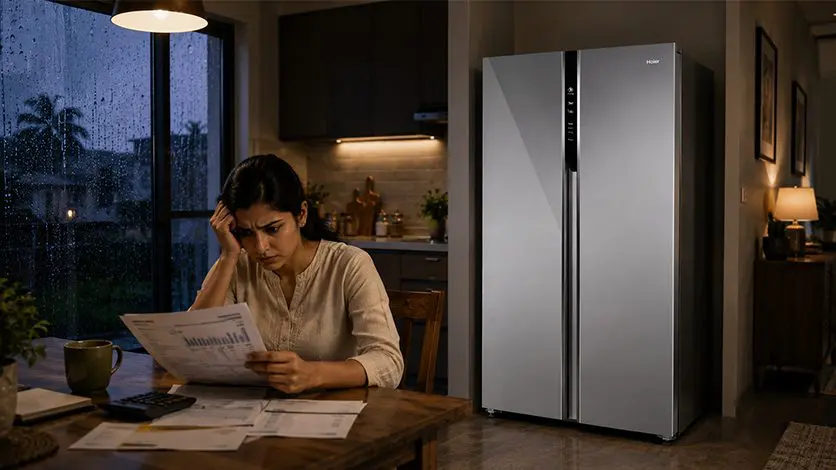
Monsoon brings several smaller demands together, and each adds some extra work for refrigeration. None seems serious alone, but their combined effect can raise electricity consumption during rainy months.
- Humid air slows heat dissipation from the condenser coils, so the compressor stays active for longer stretches.
- Frequent door openings, common when households stock up on perishables, let humid air in again and again.
- Kitchens run warmer during monsoon due to cooking and poor ventilation, adding to the fridge’s thermal load.
- An overloaded fridge restricts airflow inside, forcing the compressor to work harder for even cooling.
- Storms bring voltage swings, and older compressors can draw irregular power as a result.
None of this should feel like cause for worry. It is simply how appliances respond to seasonal shifts, and most of it can be managed with basic care and the right refrigerator design.
Haier’s Approach to Humidity-Resilient, Energy-Efficient Cooling
At Haier, we have spent close to two decades studying how Indian households use their refrigerators. Humidity has always been part of that study. We have held the position of the World’s No. 1 refrigeration brand for eighteen consecutive years, and in 2025, the Bureau of Energy Efficiency named us India’s Most Energy-Efficient Appliance brand. These recognitions come from engineering built for exactly the climate stress described above.
Our refrigerators run on Smart Sense AI, a system that reads ambient conditions and adjusts cooling behaviour instead of operating at one fixed pace regardless of the weather outside. This is one of the more direct ways we work to prevent humidity power spike fridge patterns that many households notice during the monsoon. Our Expert Inverter and Triple Inverter compressor technologies support this further. Rather than switching between full power and complete stop, they modulate output to match real cooling demand, which counts for a lot once humidity pushes that demand higher.
We stand behind our compressors with a 10-year warranty. That is not a small claim to make. It reflects real confidence in how these compressors hold up under sustained, humidity-driven workloads.
We have also built in protection against what humid weather brings indoors. Our ABT and ABT Pro technology removes up to 99.99% of bacteria and viruses, while clearing odour and foul smells, both of which build up faster in moist environments. Deo Fresh Technology keeps the interior smelling fresher for longer. Magic Cooling spreads temperature evenly across shelves, so the compressor is not forced into extra cycles just to fix warm pockets. Our Anti-Bacterial Gasket keeps the door seal resistant to the microbial growth that humid air tends to encourage.
Homes dealing with unstable power during storms benefit from Stabiliser Free Operation, which keeps the refrigerator running through voltage swings without needing a separate stabiliser. Whisper Silent Operation, meanwhile, keeps this extra compressor activity from turning into a noticeable hum in the kitchen.
This thinking runs across our range, whatever the household size or kitchen layout. The Lumiere Series 4 Door carries this design furthest, with dedicated freezer space and convertible zones that ease the compressor’s load during humid months. Our 3 Door Side by Side and 2 Door Side by Side refrigerators bring similar inverter and freshness technology to larger families. For compact kitchens, our Bottom Mounted and Top Mounted ranges carry much of the same humidity-conscious engineering, while our Direct Cool refrigerators offer it in a simpler, single-door format suited to smaller households.
Want to know which refrigerator features genuinely cut your electricity bill?
Read this blog: Energy-Efficient Refrigerator Buying Guide: Features That Actually Save Electricity
Practical Ways to Save Electricity on Your Fridge During Humid Months

A handful of simple habits go a long way toward helping you save electricity fridge costs, no matter which model you own.
- Keep the fridge away from direct sunlight or other heat-emitting appliances, since ambient warmth adds to the humidity load.
- Avoid packing shelves with warm, freshly cooked food, which raises internal temperature sharply.
- Check door seals now and then. A worn gasket lets humid air seep in continuously, and the compressor pays for it.
- Do not linger with the door open, even on a tempting rainy afternoon.
- Wipe down condenser coils every few months, particularly around monsoon, when dust and moisture combine into a stubborn layer.
None of these habits asks for much effort. Together, they ease the strain humid weather puts on the appliance, and they support lower refrigerator energy consumption through the season.
Conclusion
High humidity outside your home genuinely changes how hard your refrigerator has to work. The reasoning behind it is fairly simple. Moist air carries noticeably more heat than dry air. Condensers cool that heat away less efficiently. Compressors, in turn, run longer to compensate for the difference. None of this is cause for concern once you understand it, and it is worth factoring in when picking a refrigerator built for Indian conditions. Pair the right technology with a few sensible habits, and the seasonal spike in energy use becomes far easier to manage.
FAQs
How do Haier refrigerators handle extreme humidity without spiking power usage?
Smart Sense AI and Expert Inverter compressor technology read real-time conditions and adjust cooling output accordingly. Instead of running at one fixed pace, the compressor modulates power to match actual demand, keeping energy use proportionate even in humid weather.
What role do Haier’s insulation systems play in preventing moisture stress?
Tightly sealed cabinet insulation and well-fitted, anti-tipping doors limit how much humid air enters the unit. This reduces the moisture load the compressor has to manage, helping the internal temperature stay steady without excess cycling.
Why does exterior condensation (sweating) occur on refrigerator doors during humid weather?
When warm, moisture-heavy air outside meets the cooler refrigerator surface, water vapour condenses on contact. This is a natural physical reaction to temperature difference, and it shows up more often when ambient humidity runs high.
How do Haier’s Anti-Bacterial Technology (ABT) and Deo Fresh systems protect storage during humid weather?
ABT and ABT Pro remove up to 99.99% of bacteria and viruses while controlling odour buildup. Deo Fresh Technology adds to this by keeping the interior air fresher, which matters more once humidity speeds up spoilage and smell retention.