
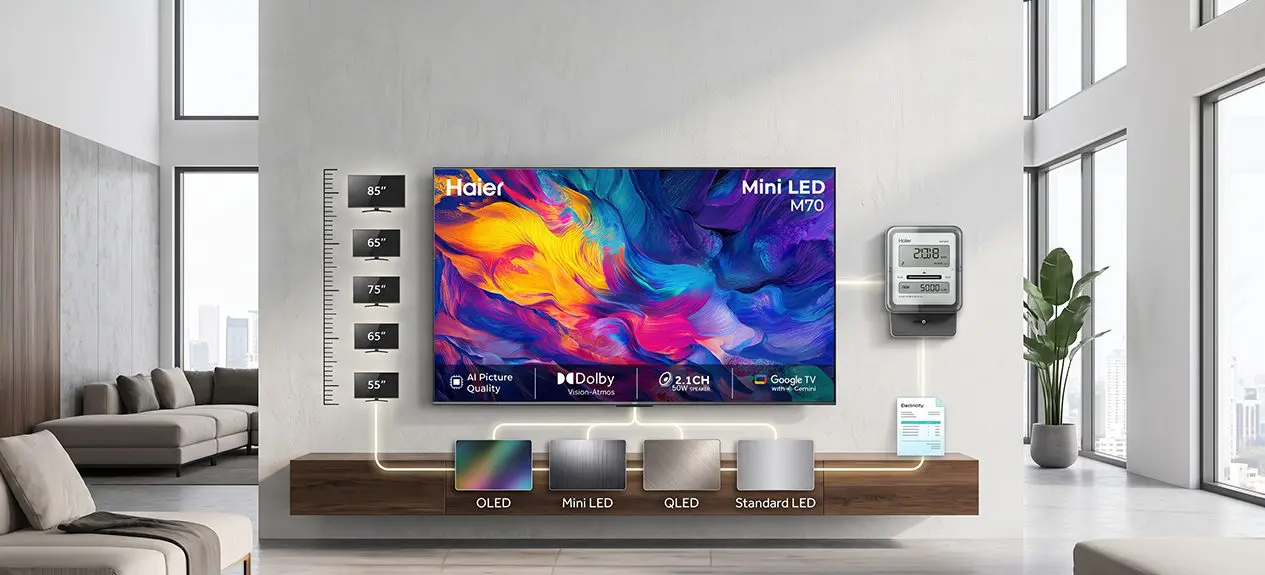

Buying a TV usually comes down to screen size, picture quality, smart features, and price. But there’s one specification worth checking before you decide: TV wattage. It tells you how much electrical power the television draws while it’s running, and combined with how many hours you watch, it plays a real part in your monthly electricity bill.
A bigger screen doesn’t automatically mean a much higher TV power consumption, and display technology matters just as much. Understanding these factors can help you land on a TV that suits both your viewing habits and everyday energy use.
What Does TV Wattage Mean?
TV wattage is simply the amount of electrical power a television uses while it’s switched on, measured in watts (W). A TV rated at 100W draws less power at any given moment than one rated at 200W.
But wattage alone won’t tell you exactly how much a TV will add to your electricity bill. That comes down to how long you’re watching it.
The simplest way to think about it:
Power consumption = TV wattage × hours of use
So a television running for two hours a day will generally use less electricity than the same model left on for six, even though the wattage remains unchanged.
Does Screen Size Affect TV Power Usage?
Yes, but not on its own.
A larger display usually means a larger panel, which can need more power to light up. So TV screen size energy consumption can climb as you move from a compact 32-inch set up to a much bigger 75- or 85-inch model.
However, modern display technology and power management systems have made this less simple than it used to be. Two TVs of the same size can have quite different power needs depending on their panel technology, brightness settings, processor, and other hardware underneath.
A 55-inch TV built with efficient components, for instance, won’t necessarily draw power the same way as another 55-inch TV running different display technology.
This is why screen size is worth weighing alongside a TV’s rated power consumption, not treated as the whole story on its own.
TV Wattage: What Should You Expect From Different Sizes?
The type of display a TV uses can shift its power needs a bit. LED, QLED, Mini LED, and OLED televisions all use different approaches to producing the picture you see.
1. LED TVs
LED TVs rely on an LED backlight behind the screen. Their power consumption depends on screen size, brightness, and how the backlight is managed.
For everyday viewing, LED TV power usage tends to stay manageable as long as brightness is kept appropriately.
2. QLED TVs
QLED TVs bring in quantum dot technology to enhance color and brightness. Because brightness levels can run higher here, actual energy use ends up depending on how the television is set up and what you’re watching on screen.
3. Mini LED TVs
Mini LED televisions use a large number of smaller LEDs arranged into local dimming zones, which allows the TV to control brightness more precisely across different parts of the screen.
Haier’s Mini LED range pairs this display technology with intelligent picture processing, helping the TV adjust the picture based on the content being played.
4. OLED TVs
The OLED display works differently because individual pixels produce their own light rather than relying on a backlight behind the whole panel. That means power consumption can shift depending on the content itself: darker scenes generally require less light from the display.
The takeaway here is simple: TV power consumption comes down to more than just the number on the screen. Display technology, brightness, content, and your viewing habits all play a part.
Bigger Screen or Better Efficiency: What is More Important?
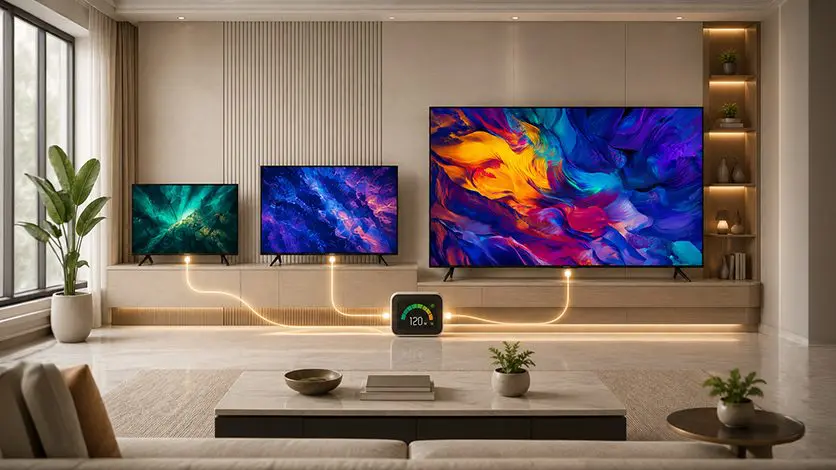
It’s easier to assume that buying a smaller TV is automatically the more energy-efficient pick. But it’s not necessarily the whole story.
If you watch a larger TV for a couple of hours a day, its overall electricity use can stay reasonable. Meanwhile, a smaller TV left switched on for most of the day can still rack up a meaningful chunk of your electricity consumption.
Your viewing pattern ends up mattering just as much as the screen size itself.
| Factor | How it can affect consumption |
| Screen size | Larger panels may require more power |
| Display type | Different technologies have different power requirements |
| Brightness | Higher brightness can increase energy use |
| Viewing hours | Longer usage means greater total consumption |
| Picture settings | Certain modes can use more power |
| Standby | Small amounts of power may continue to be used |
How to Lower Your TV’s Electricity Use
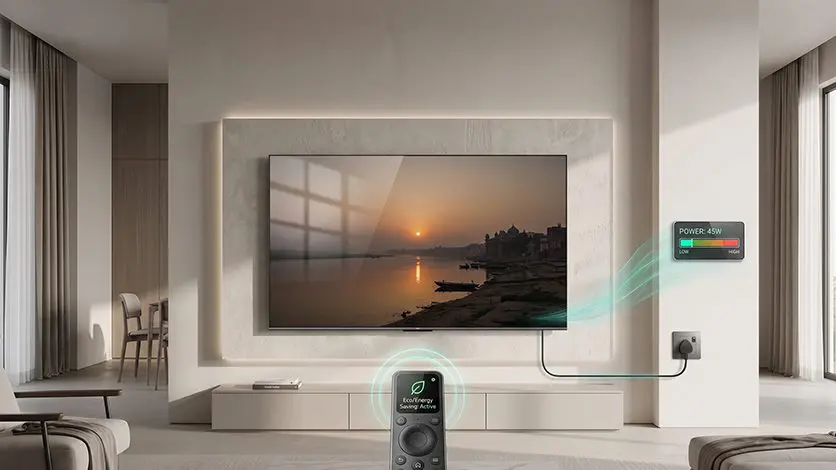
You do not have to give up on screen size or picture quality to manage energy consumption. A few small, everyday adjustments go a long way.
- Keep backlight brightness sensible: Running the TV at full brightness around the clock is rarely necessary. If the room is dim, turning the backlight down can reduce unnecessary power use and tends to be easier on the eyes too.
- Use the energy-saving settings: Most modern televisions come with picture or energy-saving modes that adjust brightness and other functions automatically. If your TV has an eco mode, it’s worth switching on for everyday viewing.
- Turn it off when you’re done watching: A TV running in the background for hours adds to total consumption, even when nobody is watching. Switching it off when it is not needed is one of the easiest ways to keep TV power consumption in check.
- Don’t ignore standby: A television can keep drawing a small amount of electricity even in standby mode. This is known as TV standby power consumption. It’s usually a small amount, but if you’re away for a while, switching the TV off at the power source avoids any unnecessary standby usage.
Want more practical ways to cut down your TV’s electricity use? Read: How to Reduce TV Power Consumption: 6 Fast Ways to Save
How Haier Approaches Energy Use Across Its TV Range
At Haier, TV design isn’t just about a bigger screen or more picture features bolted on. The way a TV manages brightness, processing, and display performance shapes how it operates day-to-day.
Haier’s television range covers different screen sizes and display technologies, so households can choose based on their room, viewing habits, and what they actually want from their entertainment setup.
From compact LED models built for everyday viewing to larger QLED and Mini LED TVs, the right pick comes down to balancing the features you want against how often, and for how long you’ll be watching the TV.
When you’re comparing models, it’s worth checking rated power consumption and energy info alongside screen size and display technology. This combination gives you a much more realistic idea of what a TV could mean for your household’s electricity use.
Conclusion
TV wattage is a useful starting point for understanding how much power a television needs, but it is only one part of the picture. Screen size, display technology, brightness, viewing hours, and standby behaviour all add up to your electricity use.
TV Wattage is a great place to begin when talking about power consumption of the television set, but it is just one part of the equation. The size of the screen, display type, brightness, viewing hours, and standby mode all add up to your energy usage.
A larger TV might use more power, but that doesn’t automatically make it an inefficient choice. And picking energy-efficient televisions isn’t just about choosing the lowest wattage. It is about finding one TV size, technology, and features that actually match how you watch.
With Haier’s range covering different screen sizes and display technologies, that’s a decision you can make around both what you want to watch and how much power it will consume to watch it.
FAQs
What is TV wattage?
TV wattage refers to the amount of electrical power a television uses while operating, measured in watts (W). Higher wattage generally means greater electricity consumption.
How do Haier Smart TVs balance high-definition picture performance with energy efficiency?
Haier Smart TVs combine efficient display technologies with intelligent power management to deliver high-definition viewing while helping manage energy consumption.
Which display panel technology is more energy-efficient, traditional LED or modern OLED/QLED?
Energy efficiency varies by model and usage, but traditional LED TVs generally consume less power than OLED, while QLED performance depends on its underlying LED technology and settings.
Are energy-rating labels helpful when shopping for a power-efficient television?
Yes, energy-rating labels provide a useful indication of a TV’s power efficiency, helping you compare models and make a more informed purchase.