
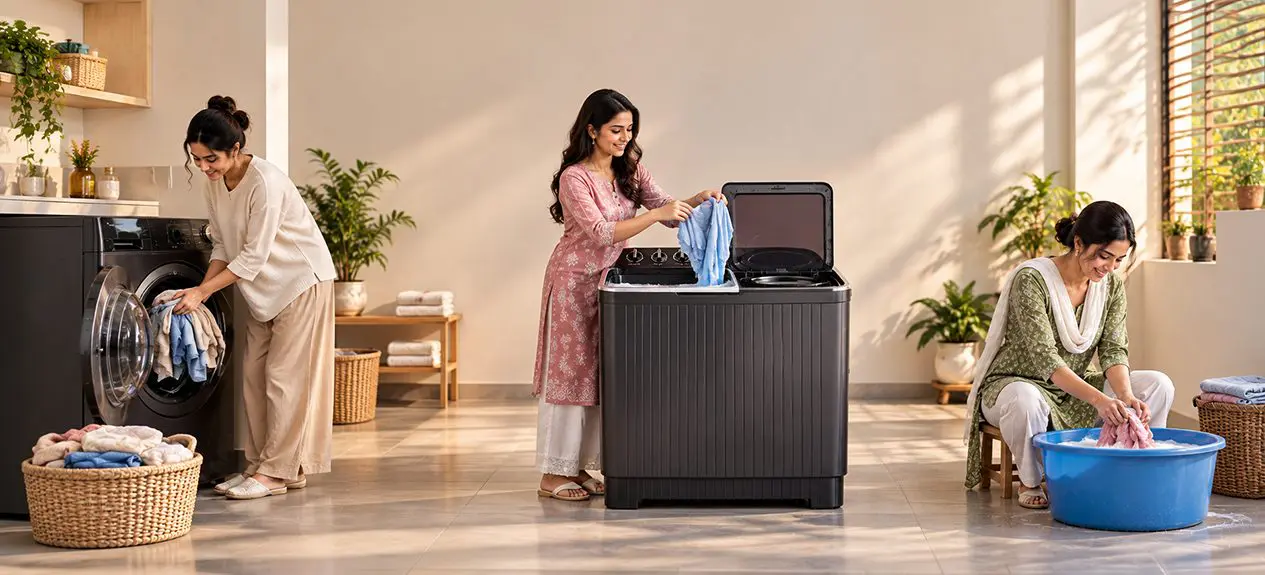

Choosing a washing machine gets confusing when three basic options start looking almost the same. Automatic, semi-automatic, and manual machines each handle laundry differently, so the better choice depends on your routine, water supply, space, and how much work you want to do.
An automatic machine handles washing, rinsing, and spinning with little intervention. Semi-automatic models need you to move clothes between tubs, but they can use water more carefully. Manual washing demands the most effort, though it can suit homes with limited water or tighter budgets.
The right machine is less about features and more about what your household can manage daily.
Automatic, Semi-Automatic and Manual: What Each One Actually Means
The key difference between automatic, semi-automatic, and manual washing is simple, who does the work. Automatic machines handle most steps themselves, semi-automatic machines need some input, while manual washing keeps you involved throughout the process.
What Is a Fully Automatic Washing Machine?
A fully automatic washing machine does the entire cycle in one tub, without you moving clothes between compartments. Load it, select a program, walk away. Water fill, wash, rinse and spin happen in sequence on their own.
Two formats exist under this category: top-load and front-load. Both qualify as fully automatic, and the confusion around “what is the difference between fully automatic and automatic washing machine” usually comes from people assuming these are separate categories. They are not.
Modern versions also sense the load. Weight-detection technology checks how much laundry is inside and adjusts water and detergent accordingly, so a half-full drum does not get treated like a full one.
What Is a Semi-Automatic Washing Machine?
A semi-automatic washing machine splits the job into two tubs, one for washing and one for spinning, and expects you to manage the movement between them. The process typically looks like this:
- Fill the wash tub with water manually and set the wash timer
- Drain the used water out once washing finishes
- Refill and drain again for rinsing, usually twice
- Lift the wet clothes into the separate spin tub
- Set the spin timer and let it run
Nobody needs to memorise this as a strict how-to. The point is that a semi-automatic unit stays involved with you at every stage.
What Is Manual Washing?
Manual washing removes the machine from the equation almost entirely. Clothes get scrubbed by hand, sometimes with the help of a bucket or basic tub, and wrung out without any mechanical spin. It is the oldest method and still the one many households fall back on for delicate items or in places where a machine is not practical.
Want to go deeper into how front-load, top-load, and semi-automatic machines actually differ mechanically? Read this blog: Types of Washing Machines: Complete Buying Guide
Key Differences at a Glance
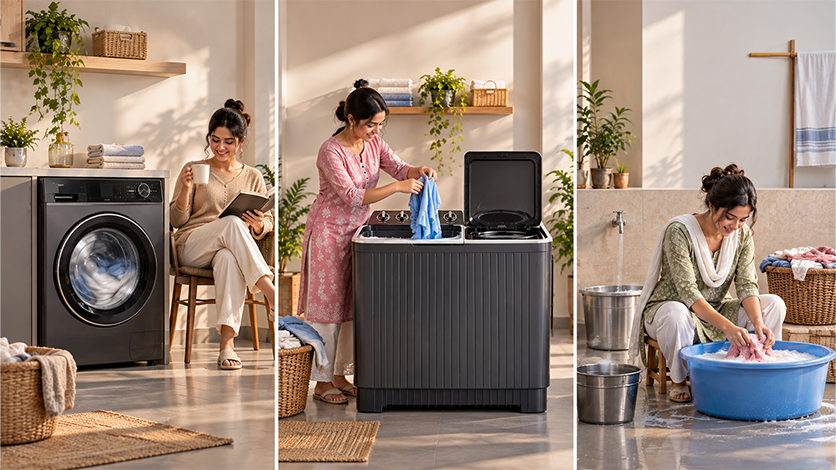
The choice gets clearer when you look beyond the basic labels. Focus on three things that affect daily use: how much water and power the machine needs, how much work you handle, and what maintenance it may require later.
1> Water and Electricity Use
This is where the gap between the three types is widest. A fully automatic machine calculates water needs based on load size, so a smaller wash uses less water without you adjusting anything. Testing on Haier’s own automatic range has measured usage as low as roughly 10 to 12 litres per kilogram of laundry per cycle, largely because load-sensing prevents overfilling.
Semi-automatic machines put that control in your hands instead. Since you decide when to drain and refill, it is easy to use more water than necessary during the rinse stage.
Manual washing draws no electricity, but water use varies by habit. Some people rinse efficiently by hand. Many use far more water than a machine would, simply because nothing enforces a limit.
2> Effort, Time and Convenience
An automatic machine asks the least of you. No monitoring is required once the cycle starts, which matters more than it sounds for anyone managing a job, kids, or simply wanting their evening back. A semi-automatic machine needs a person present through most of the cycle: moving clothes, watching timers, draining water.
Manual washing takes the most time and physical effort by a clear margin. There is no real debate on a manual vs automatic washing machine comparison here. Automatic wins on time, though manual washing still has a place for small loads and delicate fabrics.
3> Price and Maintenance
Setting price aside, maintenance differs across the three. Automatic machines have more electronics and a sealed drum, so filter cleaning becomes the main recurring task, along with occasional descaling. Semi-automatic machines are mechanically simpler, though the pulsator and mesh need periodic attention. Manual washing needs no maintenance at all.
Pros and Cons of Each Type
Every format here does something well, and every format asks something of you in return. That trade-off, more than any single feature, is what an automatic vs semi-automatic washing machine decision comes down to.
| Type | What It Does Well | What It Asks Of You |
| Fully Automatic | Convenience and consistency, with no supervision needed once the cycle is set | A steady water connection and, on front-load models especially, a fixed installation spot |
| Semi-Automatic | Flexibility with inconsistent water supply, plus castors that make it easy to shift between rooms | Your presence through most of the cycle, since filling and draining are manual |
| Manual | Total control with zero electricity draw, and gentler handling for small loads and delicate fabrics | Real-time and physical effort, with no spin function to speed up drying afterwards |
Which Type Should You Buy?
There is no single correct answer to which one is better, automatic or semi-automatic. The right pick depends on three things: household size, water supply reliability, and how much hands-on involvement someone wants to give the laundry.
For larger households doing frequent loads, a fully automatic machine earns its keep through convenience alone. Is a fully automatic washing machine worth it in that situation? Generally yes, since the time saved compounds week over week.
For homes with inconsistent water pressure, or where flexibility to move the machine matters, semi-automatic remains a sound choice. It also suits people who are more comfortable managing each step themselves.
Manual washing still has a role, not as a full replacement, but for occasional delicate items or as a backup when water supply is unpredictable.
Haier Washing Machines: Built for How India Actually Washes
We design our range around a simple observation. Indian households do not all wash the same way, so one format cannot serve everyone. That is why we build across fully automatic and semi-automatic formats, each aimed at real, everyday conditions.
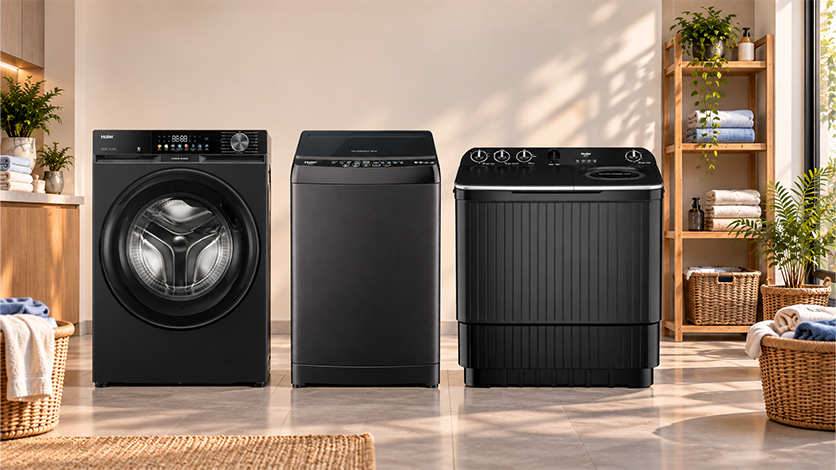
In our fully automatic front-load range, we focus on fabric care and hygiene together. Our 525mm Super Drum gives clothes more room to move during a wash, reducing wrinkling, and Dual Spray keeps the drum itself cleaner between cycles. AI-based load detection runs across these models too, adjusting water and detergent to the actual size of each wash.
Our fully automatic top load range carries our Oceanus Wave Drum and Softfall Technology, both aimed at improving how detergent works through fabric without being rough on it. Many models include an in-built heater for hygiene-focused hot washes, and our Ultra Fresh Air technology keeps the drum from developing odour by circulating air inside it between uses. A 2X Magic Filter handles lint so clothes come out cleaner.
For households that prefer a semi-automatic washing machine, our semi-automatic range is not a stripped-down afterthought. These machines include a toughened glass lid, an Anti-Rat Mesh to protect internal wiring, and castor wheels for easy repositioning. An Auto Restart feature means a power cut mid-cycle will not force you to start over, which matters given how often power fluctuates across the country.
Quick Comparison Table
| Factor | Fully Automatic | Semi-Automatic | Manual |
| Water handling | Automatic, load-adjusted | Manual fill and drain | Fully manual |
| Electricity use | Moderate, sensor-driven | Low | None |
| Monitoring needed | Minimal to none | Continuous through cycle | Constant, hands-on |
| Ideal household | Larger, frequent loads | Flexible water supply, mobile use | Small loads, occasional use |
| Maintenance | Filter cleaning, occasional descaling | Pulsator and mesh upkeep | None |
Conclusion
No washing machine type works equally well for every household. A fully automatic model fits homes where people want laundry handled with little supervision. Semi-automatic machines offer more control when water supply is limited or the machine needs moving around. Manual washing still works for small loads and delicate clothes. The right choice depends on your routine, available water, space, and how much effort you want to put into laundry each week.
FAQs
What is the difference between automatic and semi-automatic washing machines?
An automatic machine washes, rinses and spins in one tub without supervision. A semi-automatic machine uses two separate tubs, requiring you to manually fill, drain and transfer clothes between the wash and spin stages throughout the cycle.
Which is better, automatic or semi-automatic?
Neither is universally better. Automatic suits households wanting convenience and minimal supervision. Semi-automatic suits homes with inconsistent water supply or a need for portability, since these machines are lighter and move easily on castors.
What is a semi-automatic washing machine?
It is a washing machine with two tubs, one for washing and one for spinning. You manually control water filling, draining and the movement of clothes between tubs, while timers manage the wash and spin durations themselves.
Is a semi-automatic washing machine worth it?
Yes, particularly for households with variable water supply or those who want flexibility to relocate the machine. It also tends to suit users who prefer controlling each stage of the wash rather than relying on a fixed program.
Does a fully automatic machine use more water?
Not necessarily. Many fully automatic machines use load-sensing technology to adjust water levels to the actual wash size, which often results in lower water use per cycle compared to manually operated alternatives where usage depends on habit.