
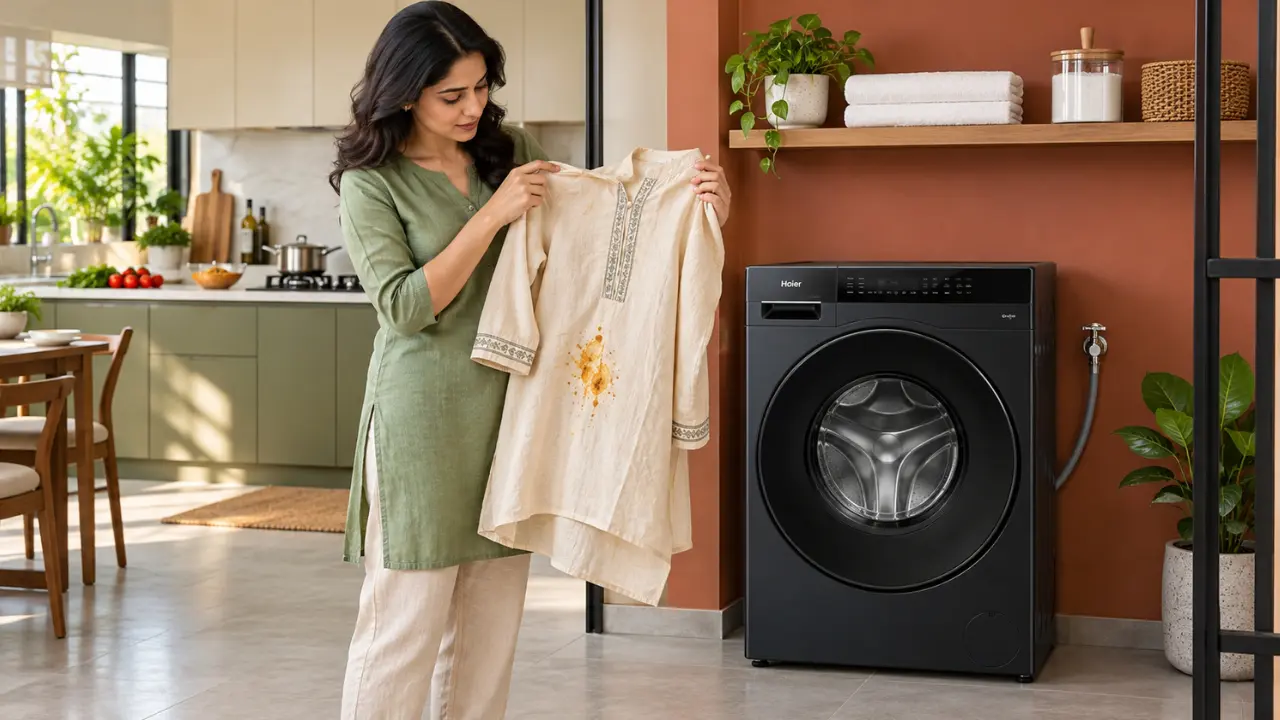

The oily spot on your favourite cotton shirt will not go away. You have done a regular wash, changed your detergent and even done another wash. However, the stain remains.
In some cases, the issue may be not the detergent, or the washing machine. It’s the water temperature.
The majority of Indian households are aware of how to wash clothes using cold water or room temperature water. It is great for normal laundry, but some stains, clothes that are very soiled and particular cleanliness needs might need hotter water.
This is where a washing machine that has an inbuilt heater is quite handy.
These machines can heat water internally based on the chosen wash programme, which means that they do not rely completely on the temperature of the water in your home.
However, do all loads require hot water? Does a washing machine heater really serve the needs of Indian households?
It depends on the item you are washing!
What is the Heater? A Heater in a Washing Machine?

A washing machine heater is an internal heating element that is used to heat the wash water.
In washing machines having this function, the heating element cooperates with the temperature control mechanism of the washing machine to heat water by following the selected washing programme.
For example, a washing machine equipped with an option of ’30°C’, ’40°C’, ’60°C’, or even ‘higher’, enables consumers to select the temperature they require for various wash needs.
This concept is quite simple.
For some detergents, warm water is more effective for cleaning, and it can be used to remove certain types of dirt or oil from fabric.
But higher temperatures are not necessarily good.
If a light piece of clothing, such as a delicate fabric, gets too hot while being laundered, it may be damaged. Therefore, the choice of temperature is just as important as the heating function itself.
The working principles of an inbuilt heater.
Typically, the heating process automatically occurs when you choose a wash programme that is compatible with the hot water system.
Here’s what generally takes place:
- The washing machine is filled to the proper level with water.
- The water is heated to the desired temperature by an internal heating element.
- With the help of temperature sensors, the machine can monitor and control the heating process.
- The clothes are driven by the drum in heated wash water and detergent.
- The remaining washing, rinsing and spinning steps are performed in this machine.
The exact order in which things happen depends on the washing machine model and programme that is selected.
Note: The heater is not always on during the cycle. It works on the basis of the temperature requirement of the machine.
On average, how much use does a washing machine heater get?
Imagine a typical Indian household.
The school uniform needs to be washed, someone returned from the gym, the kitchen towels have kitchen grease and there is a stack of bedsheets that need to be washed on the weekend.
Not all of these items are the same.
This is where temperature controlled washing comes in handy.
1. Washing Clothes with Oil and Grease Stains
To cook in Indian style, you will need a lot of oil, ghee and masalas.
Occasionally kitchen towels, aprons and everyday clothing do have those stubborn greasy marks.
Oily residues can be softened with warm water and can aid in the work of proper laundry detergent.
If possible, a temperature of 40°C could be suitable for washable cotton clothes.
But it’s possible that the clothes are still heavily stained and will need to be pre-treated before being washed in the machine.
In addition, don’t put too much heat on unknown stains. The stain will be more difficult to remove if the hot water causes a reaction with some stains, especially protein-based stains.
2. Washing Bedsheets and Pillow Covers
Bedsheets are used to trap body oils, dust, everyday dirt and sweat.
Attention to washing will be taken care of on a routine basis but if the material allows, it may be washed in a temperature-controlled programme.
For example:
- Washing cotton bedsheets at higher temperatures is possible.
- Lower temperatures may be needed to keep the look of coloured bedding.
- Delicate bedding should be treated according to the manufacturer’s guidelines.
- If there is significant soiling, some pillow covers might need special washing cycles and pretreatment.
Just remember to choose the correct temperature based on the fabric and not that every bedsheet requires hot water.
3. Washing Baby Clothes
Milk splashes, meals, and other messes make baby clothes frequently dirty and require regular washing.
A washing machine that has a temperature control lets parents choose a programme for washable baby clothes.
With some soiling, warm water may be used, if the clothing label allows.
But, temperature is not a good indicator of hygienic laundry.
The choice of detergent, the care label and the rinsing are also significant.
4. How to handle laundry this Winter.
It can be very cumbersome to do laundry in winter in northern Indian cities.
Tap water can be much cooler when the weather is cold in the winter.
For compatible washing machines, an inbuilt heater is available to heat up the water used for the washing cycles when a heat program is chosen.
This can be beneficial if the family has to wash heavily soiled cotton clothes, towels and other appropriate fabrics in winter.
But this doesn’t mean that hot water is needed for all the winter washes.
There are still plenty of ordinary clothing items that can be cycled with water that is cold.
Cold Water or Warm or Hot Water – which should I use?
Washing temperature varies based on the type of fabric, type of dirt, and laundry instructions.
A practical guide is here.
| Water Temperature | Suitable Laundry | Important Consideration |
| Cold water | Avoid wearing everyday clothes, dark colours and delicate fabrics. | A bit gentler on fabrics and require less heating energy. |
| Around 30°C | Items that are lightly soiled and suitable synthetic fibers | Good for lots of mundane cleaning. |
| Around 40°C | T-shirt, pants, and moderately and oily soiled clothing. | Remember to test for colourfastness and fabric directions |
| Around 60°C | Some towels, bed sheets and washed towels that are very dirty | Only use if stated on the care label |
| Around 90°C | Selected heat resistant white cotton articles | Not appropriate for most regular articles of clothing |
These are general principles and not rules. Follow the care label & machine directions for clothes.
And, don’t forget, the higher the temperature the more electricity will be used to heat the water.
Does a Washing Machine Heater Consume More Electricity?

Yes. Extra power is needed to heat the water.
But the consumption is not only determined by a number of factors:
- Selected washing temperature
- Temperature of entering water
- The amount of water being treated per minute.Flow rate of water being heated.
- Wash programme duration
- Design the washers and conditions for operation.
For instance the energy required to heat cold water to 60°C is, in general, more than the energy required to heat the water to 30°C.
That’s why using hot water for all washings could not be necessary.
It is better to use lower temperature programmes for normal clothing and higher ones for those which can actually gain from them.
How Haier Washing Machines Make Temperature-Controlled Laundry More Convenient
A washing machine should provide more than just a collection of washing programmes.
It should be good for the household to be able to handle various laundry needs without every wash taking too much time and effort.
Haier India is a brand that provides front load washing machines that have temperature control, multiple wash programmes and are designed for daily fabric care.
There are two models to consider: Haier F3 8Kg Front Load Washing Machine and Haier 10 Kg Fully Automatic Front Load Washing Machine.
Front Load Washing Machine Haier F3 8Kg Front Load Washing Machine (EFL80-IM12F3BKU1)
The Haier F3 is a 8 kg front load washing machine that has a few helpful features for households that want a washing machine with a flexible temperature range.
Temperature range is one of the important specifications which is very relevant: cold water to 90° C.
This enables the user to choose various washing temperatures, depending on the programme and the needs of the washing cloths.
The machine also comes with a number of laundry management conveniences.
Key Features
- Temperature Selection: Cold water to 90°C wash temperature for suitable programmes.
- Advanced AI One Touch: Automatically detects fabric type, load and dirt level to choose washing parameters.
- Multiple Wash Programmes: Cotton, Delicate, Baby Care, Hygiene, Stain Wash, Eco Wash and more.
- 525 mm Super Drum: Offers more room for fabric flow while washing.
- Smart LED Display: provides wash setting monitor and cycle info.
- 1200 RPM Spin Speed: For better water removal in the spinning stage.
This model is especially applicable for homes with various fabric types due to its temperature control and specific wash program.
A family, for instance, may choose a suitable programme for regular cotton wear, and another one for the delicate articles.
Users can choose a different washing method for each product, as opposed to using a single washing method for all products.
Haier 10 Kg Fully Automatic Front Load Washing Machine (HW100-DM14F9BKU1)
The more family members there are, the more variety of laundry.
One day it’s office attire and school clothes. Then, it’s bed sheets, towels, and sporting goods.
Haier 10 Kg Fully Automatic Front Load Washing Machine provides increased washing capacity, temperature choices and intelligent washing functions.
It has a maximum washing temperature of 90°C and provides for the following programmes: Cotton, Wool, Sport, Jeans, Hygienic, Baby Care and Delicate/Silk.
Elements for Daily Washing
- 10 Kg Washing Capacity: Ideal for larger families who typically have heavy washers.
- Temperature Control: Provides the ability to choose the temperature inside the machine from the programme settings supported by the machine.
- One-Touch AI Wash: Auto recognition of washability fabric, load and dirt level, so as to adjust washing parameters.
- Direct Motion Motor: Smooth operation with less noise and vibration.
- 1400 RPM Spin Speed: Assists in removing water from washed clothes.
- Night Wash: Provides a washing alternative to quieter operation.
- Multiple Wash Programmes: Multiple wash options are provided based on the need of the laundry.
Another helpful feature to keep in mind is the Direct Motion Motor which will benefit families that use the washing machine a lot.
Together with the wash programmes and temperature, it makes it easy to use for families who want to have more control over the washing process.
Some simple tips to help you avoid common washing machine heater problems
Just because a heated washing machine doesn’t mean each garment should be washed at the hottest setting.
Some easy tips to help keep clothes safe.
Avoid using hot water for each load.
Many synthetic fabrics, light soiling clothes and most cotton items can be washed well at lower temperatures.
Wasted heat can lead to the use of more electricity.
Always Check Clothing Labels
Certain garments tend to shrink, bleed or get damaged when washed at excessive temperatures.
Delicate fabrics and clothing like wool and silk should be given special attention.
Explain the difference between hot washing and complete sterilisation.
A heated wash can help to clean and maintain hygiene, but is not necessarily a sterilisation process.
The complete washing process, namely the temperature, the duration of washing, the type of detergent and the programme design influence the hygiene performance.
Ensure that the drum is not overloaded.
Overloading a washing machine can’t be fixed by an appropriate wash temperature.
Wash clothes should have sufficient room to move in the wash water to get cleaned.
Should an Inbuilt Heater Washing Machine be Purchased?
If someone uses cotton bed sheets, kitchen towels, baby clothes, and clothes frequently that are soiled, an inbuilt heater is a useful feature for Indian households.
It provides flexibility in using higher wash water temperatures when needed.
If you have mostly light, day-to-day clothes that are just “lightly” loaded, however, cold-water washing might already serve many of your needs.
The smart one is a washing machine that offers a variety of wash settings to suit the type of clothing, without forcing all of them to go through the same setting.
Haier India F3 8Kg and 10 Kg Fully Automatic Front Load washing machines come with temperature control functions, various wash programmes and intelligent wash functions.
Go through Haier India’s front load washing machine collection and choose the right washing machine so that it matches your family’s laundry needs, washing capacity and features.
Frequently Asked Questions
1. What is the use of a heater in a washing machine?
A heater warms the wash water to the selected temperature. It can help with certain oily stains, heavily soiled garments, and laundry that benefits from warmer washing conditions.
2. Can I wash clothes without using the heater?
Yes. Washing machines with temperature-control features generally support cold-water washing. You can select an appropriate cold-water programme when heating isn’t required.
3. Is 40°C suitable for everyday washing?
A 40°C wash may be suitable for certain cotton garments and moderately soiled clothing. However, delicate fabrics, dark colours, and specific synthetics may require lower temperatures.
4. Does hot water remove all stains?
No. Different stains respond differently to water temperature. Protein-based stains, such as blood, may become more difficult to remove when exposed to hot water. Pretreatment and suitable detergent selection remain important.
5. Do Haier front-load washing machines offer temperature control?
Yes. The Haier F3 8Kg Front Load Washing Machine (EFL80-IM12F3BKU1) supports temperatures from cold water to 90°C. The Haier 10 Kg Fully Automatic Front Load Washing Machine (HW100-DM14F9BKU1) also offers temperature selection, with a listed maximum temperature of 90°C.
6. Does a washing machine heater increase the electricity bill?
Using heated wash programmes generally consumes more electricity than comparable cold-water washing because energy is required to heat the water. Actual consumption varies according to the selected temperature, incoming water temperature, and wash programme.