


When a little more detergent appears to be a reasonable solution when clothing turns out looking dull or when you are having trouble with stubborn stains, it may be.
After all, if there are more minerals in the water, it should be possible to add more cleaning agent and clean it better, right? Not quite. In fact, when it comes to the washing machine, using too much detergent in a front load washing machine can cause a new problem altogether: too much suds, detergent residue on clothes and detergent build-up in the washing machine.
This is especially important for Indian families. The water quality may differ significantly from one locality to another, from one housing society to another and even from one water source to another in the same housing society.
The water supply for one family is from a municipality, whereas for the other family it is from a borewell which has a much higher mineral content.
Thus, will you have to adjust the amount of detergent used if you have hard water? Yes, probably but it will depend on the hardness of the water, detergent formulation, the size of the laundry load, and the manufacturer’s instructions for the washing machine. Adding an extra capful is not often the best starting point.
What Is Hard Water and How Does It Affect My Laundry?
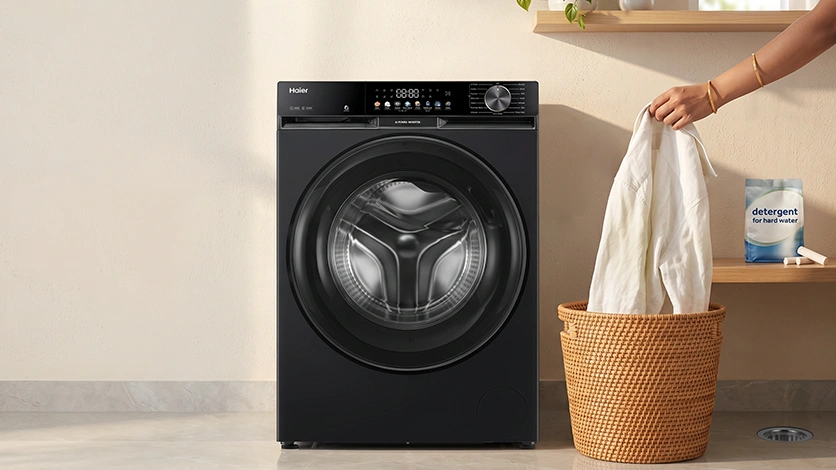
Hard water has more minerals (such as calcium and magnesium) that are dissolved in the water. The minerals may affect the effectiveness of some cleaners, particularly soaps. Laundry may not be as clean as expected, depending on the type of detergent and the hardness of the water.
The effects are not necessarily apparent after the first wash. With time, you may see that towels feel less soft; that dark-coloured clothes become somewhat dull or white ones lose some of their shine. Sometimes, a familiar household detergent that worked fine in one household doesn’t work as well after moving to another locality.
But there is a catch: these symptoms are not necessarily indicative of the presence of hard water. This can be caused by detergent overdosing, overloading the drum, using the wrong wash programmes or not rinsing enough.
How Hard Water Can Affect Your Washing Results
The impact of hard water on washing results is quite significant. The impact of hard water on washing results is not to be taken lightly.
- Low cleaning efficiency: Some detergent components are not as effective in mineral-rich water, depending on the type of detergent.
- Hardness minerals: Over time, hardness minerals can cause deposits on fabrics and washing machine parts.
- Visible marks or off-scent on clothes: If the clothes are not properly rinsed after being washed, or there is too much detergent used, they may look spotted or feel soapy.
- Increased use of detergents: Households might continue to use more detergent to clean but be unaware of the problem.
The key point is, hard water and too much detergent are two different issues. Too high a dosage can exacerbate the second problem, without fixing the first.
Do You Wash Your Clothes in a Front Load Washer with More Detergent?
Not necessarily. A better practice is to use the recommended rate of the detergent manufacturer and adjust the rate, if acceptable, in accordance with the water hardness specified in the product instructions.
Usually, front-loading washing machines use less water than many top-loading washing machines. The correct use of water and detergent is crucial in their wash systems, which are designed to use a controlled amount of water and detergent.
Never put more detergent in the washing machine to get cleaner clothes. If the detergent causes too much lather to form for the programme, the machine may not rinse as well, especially if the load fed into the machine is loaded with a lot of laundry or if the detergent formulation is not compatible with the machine.
Factors That Determine the Right Detergent Quantity
The amount of detergent used is determined by various factors.
Before adjusting the detergent dose, there are four factors to think about:
- Check water hardness: Check if your water has high calcium and magnesium levels. A water hardness test can be useful in determining this.
- Laundry load: If the load is small and the clothes are lightly worn, they may not need as much detergent as a full load of heavily soiled clothes.
- Detergent used: Use detergent designed specifically for use in automatic front-loading washing machines. If applicable, follow the instructions for hard water.
- Soil level: Muddy school uniforms, sweaty sportswear and everyday office clothes might need different wash settings or pre-treatment.
For instance, if your child’s school uniform has mud around the knees, it might work better to use a stain treatment and a wash programme that is appropriate for the stain than to add extra detergent to the laundry.
This is also true of regular washing. Measure first, observe the results and make adjustments within the recommended dosage range.
Selecting the Detergent Dose Appropriate for Hard Water Is Easy

A particular amount is not suitable for all families. The concentrations of detergent vary by type, and water hardness varies by location. If a recommendation for a particular quantity in millilitres is given without reference to the type of detergent and the actual water conditions, such a recommendation is misleading.
Rather, employ a simple process.
1. Read the Instructions on the Detergent
Look for the amount listed on the package according to the load size, soil and water hardness. Some detergents will contain specific instructions for hard water; others may not.
Where the packaging specifies a different dose for hard water, do not make up your own mind — stick to the manufacturer’s recommendation.
2. Do Not Use Too Much Detergent
The more detergent used, the more efficient it is not necessarily going to be. Excessive detergent can leave a residue, contribute to foaming and reduce rinse effectiveness.
If clothes feel soapy after washing, check the dose, load size and selected programme instead of assuming that a stronger concentration of detergent is needed in the wash.
3. Select a Wash Programme That Is Suitable
Under appropriate programme conditions, a quick wash can be useful for lightly soiled clothing. Heavily soiled clothes might require an extended cycle or a separate stain cycle.
Choosing the right programme allows the wash to be targeted at the laundry rather than relying on the detergent to do the job.
4. Keep the Washing Machine Clean
Avoiding build-up is achieved through regular drum cleaning, proper addition of detergents and adherence to the manufacturer’s maintenance guidelines.
For mineral deposits, refer to the washing machine manual for appropriate cleaning and descaling instructions. Don’t think that regular drum cleaning will solve all kinds of mineral deposits.
The Reasons for Proper Detergent Dosing in a Front Loading System
In a front-loading washing machine, the drum rotates and raises the clothes in the water. This motion assists the detergent in reaching the fabric, and the programme regulates the washing and rinsing.
The detergent must be suitable for the machine since the volume of water used in the machine will be relatively controlled. If you use a high-foam detergent which was designed for another type of washing system, it might not work for you.
The choice of programme is as important as the amount of detergent used to wash laundry in Indian homes, which varies from delicate fabrics like sarees to regular cotton clothes, denim, towels and baby clothes.
What to Check Before Starting a Wash
- Use detergent designed for automatic front load washing machines.
- Use a measuring tool to determine the dose, not your eyeball.
- Do not overstuff the drum so that there is no space for clothes to move around.
- Choose the wash programme depending on the fabric and the amount of soil.
- If available or appropriate to the machine’s instructions, use an extra-rinse option.
- Regularly clean the drum in accordance with the manufacturer’s recommendations.
These tips can help create a more routine-like washing routine. They also help to better determine the cause of poor cleaning, such as problems with the detergent, water quality, loading or programme selection.
Haier Front Load Washing Machines Make Laundry Easier

One aspect of laundry care is getting the detergent dose correct. The selection of washing machines with helpful wash programmes and intelligent controls can also make choices easier every day.
Haier India’s front load washing machine range features wash selection and convenience, with fabric care features as its basis. These can include AI-controlled wash functions, various wash programmes and drum designs intended to facilitate fabric care, depending on the model.
If a more thought-out laundry solution is a preferred choice, the Haier F3 8 kg, F5 9 kg and 10 kg fully automatic front load washing machines provide a variety of options for capacity and features.
Haier F3 8 kg Front Load Washing Machine
Model: EFL80-IM12F3BKU1
The Haier F3 8 kg front load washing machine is worth considering for households looking for a combination of intelligent wash selection and everyday versatility.
It has the following listed features:
- AI One Touch: Automatically determines the types of fabrics, load and dirt level to select proper washing conditions.
- 525 mm Super Drum: This is capable of supporting fabric movement and combating tangling.
- Multiple wash programmes: Daily Wash, Cotton, Delicate, Stain Wash, Eco Wash, Hygienic Care, Quick Wash, Baby Care, Mixed Fabric and Self Clean.
- 1200 RPM spin speed: Offers a specified spin speed for the wash cycle.
- Warranty: A two-year comprehensive warranty and a 12-year motor warranty.
When various types of clothes are added to the wash basket every day of the week, the AI One Touch function can assist in making wash-setting choices more simplified.
It should not be considered an alternative to reading detergent instructions, however. The product information does not guarantee automatic measurement of the detergent or compensation for all water hardness levels.
Haier F5 9 kg Front Load Washing Machine
Model: HW90-IM14F5BKU1
The Haier F5 9 kg front load washing machine is designed specifically for families that wash larger loads regularly, and features other smart features as well.
Key features include:
- AI Wash technology designed to optimise wash cycles.
- A 525 mm drum to help move the fabric and minimise tangling.
- Full-colour touch display to navigate controls.
- Wireless remote laundry control.
- An inverter motor.
- A listed 1400 RPM spin speed.
- A four-year comprehensive warranty and 12-year motor warranty.
For households that need to wash their laundry regularly, it is an option because of its ability to carry a significant amount of laundry. The amount of detergent used should be based on the instructions on the detergent label and washing machine, as with any washing machine.
Haier 10 kg Fully Automatic Front Load Washing Machine
Model: HW100-DM14F9BKU1
For families who frequently do large loads of laundry, the Haier 10 kg front load washing machine will be larger in size and have a unique set of convenience features.
The following specifications are included:
- One-Touch AI Wash: Ability to sense the type of fabric, load and dirt and choose the wash setting.
- AI Colour Panel: A colourful display that is intuitive and controlled by a computer.
- Direct Motion Motor: Smooth, quiet and efficient operation.
- Night Wash: A programme designed to operate quietly.
- 16 listed wash programmes: Covering options like Cotton, Wool, Jeans, Baby Care, Delicate/Silk, Daily Wash and Self Clean.
- 1400 RPM spin speed.
- Warranty: Four years comprehensive and 12 years on the motor, as stated on the product.
The higher capacity might prove helpful for a family which washes bedsheets, towels and regular clothes on a daily basis. However, this 10 kg capacity does not indicate that all the washing should be loaded to this weight. Clothing should be allowed sufficient room to rotate within the cycle.
A word on hard water: The product information of these models depicts their wash programmes and other features but does not define a specific hard-water detergent dosing function. For this reason, adjustments to the detergent should be made according to the detergent label, water conditions and the manuals of the product in use.
Common Detergent Mistakes to Avoid
You can’t fix all laundry habits with a good washing machine. There are a few little things that could make a difference.
- Adding detergent until the water is foaming: Foam is not a good indicator of cleanliness.
- Applying the same amount for each load: Size of the load, soil level and the concentration of detergent are all important.
- Failure to consider the hardness of the water: Test the water if cleaning problems remain, instead of adding more and more detergent.
- Too many clothes in the drum: The wash performance is hindered when clothes are packed too tightly in the drum.
- Neglecting machine maintenance: Clean the drum according to the manufacturer’s guidelines and adhere to other regular maintenance recommendations.
If clothes still feel rough or residue is still present after proper dosing, try to determine if the problem is due to mineral deposits, incompatibility of the detergent or poor rinsing. If the issues continue, the detergent manufacturer’s or authorised washing machine service professional’s advice may be required.
The Takeaway: The Right Balance for Better Laundry
Hard water will affect the performance of detergents, but beyond a point, more detergent will not improve the results. It’s best to know your water quality, use a detergent dose that follows the manufacturer’s recommendations and select an appropriate wash cycle for the garments in the drum.
The AI-powered wash selection, fabric-specific programmes and varying drum sizes of Haier India’s front load washers combine to facilitate hassle-free laundry tasks. The F3 8 kg, F5 9 kg and 10 kg models all offer a range of features which can be used in combination with good laundry practices for the best results.
Cleaner clothes are not just about the amount of detergent used, after all. They are all about balancing the amount of water, clothes and washing machine.
Frequently Asked Questions
1. Does hard water require more detergent in a front load washing machine?
Sometimes. The appropriate dose depends on water hardness, detergent formulation, load size and the product’s instructions. Use a hard-water dosage only when the detergent manufacturer recommends one.
2. Can using too much detergent damage clothes?
Excessive detergent can leave residue on garments and may contribute to build-up inside the washing machine. Over time, this can affect the laundry experience. Follow the recommended dose rather than adding more automatically.
3. Which detergent is suitable for a front load washing machine?
Choose a detergent specifically formulated for automatic front load machines. Check the packaging for dosage instructions, water-hardness guidance and suitability for the fabrics you wash.
4. Does AI Wash automatically adjust detergent quantity?
Do not assume so. AI Wash functions vary by model. The listed Haier F3 and F5 features describe intelligent wash-setting optimisation, but do not establish automatic detergent dispensing or universal hard-water compensation.
5. How can I tell whether my water is hard?
A water hardness test is a practical way to check. You may also notice mineral deposits on taps or glassware, although these signs alone cannot establish the exact hardness level.
6. Is a larger-capacity front load washing machine better for hard water?
Not necessarily. Capacity determines how much laundry the machine is designed to handle, not how effectively it deals with hard water. Correct detergent selection, dosing and machine maintenance remain important regardless of capacity.