


As you get ready to make lunch, the power goes out. The fan ceases to spin, the kitchen grows still and someone dips into the refrigerator for a bottle of water. After a few minutes another family member tests to see if the milk is still cold.
Doesn’t sound too dangerous, does it?
Other trips to the refrigerator might cut short the time your food is still safe to eat.
If the power goes out, the refrigerator will no longer be able to keep things cold until a compatible back-up power supply is available. Cold air which already has been in is your temporary weapon against the increasing temperature. The cool air that keeps the refrigerator cool is lost every time the refrigerator door is opened, which lets warmer air from the room in.
So, can the opening of the refrigerator cause the food to spoil quickly after a power failure? Yes, it can. Opening doors often will increase temperature fluctuations, especially in warmer seasons in India. But, food spoilage is related to various factors such as length of the outage, ambient temperature, and food stored.
Knowing the inner workings of your refrigerator will make for better, safer choices when power is out.
What Is the Maximum Time That a Refrigerator Can Keep Food Cold in the Absence of Electricity?

Refrigerators don’t get hot upon power outages. The walls and closed doors are well insulated, which slows the rate of heat entering the storage compartment.
An unopened refrigerator keeps the food cold for about 4 hours when there is a power failure.
The average freezer will hold safe temperatures for a longer period:
- When the freezer is completely full and the door is closed, the temperature can be maintained for about 48 hours.
- A half full freezer can keep the temperature for 24 hours or so.
- A refrigerator compartment will usually keep food cold for a few hours without electricity.
These are food safety estimates and do not represent guaranteed performance of specific appliances.
The actual retention of the refrigerator will be influenced by the temperature of the room, the insulation of the refrigerator, the amount of food and the frequency of the refrigerator door.
During the summer months when the temperature is above 35c in an Indian kitchen, the refrigerator might heat up faster than it would in a cool environment.
Just as that, it’s why keeping the door shut is important.
What Happens When Your Fridge Door Opens During a Blackout?
Consider the cold air coming inside the refrigerator.
Normally, heat which enters the compartment is removed by the cooling system and assists in maintaining the desired temperature.
That process is halted in the event of a power outage.
Replacement of Warm Air by Cold Air
When the fridge door is opened, air in the fridge is cooled down and the cooler air is pushed out by warmer surrounding air.
These temperature changes are more pronounced in the summer.
For instance, if your kitchen temperature is 34°C, and the refrigerator compartment temperature is approximately 4°C, the opening of the door allows the air inside the refrigerator to be into contact with warmer air.
Just one opening of the groceries doesn’t necessarily mean they’re ruined.
However, repeated openings eventually decrease the refrigerator’s capability to keep food stored safely.
Food Begins Absorbing Heat
When the temperature begins to increase, stored items slowly begin to heat up.
Foods vary in their reaction.
A sealed bottle of water can take longer to heat up than a little container of leftover dal. Meanwhile, food that needs to be kept at a certain temperature like milk, cooked rice and raw meat are more sensitive.
When Bacterial Growth Becomes an Issue
When perishable foods are in the danger zone for long periods of time, food safety becomes more important.
Bacteria grow more quickly between the temperatures known as the danger zone (4°C to 60°C).
Not all food is immediately hazardous when it is above 4°C.
But, with extended exposure, there is a greater risk of harmful bacteria building up.
Refrigerated perishable foods: the general recommendation is to discard any foods out of the fridge for more than two hours when they have been above 4°C.
What Are the Highest-Risk Foods in a Power Failure?
Refrigerators do not have all food items exposed to the same risk of spoiling.
Think of an average Indian home keeping milk packets, leftover sabzi, fresh vegetables, curd and ready to cook food.
There are some foods that need much more attention to their temperature.
High-Risk Refrigerated Foods
Pay particular attention to:
- You may need to refrigerate milk, paneer and other dairy products that are not perishable.
- Cooked rice, dal, curries and gravies
- Raw chicken, fish and meat
- Eggs and egg products that have been cooked.
- Shape fruits and pre-made salads.
- Leftover takeaway meals
These foods can be unsafe if refrigeration temperatures are allowed to be too warm for too long.
Cooked rice should be treated with special care since some bacteria that present in rice can form toxins that endanger it during reheating.
Foods Which May Be Less Temperature-Sensitive
Some unopened, whole fruits and vegetables are better suited to temporary temperature changes.
The safety of their products, however, relies on the requirements for the product’s storage.
Follow instructions on packaged food.
And last, but not least, do not use smell or appearance alone to make the decision on whether a refrigerated food is safe or not.
Not all harmful bacteria will make noticeable changes.
What to Do Now if the Electricity Goes Out?
The first few minutes of a power outage are typically the most convenient time to prevent needless temperature losses.
No fancy equipment is required! A little preparation goes a long way!
Keep the Refrigerator Door Closed
To prevent overheating, leave the door to your refrigerator open.
Do not open the refrigerator just to see if it’s still cold.
If the outage has just started, leave the door shut.
Inform other family members about the power outage and to avoid repeated opening of the appliance.
Record How Long the Power Was Out
Record the time that the power went out.
This can help you determine whether the food is safe to eat after a power outage.
Also, if outages are frequent in your area, you could use a refrigerator thermometer to keep track of real temperatures for the different compartments.
Avoid Adding Warm Food
Avoid putting just cooked food into an un-powered refrigerator.
Heat is added to the compartment when there is warm food.
Instead, practice safe food storage procedures, and don’t leave cooked food at room temperature for too long.
Consider the Places You’re Going to Go Before You Open the Door
When you must have something, make a decision about what you’ll take before you open the refrigerator.
Get an item and close the door quickly and correctly.
One brief visit is better than several unneeded visits.
Does a Home Inverter Save the Refrigerator?

Backup power may be a practical benefit for households that are likely to lose electricity for extended periods of time.
But not all the refrigerators automatically work on a home inverter.
Compatibility is dependent on the electrical needs of the appliance, the size of the inverter and whether it will have battery backup.
It is here that choosing a refrigeration unit that is properly designed is crucial.
In the event of a power failure, Haier India provides a single-door refrigerator option that is home inverter compatible, providing a possible solution for households to keep the refrigerator running in the event of a power cut.
A home inverter with an appropriate connection can enable the fridge to run during a power outage, rather than having to shut it off completely.
The operational time of course will be dependent on the inverter and battery system.
How Does Haier Refrigerator Cater to the Everyday Indians’ Households?
But, power outages are not the only factor for choosing a refrigerator.
Indian homes need practical storage, easy maintenance and everyday kitchen-friendly appliances as well.
The 190L single door refrigerator range by Haier India caters to these needs.
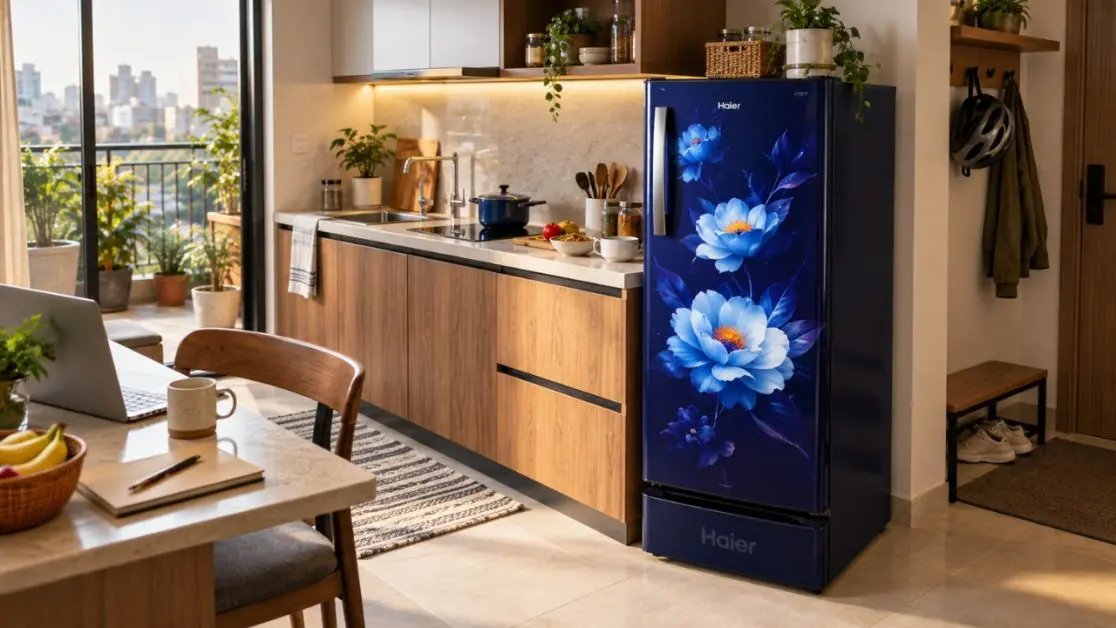
Haier 190L 5 Star Red Hilton Single Door Refrigerator
Haier Haier HRD-2115PRHA-N’s 190-litre capacity comes with a number of convenient features.
Some of its critical features are:
- Compliance with the home inverter for connection to an appropriate back-up power source. Fitting with a home inverter for use with an appropriate back-up power system.
- Protects against specified voltage fluctuations with stabiliser free operation.
- Rapid ice preparation – 1 Hour Icing Technology
- Safe & Clean Back design with a covered rear panel
- Use a separate container to store vegetables and an extra base drawer.
Another factor for residential consumers to consider when comparing electricity usage for refrigerators is the 5-star energy rating.
The separate vegetable compartment and added base drawer are useful for organizing for families that have to store food regularly for their vegetarian diet.
Importantly, in regions with high frequency power outages, home inverter compatibility may be important.
Haier 190L 5 Star Marine Hilton Single Door Refrigerator
If the buyers like another exterior design, there is the Haier HRD-2115PMHA-N which comes with Marine Hilton exterior design.
This model is also compatible with home inverters, can operate without stabilisers and includes 1 Hour Icing Technology.
The covered back panel makes cleaning easier and extra base drawer for convenient storage.
The refrigerator combines practical use and a unique design, which will be appropriate to the modern Indian kitchen.
Haier 190L Wave Glass Single Door Refrigerator
The Haier HRD-2113PWGA-N adds to the design possibilities with its Wave Glass finish.
The following are some of its advertised features:
- Home inverter compatibility with automatic connection to a suitable home inverter during power cuts
- Stabiliser-free operation
- 1 Hour Icing Technology
- An additional base drawer
- Toughened glass shelves
For those desiring more than just refrigerator power, its storage capabilities and home inverter compatibility make it a consideration.
While all three models have relevance to the Indian home, buyers must check the specifications and ensure they are compatible with their existing power back-up solutions.
How Does the Food Change When There Is Electricity Back?
When power comes back on, all of the contents of the refrigerator are not necessarily safe to eat.
The next decision will be based on the length of the outage and safe temperature of the food.
Check the Refrigerator Temperature
When using the refrigerator, you can check the temperature by using the refrigerator’s thermometer.
Use an appliance thermometer to see if the refrigerator compartment has a temperature of 4°C or below.
If the food is a frozen food product, see if there are any ice crystals left or make sure the food has an internal temperature of 4°C or lower before determining if it is safe to refreeze or cook the food.
Thoroughly Check Perishable Items
Refrigerated perishable foods may have to be thrown out if power has been out of the refrigerator for more than 4 hours, unless a confirmation can be made that they have been kept at a safe temperature.
Don’t taste food to determine whether it has spoiled.
Let the Refrigerator Cool Down Again
After a power restoration, the selected temperature has to be restored, which can only happen after a few minutes.
Do not open the door several times in a row during this time.
Also, keep in mind that fast ice making does not replace good food safety evaluation following a prolonged power failure.
What Can You Do to Get Your Refrigerator Ready for Future Power Outages?
If there are frequent power outages in your area, there are a couple of adjustments you can make to prevent needless food waste.
These are the preliminary measures to take:
- Keep the refrigerator at 4°C or cooler.
- Set the freezer temperature to around -18°C.
- Do not overcrowd and restrict internal airflow.
- Test the door gasket of the refrigerator to ensure it seals.
- Have gel packs or ice packs in the freezer in case of an emergency.
- If there are regular power outages in your home, you might consider installing a suitable home inverter.
- Follow the refrigerator manufacturer’s installation and operating instructions.
If the power goes out for a long time, it may be necessary to move perishable food to an insulated cooler that has enough ice.
Keeping food out of sight isn’t the key; it’s keeping it at safe temperatures.
Will This Be the Same if the Freezer Is Opened During a Power Outage?
Yes. When opened, the freezer door can allow warmer air in and may decrease the amount of time that frozen food is kept at a safe temperature.
The freezer typically will hold its temperature longer than the refrigerator compartment because frozen food and the surrounding materials are additional thermal mass.
This is a benefit, but diminishes if the door is repeatedly opened.
Frozen foods will thaw slowly if they are stored together.
When power outages last for a long time, check the temperature of the food, not the length of time it has been frozen.
Keep Power Cuts Less Disruptive with the Proper Refrigerator
While you can’t control a power outage, you can control how you handle your refrigerator during a power outage.
By closing the door, recording the length of time the door is open, and knowing food-safety limits, the risk of spoilage can be minimized.
Power backup compatibility is another factor to look at for Indian households thinking of buying a refrigerator.
Haier India 190L Red Hilton, Marine Hilton and Wave Glass single door refrigerators are equipped with home inverter compatibility, handy storage solutions and unique design.
Browse Haier India Refrigerator range for the right refrigerator for your kitchen, storage needs and power backup system.
When the power goes out, a little preparation can make a big difference.
Frequently Asked Questions
1. Does opening the fridge once during a power cut spoil food?
No. Opening the refrigerator once doesn’t automatically cause food spoilage. However, it allows warm air to enter, which can contribute to rising internal temperatures. Keeping the door closed as much as possible is recommended.
2. How long can milk stay safe in a refrigerator without electricity?
An unopened refrigerator generally keeps food cold for approximately four hours during a power cut. Milk should be discarded if it has remained above 4°C for more than two hours.
3. Can I keep using my refrigerator during a power cut with a home inverter?
Yes, provided the refrigerator is compatible with the inverter and the backup system can meet its electrical requirements. Selected Haier India single-door refrigerators support home inverter operation.
4. Should I open the refrigerator to check whether the food is cold?
Avoid unnecessary openings. A refrigerator thermometer is more reliable than touching food or guessing its temperature. During an outage, minimise door opening to preserve cooling.
5. Will food become safe again once the refrigerator starts cooling?
No. Refrigeration slows bacterial growth but doesn’t necessarily make food safe after it has been stored at unsafe temperatures. Perishable food that exceeds recommended time and temperature limits should be discarded.
6. Does stabiliser-free operation mean a refrigerator will work without electricity?
No. Stabiliser-free operation refers to the refrigerator’s ability to operate within its specified voltage range without requiring a separate stabiliser. Continued operation during a power cut requires a compatible backup power supply.