
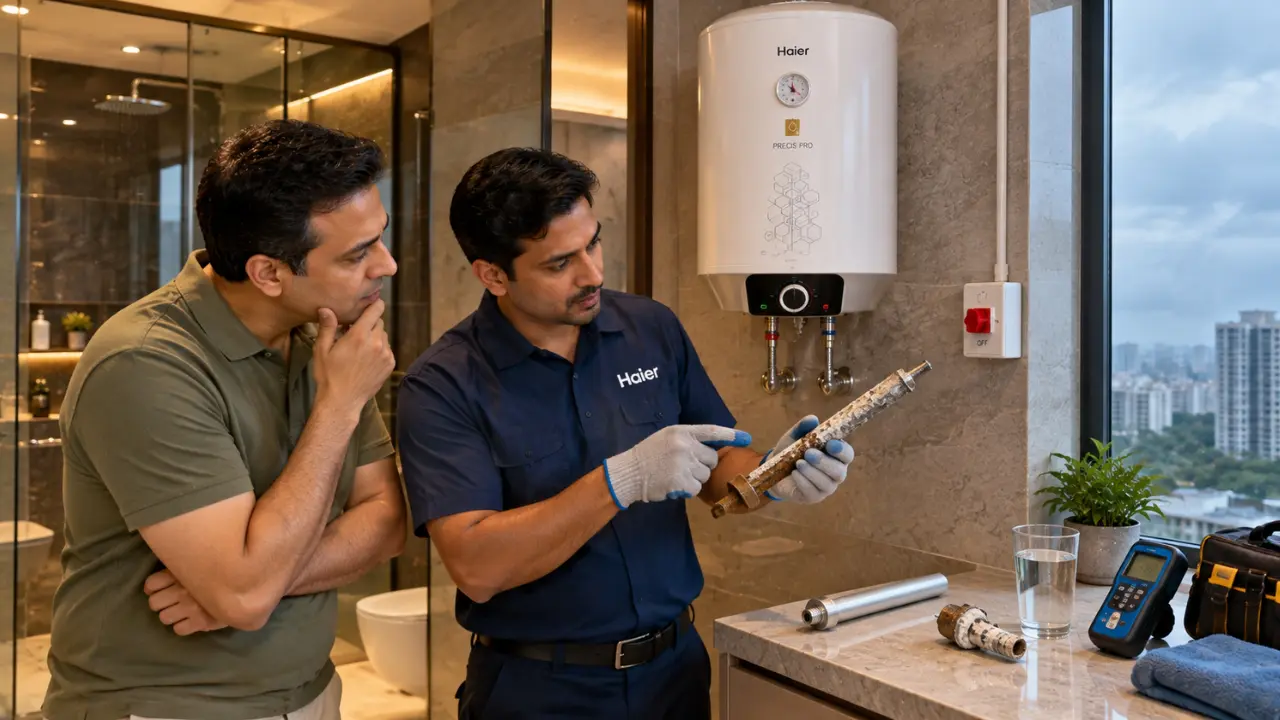

Your geyser may be heating water perfectly well today. The temperature feels right, there are no unusual sounds, and your morning routine continues without interruption. But inside the storage tank, something less obvious could be happening.
Corrosion.
It’s a concern for storage water heaters, particularly in Indian households where water contains high concentrations of dissolved minerals. While most buyers compare geysers based on capacity, heating speed and energy ratings, a small internal component deserves just as much attention: the anode rod.
An anode rod helps protect the metal tank against corrosion. In areas with hard or chemically aggressive water, this protection becomes particularly valuable.
Understanding how it works can help you choose a more durable water heater and recognise when maintenance is necessary.
What Is an Anode Rod in a Geyser?

Many storage water heaters have an anode rod, which is a piece of metal that is installed to reduce the chance of tank corrosion.
Typically composed of magnesium or aluminium alloys. The reason for the choice of these metals is that they are more electrochemically reactive than the steel in the water heater’s storage tank.
But here’s the interesting bit.
The rod is designed to corrode gradually so that the tank doesn’t have to.
This is known as sacrificial anode protection, a type of cathodic protection that is used for the corrosion protection of metal structures in contact with water.
What Is Sacrificial Anode Protection?
Electrochemical reactions may occur when water is in contact with various metals.
In a geyser with an appropriate sacrificial anode, the rod will preferentially be oxidized, thus protecting exposed steel surfaces inside the geyser.
In general, the procedure is as follows:
- The water present within the geyser is an electrolyte and hence electrochemical reactions can take place.
- The magnesium or aluminium based anode is more reactive than the steel tank.
- Gradually the anode corrodes rather than leaving exposed steel surfaces to corrode as readily.
- With time, the rod will lose its charge and may need to be replaced.
Consider it as a sacrificial element which absorbs corrosion to protect a much more valuable part of the appliance.
But an anode rod alone is not a guarantee of corrosion protection for a tank. It is dependent on water chemistry, tank construction, and the condition of the rod.
What Is the Reason for Special Attention to Be Paid to Hard-Water Areas?
Hard water has relatively high levels of calcium and magnesium.
Hard water is a common problem in many households in India, especially when groundwater or borewell water is utilized. The water properties can also differ significantly from neighbourhood to neighbourhood, building to building and water source to water source.
A common error is to believe that all geyser corrosion is caused by hard water.
Not exactly, it isn’t.
The hardness of the water is mainly related to mineral scaling, and corrosion is related to multiple factors such as the contents of the tank, the pH of the water, the temperature of the water, and the dissolved salts in the water.
However, storage geysers can present extra maintenance issues in hard water environments.
Mineral Deposits Can Have an Impact on Heating Performance
If the water is hard, and heated, deposits of calcium carbonate and other minerals can form on the inside surfaces.
With time, these deposits may:
- Minimize the transfer of heat around the heating element.
- Make water take longer to heat up.
- Make rumbling or popping noises when heated.
- Help with maintenance needs.
- Collect around internal parts.
An anode rod will not remove these minerals or stop limescale building up.
Its job is not the same: to prevent electrochemical corrosion of vulnerable metal surfaces.
If your home suffers from tough water, both corrosion protection and scale control should be considered.
When a Geyser’s Anode Rod Wears Out, What Happens?
An anode rod isn’t designed to last forever.
In fact, it is designed to deteriorate over time.
As the rod rusts, the protective material is consumed also. It could eventually become depleted and lose its protective capacity.
As a result, when this occurs, the bare metal surfaces within the storage tank may be more susceptible to corrosion.
Warning Signs That Warrant Investigation
The condition of an anode rod is not easily discerned by examining the geyser from the outside.
Some signs, however, may mean that the water heater requires a professional inspection.
- Hot water that is rusty: This can be a sign of corrosion in the hot water system, but may also be caused by corrosion in the plumbing pipes.
- Bad taste or odour: Some water conditions and microorganisms may cause bad taste or odour.
- Decreased heating efficiency: This could be caused by sediment build-up or heating-element issues.
- Odd noises when heating: Mineral deposits can produce bubbling, popping or rumbling noises.
- Leakage around the tank or connections: Must be corrected immediately.
None of these symptoms is conclusive of the failure of the anode rod.
Only a qualified technician should check the appliance, and determine the real cause before suggesting repair solutions.
Also, if the tank is leaking, the anode rod replacement will not fix the tank.
What Are Haier’s Solutions for Corrosion Protection in Storage Water Heaters?
If you are considering buying a geyser for your Indian home, there are several factors to consider other than the exterior design.
Storage water heaters by Haier India are equipped with features that help in ensuring the durability of the tank as well as its heating efficiency and safety for everyday use.
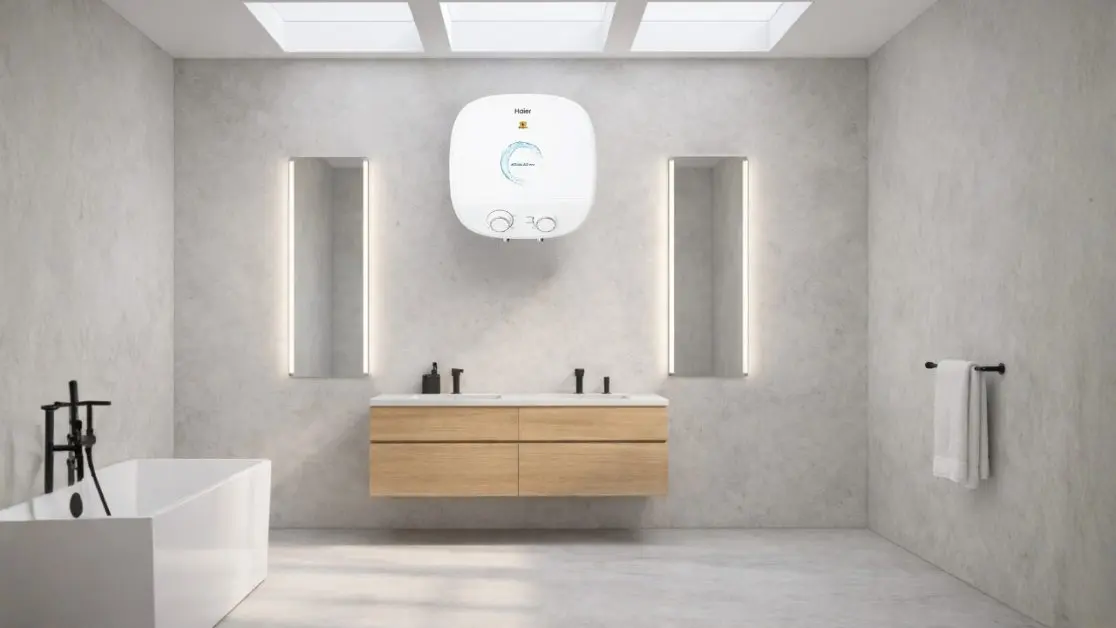
Haier PRECIS cylindrical water heaters, Haier Square Spa Ivory, Haier Square Spa Ivory are three models that would be worth considering which have a capacity of 15 litres.
1. Haier 15L Square Spa Ivory 5 Star Water Heater (ES15V-S1I)
Haier Square Spa Ivory is a compact square spa that features a number of internal protection features.
For this discussion, it is important that it is built with a magnesium rod and glass-lined storage tank.
The glass lining protects the stored water from corrosion by the metal of the tank, and the magnesium rod provides sacrificial corrosion protection.
Other features include:
- 15 litre storage for domestic hot water needs.
- 5-star energy rating.
- A tank that is lined with glass to enhance corrosion resistance.
- Durability of Incoloy 800 heating element.
- Electrical safety protection with Shock Proof technology.
- Overheating protection with Dual Thermal Proof.
- High pressure suitable installation rated at 8 bar.
- PUF insulation to reduce heat loss.
If long-term tank protection is a concern, then the magnesium rod/tank combination is a model to consider.
2. Haier 15L Square Ivory 5 Star Water Heater (ES15V-SDI)
The Haier Square Ivory is another square water heater for those who want to have some extra electronic controls.
The model is similar to the Square Spa Ivory, with a magnesium rod and corrosion resistant glass lined tank construction.
It also has the following specifications:
- 15-litre storage capacity.
- 5-star energy rating.
- Smart Timer and Smart Memory functions.
- LED Display and Remote control.
- Dual Thermal Proof technology.
- Shock Proof protection.
- Working pressure of 8 bars.
- RSC U-turn Flow Technology for better water flow.
For households that want to control their water-heating schedule, the Smart Timer and Smart Memory features provide extra convenience.
Meanwhile, the magnesium rod and glass-lined tank tackle the less obvious issue of protection against internal corrosion.
3. Haier 15L PRECIS ABS 5 Star Cylindrical Water Heater (ES15V-PRECIS)
A square geyser is not necessary in all bathrooms.
The Haier PRECIS features a cylindrical design, but still has a few crucial durability features.
It is a glass-lined tank, has a magnesium rod, and an Incoloy 800 heating element.
Additional features include:
- 15-litre storage capacity.
- 5-star energy rating.
- Shock Proof technology.
- Dual Thermal Proof protection.
- IPX4 water-resistance rating.
- Working pressure of 8 bar.
- RSC U-turn Flow Technology.
- PUF insulation for better thermal insulation.
The PRECIS offers a combination of corrosion protection, thermal insulation and safety features to homeowners who are comparing cylindrical storage geysers.
An important caveat: these features will help to make the product last longer, but won’t remove the need for maintenance in hard water.
When to Replace Anode Rods on Geysers?

There isn’t one replacement schedule that applies to every water heater.
The consumption of anode is related to water chemistry, use, operating temperature and the material of the anode rod.
In certain installations, the rod can degrade quite rapidly. In others, it may last for several years.
A good idea is to schedule regular professional checks as per the manufacturer’s maintenance guidelines and the local water conditions.
What’s a Technician Supposed to Look For?
A qualified technician can evaluate:
- The condition of the anode rod.
- Mineral deposits inside the storage tank.
- The heating element’s condition.
- Signs of corrosion or leakage.
- The pressure relief system and plumbing.
- Electrical safety and thermostat operation.
Replacement must be with a compatible component approved for the specific water heater.
Do not remove an anode rod when the geyser is energised or under pressure. An authorised or qualified service professional should conduct the inspection and replacement.
Is It Possible to Eliminate the Need for an Anode Rod with a Glass-Lined Tank?
No. These components have complementary functions.
A glass-lined tank is a tank that is coated with a protective layer between the water and the majority of the steel surface.
But there may be minor flaws or uncovered spots in protective linings.
A sacrificial anode is used to provide electrochemical protection of sensitive metal surfaces.
That is why it is important to have the combination.
Square Spa Ivory and Square Ivory and PRECIS models are equipped with a tank lined with glass and a magnesium rod, which provide two types of corrosion protection in Haier models.
This is a better consideration for buyers who are comparing geysers, rather than just looking at the exterior.
If You Are Using Hard Water, How Can You Protect Your Geyser?
The right maintenance can be beneficial to any kind of storage water heater.
There are a few practical things to do to decrease unnecessary issues.
Check Your Water Quality
For any home that uses borewell water or has frequent mineral deposits, it is advisable to have the water tested.
Hardness and other water characteristics can be determined by testing that may impact your plumbing and appliances.
Don’t Use Unnecessarily High Temperatures
In hard water, high temperatures may cause mineral deposits to build up quickly.
Follow the manufacturer’s safety and hygiene advice and use an appropriate temperature setting for your home needs.
Arrange Periodic Descaling
If there is a large amount of minerals, professional descaling can be used to improve heating performance.
Frequency will vary according to the water conditions and usage.
Don’t Ignore Small Changes
If a geyser suddenly starts taking longer to heat water, producing strange noises or has a leak, it should be examined.
Regular checks could prevent larger maintenance problems.
Should an Anode Rod Be a Consideration When Purchasing a Geyser?
Yes, especially if the long-term durability of the tanks is important.
A storage geyser is expected to be able to perform after repeated heating cycles, seasonal changes and varying water conditions.
The anode rod can be located within the tank but its role is essential in corrosion protection.
For Indian households that are considering the options for water heaters, Haier’s Square Spa Ivory, Square Ivory and PRECIS models are practical choices that include magnesium rods, glass lined tanks and other safety features.
The best option will depend on your bathroom size, hot water needs, water pressure and your preferred controls.
There are a number of things to consider before buying: Read the product specifications and talk to an approved professional about any concerns regarding local water quality.
A geyser is not just meant to supply hot water on the day of installation. It should also be well built inside to ensure that it will perform reliably over time.
Frequently Asked Questions
1. What is the main purpose of an anode rod in a geyser?
An anode rod helps protect the metal storage tank from electrochemical corrosion. It gradually corrodes itself, reducing corrosion of susceptible tank surfaces.
2. Does an anode rod prevent hard-water scaling?
No. An anode rod provides corrosion protection, not water softening. Calcium and magnesium deposits may still accumulate inside the geyser.
3. Do Haier water heaters come with magnesium rods?
Yes. The Haier 15L Square Spa Ivory (ES15V-S1I), Square Ivory (ES15V-SDI) and PRECIS (ES15V-PRECIS) models list magnesium rods in their specifications.
4. Can a geyser work without an anode rod?
A geyser may continue heating water even when its sacrificial anode is depleted. However, susceptible metal surfaces may face an increased risk of corrosion.
5. How do I know whether my geyser’s anode rod needs replacement?
The most reliable approach is professional inspection. A technician can assess the rod’s remaining material and determine whether replacement is necessary.
6. Is a glass-lined geyser suitable for hard-water areas?
A glass-lined tank can help resist corrosion, making it a useful feature to consider. However, hard-water scaling can still occur, so appropriate maintenance remains important.