
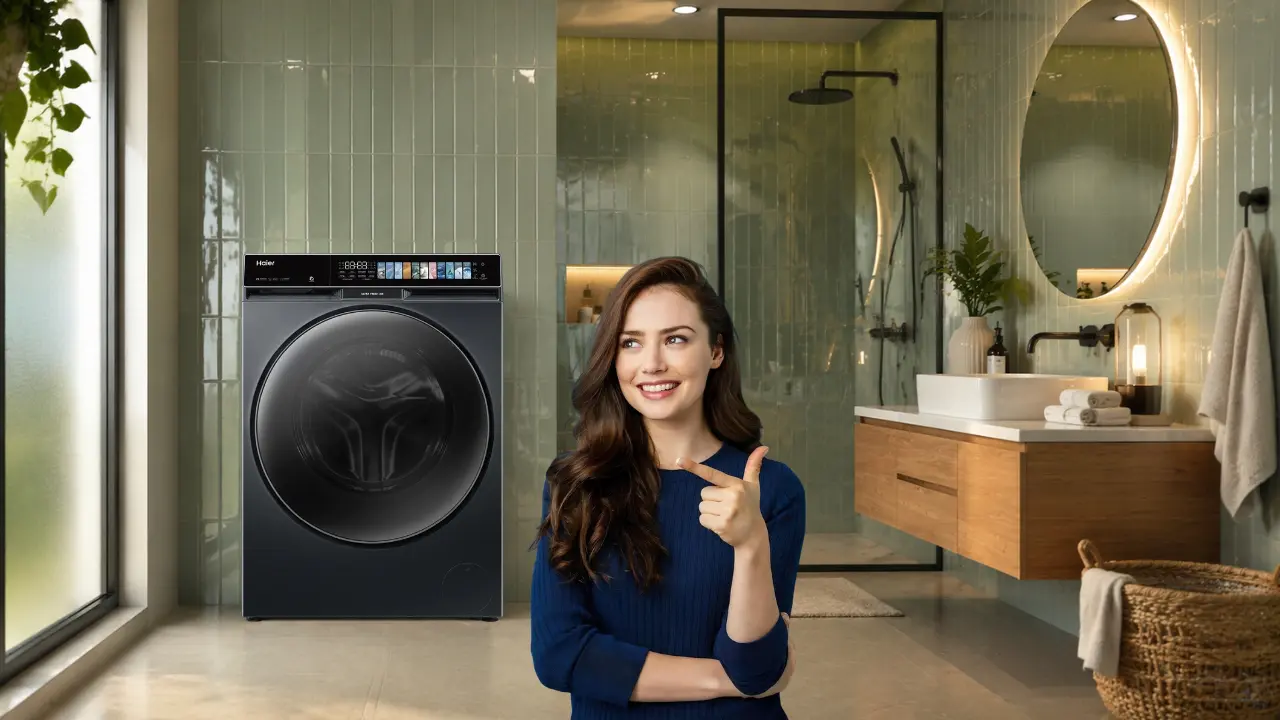

In the case of the laundry sector, AI is changing the way washing machines work by allowing them to become intelligent devices that can automatically detect the type of cloth used, the weight of the load, and the degree of soiling.
Cleaner clothes with less effort and more intelligent resource management.
The everyday problem we stopped questioning.
It is 9:30 PM.
A pile of clothes sits on a chair. Office shirts. Gym wear. A delicate kurta someone forgot to hand wash.
You stand in front of the washing machine.
Which setting?
Cotton? Quick wash? Delicate? Extra rinse?
Laundry, for something so routine, asks too many decisions.
And here is the uncomfortable truth.
Most people guess.
Laundry Was Never About Washing. It Was About Decisions
Traditional washing machines ask you to think like an engineer.
- How dirty are the clothes
- What fabric is this
- How much water is enough
- How long should it run
The machine waits. You decide.
That system worked when life was slower.
It breaks when life becomes layered.
Work calls. Family routines. Late nights. Early mornings.
The cost of manual decisions is not time. It is mental fatigue.
And this is exactly where AI enters the story.
What AI Actually Changes in Laundry Appliances
AI does not just automate. It observes.
Modern AI-powered washing machines use sensors, algorithms, and pattern learning to make decisions in real time.
What AI detects automatically
- Load weight
- Fabric type
- Level of dirt
- Water absorption patterns
What AI adjusts automatically
- Water level
- Wash duration
- Drum movement
- Spin speed
- Energy consumption
Machines like Haier’s front-load models with AI One Touch Wash go a step further.
With a single touch, the system selects optimal settings by itself.
No trial. No errors. No second guessing.
The machine stops asking questions. It starts answering them.
A Simple Comparison That Changes Everything
| Traditional Washing | AI-Powered Washing |
| User selects settings | Machine selects settings |
| Fixed programs | Adaptive programs |
| Risk of over-washing | Optimized cycles |
| Higher water usage | Controlled water usage |
| Trial and error | Data-driven precision |
The difference is not technical.
It is behavioral.
AI removes friction from everyday decisions.
The Three Layers of AI in Modern Laundry
Not all AI is equal.
Understanding this helps you see what actually matters.
1. Reactive AI
The machine responds to inputs.
You choose settings. It executes efficiently.
Cost: Low complexity
Benefit: Reliable performance
2. Adaptive AI
The machine senses and adjusts in real time.
It changes water levels, time, and movement mid-cycle.
Cost: Slightly higher investment
Benefit: Better cleaning with less resource use
3. Predictive AI
The machine learns patterns over time.
Learn your habits, suggest cycles, and improve future washes.
Cost: Advanced systems and connectivity
Benefit: Minimal user intervention
Machines with features like Smart Wash and Eco Wash combine adaptive and predictive layers.
They detect fabric types and adjust parameters to save energy, water, and time.
Why This Matters More in Indian Homes
Laundry in India is not uniform.
It is diverse.
- Cotton shirts for office
- Synthetic gym wear
- Heavy bedsheets
- Delicate sarees
- School uniforms
Each load is mixed.
Each fabric behaves differently.
And this creates a hidden problem.
One wrong setting affects multiple clothes.
AI solves this by treating laundry as a system, not a category.
The Hidden System: Fabric, Water, Time

Every wash cycle balances three variables:
- Fabric sensitivity
- Water requirement
- Time needed for cleaning
Traditional machines fix these values.
AI machines optimize them.
Example
A lightly soiled cotton shirt does not need:
- High spin speed
- Long wash time
- Excess water
AI detects this and reduces all three.
Less effort. Less wear. Less waste.
Efficiency Is No Longer a Feature. It Is a System
Look closely at modern machines.
You will notice a pattern.
AI-driven benefits
- Energy savings through optimized cycles
- Water conservation via load sensing
- Time efficiency through dynamic washing
For example, Eco Wash adjusts water and washing time based on load weight to conserve resources.
And this is not just convenience.
It is economics.
The Real Cost of Not Using AI in Laundry
Let us make it practical.
Without AI
- Overwashing leads to higher electricity bills
- Excess water usage increases costs
- Clothes wear out faster
- Time spent adjusting settings adds up
With AI
- Optimized cycles reduce power usage
- Controlled water consumption
- Better fabric care
- Minimal decision-making
Efficiency compounds quietly.
When Machines Become Interfaces, Not Appliances
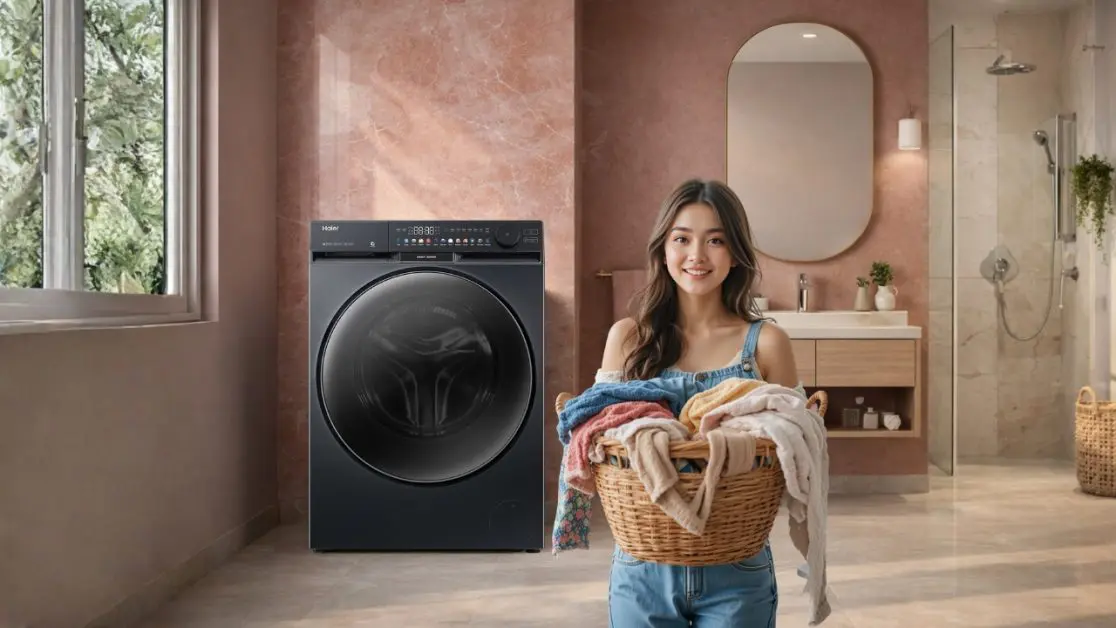
One subtle shift often goes unnoticed.
The washing machine is becoming an interface.
Not just a device.
Take features like:
- AI colour touch panels
- Dedicated fabric programs
- App-based controls via WiFi
These are not cosmetic upgrades.
They change how you interact with the machine.
Haier’s AI Colour Panel, for instance, creates an intuitive, visual interface for selecting fabric-specific programs.
Complexity moves inside the machine. Simplicity stays outside.
Smart Connectivity Changes Behavior, Not Just Access
WiFi-enabled washing machines introduce a new layer.
Control without presence.
What this enables
- Start or stop cycles remotely
- Get notifications when laundry is done
- Monitor remaining time
Machines connected through smartphone apps allow you to manage laundry without standing next to the appliance.
This sounds small.
It is not.
Convenience is not about speed. It is about flexibility.
The Silent Shift Toward Hygienic Laundry
Another layer where AI plays a role is hygiene.
Modern households care about:
- Allergen removal
- Bacteria reduction
- Fabric freshness
Features like dual spray systems remove detergent residue and reduce allergens from clothes.
Add steam-based programs, which reduce wrinkles and odours between washes.
This changes the purpose of washing.
It is no longer just cleaning. It is fabric care.
A Pattern You See Across Smart Homes
Look beyond laundry.
The same system appears everywhere.
- Refrigerators adjust cooling based on usage
- ACs adapt airflow based on room conditions
- TVs recommend content based on preferences
Now washing machines do the same.
AI turns appliances into participants.
Not tools. Not machines.
Participants in daily life.
So What Should You Look For in an AI Washing Machine
Not all features matter equally.
Focus on systems, not specs.
One option is simplicity-first AI
- One-touch washing
- Automatic load sensing
- Minimal user input
Best for busy households.
The second option is control-plus-AI
- Multiple fabric programs
- Manual override with AI support
- Customizable cycles
Best for users who want flexibility.
The third option is connected AI
- App control
- Notifications
- Usage tracking
Best for tech-enabled homes.
The Insight Most People Miss
Here is the deeper shift.
AI is not making washing machines smarter.
It is making decisions disappear.
And when decisions disappear, something else appears.
Time.
Clarity.
Ease.
The Future of Laundry Is Quietly Invisible
The best technology does not announce itself.
It fades into the background.
You load clothes. Press one button. Walk away.
No second thoughts.
No corrections.
No regrets.
Machines like the Haier 12 Kg F9 Pro Front Load Washing Machine show this clearly.
And so does the Haier 12 Kg F11 Front Load Washing Machine (HW120-DM14F11BKU1).
From AI One Touch Wash to energy-efficient direct motion motors, the system works silently to optimize every cycle.
Because the real upgrade is not more control.
It is less thinking.
Take what the F11 series quietly adds.
- AI One Touch Wash that senses fabric, load, and dirt level automatically
- Ultra Fresh Air Technology that keeps clothes fresh for up to 12 hours after the cycle
- Direct Motion Motor that reduces noise, vibration, and energy usage
- Essence Wash that pre-mixes detergent for deeper, faster cleaning
And if you step one level further, the Haier 12 Kg F11 Front Load Washer & Dryer (HWD120-DM14F11BKU1) extends this same philosophy.
Wash and dry.
One seamless flow.
No transfers.
No waiting.
Because convenience is not about adding features.
It is about removing steps.
And that is the pattern worth noticing.
The best machines do not impress you in the first five minutes.
They earn your trust over the next five years.
What This Means for How We Live
Laundry used to be a task.
Then it became a routine.
Now it is becoming invisible.
And that is the real transformation.
The future of appliances is not more features. There are fewer decisions.
When machines think, people get space to focus on what matters.
And in a world that constantly demands attention, that might be the most valuable upgrade of all.
Frequently Asked Questions
Why do I feel mentally tired just choosing washing machine settings every day?
Because traditional machines push decision-making onto you fabric type, dirt level, time, water. These micro-decisions stack up, especially after long days, causing unnoticed mental fatigue.
I usually just guess my laundry settings. Am I doing it wrong?
Not really, most people guess. But guessing often leads to overwashing, fabric damage, and wasted water/energy. AI removes that guesswork.
Can AI washing machines really eliminate decision fatigue?
Yes. With features like AI One Touch Wash, the machine automatically selects the best cycle, removing the need for manual thinking.
Why does laundry feel harder at night after work?
Because your cognitive energy is already low. Tasks that require decisions (even small ones) feel heavier.
What does AI actually do inside a washing machine?
It detects load conditions (weight, fabric, dirt) and automatically adjusts water level, spin speed, wash time, and energy usage.
Are WiFi washing machines actually useful or just gimmicks?
They’re useful for flexibility remote control, notifications, and monitoring cycles without being physically present.
What is the difference between normal and AI washing machines?
Traditional machines follow fixed programs. AI machines adapt in real time and learn over time.