
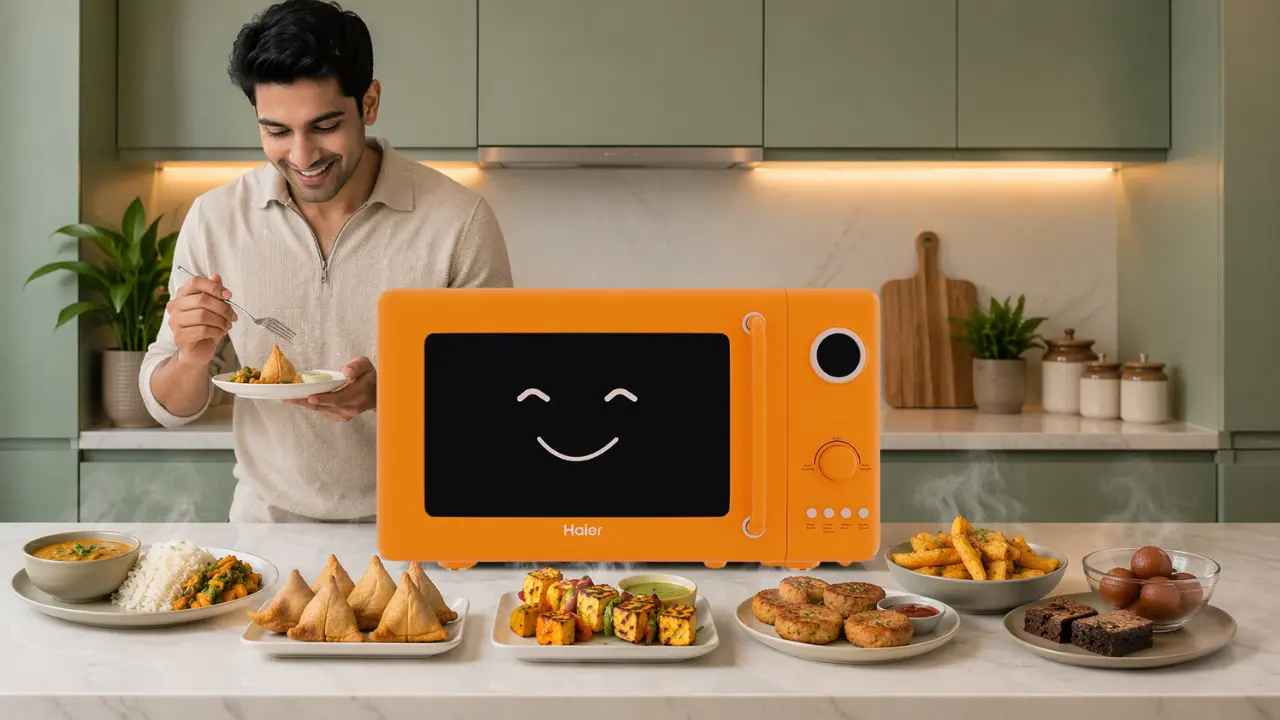

The right microwave for your kitchen design is not just about cooking. It is about fit, flow, and function.
Choose based on three things,
Your kitchen layout, your cooking habits, and how much visual space you are willing to give up. Get these aligned, and everything else becomes easier.
The kitchen is not a room. It is a system.
Walk into a modern Indian kitchen at 8:30 pm.
Pressure cooker whistles. Someone reheats dal. Someone else warms milk. A third person just wants popcorn.
Three needs. One counter.
And suddenly, the microwave is not just an appliance. It becomes shared infrastructure.
This is where most buying decisions go wrong.
People choose microwaves like gadgets.
But kitchens behave like ecosystems.
A microwave that fits your cooking style but not your kitchen layout creates friction every single day.
Start here: What role will your microwave actually play?
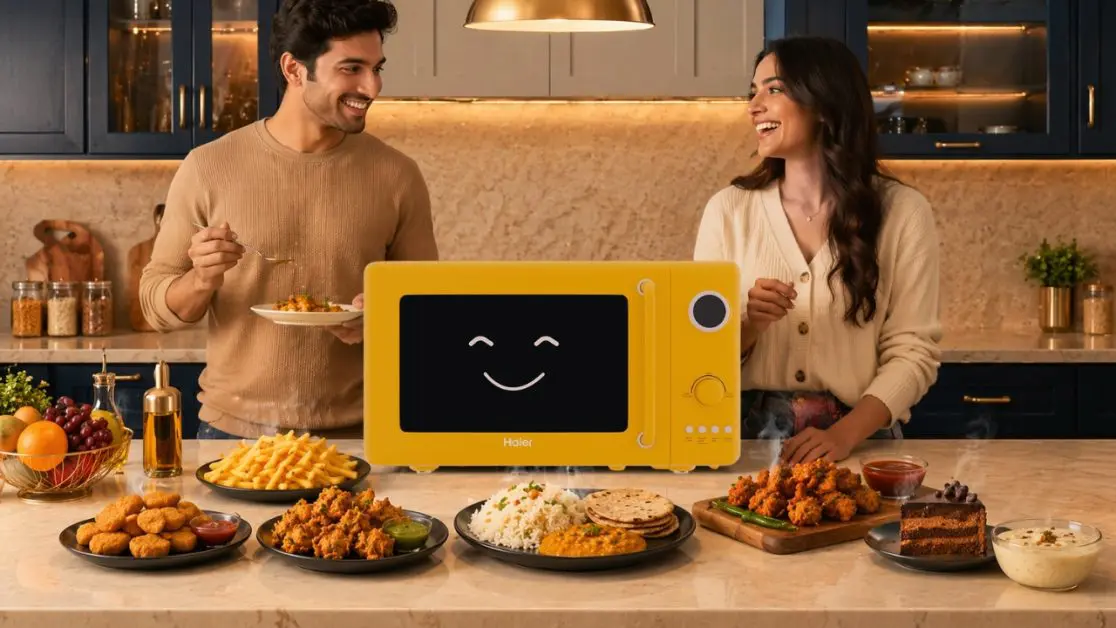
Before design, before size, before brand, ask one question.
What will you use it for, every single day?
Because microwaves are not one category. They are three different systems.
1. Solo Microwave
- Best for reheating, defrosting, basic cooking
- Lower cost, simpler controls
- Ideal for small households or working professionals
Example: Haier Vogue 20L Lemon Solo Microwave Oven with Auto Cook Menus I Digital Display (HIL20V1MYPD)
2. Grill Microwave
- Adds grilling function
- Useful for sandwiches, kebabs, light roasting
- Slightly higher cost
3. Convection Microwave
- Full cooking system
- Baking, roasting, grilling, reheating
- Ideal for families or cooking enthusiasts
Insight:
The more you expect from your microwave, the more space and attention it demands in your kitchen.
Your kitchen layout decides more than your budget
Most people think the budget decides the microwave.
Wrong.
Your kitchen layout decides 70 percent of the decision.
Three common Indian kitchen setups
| Kitchen Type | Microwave Fit | Best Choice |
| Compact apartment kitchen | Limited counter space | Solo or built-in |
| Modular mid-size kitchen | Flexible layout | Grill or convection |
| Large open kitchen | Design-first approach | Built-in convection |
One simple rule
- Small kitchen = compact microwave
- Medium kitchen = flexible microwave
- Large kitchen = integrated microwave
Insight:
Space is not about square feet. It is about how much friction you can tolerate while cooking.
Where will it sit? Placement is the real design decision
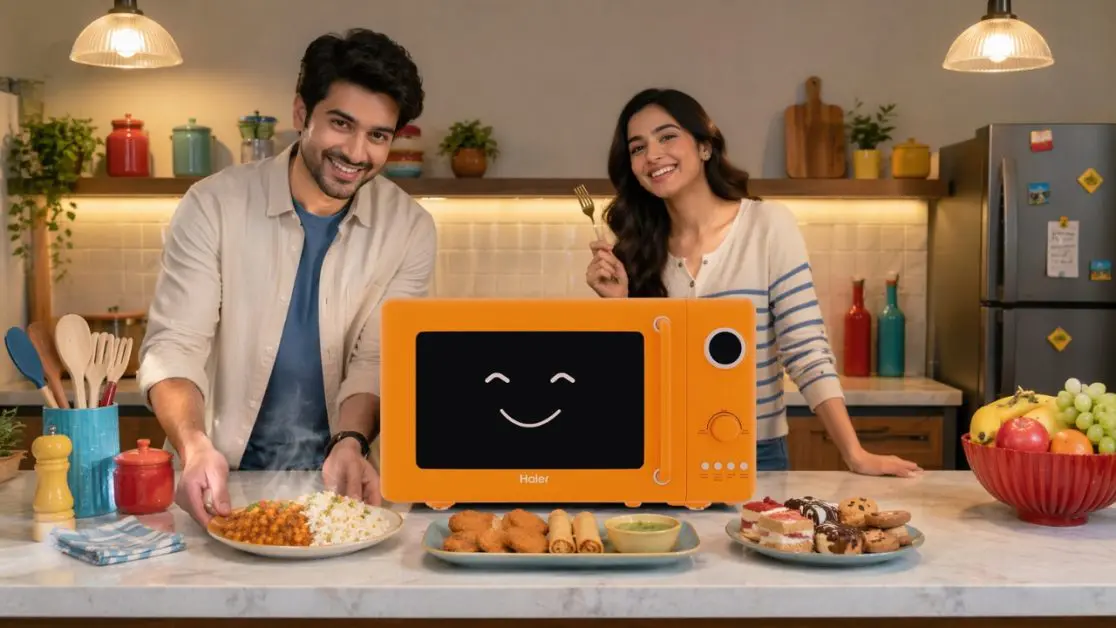
You can buy the perfect microwave.
And I still hate using it.
Because placement decides experience.
Three placement options
1. Countertop placement
- Easy installation
- Flexible
- Takes visible space
Cost: Uses up counter space
Benefit: No structural changes needed
2. Built-in cabinet placement
- Seamless look
- Saves counter space
- Requires planning during kitchen design
Cost: Higher installation effort
Benefit: Clean, premium aesthetic
3. Overhead placement
- Mounted above eye level
- Saves space
- Slightly inconvenient for frequent use
Cost: Accessibility
Benefit: Space efficiency
Insight:
A microwave placed wrong will feel heavy even if it is lightweight.
Design matters more than people admit
Most Indian kitchens are evolving.
Less clutter. More personality.
And appliances are no longer hidden. They are visible design choices.
Take the Haier Vogue range as an example:
- Haier Vogue 20L Lemon Solo Microwave Oven with Auto Cook Menus I Digital Display (HIL20V1MYPD)
- Haier Vogue 20L Peach Solo Microwave Oven with Auto Cook Menus I Digital Display (HIL20V1MOPD)
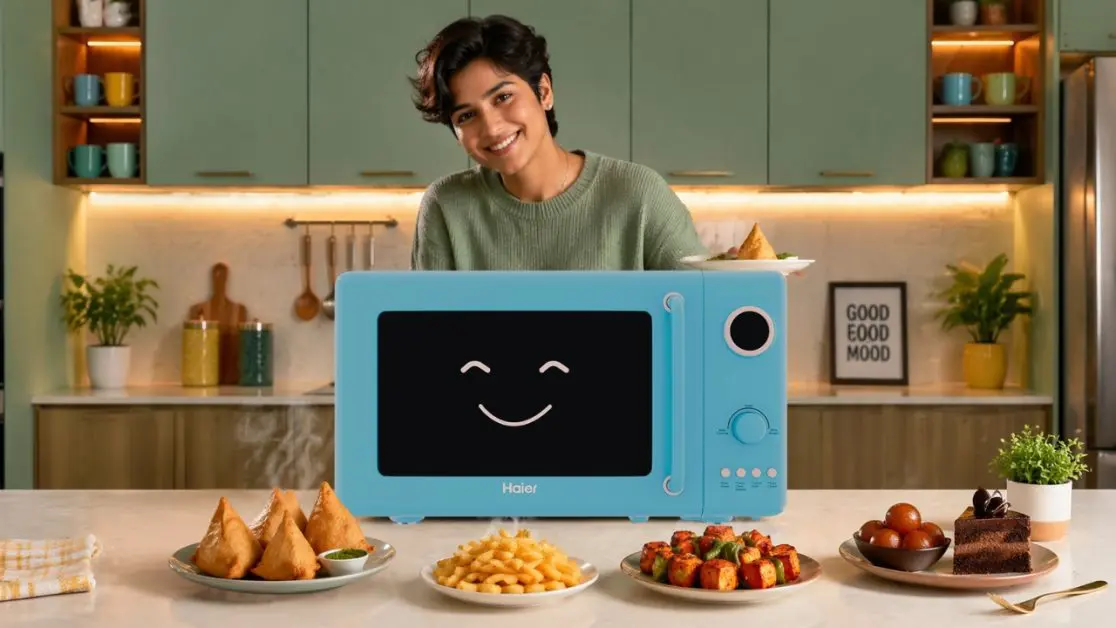
- Haier Vogue 20L Blueberry Solo Microwave Oven with Auto Cook Menus I Digital Display (HIL20V1MBPD)
These are not just appliances.
They are design statements.
- Multi colour options that match kitchen aesthetics
- Smiley glass door that adds personality
- Compact size that fits modern layouts
Insight:
Appliances are becoming part of interior design, not just tools you hide away.
Capacity is not about size. It is about rhythm
Most buying guides say:
- 20L for small families
- 25L+ for bigger families
That is incomplete.
Capacity is actually about cooking rhythm.
Choose based on usage frequency
- Occasional use → 20L is enough
- Daily reheating → 20L to 23L
- Frequent cooking → 25L+
For example, Haier Vogue 20L Lemon Solo Microwave Oven (HIL20V1MYPD) is designed for compact kitchens and everyday usage
Hidden cost of wrong capacity
- Too small → multiple cycles, wasted time
- Too large → wasted energy, unnecessary space
Insight:
The right capacity reduces friction. The wrong one multiplies it silently.
Features are not features. They are shortcuts
Let’s talk about features.
Not as specs. But as time-saving systems.
Key features that actually matter
- Auto cook menus
Pre-set programs that adjust time and power automatically - Instant start
One-touch operation for quick heating - Jog dial control
Faster navigation compared to buttons - Digital display
Precision and clarity
All of these are available in models like the Haier Vogue 20L Lemon Solo Microwave Oven (HIL20V1MYPD)
What these features really do
They remove decisions.
And in a busy kitchen, removing decisions is everything.
Insight:
Good appliances do not add features. They remove effort.
Energy and power: The invisible cost
Most people ignore this.
Until the electricity bill arrives.
Typical microwave power insights
- Input power: around 1150W
- Output power: around 700W
What this means
- Higher power = faster cooking
- But also higher consumption if overused
How to think about it
- Occasional use → power is not critical
- Daily use → efficiency matters
Insight:
Energy cost is not about the appliance. It is about how often you rely on it.
A quick decision framework you can actually use
Instead of overthinking, use this.
Step-by-step filter
1. What do you cook most?
- Reheat → Solo
- Grill → Grill microwave
- Bake → Convection
2. How big is your kitchen?
- Small → Compact countertop
- Medium → Flexible placement
- Large → Built-in
3. How often will you use it?
- Weekly → Basic features
- Daily → Auto menus + fast controls
4. What does your kitchen look like?
- Minimal → Neutral design
- Bold → Colour microwave like Haier Vogue series
- Premium → Integrated
The hidden system nobody talks about
Here is the real insight.
A microwave is not about cooking. It is about reducing interruptions.
- Interruptions in time
- Interruptions in flow
- Interruptions in decision-making
The right microwave does not just heat food.
It removes friction from your day.
So, how should you choose?
Not by specs.
Not by price.
But by alignment.
- Alignment with your kitchen
- Alignment with your routine
- Alignment with how you actually live
Because in the end:
A good microwave disappears into your life.
A bad one keeps reminding you it exists.
And the difference?
It is not technology.
It is how well you choose.
Frequently Asked Questions
I only reheat food and make tea. Do I really need more than a basic microwave?
No. A solo microwave is enough. Anything more will add cost and complexity you won’t use.
I feel confused between grill and convection. What’s the real difference for my daily cooking?
Grill is for light extras (sandwiches, kebabs). Convection is a full cooking system (baking, roasting). Choose based on how often you actually cook, not what sounds good.
I like the idea of baking, but I rarely do it. Should I still buy convection?
Only if you’ll use it at least weekly. Otherwise, it becomes unused potential taking up space.
I want fast cooking, but I’m worried about energy consumption. What should I do?
Higher wattage cooks faster but consumes more if overused. If you use it daily, choose a balanced model (~700W output) with efficient presets.
Is a bigger microwave always better for faster cooking?
No. Bigger capacity doesn’t mean faster, it often wastes energy if underutilized. Match capacity to your usage rhythm, not family size alone.
I reheat food multiple times a day. What capacity should I choose?
20–23L is ideal. It avoids repeated cycles (too small) and wasted space (too large).
Are auto cook menus useful or just marketing gimmicks?
Useful especially in busy households. They reduce guesswork and save time.
I get confused with too many buttons. What controls should I look for?
Choose jog dial + minimal buttons for faster, intuitive use.
What is the one feature that makes the biggest difference daily?
Instant start (one-touch heating) removes repeated effort.